Showing posts with label Iraq. Show all posts

April 10, 2021

Hoopdarshan Episode 102: Vishesh Bhriguvanshi Keeps Winning


In Episode 102, Team India captain Vishesh Bhriguvanshi returns to Hoopdarshan to discuss his miraculous game-winner in the FIBA Asia Cup Qualifiers against Iraq, his dream come true with the Arjuna Award, his recent biography, and that viral ‘pawri’ video. Hosted by Kaushik Lakshman and Karan Madhok. 

Guard/forward for Team India and ONGC, Vishesh Bhriguvanshi has been one of India's best basketball players for over a decade, and recently led India to a 1-1 record in the latest window of the FIBA Asia Cup Qualifiers. Hailing from Varanasi, Bhriguvanshi was conferred the prestigious Arjuna Award last year. 

In Episode 102, Kaushik and Karan also discuss NBA Academy India's Harshwardhan Tomar receiving a scholarship to play in the US and share their opinions in the most wide-open NBA MVP race in years.


Hoopdarshan is the truest voice of Indian basketball, and since we're such hopeless fans of the game, it will become the voice of everything basketball related we love, from the NBA to international hoops, too. On every episode of Hoopdarshan, we will be inviting a special guest to interview or chat to about a variety of topics. With expert insight from some of the brightest and most-involved people in the world of Indian basketball, we hope to bring this conversation to a many more interested fans, players, and followers of the game.

Make sure to follow Hoopdarshan on Soundcloud or search for 'Hoopdarshan' on the iTunes Store! Auto-sync Hoopdarshan to your preferred podcast app NOW!

Hoopdarshan can be found on...


June 10, 2019

FIBA Asia Cup 2021 Draw completed in Bengaluru - with a visit from NBA Hall of Famer Yao Ming


The Asian basketball world descended to Bengaluru - the new hoops capital of India - on Saturday, for the group stage draws of the FIBA Asia Cup 2021. India were of course one of the teams drawn into the qualifying draw. A number of great Asian basketball players were present for this event, including Basketball Hall of Famer Yao Ming, who made his third visit to India.

India were drawn in Group D alongside Bahrain, Lebanon, and Iraq.

2021 FIBA Asia Cup Qualifier Groups
  • Group A: Philippines, Indonesia, Thailand, Korea.
  • Group B: Chinese Taipei, Japan, Malaysia, China.
  • Group C: Australia, Hong Kong, New Zealand, Guam.
  • Group D: Bahrain, Lebanon, India, Iraq.
  • Group E: Saudi Arabia, Syria, Qatar, Iran.
  • Group F: Jordan, Kazakhstan, Sri Lanka, Palestine.

India will play each of the three teams in its group on a home and away basis over three qualifying windows - November 2019, February 2020, and November 2020. At the end of the three windows, the top two teams from each group directly qualify for the 2021 FIBA Asia Cup. The six third-placed teams qualify to participate in a final qualifier tournament in February 2021. The top four teams from that tournament will join the earlier 12 to complete the list of participating nations for the tournament.

Yao Ming, who was the star of China's basketball team, the Houston Rockets in the NBA, the Shanghai Sharks, and is now the chairman of the Chinese Basketball Association (CBA), made his third visit to India as one of the dignitaries at the draft. Yao had earlier come to Kolkata in 1998 to represent China at the FIBA Asia U18 Championship. Two years ago, he visited Bengaluru for the FIBA Asia Women's Championship.

Also present at the draw ceremony at the Shangri-La Hotel in Bengaluru: Former Philippines star player Jimmy Alapag, Japanese women’s professional player Asami Yoshida, FIBA President Horacio Muratore, FIBA Secretary General Andreas Zagklis, FIBA Asia President Sheikh Saud, Basketball Federation of India (BFI) President K. Govindraj, and Karnataka Governor Vajubhai Vala.

In August 2017, Australia become FIBA Asia Cup champions in Lebanon, while a disappointing Team India were ousted in the First Round.

The General Assembly of FIBA's member federations was also held in Bengaluru on Sunday. Sheikh Saud Ali Al Thani was re-elected as President of FIBA Asia. India's BFI president Govindraj is the SABA (South Asian) sub-zone representative.

July 13, 2017

India's Men squad head to Chinese Taipei for 2017 William Jones Cup: Roster, Schedule, Preview


India's big summer of international basketball action continues. After the women's team's experiences at the William Jones Cup last week, the Senior Men's squad will have their chance at the prestigious invitational tournament in Chinese Taipei. Under a new, experienced head coach, but minus several of our top players, India heads to Chinese Taipei for the 2017 William Jones Cup - the Men's tournament - to be held from July 15-23 at the Taipei Heping Basketball Gymnasium in Taipei. The tournament will serve as crucial practice for India as they prepare for the summer's biggest extravaganza: next month's FIBA Asia Cup in Lebanon.

India's squad from the 2017 BRICS Games last month
This year's large fray of the round robin championship will feature ten teams, including international squads from Asia and a couple of club teams from the rest of the world. India's schedule will be jam-packed, with nine games in nine consecutive days. Participating teams include two host Chinese Taipei teams, Asian champions Iran, Philippines, Japan, South Korea, Iraq, and club sides from Lithuania and Canada.

Last year's the Philippines' club squad Mighty Sports won the William Jones Cup. India showed potential but finished with a 1-7 record. Memorably, a couple of important Indian players arrived late to Chinese Taipei because of a visa issue.

India will not be held back by visa problems this year, but injuries and travel will reduce the team to a more depleted squad, compared to what the coaching staff will hope will be the full team for Lebanon. India is being led by Rikin Pethani as captain and will feature international star Amjyot Singh. Missing from action will be Vishesh Bhriguvanshi and Yadwinder Singh (injury) and Amritpal Singh, Palpreet Singh, and Satnam Singh (busy with international club obligations). Their absence will give other veterans and up-and-comers like Pratham Singh, Basil Philip, Prudhvi Reddy, Baladhaneshwar Poiyamozhi, Gurvinder Singh Gill, and Prasanna Sivakumar a chance to shine.

All the spotlight, however, will be on Phil Weber, newly-hired coach of the Indian Men squad - even though at the time of writing, the Basketball Federation of India (BFI) is set to finalise his contract or make an official announcement. Weber is an experienced NBA assistant coach who is currently working for the New Orleans Pelicans alongside Alvin Gentry and has worked in the past for the Phoenix Suns and the New York Knicks. This will be the first opportunity for Weber to put to test about ten days of practice time with the national team and get an idea of how India will shape up against top-ranked teams from the region (and beyond). Assisting him in India's coaching staff will be experienced national coaches Bhaskar Sappaniambalam and Sebastian Padipurakkal Joseph.

India Men's roster for 2017 William Jones Cup
  • Prudhvi Reddy
  • Anil Kumar Gowda
  • Arjun Singh
  • Pratham Singh
  • Basil Philip
  • Jeevanantham Pandi
  • Rikin Pethani - captain
  • Amjyot Singh
  • Baladhaneshwar Poiyamozhi
  • Gurvinder Singh Gill
  • Prasanna Venkatesh
  • Muin Bek Hafeez
  • Head Coach: Phil Weber
  • Assistant Coach: Bhaskar Sappaniambalam
  • Assistant Coach: Sebastian Padipurakkal Joseph
  • Manager: Devender Kumar

India Men's schedule for 2017 William Jones Cup - all timings IST
  • July 15 - Iraq vs. India - 8:30 AM
  • July 16 - India vs. South Korea - 8:30 AM
  • July 17 - Chinese Taipei Blue vs. India - 4:30 PM
  • July 18 - India vs. Iran - 12:30 PM
  • July 19 - Atletas All-Star Lithuania vs. India - 8:30 AM
  • July 20 - India vs. Chinese Taipei White - 12:30 PM
  • July 21 - 3D Canada vs. India - 8:30 AM
  • July 22 - India vs. Philippines - 10:30 AM
  • July 23 - India vs. Japan - 12:30 PM

India's last international outing was at the 2017 BRICS Games in Guangzhou, China, from where they returned with a 0-3 record. Without Amritpal and Bhriguvanshi on the roster for the William Jones Cup, a lot of hopes will be on Amjyot Singh to be India's star man. Coach Weber will be putting a lot of trust on relatively inexperienced role players beyond the core of Amjyot, Pethani, Pratham, and Venkatesh, but that is why a tournament like this can be crucial to help the team get big match practice.

India's most winnable challenge will be in their very first game, against Iraq. The rest of the national teams are ranked higher than India and the club squads are likely to post a major threat, too. Playing against Iran will give India a good idea of the team they are also scheduled to face in their preliminary round stage at the FIBA Asia Cup.

The 2017 FIBA Asia Cup will be the biggest-ever iteration of the event, featuring the top teams from both the Asia and Oceania regions, held from August 8-20 in Beirut, Lebanon. India are in Group A of the tournament with defending champions Iran, Jordan, and Syria. Hopefully, Weber and the team are able to learn important lessons at the William Jones Cup over the next ten days and have a full, healthy squad available for the bigger challenge ahead.

October 16, 2016

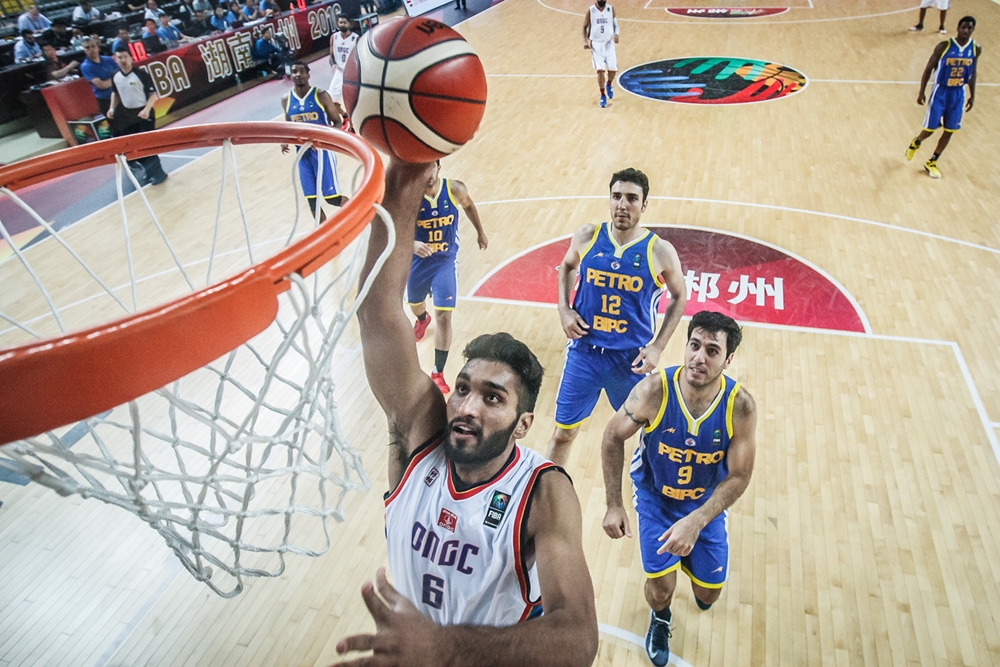
China Kashgar win 2016 FIBA Asia Champions Cup; India's ONGC return winless


Asia's premier international club basketball tournament - the 2016 FIBA Asia Champions Cup - concluded in Chenzhou, China, on Sunday October 16 with the host country's representative China Kashgar winning the finale. This was Kashgar's (otherwise known as the Xinjiang Flying Tigers) first victory at the FIBA Asia CC, and they defeated Lebanese champions Al Riyadi in an entertaining final at Chenzhou's Olympic Sports Centre Gymnasium.

India were represented at this tournament by Dehradun's ONGC, who, despite featuring some top Indian talent, were ousted from the Preliminary Round stage without a win and finished tied for 9/10th place in the ten-team fray.

Kashgar's squad were led by naturalized Philippines player and former NBA player Andray Blatche. Blatche was the star man in the final, scoring 22 points with 8 rebounds for China, while his teammates Darius Adams and Abudushalamu Abudurexiti added 19 each in the victory. China led most of the way, and survived a furious comeback by Al Riyadi in the final quarter to notch the 96-88 win. Fadi El Khatib (23) and Dewarick Spencer (19) were the leading scorers for the Lebanese squad.

Spencer was named the Most Valuable Player (MVP) of the tournament.

Also on the final day, Iran's Petrochimi confirmed a third-place finish for the bronze medal by defeating the UAE's high-risers Al Ahli, 100-74. Al Ahli's Samuel Young was a one-man wrecking machine, notching 43 points and 10 rebounds, but he got little help from his teammates. Petrochimi relied on a more balanced offense, backing up on the efforts of James White (22 points, 19 rebounds), Behnam Yackchali (22), and Gerald Robinson Jr. (21) for their blowout victory.

A day earlier, China survived a mammoth clash against Petrochimi 90-86 in the semi-finals to secure their spot in the finale. The game featured numerous twists and turns, and China had to bounce back from an eight-point halftime deficit to take the advantage at the end of the tense game. Blatche was again the hero, leading with 26 points and 10 rebounds, while Darius Adams added 20. Petrochimi were held at bay despite 26 point efforts by both Behnam Yackchali and James White. In the second semi-final, Al Riyadi had no problem blowing past Al Ahli, 107-79. Dewarick Spencer scored 26 for the winning side, while Fadi El Khatib (20) and Alade Aminu chipped in crucial points, too. Al Ahli's lone warrior was Samuel Young, who had 32 points and 10 rebounds in the loss.

The FIBA Asia CC tipped off on October 8th with ten teams, and India's ONGC - who had qualified for the tournament with their Federation Cup victory - were placed in Preliminary Round Group A with four touch matchups. They were led by head coach Dinesh Kumar and India international talents like Amrit Pal Singh, Vishesh Bhriguvanshi, and Yadwinder Singh.

From the opener against Iran's Petrochimi onwards, it became clear that ONGC were going to be fighting an uphill battle in this tournament. Petrochimi used a balanced effort to take an early double-digit lead over ONGC and played hawking defense to cruise to an easy 95-51 win.

ONGC's second match was more of the same, this time against Iraq's Al Rayyan. Another poor offensive effort had ONGC playing catchup from the get go. Preston Knowles of Al Rayyan turned out to be sublime in this game, putting up 39 points and 14 rebounds in the 95-53 win. Al Rayyan's captain Mohamed Mohamed added 17 in the win. The lone bright spark for ONGC was India's star guard Vishesh Bhriguvanshi, who notched 20 points and 8 rebounds in the loss.

Another tough loss followed the next day for ONGC, this time against eventual finalists Al Riyadi of Lebanon. For ONGC, the duo of Amrit Pal Singh (21 points, 11 rebounds) and Vishesh Bhriguvanshi (18 points, 11 rebounds) played their best, but they got little help from the rest of the squad. Al Riyadi were led by Wael Arakji (21), Karim Zeinoun (20), and Dewarick Spencer (17) in the 91-65 win.

ONGC's campaign got an early end with a fourth-straight loss in their final Preliminary Round game to Chinese Taipei's Pauian. ONGC played their best game of the tournament for about three quarters, staying within sight of the Taiwanese competition as they trailed 73-62. But it was all Pauian in the final period, who blew open the gates to cruise eventually to a 101-71 win. Chin-Pang Lin scored 19 for Pauian, overcoming strong performances by Amrit Pal Singh (19 points, 13 rebounds) and Riyazuddin (18 points) of ONGC.

ONGC finished 0-4 in the tournament. Amrit Pal Singh ended with averages of 17 points and 9.2 rebounds per game, leading ONGC in both categories. Vishesh Bhriguvanshi chipped in with 16.5 ppg in the course of the tournament, too.

This was obviously not the improvement that ONGC were looking for, as basketball club representatives of India, after a similar finish at the last FIBA Asia CC back in 2013. ONGC simply did not have the depth and firepower to match the loaded squads that they faced, many of whom featured naturalized foreign players and other foreign recruits to add to their strenghts. The club tournaments will remain a weak point for Indian basketball internationally until India can begin their own proper basketball league and bring together more talents to play for Indian clubs.

September 20, 2016

2016 FIBA Asia Challenge: Iran win for 3rd straight time; India have best performance in 27 years!


The headlines from the 2016 FIBA Asia Challenge - deservedly - will be about Iran. Led by Hamed Hadadi's continuing brilliance, Iran won the tournament (previously known as the FIBA Asia Cup and the FIBA Asia Stankovic Cup) for the third straight time, this time defending the crown as the tournament's hosts. Iran were nearly flawless throughout the 10-day tournament and put the cherry on top of their dominance with an impressive 77-47 victory over Korea in the final on Sunday, September 18, at the Azadi Sports Complex in Tehran.

But there was much more to this tournament than the headlines. Cushioned between the mid-tier teams at 7th place, the Indian Men's Team return from Tehran after one of their finest international basketball basketball performance in decades. Entering the 12-team tournament as one of the underdogs, India upset several higher-ranked teams and announced - once and for all - that they will be a threat in the Asian basketball circuit for the foreseeable future.

The tournament ended on Sunday with Iran - hosts and reigning champs from 2014 in Wuhan - defeating Korea with a monstrous, 20-point, 23-rebound performance by Hadadi. After a tense, low-scoring first quarter, Iran opened up a ten point lead at halftime, and then completely dominated after the break, outscoring Korea 47-27 in the third and fourth quarters. Hadadi's performance took his overall tournament averages to 18 points and 13.8 rebounds per game.

Earlier in the final day, Jordan started off strong against Iraq to run away to a 94-72 victory and win the bronze medal. Jordan's Darquavis Tucker led all scorers with 19.

A day earlier, Jordan had fallen victim to Iran in the semi-final 74-63, giving them one of their only close matchups of the entire tournament. The game was led by the usual suspects: Hadadi had 26 points and 20 points for Iran while Tucker scored 25 for Jordan. Korea defeated Iraq 78-72 in the second semi-final which came down to the wire. Iraq held a surprising two-point lead at the end of the third and only a final period surge helped see Korea through to the final. Seonghoon Lee (22) and Ilyoung Heo (18) were the leading scorers for Korea, while Iraq were paced by Mohammed Al-Khafaji (17) and Kevin Galloway (16).

The FIBA Asia Challenge is the second-most prestigious tournament in the continent, and because of its secondary status, many of the top teams like China and Philippines chose to send younger or less experienced teams to Tehran. Due to this, there were several major upsets in the tournament, and both China and Philippines - ranked 1 and 3 in the Asia - didn't make it to the Semi-Final stage.

While the others rested, India rose. Although they were denied the services of NBA D-League chasing Satnam Singh and Palpreet Singh, players from the UBA League, and the injured duo of Arvind Arumugam and Aravind Annadurai, India sent the best of the available options. The lineup including the country's superb 'Big Three' of captain and center Amrit Pal Singh, superstar forward Amjyot Singh, and veteran guard Vishesh Bhriguvanshi. Flanking around the top three were the point guard duo of Akilan Pari and TJ Sahi, experienced forward Yadwinder Singh, and important role-players Prasanna Sivakumar and Rikin Pethani. Coached by Sat Prakash Yadav and CV Sunny, India were ready for the challenge, and their inspirational performances eventually earned them laurels and respect like never before.

In the Preliminary Round stage, India were grouped with Philippines and Chinese Taipei. The opener against the Philippines turned out to be just the confidence boost that India needed. The Philippines had sent an inexperienced squad to Tehran, and India took full advantage. After trailing by five in the first quarter, India dominated proceedings, outscoring their opponents in the second and third by double digits, and eventually, holding off a late game rally to win 91-83. It was a historic moment for India, as they hadn't defeated the Philippines at the senior stage for decades. The Big Three didn't disappoint: Amjyot Singh was marvelous with 24 points and 18 rebounds, Vishesh Bhriguvanshi scored 20, and Amrit Pal Singh added 16 points to go with 8 boards.

But India got a major reality check the next day against Chinese Taipei. After staying with arm's length at the end of third quarter, India lost their composure in the third and a 26-15 run for the opponents settled the game for good. Taipei went out to win by a blowout, 90-66, led by 18 points and 14 rebounds by Quincy Davis and 23 by Yi-Hsiang Chou. While most of the team struggled, Bhriguvanshi carried India's load in the losing effort with a valiant 34 points.

India then entered Second Round Group E carrying a 1-1 record when they faced eventual semi-finalists Jordan. This turned out to be one of the worst-ever performances by India. The lackluster team came out slowly from the gates and fell into a 37-17 pit by the end of the first quarter. Jordan's offense was irresistible all game, and the likes of Sinan Eid (19), Darquavis Tucker (17), Sami Bzai (17) and Zaid Abbas (17) were too much for India to handle. Jordan went on to win the game 121-65.

However, even after the hard fall, India bounced right back up, in the most spectacular of fashions. Two years after upsetting China in the legendary 'Wonder of Wuhan' when the tournament used to be called the FIBA Asia Cup, India faced them again. China was without most of their Olympics team, but still packed a punch and were undefeated thus far in Tehran. But India were not deterred. The duo of Amrit Pal Singh (23 points, 14 rebounds) and Amjyot Singh (16 points, 8 rebounds) dominated the interior in the close, back-and-forth game. India made up for a first quarter deficit to take a two point lead into halftime. They maintained their composure through the second half, and held on in the close finale to upset China - Asia's top-ranked team - once more, 70-64. Jinqiu Hu scored 19 for the losing side.

India were now guaranteed a Quarter-Final spot, and carried on their new confidence to their final Second Round game against Kazakhstan. It was a competition between two big teams, but the smallest guy on court became the most valuable of the night. India's point guard TJ Sahi hit six threes in a 14-minute stretch in the first half to give India a 51-43 lead. India allowed Kazakhstan to catch up and tie the game in another weak third quarter, but they finished in style to win 100-90, their highest-scoring game at the tournament. Sahi finished the game with 32 points, 7 rebounds, and 5 assists, while Amrit Pal added 28 points and 7 rebounds. Kazakhstan were led by Mikhail Yevstigneyev (30) and Pavel Micheev (22).

Despite their strong performances, India finished fourth in Group E, an effect of the huge loss to Jordan. This handed them the toughest Quarter-Final matchup, against the loaded Iran squad. India stayed competitive for the first half while Iran led just 38-31. But the home team revved into top gear in the second half, relying on a huge 26-2 third quarter run to blow India out and secure a 77-47 win. Hadadi was the difference maker on the inside with 17 points and 23 rebounds. Oshin Sahakian added 16 for Iran.

Out of the tournament, India still had some work to do as they were placed in the 5th-8th place around. Their first game was against Japan, but a slow start proved costly for India. Japan took a 22-14 first quarter lead, and despite staying neck-to-neck with the opponents for the rest of the game, India couldn't close the game and lost 77-66. Ira Brown had 20 points and 14 rebounds for Japan, battling in the middle against Amrit Pal who notched up 22 and 14. Japan's Makojo Hiejima added 19 while India's Amjyot scored 18.

India's last game in Tehran was a rematch against their Preliminary Round opponents Chinese Taipei, and this time, India was out for revenge! Taipei led 22-17 in the first quarter, but India bounced right back to take a 33-32 lead into halftime. The game remained close until the final period, when India once again showed their ability to remain calm under pressure, as they outscored Taipei 28-18 in the fourth quarter to notch yet another huge upset victory, 80-68. Vishesh Bhriguvanshi was the star for India with 22 while Rikin Pethani stepped up in the absence of the ailing Amjyot to score 17 with 9 rebounds. Taipei, who lost captain Liu Ching earlier in the tournament to injury, were led by Yu-An Chiang (16) in the loss.

This finish saw India end the tournament at 7th place, a repeat of the previous iteration of this tournament, but with an impressive 4-4 record that included victories over China, Philippines, Chinese Taipei, and Kazakhstan. The Basketball Federation of India (BFI) declared this the best-ever finish for India since the 6th place finish at the 1989 FIBA Asia Championship. This is also the only time when India has beaten 3 higher ranked sides (China, Philippines and Taipei) in the same event. The performance marked India's rapid pace to improvement, as the team finished 8th in last year's FIBA Asia Championship, their best finish in 12 years.

From an individual performance standpoint, India’s ‘Big Three’ of centre Amrit Pal Singh, power forward Amjyot Singh and shooting guard Vishesh Bhriguvanshi have reaffirmed their status as one of Asia’s best players in their respective positions. Amrit Pal led India in scoring (17.8 ppg) and rebounds (10.4 rpg - 4th best overall in the tournament). Bhriguvanshi added 16.9 ppg and 3.8 assists per game (fifth-best overall). Amjyot notched in with averages of 12.8 ppg and 8.2 rpg. The three stars were top three for India in all three major statistical categories: scoring, rebounds, and assists. Guard TJ Sahi scored 11 ppg, too, with most of this scoring coming in the outburst against Kazakhstan.

Recognising the significance of this performance, the BFI's President K Govindaraj announced a cash prize of INR 5,00,000/- to the entire team and coaching staff.

"Reaching the top 7 in Asia is an excellent achievement, especially considering the circumstances and opponents," said Govindraj. "We beat three teams who have better world rankings. This cash prize is a small token of appreciation for our players’ indomitable spirit. They have kept India’s flag flying high. This is a culmination of all that sacrifice by everybody involved."

"It is important to remember that even though our national federation has approval from the international body i.e. FIBA, we have not received any government funding for almost two years now," Govindraj added, "In spite of this we have been able to send our national teams for participation in ten international events and conducted all the National Championships."

BFI Secretary Chander Mukhi Sharma said, "Prior to the team’s departure, I had wished that the players put up a performance that is even better than in all the previous championships they have attended. They have superbly delivered."

Govindraj's comments are true. Because of rift between the Ministry of Youth Affairs and Sports with the BFI, the basketball federation has operated independently of support and funding from the government for one and a half years now. It is truly a testament to India's star players - who we may well remember as a golden generation - that they have continued to perform so well and improve against Asia's toughest teams.

Reflecting on the side’s performance, Head Coach Yadav said, “The Indian team has earned lots of appreciation from FIBA President (Horacio Moratore) and other officials as well as from other good teams in Asia. This time around we have focused especially on defence and were able to successfully execute our tactics as practiced in the training camps. Our boys and India overall are now confident about taking on any challenge in the near future. This achievement does not belong to a single person but was a good team effort by all."

“It feels good and I’m happy with the performance," added Bhriguvanshi. "We can still do a lot better in the upcoming tournaments and I hope we will continue with this energy and morale."

Despite the domestic uncertainties, these are truly glory days for Indian Basketball. The current team is definitely the best collection of Indian Men's basketball talent that I have witnessed in my adult lifetime, and clearly the best Indian squad since the "golden generation" - led by Ajmer Singh - of the 70s and 80s. However, if the likes of Amrit Pal, Amjyot, Vishesh, continue to improve, this team could have a lot more success scripted in the future. Hopefully, players like India's first NBA-draftee Satnam Singh (who will be playing for the D-League's Texas Legends) this season can contribute to the national team in the future. If India can add a few more solid pieces to the rotation - particularly the backcourt - they can have legitimate dreams of repeating this performance at next year's prestigious 2017 FIBA Asia Cup, which will be the highest-level of basketball competition in Asia.

Final Standings
  • 1. Iran
  • 2. Korea
  • 3. Jordan
  • 4. Iraq
  • 5. China

July 21, 2016

Preview: India's campaign at 2016 FIBA Asia U18 Championship to tip off in Tehran (Iran)


The qualifying round was a breeze. India's Junior players, the future stars of the senior national squad, easily swept aside South Asian rivals at the SABA Qualifiers in Bangladesh last month. The average margin was victory was over 68 points each, and India - in impressive fashion - had secured their spot at the 2016 FIBA Asia U18 Championship.

Now begins the real test.

India's U18 squad was officially announced by the Basketball Federation of India (BFI), as the 12-man contingent headed for Tehran (Iran) for the FIBA Asia U18 Championship, set to be held from July 22-31. The tournament will take place at the Azadi Sports Complex in Tehran. India will be among 12 teams taking part in this tournament, which is the highest level of competition for junior players in the continent. In the last iteration of the FIBA Asia U18 in 2014, China won the championship for the third time in the row while the disappointing Indian squad finished at last place (13th).

For the preliminary round of 2016 FIBA Asia U18, India have been grouped with reigning champions China, Philippines, Chinese Taipei, Thailand, and Iraq. India will be captained by Tamil Nadu phenom Baladhaneshwar Poiyamozhi and head coached by Dilip Gurumurthy, a former Indian Olympian from the 1980 Moscow Olympics.

Participating teams
  • Group A: China, Chinese Taipei, India, Iraq, Philippines, Thailand.
  • Group B: Indonesia, Iran, Japan, Kazakhstan, Korea, Lebanon.

Team India roster for 2016 FIBA Asia U18 Championship
  • Hansraj (Delhi)
  • Saqlain Jamir Sayyed (Maharashtra)
  • Rachit (Delhi)
  • Vishal Kumar Gupta (Uttar Pradesh)
  • Mohammed Ali (Rajasthan)
  • Deepak (Haryana)
  • Baladhaneshwar Poiyamozhi (Tamil Nadu) - Captain
  • Hariram Raghupathy (Tamil Nadu)
  • Daniel Richards Arthur Wilson (Tamil Nadu)
  • Gineeb Benny (Kerala)
  • Muhammed Shiras Noushad (Kerala)
  • Sahil (Haryana)
  • Head Coach: Dilip Gurumurthy
  • Assistant Coach: Paramdeep Singh
  • Physio: Dr. Kannan Ratinasamy Bose
  • Team Manager: Ashok Sahu

India's Preliminary Round Schedule - All Timings IST
  • India vs Thailand – 22nd July, 5:00 PM
  • India vs China – 23rd July, 1:00 PM
  • India vs Chinese Taipei – 24th July, 5:00 PM
  • India vs Iraq – 26th July, 9:00 PM
  • India vs Philippines – 27th July, 9:00 PM

The top four teams from each group will qualify for the Quarter-Finals and Placement Rounds, which are set to begin on July 29th. The Final is scheduled on July 31st.

For India, qualifying for a Quarter-Final spot is a real possibility if the team can provide up to its potential. India, on paper, is better than Thailand and Iraq in Group A. If they are able to defeat both those teams, they can be ensured of a fourth place finish. Anything more - against better-seeded sides like China, Chinese Taipei, or the Philippines - will be a bonus.

India's fortunes will depend largely on the performances of Baladhaneshwar Poiyamozhi, who has played well for the national squad in the SABA Qualifiers and the FIBA Asia U16 Championship last year. He also represented India at the Basketball Without Borders Asia camp earlier this year. Fans should also keep an eye out for talents such as Gineeb Benny and Vishal Kumar Gupta.

The favourites for the tournament will again be China, while Group B giants Korea and Iran could also be in the mix for ending China's unstoppable run at the top.

November 8, 2015

Korea win 2015 FIBA Asia U16 title in Jakarta; India drop to 13th place


Korea's youth team have emerged among Asia's best and given a ray of hope for the future of the nation's basketball programme. At the 2015 FIBA Asia U16 Basketball Championship (FIBA U16 ABC) in Jakarta (Indonesia), Korea ended China's monopoly at the top of the tournament's standings at the semi-final stage, and followed it up with a victory in the Final against Chinese Taipei on Saturday, November 7. This was Korea's first title at the tournament, and the first time that anyone other than China has won the FIBA U16 ABC after four iterations of the tournament.

The tournament was held from October 29 to November 7 and featured 15 teams (should've been 16 but North Korea pulled out) including India. India's U16 team ended the tournament with a 2-3 record and dropped to 13th place.

Korea were still buzzing after ousting China at the semi-final stage, but their energy was matched by Chinese Taipei's youngsters in the Final. For the first half, there was little to separate the two teams, as Chinese Taipei held on to a slim 31-30 lead at halftime. But Korea pushed into an extra gear in the third quarter, outscoring Chinese Taipei 28-15 in a stretch that ultimately proved to be the difference. Lee Junghyn and Minwoo Park both scored 17 apiece to lead Korea's march to a 78-69 victory. Minsuk Shin added 16. Lin Ting-Chien was Taipei's highest scorer with 19.

Both the finalists qualified for the 2016 U17 FIBA World Championship in Spain, as did China, who finished third in the tournament.

China took out the frustrations of their semi-final loss in the Bronze-Medal game earlier on Saturday against Japan. Led by Rui Wang (22) and Jie Xu (20), China blew the game open in the second quarter. Their 13-point halftime lead was unassailable for the Japanese as China stretched their lead to a 80-58 win. Yudat Nishida scored 18 in a losing effort for Japan.

Both the semi-finals on Friday were memorable contests between the remaining East Asian teams in the tournament. Korean captain Jae-Min Yang exploded for 30 points as his team edged China 90-84 in an entertaining, high-scoring contest. Minsuk Shin dropped 21 for Korea while Junghyun Lee added 18. China's duo of Rui Wang (20) and captain Yibo Wang (17) couldn't do enough to stop Korea from turning a three-point halftime deficit into a six-point victory. In the earlier semi-final, Chinese Taipei survived a late flurry by Japan to win 60-57 and book their ticket in the final. After a close first half, Chinese Taipei created some separation between the two teams in the third period, and held on to their lead just in time for the final buzzer. Wei-Chieh Tang of Taipei led all scorers with 21.

At the start of the tournament's Preliminary Round, India found themselves in a tough Group D, which featured two semi-finalists - Korea and China - as well as Iraq. The team was led by Head Coach Mahendar Singh Rathore and captained by rising young star Baladhaneshwar Poiyamozhi from Tamil Nadu.

India's start - against threepeat winners China - was not pretty. Despite a good offensive showing in the first quarter, India were helpless to put a roadblock on China's onslaught on the other end of the floor. China outscored India by double digits in each quarter and raced to a comfortable 116-57 win. Rongqi Huang scored 22 to pace China, while Poiyamozhi - a 5-foot-11 undersized forward - had 18 for India.

Facing the eventual champions Korea the following day, India were determined to correct the previous day's mistakes and put up a more respectable showing. Despite a 19-point loss, India played one of their best games on the tournament. Korea had a three-point lead at the end of the first quarter, which they opened up to 12 by halftime. But an offensive explosion in the third had India down by just 8 before the start of the final period with dreams of an upset. Alas, Korea showed their class in the decisive fourth, outscoring India 28-17, and cruising to a 104-85 win. The Korean duo of Jae-Min Yang (25 points, 12 rebounds), Sechan Seomoon (22), and Hyunjung Lee (19) were a handful for India all game, but it was Indian captain Poiyamozhi that truly stole the show, totaling his tournament-best 33 points to go with 10 rebounds for India in the loss. Adarsh Jayakumar aided his effort with 23.

India followed the encouraging performance with a dud against Iraq, in what would've been their most-winnable game of the Preliminary Stage. Despite ranking higher than Iraq, India came out flat and allowed Iraq to lead by double digits early in the game. India had no answer for Iraq's Abdullah Abdullah, who exploded for 39 points and 6 rebounds in an impressive solo performance that helped his squad win 90-69. Abbas Al-Qarnawi added 16 for the winning side. Poiyamozhi was again India's top man, scoring 26 points in a losing effort, while his teammate Ankit Joshi scored 24.

By finishing last in their group, India failed to qualify for the tournament's Second Round and had to settle for 13-16th place classification games. They received a 'bye' win 20-0 against the absent North Korea in the first game.

India's first and only 'real' win of the tournament was in their last game against Hong Kong. After gaining an extra day's rest because of North Korea's no-show, India played with an extra skip in their step in the second and third quarters of the game versus Hong Kong, outscoring their opponents by 16 in that crucial 20 minute stretch. Three Indians touched 20 in this encouraging 80-70 win, led as always by Poiyamozhi (22 points, 8 rebounds), Ankit Joshi (20 points, 6 rebounds, 6 assists), and Adarsh Jayakumar (20 points, 7 rebounds). Hong Kong's captain Yiu Pong Yip scored a team-high 21.

India ended the tournament at 13th place, dropping two spots after finishing 11th in 2013.

It was a tournament of ups and downs for the young, relatively inexperienced Indians. The performances against Korea and the finale versus Hong Kong showed the potential of many of players, as individuals and as a collective. But the loss against Iraq will be remembered as the tournament's big tipping point for India. They can also consider themselves lucky to earn a win without playing against North Korea, although an extra game would've always been useful to provide more exposure to the players.

The big story for India was of course the star captain Baladhaeshwar Poiyamozhi. After dominating the youth and sub-junior levels for Tamil Nadu in recent years, Poiyamozhi was a force to be reckoned with in his first big international tournament for India. He finished as India's leading scorer (24.8 ppg) and rebounder (6.2 rpg) and was second in assists (3.5 apg) and would've finished as among the leading scorer in the entire tournament had India played more games. The little forward plays much bigger than his size, and hopefully has a bright future ahead of him for the country. India also got encouraging performances by Ankit Joshi (13.5 ppg, 5.2 rpg), Adarsh Jayakumar (14.2 ppg) and Manoj Sisodiya.


October 28, 2015

2015 U16 FIBA Asia Championship: The full Team India roster, schedule, and preview


The youngest competitors at the Asian basketball stage are the under-16s; youth players who have shown potential for greatness, and get their first opportunity to represent their squads at the biggest stage in the continent. When the U16 FIBA Asia Basketball Championship (ABC) began in 2009, China - one of the continent's finest teams - jumped out in front and took charge of the future. The tournament has taken place every two years twice more, and China have won every single time, including the most recent championship held back in 2013 at at Tehran (Iran).

On Thursday, October 29, the tournament will return in full force to Jakarta (Indonesia), as China attempts to make it four out of four. India, meanwhile, have finished 10th, 10th, and 11th in the first three turns of the tournament, and the newest brigade of young players heading out for the 2015 FIBA Asia U16 Championship will hope to provide a boost and some encouraging results to showcase the bright future of Indian hoops. This tournament is a qualifying tournament for the 2016 FIBA Asia U17 World Championship.

India have been placed in Group D of the tournament with none other than reigning champions China, along with South Korea and Iraq. The 12-member boys squad, under the helm of coach Mahendra Singh Rathore, headed out to China a few days ago. Baladhaneshwar Poiyamozhi of Tamil Nadu was named team captain.

The tournament was initially supposed to be held in India itself - at Bengaluru - in July, but due to the troubles with India's own basketball federation, FIBA shifted the tournament to Indonesia and to a later date. Jakarta's BritAma Arena and GOR Pulogadung will be the two venues for the games.

Addressing the players before their departure, the Basketball Federation of India (BFI) secretary Chander Mukhi Sharma said, "You are the top talent in the country at your age group. The coaches have imparted their knowledge over the last few weeks to all of you. It is now your duty to perform to the best of your abilities and make the nation proud."

Preliminary Round Groups
  • Group A: Japan, Kuwait, Hong Kong, Malaysia.
  • Group B: Chinese Taipei, Bangladesh, Indonesia, Lebanon.
  • Group C: Philippines, Bahrain, North Korea, Thailand
  • Group D: China, India, Korea, Iraq.
Team India for the 2015 U16 FIBA Asia Championship
  • Swapnil Sharma
  • Manoj Singh Sisodia
  • Hansraj
  • Sorav Singha
  • Ankit Joshi
  • Muhammad Shiras Noushad
  • Harshwardhan Tomar
  • Baladhaneshwar Poiyamozhi
  • Joshua Jaison George
  • Amit
  • Adarsh Premsan Jayakumar
  • Kanwar Gurbaz Singh Sandhu
  • Head Coach: Mahendar Singh Rathore
  • Coach: Aju Jacob
  • Manager: Venkata Siva Naga Prasad Takasi
Preliminary Round - all timings IST
  • India vs. China - October 29 - 12:30 PM.
  • India vs. Korea - October 30 - 4:30 PM.
  • India vs. Iraq - October 31 - 4:30 PM.
The Second Round will be held between November 1-3, and the Final Round from November 5-7. India have to finish in the top three of the four preliminary round groups to qualify for the Second Round. China, as favourites will be the toughest to beat, while Korea - who are also in India's group - are the second-ranked youth team in the FIBA Asia rankings. India's (rank 10) best chance for a victory will be against Iraq (rank 16), but they will need their star young players - led by Baladhaneshwar - to perform at a high level. A second round appearance will ensure a 9-12 place finish for India, but if they want to emulate the seniors who finished top 8 in Asia this year, India will need to shock a few more teams in the Second Round and qualify for the Quarter-Finals.

September 12, 2013

India's ONGC to take part in 2013 FIBA Asia Champions Cup in Jordan


Pitting together the top clubs from various Asian countries, FIBA Asia's official international club tournament - the 24th FIBA Asia Champions Cup - is set to be held in Amman, Jordan from September 13-21, 2013. The tournament will feature nine top club men's basketball teams from nine different Asian countries. India's Men's champions from the 2013 Federation Cup in Bangalore - Uttarakhand's ONGC - will be the sole representative from South Asia at Amman.

The annual Champions Cup returns in interesting circumstances, as last year's final in Lebanon - between local side Al Riyadi Beirut and Mahram of Iran - was put off due to security concerns in the region.

India's ONGC are currently riding a wave of great success domestically, particularly after they signed Indian international stalwarts Vishesh Bhriguvanshi and Yadwinder Singh into their star-studded veteran mix. They qualified as India's top side after the blowing past Chennai's IOB at the BFI's Federation Cup Championship in February this year.

ONGC have been placed in Group B of the Champions Cup's Preliminary Round, along with Al Rayyan, Duhok, and BC Capchagay. A team from Philippines to represent South East Asia - the San Miguel Beerman - pulled out from the tournament due to unavailability of players. Since there are only four teams in the group, they are guaranteed to qualify for the knockout stage, but they will shoot for as high as finish as possible to get a favourable draw in the Quarter-Finals.

24th FIBA Asia Champions Cup Groupings

Group A: Al Hala (Bahrain), ASU (Jordan), Foolad Mahan (Iran), Khas Bronchos (Mongolia), Al Jaish (Syria).
Group B: Al Rayyan (Qatar), Duhok (Iraq), ONGC (India), BC Capchagay (Kazakhstan).

ONGC's roster for FIBA Asia Champions Cup
  • Dinesh Kumar
  • Vishesh Bhriguvanshi
  • Amrit Pal Singh
  • Sridhar Shanmugum
  • Anoop Mukkanniyil
  • Des Raj
  • Yadwinder Singh
  • Mohit Bhandari
  • Trideep Rai
  • Riyazuddin
  • Murali Krishna Ravindran
  • Sabeer Ahmed
  • Head Coach: Durgesh Bhatia
Aside from Vishesh and Yadwinder, ONGC feature up-and-coming India international big man Amrit Pal Singh as well as savvy veterans like Bhandari, Trideep, Sridhar, and Murali Krishna.

Preliminary Round Schedule for ONGC - All Times IST
  • September 14 - 6:30 PM: BC Capchagay vs. ONGC.
  • September 15 - 8:30 PM: ONGC vs. Duhok.
  • September 16 - 8:30 PM: Al Rayyan vs. ONGC.

The Quarter Finals will begin after the Preliminary Round, and the Final is scheduled for September 21st.

November 1, 2011

India’s U16 Boys coach JP Singh: “We felt we could beat any team except for China”


10th place in 2009, 10th place in 2011: if the final result is to be believed, there was no improvement in the basketball team that represented India at the 2nd U16 FIBA Asia Championship which recently concluded in Nha Trang City, Vietnam. India finished the tournament having won three games, lost five, and finishing, just like the tournament two years ago, at 10th place.

But look closer and you’ll see that, perhaps for the first time in recent memory, India returned from a top Asian-level tournament glowing with confidence of being able to look any opponent in the eye, and also earning the respect of all the teams they went against. Usually the whipping boys of Asia, India U16’s elite defensive ability and improving talent level ensured that they couldn’t be ignored by the opposition anymore.

“We began to feel very confident with ourselves as a team, in our defense, and in our talent during this championship,” said Jai Prakash ‘JP’ Singh, the head coach of this side and the mastermind behind India’s improvement, “Our boys approached every game feeling that they could get something out of it.”

Singh, who works at Tata Steel in Jamshedpur, Jharkhand, exhumed his confidence as India were pooled with China, Malaysia, and Chinese Taipei, all teams previously ranked higher. India started the championship with a huge loss to the tournament’s eventual champions, China. “The China game was almost like a practice game for us, because they were miles ahead in talent,” said Singh, “They are the strongest and most-feared team in Asia, and you can see that they won every single game by a large margin, up until the final against Korea which they won by 40 points!”

But even in this big loss was a silver lining: India may not have been able to get many points on the board (27), but they also managed to hold China to their lowest point total in the entire tournament (64).

Things got better for India from then onwards, as they crushed Malaysia in the second game by 53 points, and, in perhaps their best performance of the tournament, defeated a traditionally much-stronger Chinese Taipei side by 21 points.

“This is a team that prides itself on defense,” said Singh, after India held Malaysia and Taipei to 40 and 52 points respectively. “We started everything on the defensive end. Against Taipei, a much-more experienced team than ours, I thought that some of our players may get nervous and start making mistakes. Instead, it was the Taipei players who began to struggle to score on us as our defense grew stronger."

It was in the Second Round that the heartbreak began for India, with consecutive close losses against usual Asian powerhouses, Lebanon, Korea, and Iraq. “We gave a fight in all three games and just couldn’t finish them right,” said Singh.

But even though India lost and were knocked out from a chance of reaching the tournament’s Quarter-Finals, Singh felt that his players gained a new sense of confidence. “We knew that the opposition were now looking at us with new-found respect; they knew that we would give them a battle. We felt that, if we worked that it, we could beat any of the other teams – Korea, Japan, Taipei – except for China.”

Singh lamented that India’s chances for the Quarter-Finals were also hampered by the tournament match-ups. In the Second Round, teams qualified from Group A were to play teams qualified from Group B. But most of the easier opponents, Singh felt, were in Groups C and D. “We would’ve had a better chance of qualifying had we played some of the other teams who qualified for the next round, such as Indonesia, Qatar, or Vietnam.”

After shrugging off hosts Vietnam in a classification game, India lost the 9th spot to a buzzer-beater by Chinese Taipei’s Lu-Kuan Shiuan in a rematch against the side we had defeated handedly only days ago. Still, it wasn’t enough to dampen the spirit and the optimism of the players. “We may not have improved our position, but we were able to come back feeling much better about our performance, particularly our defense,” Singh added.

That defense was manned in the middle by Satnam Singh Bhamara, India’s behemoth young Center, a 15-year-old seven-footer who had already gained experience by representing India in the senior side at the 26th FIBA Asia Championship. Bhamara was a beast on both sides of the floor, having the highest scoring average of any player in the tournament, despite only clocking 24 minutes per game. Defensively, Bhamara’s size and post defense kept other attacking players at bay.

Troy Justice, the Director of Basketball Operations for NBA India, went to Vietnam to watch the team in action and was impressed by their improvement. On Bhamara, he said, “Satnam was one of the top three players at this championship. We saw his ability to change the game at both ends of the floor. He controlled the boards effectively and for difficult for the other teams to stop.”

Justice also credits India’s improvement to its defense, mostly because India had the size and athletic ability which was matched only by two other teams at the tournament: China and Lebanon. “Defensively, India stood out as one of the best. We matched up against teams like China with our size, with players like Satnam, Rakesh Sangwan, and Ajay Pratap Singh all big for their respective positions.”

Having spent considerable time in India working with young players at the grassroots level, Justice noted a considerable improvement in talent for this youth side. “This was a very talented team, we knew that, and I think all the other teams in the tournament knew it, too. Satnam and Ajay were two key players for India and both performed well; Rakesh was India’s most improved player.”

The group of players has now returned to India, and spread back to their different directions, but Coach JP Singh remains cautious about their future.

“This is a special group,” he says, “And they could improve on their performance in two years when they play in the U18 FIBA Asia Championship. But to do that, the important thing is to make sure that they continue to be disciplined as they improve as basketball players. The next two years are tricky for kids of this age group, but if they are provided the correct discipline and a similar type of training leading up to the U18 championship, we could see them work wonders again.”

"The Basketball Federation of India and the Sports Authority of India had a big hand in giving this team the opportunity," Singh added, "If we keep up the same type of training and discipline in the future, these type of performances can be repeated and improved."

It seems that perhaps this team’s biggest achievement could be a long term impact: they have been able to put up a first step forward to change the mindset of India as easy opponents in Asian championships. Additionally, their performance will also serve as encouragement to other young players who feel that they can now dream of stepping out into any Asian arena with their heads up high.

October 29, 2011

China win U16 FIBA ABC; India impress but finish at 10th place


At the recently concluded 2nd U16 FIBA Asia Basketball Championship, in Nha Trang City, Vietnam, India's Youth side finished at an unflattering 10th place out of 16 participants. The final standing was no improvement to our standing at this competition two years ago, where we had finished 10th too.

And yet, the players and coaches who represented the country in Vietnam, and the fans who followed their every move, couldn't help but feel a sense of optimism about India's incredible performance. Impressing opponents and fans alike with their considerably improved play, India, perhaps for the first time on the Asian stage, have given a warning with their performance about the things to come. As this current crop of talented youngsters grow up, and more are added to the system, Indian basketball has definitely taken a step in the right direction.

But first: respect must go to the tournament's eventual champions, China, the most dominating and the only undefeated team at the championship. China continued their dominance in the final of the tournament as they blew past Korea 92-52 for their second consecutive gold medal of this competition on Friday.

China had an air of invincibility about them as they went about their business against a potentially tricky opponent in the final. Zhou Qi of China had a final to remember, scoring a tournament-high 43 points to lead his side to a 40-point victory, 16 of which came in the second quarter which opened the gap between the two sides.

Korea’s best player on the night was Hae Hoon, who pitched in 19 points for his side that had to settle for the silver medal.

The finalists China and Korea have both qualified for the 2nd U17 FIBA World Championship which will be held in Kaunas, Lithuania, in 2012.

Earlier in the day, Japan defeated the Phillipines with a disciplined effort 94-81 to claim the bronze medal. Japan were led on the scoresheet by Dalki Kaneko (25 points), Yusel Sugiura (21), Yudal Baba (17), and Kelta Shinkawa (16).

India's coach Jai Prakash 'JP' Singh did not use a fixed starting lineup for the eight games his side played, giving the most amount of minutes to Ajay Pratap Singh, Loveneet Singh, Rakesh Sangwan, Narender Satyawan, Satnam Singh Bhamara, and Karthickeyan Saminathan.

India were grouped in the Preliminary Stage of the tournament with China, Malaysia, and Chinese Taipei. It was international baptism by fire for most of the Indian players as they were caught in the Chinese roller coaster, losing 27-64 in their first game to the tournament's eventual champs. China were bigger, faster, and more experienced than the Indian side, which featured only one player - seven-foot-one, 15-year-old Punjabi phenon Satnam Singh Bhamara - with any major international experience.

But the tournament only improved for India after that: in their second game against Malaysia, India started hot to thrash their opponents, 93-40. India were led by Karthickeyen Saminathan (18 points). Loveneet Singh accounted for 8 points in the first quarter to lead the Indian charge and went on to score 16 points. Ajay Pratap Singh contributed 17 points, 5 of them coming in the first quarter. And in limited time of just one quarter, Satnam scored 16 points.

In the final group game, India pulled off one of the major upsets of the tournament, clocking a memorable 73-52 victory against Chinese Taipei. India shut down Taipei early in the game, and then rode the three-point prowess of Ajay Pratap Singh (25) and Karthickeyen Saminathan (18) to prevail. India's improving defense was a major cause of this win, something that coach JP Singh noted in his interview with FIBA.com. The win helped India finish at 2nd place in their group.

In the tournament's Second Round, India were slated to face three tough teams: Lebanon, Korea, and Iraq, and despite strong efforts in all three games, India couldn't find a single victory. A loss in a loss in any language, but playing against teams that are used to defeating us by 30 points and then holding them to near-even terms shows the improving stature of the Indian side. After a close game in the first half, Lebanon's offense finally broke free from India's stingy defense and rode their way to a second round vicory, 77-65. Jimmy Salem led the scoring for Lebanon and the game with 22 points with Gerard Hadidian contributing 20 points, his third successive 20-or-more score in the competition. Albert Zeinoun had 21 points. India were led by Loveneet Singh, who had 16.

One of India's high-points of the championship was their loss to eventual runners-up Korea: Satnam Singh Bhamara finally broke free and scored 41 points (second highest individual score in the tournament), keeping India tied with the Asian powerhouses up till the start of the fourth quarter! Korea's Heo Hoon, who sat out the entire first quarter nursing a painful ankle, made an entry midway through the second and went on to lead Korea’s scoring with an all-round 31 points. Level at 47 at the end of the third, Korea opened a 19-10 blitz in the first five minutes of the final quarter. Heo had 14 of his points in the fourth quarter. Kim Gookchan had 18 points.

Satnam continued his inspired run against Iraq, as he once again dominated the post for 32 points. India started off well again, but Iraq came into their stead in the second quarter to take a lead and not give it up again. India stayed close throughout, however, and leveled the scores in the final period after free throws by Kushmeet Singh, but Iraq's Ahmed Razzaq (27) scored a couple of clutch baskets to give his team the eventual 72-64 win. Karrar Hamzah added 21 for Iraq.

Because of these losses, India failed to qualify for the Quarter-Final stage and had to settle for 9-12 place playoffs. They played in the first playoff game against the home side Vietnam in what became India's most dominating offensive and defensive performance of the tournament. Using stifling defense, India held Vietnam to just 19 points after the first three quarter as they cruised to a 107-40 victory. Vietnam were no match for India, who dominated the game from start to finish. Ajay Pratap Singh posted 20 points in the first half before being rested for the rest of the game. JP Singh introduced Satnam Singh Bhamara in the third quarter, where the young Center scored a further 19 points. Loveneet Singh scored 20 points for India, while Rakesh Sangwan added 16.

In their last game of the championship, India were set for a rematch against Chinese Taipei for the 9th place. It turned out to be a heartbreaking game for India, as Lu Kuan-Shiuan’s three-pointer, with less than three seconds left in the game, helped Chinese Taipei fashion a resurgent 61-60 win. India held the edge on the scoreboard for the better part of the first half, but Taipei unleashed a 15-2 run through the start of the third quarter and went on to build a 10-point lead. India seemed to recover from that deficit and kept the score close and were ahead 60-58 with 20 seconds left on the clock, when coach JP Singh took a time-out. Taipei having run out of time-outs pounced on the opportunity to plot their play, and after the usual rotation, Wang I-Feng drew the rival defense towards and sent the ball to Lu. Who had had no trouble in firing the match-winner in. I-Feng had 17 points for Taipei, while India were led once again by Satnam Singh Bhamara, who had 29.

Thus, India finished the tournament with a 3-5 record. We were led individually in scoring by Satnam Singh Bhamara, who averaged 19.3 points per game in the course of the championship. What makes it more amazing is that Satnam was only the starting five for perhaps half of the games played. Ajay Pratap Singh (13.1 ppg) and Loveneet Singh (10.3 ppg) were regular offensive options. Rakesh Sangwan and Karthickeyen Saminathan also pitched in valuable contributions for the Indian side.

Of course, there is the disappointing after-taste of 'what could've been?' with many of the games we played. The losses to Korea and Iraq hurt especially, since we were so close so late into these match-ups, and of course, our final seconds loss to Chinese Taipei, after holding on to a two-point lead, didn't settle easy in the stomach either. But the fact that we are getting this close is a marvel in itself. The fact that we defeated Taipei by 21 points in an earlier game, and that we completely destroyed the likes of Malaysia and Vietnam (teams who are close to equal to us) makes me very optimistic.

This is a talented and deep team with good defensive fundamentals, and the likes of Ajay Pratap Singh and Loveneet Singh will be stars to watch for India in the future. Ajay Pratap Singh finished with the best assists average (4 apg) in the entire tournament! And then there is the case of the unpolished but dominating big man, Satnam Singh Bhamara. Still over a month away from his 16th birthday, this seven-footer had a coming-out party at the tournament in Vietnam. It isn't just the points he scored, it was the frequency with which he scored them, even when he was handed limited minutes. At 19.3 ppg, Satnam was the leading scorer of the entire championship!

A student-athlete at the IMG Academy in Bradenton, Satnam has had a big year, as he made his debut with India's Senior national team in MAZ Qualifiers in India, and later, was part of the squad that performed poorly at the 26th FIBA Asia Championship in Wuhan. His play was very limited in that championship, but amongst his own age group in Vietnam, he was unstoppable. What makes Satnam's improvement so much more amazing is that the youngster seems to continue having a level-head and surprising maturity: In an interview with FIBA, Satnam made it clear that he puts team first. Here are some of his quotes from that interview:

"I only wish I had scored half as many points in any of those games, and we had entered the quarterfinals. Only then my performance can be spoken about."

"I feel a lot more confident now. I am not scared of any situation anymore."

"The way I want to contribute is not only by scoring 40 points, but also stopping 40 points. That way I think my contribution to the team will be more valuable."


Satnam will now return to India, perhaps to take part in an Indian Juniors camp in Delhi, or perhaps to return to the IMG Academy in Florida, USA, straight away. We hope he keeps improving either way, and so do this current Youth team. They could come together again in a year or two when India play in U18 international championship, and we'll see then if this side can learn to find a way of winning more close games.

Congrats again to China, by the way, who are just looking scary good from all angles in basketball right now. China is dominating every Asian-level tournament is taking part in. And the future looks good for them too: it will be a long time before any other basketball playing country in Asia can replace them at the number 1 spot.