Showing posts with label Pratham Singh. Show all posts

February 4, 2017

India internationals Amritpal Singh, Yadwinder Singh, and Amjyot Singh to play in Mizoram Super League this season


UPDATED February 22, 2017

Two of India's top basketball players will be heading North-East next month as the marquee names in season three of the Mizoram Super League (MSL). Superstars Amritpal Singh and the veteran Yadwinder Singh have signed with the MSL team Zarkawt BCA for season three, which is set to begin from March 21, 2017. India's international star Amjyot Singh signed for Tuikual South Basketball Club.

The The MSL was announced by the Mizoram Basketball Association (MBBA) in the state's capital city Aizal in November 2014 and launched early in 2015. Zarkawt's bagging of the two national superstars isn't unprecedented; last year, India internationals Vishesh Bhriguvanshi and Pratham Singh both played for the Tuikual South Basketball Club. The arrivals of Amritpal and Yadwinder makes Zarkawt virtual favourites to win the league in Season 3.

Amritpal Singh has captained India in various international tournaments and has been a linchpin for the national team for several years. He and Amjyot Singh have also played professionally in Japan's BJ Summer League and the Japan's Development League, winning the title in the latter for the Tokyo Excellence. Last year, they declared their names for the NBA's D-League draft but weren't picked. Amjyot is one of India's top players and has been ranked one of the top 3x3 players in the world. Yadwinder Singh has a part of India's national squad for almost a decade and continues to be an important veteran presence off the bench.

While other sports have raced ahead through professional leagues in India, basketball has lagged behind, due to a split within the Basketball Federation of India (BFI), among various other reasons. The MSL is one of the few part-time leagues in the country, the most popular of which is the UBA. The UBA, however, launched their league without full affiliation with the BFI, and the BFI disallowed players associated with India's international/domestic basketball structure from taking part in the UBA League. This is why several players like Bhriguvanshi and Pratham last year and Amritpal and Yadwinder this year have taken for any paying basketball option they could find. Last year, Bhriguvanshi and big man Rikin Pethani also played in a pro league in Maldives.

Mizoram doesn't have a long history of national basketball excellence, but the state does feature passionate support for the game and an eager association looking to get basketball off the ground. Hopefully, the presence of Amjyot, Amritpal and Yadwinder this year can help shine a spotlight on MSL and the other rising basketball talent in the state.

And of course, no such article would be complete without another hopeful nod towards the BFI's own full pro league in India. No matter how many years pass, I'll keep hoping for that big news, one melancholy blog post at a time.

July 3, 2015

India hosts 4th South Asian Basketball Championship in Bengaluru from Friday: Participants, Roster, & Schedule


Over the last few months, there has been a lot of talk about why basketball is not working in India and how one singular Indian is making basketball work for himself, abroad. Finally, it's time for the talk to end, and for India to start playing some meaningful basketball again.

India's Senior Men's national team will get a chance to bury recent distractions played by the Basketball Federation of India (BFI) in the past and refocus their attention on the sport this week. From Friday, July 3 to Sunday, July 5, India will host the 4th South Asian Basketball Association (SABA) Championship at the Sri Kanteevara Basketball Courts in Bengaluru. The tournament will pit six top teams from the South Asia Zone against each other and the winner will qualify for the 2015 FIBA Asia Championship, set to be held in Hunan, China, from September 23 to October 3.

The three-day tournament will be played in a round-robin format. India's Senior Men have been in camp in preparation for the tournament in Bengaluru for the past few weeks. After the Ministry of Sports had decided to disallow the BFI to hold any basketball events in India until they dealt with the federation's internal power struggle, the Karnataka High Court granted interim relief to the BFI just in time to let the games be played. GLR Prasad will be the team's head coach, taking over after the American Scott Flemming left a few months ago.

Participating Teams: Bangladesh, Bhutan, India, Maldives, Nepal, Sri Lanka

Team India Roster
  • Joginder Singh
  • Narender Grewal
  • Akilan Pari
  • Vikash Kumar
  • Pratham Singh
  • Arvind A.
  • Vinay Kaushik
  • Akashdeep Hazra
  • Gurvinder Singh Gill
  • A. Aravind
  • Prasanna Venkatesh
  • Rikin Pethani - (captain)
  • Coach: GLR Prasad
  • Manager: Goutan Ganguly
India, who are usually the favourites against the South Asian opponents, will be fielding a relatively weaker and younger roster than usual. Satnam Singh Bhamara is busy after getting drafted to the NBA. Amjyot Singh and Amrit Pal Singh have taken their talents to the BJ Summer League in Japan. Vishesh Bhriguvanshi and Yadwinder Singh are both injured.

In their place, the remaining veterans in the squad: Rikin Pethani, Pratham Singh, Narender Grewal, and Joginder Singh will be counted upon to fly the Indian flag and help see the team through to the FIBA Asia Championship later this year. Pethani has been named captain but the leadership duties will likely be shared by all four named above. Look for the likes of Gurvinder Singh 'Gary' Gill to step up and make a case for himself for a more constant role in the national side. If India are able to qualify, it is likely that the team that flies to China looks starkly different from this one, especially if our best players Amjyot, Amrit Pal, and Vishesh are able to make a comeback.

India's Schedule
  • July 3 - 9:30 AM - Nepal vs. India.
  • July 3 - 5 PM - India vs. Bangladesh.
  • July 4 - 11 AM - Bhutan vs. India.
  • July 5 - 9:30 AM - India vs. Maldives.
  • July 5 - TBC - Sri Lanka vs. India.

With our national team a little weakened, our opponents will probably be spelling blood, and these tournament should be closer than the past South Asian championships usually have been (except for our battles against Afghanistan). The organizers have smartly scheduled India vs. Sri Lanka as the last game of the tournament; there is no 'final' in the round-robin style, but these two teams are the early-tournament favourites, and unless there is a major upset, this game will likely be the decider of which team goes to Hunan in September.

If you are in or around Bengaluru, try your best to make it to the stadium and cheer for India!

June 12, 2015

BFI announces Senior Men's basketball team probables and schedule for national coaching camp


With an eye forward at the 4th South Asian Basketball Championship and the 28th FIBA Asia Basketball Championship, the Basketball Federation of India (BFI) has announced the list of 24 senior national men's team probables for the upcoming national coaching camp, scheduled to be held at the Sri Kantaveera Stadium in Bengaluru (Karnataka) from June 15 to July 11. This is the first national coaching camp of the year organized by the BFI. India will also host the upcoming South Asian Basketball Association (SABA) Championship at the same venue in Bengaluru during the course of the national camp, from July 3-5.

Several Indian star players, such as Amjyot Singh, Amrit Pal Singh, Vishesh Bhriguvanshi, Pratham Singh, and Satnam Singh Bhamara have been invited for this camp. Out of the 24 players invited, Amjyot, Amrit Pal, and Satnam Singh may not attend the camp because of their professional basketball engagements abroad: Amjyot and Amrit Pal have signed summer league contracts with a team in the BJ League in Japan while Satnam is pursuing the NBA Draft in the hope to become the first Indian citizen in the NBA.

Here is the full list of probables invited for the national coaching camp:
  • Amjyot Singh (Tamil Nadu)
  • Amrit Pal Singh (Uttarakhand)
  • Akilan Pari (Tamil Nadu)
  • Joginder Singh (Services)
  • S. Prasanna Venkatesh (Tamil Nadu)
  • Pratham Singh (Tamil Nadu)
  • Rikin Pethani (Tamil Nadu)
  • Vishesh Bhriguvanshi (Uttarakhand)
  • Yadwinder Singh (Uttarakhand)
  • Narender Grewal (Service)
  • Himanshu Sharma (Haryana)
  • Vikash Sharma (Haryana)
  • Akashdeep Hazra (Indian Railways)
  • Arvind A. (Karnataka)
  • Rajesh Prakash Uppar (Karnataka)
  • Basil Phillip (Kerala)
  • Siddhant Shinde (Maharashtra)
  • Gurvinder Singh Gill (Punjab)
  • A. Arvind (Tamil Nadu)
  • Jeevanatham (Tamil Nadu)
  • Murli Krishnan (Uttarakhand)
  • Satnam Singh Bhamara (Punjab)
  • Vinay Kaushik (Gujarat)
  • Pravesh Rathee (Services)
It still hasn't been confirmed who will be the coach of India's Senior Men's Basketball team at the camp, since the former American coach Scott Flemming left the team last month.

The schedule of events at the National Coaching Camp at Sri Kantaveera Stadium in Bengaluru:
  • June 15-20: – National Coaching Camp for 24 probables.
  • June 19-20: Selection of Players for next Camp and 4th South Asian Basketball Championship.
  • June 21 - July 2: National Coaching Camp for 16 probables.
  • July 3-5: 4th South Asian Basketball Championship (Qualifying Round for 28th FIBA Asia Championship).
  • July 6-11: National Coaching Camp for 16 probables.
Last year's SABA Championship/Qualifiers were held in Kathmandu (Nepal) and won by India. This year, the teams playing at the SABA championship will be: India, Bangladesh, Bhutan, Maldives, Nepal, and Sri Lanka

November 13, 2014

India back at 4th Asian Beach Games in Thailand to continue stellar basketball record - Rosters & Preview


India may still be taking baby steps up the Asian basketball ladder, but when it comes to the 3x3 version of the game, the country has been able to enjoy consistent success in the continent over the past few years. Most notably, India have been stellar in the Asian Beach Games, with the Men's team winning gold at the games' first 3x3 basketball tournament in Bali in 2008 and with the women winning gold at the most recent iteration of the tournament in Haiyang (China) two years ago.

Now, both of India's senior men and women head back to the beach to continue their streak of success.

The 4th Asian Beach Games will begin in Phuket (Thailand) tomorrow - November 14th - and held until the closing ceremony on November 23rd. A total of 43 Asian nations will participate in 26 sporting events, including 3x3 beach basketball.

The basketball tournament for men and women is slated to be held over four days from November 15-18 at Karon Beach in Phuket. 15 Men's teams and nine Women's teams are schedule to compete for the basketball medals. (You can find the full draw here). India's Men were drawn in Group B with China, Kuwait, Bhutan, Indonesia, Mongolia, Thailand, Laos, and India's Women were placed in Group A along with China, Mongolia, and Philippines. The top two teams from each group – in both sections – will qualify to play criss-cross Semi-Finals.

The Basketball Federation of India (BFI) released the roster and coaching staff list of names representing India at the tournament yesterday. FIBA Referee Zanim Hashim will be travelling with the teams as well.

Women
  • Kavita Kumari
  • Jeena PS
  • Poojamol Kochuparambu
  • Rajaganapathi Rajapriyadharshini 
  • Head Coach: Ashok Rangeen
At an average age of 20, this is a young Indian team, but still loaded with a lot of experience. India may not have the supreme talents of Geethu Anna Jose or Anitha Paul Durai that helped us win the gold two years ago, but the new crop of stars - out of whom I'm expecting the Kerala duo of Jeena and Poojamol to shine the brightest - should still be able to play at a high level. India will play against China - the team they defeated in 2012 to win the gold - in the preliminary round.

Men
  • Pratham Singh
  • Vishesh Bhriguvanshi
  • Amrit Pal Singh
  • Yadwinder Singh 
  • Head Coach: KK Chansoria
After finishing fifth in Haiyang in 2012, India's Men's team aren't messing around, naming a roster with their eyes focused only on winning the gold. This is a strong Indian team, with all four members a regular part of India's senior basketball squad and all four experienced at the Beach Games or 3x3 level too. Like the Women, India's Men will have to deal with China, too, but as long as they can make it in good form into the semi-final stage, this team has the talent required to go all the way. I expect national team captain Amrit Pal Singh to be the difference-maker for this squad.

October 20, 2014

IOB win first-ever Mulki Sunder Ram Shetty All India tournament in Bengaluru


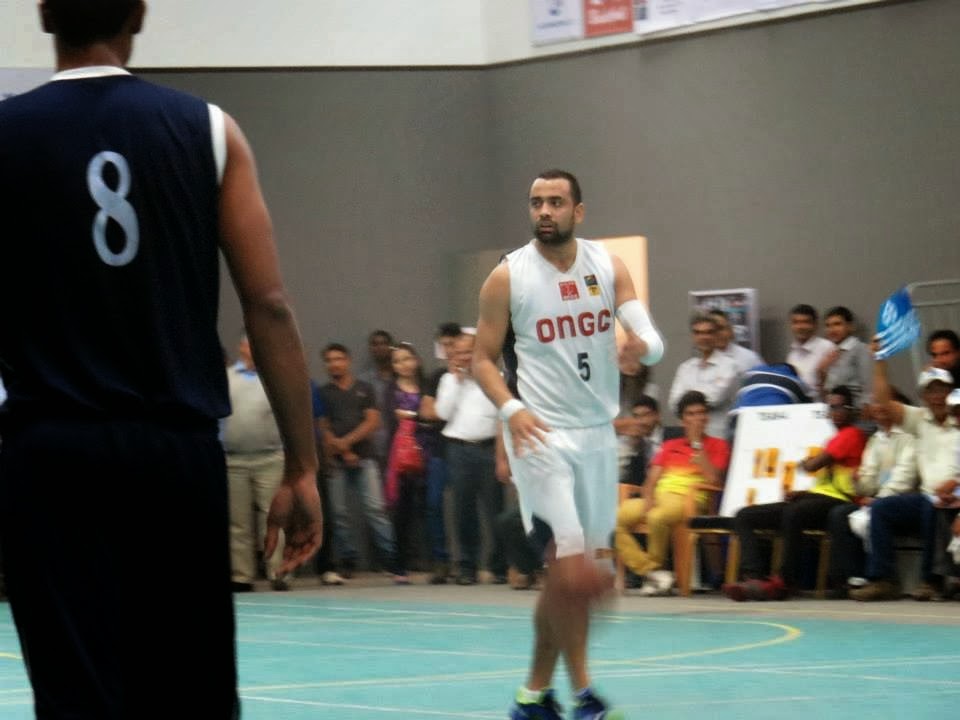
From October 15-19, the city of Bengaluru hosted the inaugural Mulki Sunder Ram Shetty All India Basketball tournament, a men's championship that featured six of India's top club level or state teams. After five days of high-notch basketball, the tournament was settled with a comfortable final win by Indian Overseas Bank - IOB - against their Chennai city rivals ONGC on Sunday, October 19th at the Bharat Sports Union in Malleshwaram, Bengaluru.

After a neck-to-neck start to the final, IOB relied on the sharp-shooting abilities of India international Pratham Singh, who scored 25 points to help his team open up a double digit lead in the second half. IOB trailed in the first quarter, caught up before halftime, and then continued to ride their positive momentum en route to a 63-49 victory. The star-studded IOB squad, which also featured the likes of Amjyot Singh, Hareesh Koroth, Mihir Pandey, Aravind A., and Prasanna V., thus became the first claimants to the Mulki Sunder Ram Shetty winner's trophy.

Prasanna was named the tournament's MVP.

In a high-scoring encounter for third-place earlier on Sunday, host team Vijaya Bank relied on the efforts of Anil (26) and Arvind (24) to defeat the Karnataka State team 89-75. Visu led the way with 24 for Karnataka.

Only teams from three southern Indian states - Karnataka, Tamil Nadu, and Kerala - took part in the inaugural iteration of this tournament. The participating teams were: ONGC, Vijaya Bank, Kerala State Electricity Board (KSEB), Tamil Nadu, IOB, Cochin Customs, Chennai Customs, and Kerala.

Final Standings
  • IOB
  • ONGC
  • Vijaya Bank
Check out the complete coverage on Ekalavyas.com for more from this tournament.

October 14, 2014

The Fit & the Furious


India’s Strength & Conditioning Coach Tommy Heffelfinger discusses the importance of keeping Indian basketball players healthy.

This article was first published in my column for Ekalavyas.com on September 8, 2014. Click here to read the original post.

Tommy Heffelfinger gets the Indian Women's squad psyched up for a
strength and conditioning workout. Photo: Rajesh Chavan
As the final seconds ticked away in India’s Asian Games contest in Incheon (Korea) against the Philippines and an Indian loss was all but ensured, Indian swingman Pratham Singh suffered a nasty fall, hurting both his head and his back. As Pratham writhed in pain on court, a hush fell in the arena, and his teammates momentarily ignored the result to focus on their hurting teammate. Pratham was stretchered off court, and for the next few hours, the Indian basketball team, coaches, as well as fans held their breath and hoped for some good news from the medical team.

Over four and half thousand kilometers away from Incheon, India’s Strength & Conditioning Coach Tommy Heffelfinger followed the game in New Delhi with bated breath, too. Since his appointment by the Basketball Federation of India (BFI) three months ago, Heffelfinger has worked closely with Pratham Singh and several others of India’s top players – both at the Senior and under-18 level in both genders – to ensure that serious injuries are reduced as much as possible.

“When injuries go down, the performances go up,” he stated, something that may sound obvious but is always easier said than done. For an individual like Pratham – a top-six rotation player for India’s Senior Men’s national basketball team – his fitness is directly related to his team’s performance.

Later that day, some good news trickled out of the Indian camp in Incheon back to Delhi: Pratham went through some tests on his back and leg, revealing no serious injuries. He was rested for the next day against Iran, but for the big picture, Heffelfinger let out a sigh of relief.

Hailing from Ann Arbor in Michigan, USA, sports took Heffelfinger across the pond to England for a decade, where he worked with national players from the British Basketball Team, football players of the English Premier League club West Ham United, and rugby players, too. Choosing to be nearer to his wife – who is from Nepal – Heffelfinger jumped at the opportunity of joining the BFI’s Strength & Conditioning team, taking over a position left vacant since the previous Coach – Zak Penwell – finished his tenure. Familiar with India and South Asia in the past, Heffelfinger skipped over the culture shock that most foreign coaches suffer in their initial stages of their visit.

“I felt like I was pretty much ready for anything when I got here,” he said when I met him in New Delhi in mid-September.

What his previous visits wouldn’t have prepared him for would’ve been the basketball. As his predecessor Penwell discovered during his two years in India, the exercise, diet, and fitness regimes of Indian basketball players were uniquely specific and, in some ways, separate from the athletes they would’ve trained before.

“In India, first of all the dietary restrictions are a big deal,” Heffelfinger said, “And this is something to which we are constantly adjusting on camp. Beyond that, when it comes to dealing with player workouts, I’ve learnt how difficult it is for our national team players to stick to their regimes outside of practice – all of these players have other day jobs outside of basketball. It is difficult for them to find dedicated time to follow up with their fitness schedules outside of camp.”

“The positive,” he added, “Is that kids in India tend to have better base mobility and movement. They still do not have better control of their body weight, and we have to work on making sure that they reach certain standards before they start working with heavier weights.”

Heffelfinger’s responsibilities encompass the entire plethora of Indian national teams, including the Seniors, the U18s, the U16s, and the U14s for both boys and girls. Over the past three months, he has only had a chance to work with the Seniors and the U18s, the latter of whom he took part in a camp most recently and will be heading out again to the SAI Center in Aurangabad to help the U18 girls’ prepare for the upcoming FIBA Asia U18 Championship for Women in Jordan in a few weeks.

When his responsibilities eventually trickle down to the U16s and U14s, Heffelfinger will be handed the keys to coaching kids at the most transformative of ages.

Tommy Heffelfinger takes the team through stretching exercises. Photo:
Rajesh Chavan.

“When kids get to a certain age, it is considered their peak-height velocity, after which we can begin more focus on strength training,” said Heffelfinger, “That is a maturation point, usually around 15-16 for most kids, where we can introduce heavy weights more. Before that age, most of the training is usually technique based.”

But once the young players begin to focus on lifting weights and sculpting their bodies for optimum basketball shape, Heffelfinger warns that there is a strict need to be aware of the right parts of the body to work on.

“It’s true, a lot of people don’t know which part of the body they must work on, and the same is true for basketball,” he said, “For example, in basketball, you need to have strong quads, and work on the hamstrings. Focusing on the lifting weights for the right parts of the body will improve performance and reduce risk of injury.”

“Players need to start addressing the balance of their bodies. Posterior imbalance can be the cause of a lot of injuries.”

Heffelfinger’s work over the past three months has already begun to show some early signs of improvement among the elite Indian athletes. He worked with the Senior Men’s team at camp in Greater Noida prior to the FIBA Asia Cup in Wuhan (China) a few months ago, a tournament now immortalized in Indian hoops history for showcasing some of India’s best-ever performances, including a memorable victory over Asian giants China. While the team’s Head Coach Scott Flemming deserved much of the credit for tactically preparing India – particularly on the defensive end – to punch above their weight, the work of Indian physiotherapists and strength trainers such as Heffelfinger in the background shouldn’t be ignored either; it was no doubt that the new Team India looked fitter than ever before and can now respond to many more of Coach Flemming’s gruelling demands.

In training camps, Heffelfinger has also noted improvement on more specific aspects of fitness. For example, he mentioned that the junior girls have improved their short-distance (20 meters) sprint times drastically over the past few months. “The improvement was off the roof,” he said, “I couldn’t even have hoped for them to improve their times so soon. They are all adding strength to their lower body.”

While the early returns have been positive, there are still several challenges that Heffelfinger hopes that India can overcome in the near future. The first priority, he said, is to find a place to lay out all the strength and conditioning related equipment and set up what he hopes will eventually become the ‘BFI Player Development Center’.

“We have all the equipment with us already,” he said, “But we still haven’t been able to use most of it, since we’re still waiting to find a place to set it up.”

Another concern for Heffelfinger has been the diet, and he has noted that the senior teams often return overweight or out of shape form breaks in national camps. With many players also being vegetarian, Heffelfinger has had to get creative with his dietary advice.

“First and foremost, they need to just stay away from oily food,” he said, “Currently, they also seem to have a very limited intake of food, which is shocking.”

Heffelfinger’s long-term goals for India start by prioritizing athlete health. He wishes to reduce basketball injuries by two-thirds and over-training injuries by one-half, too. He also has hopes to collect medical data of Indian players to create reports of players’ injury history. At this point, there is no such existing medical database in Indian basketball.

Further on, he plans to spend time with other strength coaches in India and train them to help create a pyramid system where each coach can then pass on health and fitness tips to many more around the country.

“I feel that there has been a distinct improvement in the national teams over the past few months,” said Heffelfinger, “It was extremely rewarding to see when the improvement leads to improved results.”

Some injuries – like Pratham Singh’s fall at Incheon – are unavoidable. Some are caused by unforeseen circumstances, an over-aggressive opponent, or simply bad luck. There is no perfect science to staying fit and no athlete – no matter how well trained – is going to be indestructible. But concentrated efforts from Heffelfinger and India’s health, fitness, and physiotherapy teams can seriously turn the odds around to avoiding injury.


And, as Heffelfinger states, the obvious fact is also the most important one. Healthier teams are more successful teams. For Indian basketball in the midst of a rapid push forward, any competitive edge for further success should be embraced. 


July 18, 2014

Don't Call it a Comeback: Pratham Singh returned from injury to become one of India's heroes at Wuhan


No pressure. It was only the chance of leading India to their biggest win in history. It was only their first opportunity to ever defeat China, historically Asia's most successful team. It was only a chance to overturn years and even decades of Team India falling short of their potential, over and over again. So, yes, no pressure.

In the fourth quarter of what became a surprisingly closely-contested match-up, China made every attempt to avoid an astronomical upset. And for every question that China posed, India's 23-year-old Pratham Singh had an answer. Pratham hit three of the biggest shots of his career - clutch three-pointers - in the fourth quarter to give India the lead for good, and helped secure the win which will forever be remembered as the 'Wonder of Wuhan', of the first time India silenced the mighty Chinese on the basketball court.

And throughout this heroic, clutch performance, he remained calm. No over-reaction, no nervous breakdown, no shot taken too quickly or taken too slow. No pressure.

A few days later, when I asked Pratham Singh about his calm under the storm of that entertaining contest in Wuhan, China, at the 5th FIBA Asia Cup, he responded with humility, instead crediting the whole team for his individual performance.

"It's all about team defense," he said, "When the team is playing good defensively, and you're playing well defensively, too, then you automatically get confident and you feed off that good defense on the offensive end. The offense comes easy then. But if your defense lacks, then it gets in your head on the offensive end, too. Our team plays great defense, just as we did against China in those possessions."

Pratham talked about being lost in the moment of the game, when it's just him and the bucket, and him his job off the ball. His job was to stop China and his job was to hit those open shots. He did just that, and three after three after three, he was successful.

For Pratham Singh, each big moment now plays as the perfect balm to heal the missed opportunities of his past. One by one, each three he hit in the fourth quarter against China soothed the pains that he went through as a younger player, the pains that derailed his career and threatened to end a promising career before it could even take off.

Born in Amritsar, Punjab, but trained as a rising young talent at the Bhilai Steel Plant in Chhattisgarh, Pratham's performances caught the eye of the Indian Overseas Bank (IOB) in Chennai when he was just a teenager, They brought in the 6-3 sharp-shooter in to strengthen their wing position for the future. It was around the same time - in 2009 - that he moved up from India's junior squads to get a first senior team call-up. But Pratham's career paused before it could truly begin to ascent; a knee injury put him out of action for two years. For two years, basketball in IOB and internationally for India passed him by, and Pratham waited on the sidelines as it seemed to leave him behind.

An injury like this could've proven to be the end of an elite career for many players, but Pratham, gracious as ever, credited his IOB teammates for not letting him get down on himself.

"The team I got - IOB - were really good and supportive," he said, "So even when I wasn't playing, I wasn't disconnected from basketball. The senior players like S. Robinson and others who played for Team India really supported me and kept encouraging me. They told me that all players suffer through injuries, but it's only the ones who come back strong that become really great. Slowly I started coming back to practice and made a comeback."

The comeback, so far, has been electrifying. Once Pratham got his strength and explosiveness back, he became a can't-miss player - literally and figuratively speaking - for club, state, and country. He took a bigger role at IOB as the likes of Robinson made way for a younger generation, he helped Tamil Nadu - the state whom he represents now - reach the top by winning this year's Senior National Championship, and, most importantly, he found himself back in Team India colours - this time for good.

While the injury stole two years of basketball away from Pratham, he looked back at it now as a great learning experience, and his comeback for Team India has been all the better for it. "I was inexperienced as a Junior," he said, "But playing with and spending time with players like Robinson in IOB, I learnt a lot more about the game, I became stronger, and all of that helped me when I returned."

Since last year, Pratham has become an indispensable part of India's rotation. He made his national comeback by playing for India's 3x3 side at the FIBA Asia 3x3 Championship in Qatar. He was picked by Scott Flemming for the FIBA Asia Championship team, the Lusofonia Games, the SABA Qualifiers, and now, here at the FIBA Asia Cup. He is a regular starter for India, and for his clutch antics, a regular finisher in close games, too.

Pratham's rise has come parallel to the team's surprising rise as well. "In the last FIBA Asia Championship, we were losing to these same teams very badly in all our games," he said, "For this tournament, we didn't get an exposure trip before we started, and if we had, we would've done better against Japan in the first game. Of course, then the best thing happened and we beat China - after that our confidence level went up. Before we used to look at Iran, and think within ourselves that they're a really good team. We used to fear them. Now, we think of them, like, 'Okay, it's Iran, but we can play them well.' Teams like Iran and Philippines used to big us big. We've turned things around now."

"Our confidence level after this tournament has gone really high," he repeated, "And the coaches feel that this team can do well. Our players have improved, specially defensively. At the last Asia Championship, we played scared. Now, we know that if we practice hard in the future, we can do better."

The confidence in Pratham individually seems to be at an all-time high too, despite the fact that India followed their wins against China and Indonesia with three losses at the hands of Iran, Philippines, and Jordan. Despite the losses, the team left a strong impression and turned some heads. India's next big challenge after Wuhan will be an invitational basketball tournament in Dubai, and after that, they will likely head to Incheon, Korea, for the Asian Games in mid-September.

"My dream is that India plays well at the FIBA Asia Championship," he said, "This time we nearly did it, but missed. It was a great chance to make semi-finals but we lost by just 4 points. Next time, we'll try in Dubai tournament to reach semis or finals. And then continue good work in Asian Games as well."

These are bold ambitions from a player who represents a team that has rarely cracked the top four of Asia's best. But India's new crop of players - among whom Pratham Singh is their clutch, cool three-point threat - now have the conviction to look any opponent in the eye and believe that they could be taken down. After beating China, Pratham Singh and India have the conviction to make history again.

So yes, no pressure.

July 14, 2014

Wonder of Wuhan: India should build on historic win over China to spark a basketball revolution


Sometimes, revolutions don't need pomp and noise, or confetti or loud celebrations. Some revolutions aren't greeted with cheering voices or waving flags. Some revolutions happen in stunned silence.

The last five minutes of India's historic first-ever win over China - perhaps the greatest win in 78 years of India's international basketball history - were played under an eerie hush. The game was talking place at the Wuhan Sports Center in Wuhan, the most populous city in Central China. This was the 5th FIBA Asia Cup, a biennial tournament held between 10 of the top teams on the continent. This is a relatively smaller tournament than the more highly-regarded FIBA Asia Basketball Championship (ABC), and the local Chinese fans only filled up a fraction of the 13,000-seat arena in Wuhan's Zhuankou suburb.

The hosts, favourites to win the tournament after winning their first two games and defeating Asian champions Iran in the process, were confident against India. The fans were out with vuvuzelas, balloon clappers, and there were animated MCs and scantily-clad cheerleaders to boost their spirits. Yet, nothing could divert their horrifically stunned attentions away from the upset on court. As the clock ticket away in the game's final minutes and it seemed that India would achieve the impossible, the arena grew quieter. Each squeak of a shoe sole on the polished wooden floor reverberated across the gymnasium. Each word of encouragement from the Indian bench to the heroes on court could be heard by every fan, media-person, and official in attendance.

And in this silence, India found joy: the team nicknamed the 'Young Cagers' - led by Head Coach Scott Flemming - finally grew up, and announced the coming of age of all of Indian Basketball with a memorable win. All the odds had been stacked against India, who are ranked 61st in the FIBA World Basketball rankings compared to China, who are 12th and are tops in Asia. India had lost their first game against Japan a day ago while China were riding a positive streak behind a talented youth movement. Yet, the final score read 65-58 in India's favour, and a milestone for Indian hoops was achieved.

Expectations, as they always are in such high-level Asian tournaments, were low for India. Always the minnows against other giants of the game, India returned without a win at bottom place in the previous iteration of the FIBA Asia Cup in Tokyo two years ago. In last year's FIBA Asia Championship in the Philippines, India showed some improvement, but were still defeated in blowout fashion against top teams like Iran, Korea, and of course, China, who beat India 79-45, just 11 months ago.

In the world of an Indian basketball follower, low expectations are the norm. We prematurely resign ourselves to embarrassing losses against the Chinas and the Irans of the continent, and hope for the best against teams ranked closer to our stature, like Kazakhstan or Bahrain. Rarely has India's senior men's team won a meaningful game of basketball in the past several decades, a hypnotizing lull of losses upon losses that numbed Indian media and fans into submission to the point of ignorance. China regularly expects to defeat India by 30, 40, or 50 points per contest. Coming into this tournament, India were once again ignored as outsiders with a seventh or eighth place finish (out of 10) as best-case scenario. Apart from the minuscule, almost-irrationally passionate fanbase of Indian basketball, the mainstream continued to not pay the team any attention.

Perhaps this was why, despite qualifying once more for a major Asian FIBA tournament, there were no mainstream media-houses from India covering the event, and the games itself weren't shown on any TV channel back home. China were stumped and India were absent, and, outside of the cheers and hoots from the victorious Indian locker-room, there was nothing but silence.

It was only through the power of the internet live commentary and social media that we were able to get the word out, and once the news leaked, it quickly went viral. Thousands of supporters of the Indian hoops cause were made aware of the news that no other traditional media outlet had covered. The players and the coaches who had made this achievement possible - ironically - couldn't even hear the online applause, finding themselves stuck behind the Great Firewall of China and unable to access the hysteria of Indian fans thousands of miles away.

One of those voices online was of Bobby Sharma, the senior VP of global basketball for IMG Worldwide, the company which, in their partnership with Reliance and the Basketball Federation of India (BFI) is hoping to usher in India's first professional basketball league in coming years. Sharma congratulated the BFI by calling this upset a 'monumental watershed moment'. Indeed, the achievements of those 12 men on court and their coaches in one simple game could be the springboard that India needs to finally take that basketball leap we have long been dreaming of.

Indian basketball will always remember the day - July 13, 2014 - that they eclipsed the mighty Chinese. This victory is set to change India's attitude and approach looking forward at all our basketball encounters in the future. If this team indeed has the ability to beat China, then it prepare with a realistic mentality of having a shot in every match-up, against any opponent. There are no reasons to throw in the towel before any game, and every Indian team from here on out should look up at Wonder in Wuhan on July 13 and find the motivation to do it again.

Perhaps, more young Indians back home, disillusioned that the game has no future in India, will start believing in the amazing possibilities of sport once again. The achievements of our best players should inspire countless others to remain geared towards a career in basketball, and motivated to recreate and build upon the success of the current squad.

Perhaps, with increased attention from the Indian mainstream after this victory will shine a spotlight on India's national teams and force our media and our sponsors to acknowledge them. Maybe this leads to greater financial rewards for our players, the majority of whom come from poor families and chose basketball as their only way to a stable job.

This win means a lot many of India's individual players, who are on various points in their careers. Vishesh Bhriguvanshi, India's captain and most consistent performer in recent years will relish this game forever. Pratham Singh was India's fourth-quarter hero, and sank several clutch three-pointers to give India the lead for good. Amjyot Singh played fantastically on both ends of the floor and showed elite athleticism against China's 7-foot-1 prodigy Zhou Qi. Yadwinder Singh, India's energy bar, lifted the team with his hustle on the defensive end. Amrit Pal Singh was a farmer at age 19 when he discovered basketball; just four years later, he was controlling the defensive paint against Chinese bigs. The likes of Joginder Singh, Narendar Grewal, Rikin Pethani, and more in the rotation have etched their names in Indian hoops history forever.

And the man who should be celebrated with special plaudits after this historical night is Head Coach Scott Flemming. After 32 years of coaching experience in the USA, most recently with the NBDL side Texas Legends, Flemming chose a different challenge, coming to India to try and make a difference in a country on the basketball hinterlands. Two years after his appointment, he isn't only the longest-serving foreign coach in India, he is also one of the most successful. Flemming led India to a gold medal victory at the Lusofonia Games this January and a first place finish at the South Asian Basketball Championship. But this was, by far, his biggest win with India.

The FIBA Asia Cup is still in process. India play their third and fourth Preliminary Round games against Indonesia and Iran on Monday and Tuesday respectively. They've almost ensured qualification for the Quarter-Final stage. Coach Flemming has spoken optimistically of India's ability to continue performing basketball miracles.

For now, this victory is a wake-up call for Indian basketball to start believing in its potential. We beat China on the court yesterday, but China basketball are miles ahead in the longer marathon. Our best basketball facility is only as good as 50-60 of what Chinese Tier 2 or Tier 3 cities possess. China's young talents are trained and developed from a young age to maximize their potential. All of the players in China's national team are professionals in the well-established Chinese Basketball Association (CBA). They have developed NBA talent in the past and have the resources to develop more such talent in the future. They have much better coaching down to the grassroots level and have much more money to pump into their various basketball federations. India, meanwhile, have an unbalanced and mostly disorganized grassroots nursing system, don't have the infrastructure to provide our top talents and don't have enough support from the common public that rarely looks beyond cricket (or the FIFA World Cup) when the word 'sport' is uttered. Worst of all, internal politics stunts any real growth and there is rarely any motivations from those who are in the basketball fraternity to rise higher, as many stay content to swivel around in lower mediocrity.

And yet, if India can beat China despite being completely overshadowed across every sphere in the basketball world, imagine what we could do if we actually put in an honest effort to improve hoops in the country, from the grassroots to the top, instead of making the sport into just another way for bureaucrats to enjoy a small morsel of power?

Team India's moment - this Wonder of Wuhan - was a silent revolution indeed; but let's hope that the reaction to this moment is loud, energetic, and points to a brighter future for Indian basketball.

UPDATE: Thanks to FIBA, now we have the entire game tape of India's historic win over China on YouTube. Check it out here:


May 9, 2014

ONGC basketball team shifts base from Dehradun to Chennai, strengthen Tamil Nadu squad


When two of the finest teams in the country face each other, fans expect fireworks. But when the two teams merge into one, it calls for doomsday for every other opponent in the nation. This is exactly what may happen in the foreseeable future for Indian basketball. Tamil Nadu were already the hottest team in Indian hoops after they won the Men's gold medal at the National Championship in Delhi back in March. Now, one of the most talented clubs in India - ONGC - has announced that it will be shifting base from Dehradun to Chennai, which means that Tamil Nadu will be boosted with all the ONGC players who had been representing the state of Uttarakhand until now.

Photo Courtesy: Ekalavyas.com
The Oil and Natural Gas Corporation - or ONGC - employ some of India's top players including present and former internationals such as Vishesh Bhriguvanshi, Amrit Pal Singh, Yadwinder Singh, Trideep Rai, Murali Krishna and many more. ONGC have won most of the Men's titles in most All India invitational tournaments in recent years and their stars helped guide Uttarakhand to the 2013 National Championship gold, too. Earlier this year, Uttarakhand finished fourth in the Senior Nationals, while Tamil Nadu took home the gold.

The Asian Age recently reported that ONGC - the 2014 Federation Cup champions - will be shifting both their strong basketball and volleyball teams to Chennai, bolstering the national champion Tamil Nadu sides in both squads. According to the report, the players have been ordered to report at the Chennai office on June 13.

Although no players have appeared on record, the report - written by C. Santhosh Kumar - quoted a key member of the ONGC basketball squad who said, "The [ONGC] management always wanted better exposure [for] its team and I reckon it's the reason behind shifting base to Chennai, where basketball and volleyball are more vibrant than Dehradun. Even though talks started a year ago, receiving the order on Tuesday evening was a big surprise."

Tamil Nadu's basketball fraternity will be glad to be spoiled for choice now in choosing their Men's state teams, and it should make for some healthy competition. Currently, the Indian Overseas Bank (IOB) is the only public sector company in Chennai that regularly recruits players. IOB have done fairly well on the national stage, though, and many of their players were in TN's national winning side. Stars like Rikin Pethani, Pratham Singh, SP Venkatesh, and more will be contending for their spots for Tamil Nadu after their recent successes.

"I understand that the ONGC board has approved the change of base," said L. Suren, Treasurer of the Tamil Nadu Basketball Association (TNBA), "If they come to Chennai, it will create more job opportunities for Tamil Nadu players and help develop the sport here."

But how soon could ONGC players start suiting up for Tamil Nadu? Rules state that a player must reside in a state for at least six months before being eligible to represent it. Suren added that, "in this case, apart from the residential status, the Basketball Federation of India (BFI) can decide straightaway because the entire team will be moving from one place to another."

But not everyone is happy about this move. In a report published on The Hindu today, some of ONGC's basketball players have expressed disappointment over the move from Dehradun to Chennai.

Via The Hindu

Speaking to The Hindu on Thursday, V.K. Mahendru, Head, Corporate Sports (New Delhi) said: “As far as volleyball is concerned we are hopeful that it will be in Chennai, but when it comes to basketball, we are yet to make a call. The final decision will be taken within 10-15 days. Whatever we do, we will do it in the best interest of the team.”
A senior basketball player said most of the players were not happy with the move.
He argued that, with Chennai being home to good teams such as IOB, ICF, Customs and Indian Bank, not many ONGC players will get the chance to represent Tamil Nadu.
“We have two cement courts in our residential colony (in Dehradun). Where will we now practice in Chennai? And the weather too is hot,” he said.
Another player said: “They’ve decided. We have no choice. We have got the orders to join duty in Chennai on June 13 after playing in an all-India tournament in Hyderabad.”
He said the Tamil Nadu team selection will now be tougher with so many good hoopsters.
“While Tamil Nadu basketball team will be very strong, other teams will not be so.”

You can only have 12 players in a team, and the presence of ONGC players fighting for their spot against other IOB/Tamil Nadu players should make for some fascinating competition in the state. Star players will be snubbed, but overall, it could make for one hell of a roster top to bottom for TN. They will become the Indian hoops version of a 'super-team'; and the pressure will be on rivals from Punjab, Services, or Indian Railways to step up a gear. The losers of his move will unfortunately be Uttarakhand, who will be left with little without the ONGC talent and could experience a major drop in national rankings next year.

March 13, 2013

IOB (Chennai) win 1st Chandigarh Invitational Basketball Tournament


A top-level national club basketball tournament finally came to the city of Chandigarh, and fans who witnessed the action over the past five days were rewarded with games featuring some of India's finest players. Chandigarh's 1st All India Invitational Basketball Tournament saw the participation of eight of the best Indian club sides at the Sector 46 Complex Courts from March 8-12, 2013. On the tournament's finale on Sunday, Chennai's Indian Overseas Bank (IOB) emerged winners, defeating favourites ONGC (Uttarakhand) to lift the trophy.

ONGC came into the Final featuring the tournament's hot hand Trideep Rai, who had up to that point, been the leading scorer in the tournament. But balanced play from their opponents turned out to be too much for ONGC, who trailed through the course of the game, down by 15 points at half time and finally losing the game 71-57. Pratham Singh dominated proceedings for IOB with 27 points in the Final, while Mihir Pandey chipped in with 18. The winning team (IOB) won Rs. 1.5 lakhs prize money, while the runners-up received Rs. 75,000.

Earlier in the day, Punjab Armed Police (PAP) faced Indian Army in one of the best games of the tournament, a back-and-forth encounter that remained close until the very end. PAP were able to sneak by to win the game 72-71 and claim the Rs. 50,000 third-place award. Army led at halftime, but PAP were able to turn the score around behind big performances by Harminder (20) and Tejinder Pal Singh (18). Gopal Ram (27) was the leading scorer for the losing side.

In the previous day, IOB had entered the final after they blew out Indian Army 87-60. ONGC defeated PAP 87-76 in their semi-final in a comeback win after trailing at halftime.

The tournament was organised by the Chandigarh Administration. Check out a special feature by Neeraj Grover over at SportsKeeda, who attended the games in Chandigarh and wrote a nice first-person account of the championship!