Showing posts with label Incheon. Show all posts

October 14, 2014

The Fit & the Furious


India’s Strength & Conditioning Coach Tommy Heffelfinger discusses the importance of keeping Indian basketball players healthy.

This article was first published in my column for Ekalavyas.com on September 8, 2014. Click here to read the original post.

Tommy Heffelfinger gets the Indian Women's squad psyched up for a
strength and conditioning workout. Photo: Rajesh Chavan
As the final seconds ticked away in India’s Asian Games contest in Incheon (Korea) against the Philippines and an Indian loss was all but ensured, Indian swingman Pratham Singh suffered a nasty fall, hurting both his head and his back. As Pratham writhed in pain on court, a hush fell in the arena, and his teammates momentarily ignored the result to focus on their hurting teammate. Pratham was stretchered off court, and for the next few hours, the Indian basketball team, coaches, as well as fans held their breath and hoped for some good news from the medical team.

Over four and half thousand kilometers away from Incheon, India’s Strength & Conditioning Coach Tommy Heffelfinger followed the game in New Delhi with bated breath, too. Since his appointment by the Basketball Federation of India (BFI) three months ago, Heffelfinger has worked closely with Pratham Singh and several others of India’s top players – both at the Senior and under-18 level in both genders – to ensure that serious injuries are reduced as much as possible.

“When injuries go down, the performances go up,” he stated, something that may sound obvious but is always easier said than done. For an individual like Pratham – a top-six rotation player for India’s Senior Men’s national basketball team – his fitness is directly related to his team’s performance.

Later that day, some good news trickled out of the Indian camp in Incheon back to Delhi: Pratham went through some tests on his back and leg, revealing no serious injuries. He was rested for the next day against Iran, but for the big picture, Heffelfinger let out a sigh of relief.

Hailing from Ann Arbor in Michigan, USA, sports took Heffelfinger across the pond to England for a decade, where he worked with national players from the British Basketball Team, football players of the English Premier League club West Ham United, and rugby players, too. Choosing to be nearer to his wife – who is from Nepal – Heffelfinger jumped at the opportunity of joining the BFI’s Strength & Conditioning team, taking over a position left vacant since the previous Coach – Zak Penwell – finished his tenure. Familiar with India and South Asia in the past, Heffelfinger skipped over the culture shock that most foreign coaches suffer in their initial stages of their visit.

“I felt like I was pretty much ready for anything when I got here,” he said when I met him in New Delhi in mid-September.

What his previous visits wouldn’t have prepared him for would’ve been the basketball. As his predecessor Penwell discovered during his two years in India, the exercise, diet, and fitness regimes of Indian basketball players were uniquely specific and, in some ways, separate from the athletes they would’ve trained before.

“In India, first of all the dietary restrictions are a big deal,” Heffelfinger said, “And this is something to which we are constantly adjusting on camp. Beyond that, when it comes to dealing with player workouts, I’ve learnt how difficult it is for our national team players to stick to their regimes outside of practice – all of these players have other day jobs outside of basketball. It is difficult for them to find dedicated time to follow up with their fitness schedules outside of camp.”

“The positive,” he added, “Is that kids in India tend to have better base mobility and movement. They still do not have better control of their body weight, and we have to work on making sure that they reach certain standards before they start working with heavier weights.”

Heffelfinger’s responsibilities encompass the entire plethora of Indian national teams, including the Seniors, the U18s, the U16s, and the U14s for both boys and girls. Over the past three months, he has only had a chance to work with the Seniors and the U18s, the latter of whom he took part in a camp most recently and will be heading out again to the SAI Center in Aurangabad to help the U18 girls’ prepare for the upcoming FIBA Asia U18 Championship for Women in Jordan in a few weeks.

When his responsibilities eventually trickle down to the U16s and U14s, Heffelfinger will be handed the keys to coaching kids at the most transformative of ages.

Tommy Heffelfinger takes the team through stretching exercises. Photo:
Rajesh Chavan.

“When kids get to a certain age, it is considered their peak-height velocity, after which we can begin more focus on strength training,” said Heffelfinger, “That is a maturation point, usually around 15-16 for most kids, where we can introduce heavy weights more. Before that age, most of the training is usually technique based.”

But once the young players begin to focus on lifting weights and sculpting their bodies for optimum basketball shape, Heffelfinger warns that there is a strict need to be aware of the right parts of the body to work on.

“It’s true, a lot of people don’t know which part of the body they must work on, and the same is true for basketball,” he said, “For example, in basketball, you need to have strong quads, and work on the hamstrings. Focusing on the lifting weights for the right parts of the body will improve performance and reduce risk of injury.”

“Players need to start addressing the balance of their bodies. Posterior imbalance can be the cause of a lot of injuries.”

Heffelfinger’s work over the past three months has already begun to show some early signs of improvement among the elite Indian athletes. He worked with the Senior Men’s team at camp in Greater Noida prior to the FIBA Asia Cup in Wuhan (China) a few months ago, a tournament now immortalized in Indian hoops history for showcasing some of India’s best-ever performances, including a memorable victory over Asian giants China. While the team’s Head Coach Scott Flemming deserved much of the credit for tactically preparing India – particularly on the defensive end – to punch above their weight, the work of Indian physiotherapists and strength trainers such as Heffelfinger in the background shouldn’t be ignored either; it was no doubt that the new Team India looked fitter than ever before and can now respond to many more of Coach Flemming’s gruelling demands.

In training camps, Heffelfinger has also noted improvement on more specific aspects of fitness. For example, he mentioned that the junior girls have improved their short-distance (20 meters) sprint times drastically over the past few months. “The improvement was off the roof,” he said, “I couldn’t even have hoped for them to improve their times so soon. They are all adding strength to their lower body.”

While the early returns have been positive, there are still several challenges that Heffelfinger hopes that India can overcome in the near future. The first priority, he said, is to find a place to lay out all the strength and conditioning related equipment and set up what he hopes will eventually become the ‘BFI Player Development Center’.

“We have all the equipment with us already,” he said, “But we still haven’t been able to use most of it, since we’re still waiting to find a place to set it up.”

Another concern for Heffelfinger has been the diet, and he has noted that the senior teams often return overweight or out of shape form breaks in national camps. With many players also being vegetarian, Heffelfinger has had to get creative with his dietary advice.

“First and foremost, they need to just stay away from oily food,” he said, “Currently, they also seem to have a very limited intake of food, which is shocking.”

Heffelfinger’s long-term goals for India start by prioritizing athlete health. He wishes to reduce basketball injuries by two-thirds and over-training injuries by one-half, too. He also has hopes to collect medical data of Indian players to create reports of players’ injury history. At this point, there is no such existing medical database in Indian basketball.

Further on, he plans to spend time with other strength coaches in India and train them to help create a pyramid system where each coach can then pass on health and fitness tips to many more around the country.

“I feel that there has been a distinct improvement in the national teams over the past few months,” said Heffelfinger, “It was extremely rewarding to see when the improvement leads to improved results.”

Some injuries – like Pratham Singh’s fall at Incheon – are unavoidable. Some are caused by unforeseen circumstances, an over-aggressive opponent, or simply bad luck. There is no perfect science to staying fit and no athlete – no matter how well trained – is going to be indestructible. But concentrated efforts from Heffelfinger and India’s health, fitness, and physiotherapy teams can seriously turn the odds around to avoiding injury.


And, as Heffelfinger states, the obvious fact is also the most important one. Healthier teams are more successful teams. For Indian basketball in the midst of a rapid push forward, any competitive edge for further success should be embraced. 


October 4, 2014

Recap: India at 2014 Asian Games basketball tournament; Hosts South Korea win double gold


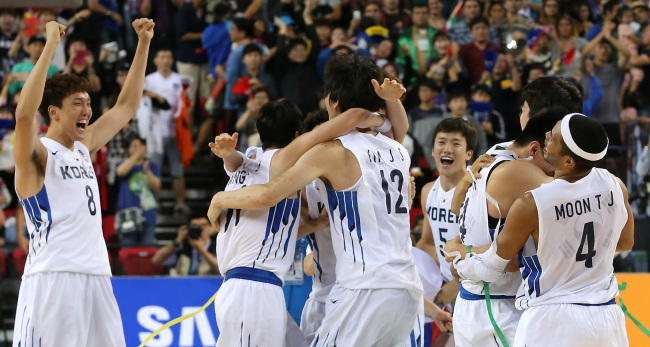
South Korea defended their home turf in style, as both their Men and Women's squads outperformed higher-ranked squads to secure the gold medal at the Basketball tournament of the 17th Asian Games in Incheon. Both the finals of the tournament were held at the Samsan World Gymnasium in Incheon on Friday, October 3rd, the penultimate day of events at the Asian Games. South Korea's Men won a thrilling contest against Iran, while their Women's squad edged to a victory over China.

Topsy-turvy performances by India saw some positive moments but also left a lot to be desired. India's Men finished 12th (out of 16) and Women finished 6th (out of 11).

The basketball tournament at the Games was held at the Samsan World Gymnasium and the Hwaseong Sports Complex from September 20 - October 3.

After trailing by two at halftime, Korea's Women took a third quarter lead over China in the final, before surviving in the final minutes to a 70-64 victory. Yeonha Beon scored a team-high 16 for South Korea, while on the Chinese end, Xiufeng Shi scored 16 too. As hosts, Korea had made sure to send their top 'A' squad to the Asian Games tournament, while their 'B' team played at the FIBA World Championship for Women. China, who also qualified for FIBA Worlds, did the reverse.

In the Men's final, South Korea again rallied on their home support to take an early lead against FIBA Asia champs Iran and hold on to secure the gold despite a strong comeback by the Iranians in the second half. Behind the efforts of their superstar Taejong Moon (19 points) and Jongkyu Kim (17), Korea raced to a nine point lead in the first quarter and held a 42-36 advantage at the halftime break. But Iran - boosted by a 30-point outing by captain Mohammadsamad Nik Khahbahrami - bounced back to take a lead in the third. Down by five in the game's last two minutes, Korea bounced back to take a lead with just 36 seconds left in the game, and a missed last shot by Iran's Khahbahrami secured the hosts a 79-77 win.

Earlier in the day, Japanese Women survived another back-and-forth close contest versus Chinese Taipei to secure the bronze medal with a 61-59 win. Japan's Men won the bronze too, but it didn't come easy against the surprise team of the tournament, Kazakhstan. Kosuke Kanamaru scored 21 points for Japan, who only put the Kazakhs away for good in the game's waning minutes for a 76-72 win. Kosuke Takeuchi added 17 points for the victors, while Kazakhstan's Dmitriy Gavrilov scored a game-high 22 points in the losing effort.

A couple of days earlier, Xiufeng Shi (20) and Dan Liu (18) helped China's Women bounce back from an early deficit to defeat Chinese Taipei 75-63 in the Semi-Final stage. Ping Jen Huang scored 19 for Chinese Taipei in the loss. In the second women's semi-final, hosts South Korea overcame a very slow start to beat Japan 58-53. Japan's Naho Miyoshi scored a game-high 18.

Japan and South Korea also faced off in the Men's semi-final, and after being locked at 34-each at halftime, the hosts once again found a second half boost to race to a 71-63 win. The Koreans overcame 18 points by Japan's Naoto Tsuji. Kazakhstan played valiantly against Iran in the other Men's semi-final, giving the Iranians trouble on all ends of the court until the game's dying seconds. But it was Khahbahrami who poured in a heroic 27 points to insure a final appearance for his nation. Kazakhstan's duo of Pavel Ilin and Anton Ponomarev scored 16 points each in the loss.

After some positive performances over the last few months, India's Men's team entered their last international competition of 2014 with some cautious optimism. India were placed in Group B of the Men's Qualifying Round in the tournament, along with Saudi Arabia, Kazakhstan, and Palestine, and their task was to finish in the top two to qualify for the Preliminary Round with Asia's stronger teams.

India started well against the minnows of their group, Palestine. The Young Cagers raced to a double digit lead in the first quarter and never looked back, hitting from all angles and playing hard on the defensive end, too. Amjyot Singh scored 25 to lead the Indian attack in the 89-49 win for India. One bright spark for Palestine was their captain Hend Sani GS Sakakani, who finished with 19 points for his side.

But India were given a brutal shock the very next day against Saudi Arabia, who were considered to be beatable opponents. The Saudis capitalized on careless offense by India to take an early lead and stretch it to 40-27 at halftime. India began to play their best basketball in the fourth quarter, but the comeback attempt was left too late and Saudi Arabia held on for a 73-67 win. Fahad Alsalik M Belal scored 17 to lead the Saudis. India's top performers were the big men duo of captain Amrit Pal Singh (19 points, 10 rebounds) and Amjyot Singh (19).

With their backs against a wall and needing a win - a convincing one at that - to qualify for the next round against the group's toughest team, India bounced back in style against Kazakhstan. In what became their best performance of the tournament, India's hot shooting gave them a 24-14 lead in the first quarter, and from then on, India held on to their double digit advantage all game. Point guard Joginder Singh hit seven three-pointers for a game-high 25 points, while veteran guard Vishesh Bhriguvanshi added 16. Anton Poromarev scored 16 for Kazakhstan. India finished the game with a 80-61 win; and the margin of victory helped them qualify for the Preliminary Round by finishing top in their group, relegating Kazakhstan to second.

India thus found themselves Preliminary Round Group E, along with Asian giants Iran and Philippines, both of whom had recently represented the continent at the FIBA World Cup in Spain. India started slow against the aggressive Filipinos, who were playing their first game at the competition. The Philippines took a 50-37 lead at halftime, and a slew of bad shooting and turnovers kept India at bay. The Indians did make a strong comeback in the fourth quarter, but it wasn't enough as they fell to a 85-76 loss. Amrit Pal Singh was the game's leading scorer with 16.

India played their fifth game in five days against Iran next, who were playing their first game at the tournament. The more athletic, experienced, and rested Iran side left no chance for an Indian upset. Despite a decent start where India were only down by six in the first quarter, Iran fed the ball to experienced big man Hamed Haddadi (16) for much of the damage in the first half and the explosive Khahbahrami (16) to dominate in the second. India were outplayed in all aspects of the game and their tiredness showed as they fell to a 76-41 loss. By finishing last in the group, they were eliminated from the tournament.

India Men finished the tournament with a 2-3 record at 12th place.

"In general this was a great experience," said Scott Flemming, Head Coach of the Indian Men's team, "Being in a setting with 45 countries and 13,000 athletes is enlightening. This was a chance, if taken advantage of, to broaden our scope globally. In regards to basketball there were things we could control and other aspects we could not control. In the areas we could control I feel as though our defense continues to be our strong point, maybe with the exception of the Philippines game. We have also improved in our shot selection and our accuracy from the field. Where we struggled at crucial times was in our defensive rebounding, free throw shooting and number of turnovers that led to points by our opponents. I will take responsibility for these short comings. They will need to be focused on even more in the future.

"We also had a few areas that we could not control," Flemming added, "Again, we played no preparation games leading up to this tournament. Many of these teams have played anywhere from 10 to 50 preparation games before coming to Korea. These are crucial to compete at these high level tournaments. We also played 2 of the top teams in Asia (Iran, Philippines) while playing 4 and 5 days in a row. They were both fresh in these games. It may not have hurt us so much if we had played in one of the other pools in the next round. But again, those things we cannot control. We ended up first in our qualifying pool. We played very well at times but we definitely need to take another step to reach those medal games. I am proud of what we have accomplished this year but there is definitely more work to be done."

India's Women, who had finished at a best-ever fifth place in last year's FIBA Asia Championship for Women, began their tournament by automatically starting in the quarter-final. The only problem? Their quarter-final opponents were reigning Asian champs Japan. The swift and talented Japanese dominated India from beginning to end, and even holding India to just five points in the opening quarter. No Indian player was able to crack double digits in scoring and Japan cruised to an easy 70-37 win, eliminating India from moving further up into the tournament.

Instead, the Indian eves fell to the 5-8th place bracket, where they first played Mongolia, losers of another quarter-final. Jeena PS got India started off on a roll and the experienced Prashanti Singh (17) took over late. India maintained a healthy distance from the Mongolians through the course of the game and held on for a 68-50 win. Mongolia's leading scorer was Ganzul Davaasuren, who finished the night with 25 points.

India's last game at the tournament was against Kazakhstan, and despite a competitive start, India were outclassed for the final three quarters of the game. Kazakhstan, who had a 15-12 lead after the first quarter, stretched their lead to 14 at halftime and then outscored India 19-4 in a big third-quarter surge. Kazakhstan finished the night with a 68-47 win and were secured of fifth place at the tournament.

India Women finished the tournament with a 1-2 record at sixth place.

"On paper, if you check that we were at 6th position, you might think we played a good tournament," said Francisco Garcia, Head Coach of India's Women's team, "And of course, 6th position is good since that we had the youngest team in competition. But the reality is that we did not find our pace in this championship. Mainly we faced teams with players who play around 60 games a season and came to Incheon with 10-15 practice games before the tournament began. We came here with zero practice games after three camps. And of course there is no team in the world who do that before a championship. I am really dissappointed about that."

"We have been asking since a long time ago to create pro leagues for men and women and no one listen to us," added Garcia, "That is the key for our players to grow and compete better internationally, apart from playing often with our team abroad. And I repeat, this is not a fact of the result, because it was a good one. It is necessary to become closer to the top teams. IMG Reliance and the Basketball Federation of India (BFI) must urgently plan pro leagues."

Final Standings

Men
  • Gold: South Korea
  • Silver: Iran
  • Bronze: Japan
Women
  • Gold: South Korea
  • Silver: China
  • Bronze: Japan

September 19, 2014

2014 Asian Games: The Complete Team India Basketball Preview


The journey - as it usually is with Indian sports - wasn't easy, and threatened to unravel into disaster as, less than 10 days before the beginning of the 2014 Asian Games in Incheon (Korea), the fate of India's basketball (and a few other sports) teams hung in the balance. Luckily for the Indian athletes and hoop lovers back home, the turmoil finally ended last week and India's Men's and Women's Senior basketball squads were confirmed to participate at the basketball tournament in Incheon, set to be held from September 20 - October 4.

The 17th Asian Games - or the XVII Asiad - will be held in Incheon from September 19 - October 4, 2014. A total of 439 events from 36 sports and disciplines set to feature in the Games. The basketball tournament at the Games will be held at the Samsan World Gymnasium and the Hwaseong Sports Complex.


India's Men's Basketball team at the 17th Asian Games
  • Joginder Singh
  • Narender Kumar Grewal
  • Akilan Pari
  • Prakash Mishra
  • Pratham Singh
  • Vishesh Bhriguvanshi
  • Amrit Pal Singh (Captain)
  • Prasanna Venkatesh Sivakumar
  • Palpreet Singh Brar
  • Amjyot Singh
  • Yadwinder Singh
  • Rikin Shantilal Pethani
  • Head Coach: Scott Flemming
  • Coach: Prasad Rama Linga
  • Physiotherapist: Naved Hameed
Head Coach Scott Flemming has opted for a completely unchanged roster for Team India from the squad that performed wonders at the 5th FIBA Asia Cup in Wuhan (China) in July this year. Flemming's decision is no surprise at all: this is the same Indian squad that defeated the mighty Chinese on their home soil at the FIBA Asia Cup for the first time in the nation's basketball history. Although India finished the tournament at only 7th place, they managed to scare much-favoured Asian squads like Iran and the Philippines (both of whom played at the FIBA World Cup) and proved that they were much better than their 61st FIBA World Ranking proclaimed. India will once again rely on their three most talented players - Vishesh Bhrighuvanshi, Amjyot Singh, and new captain Amrit Pal Singh - to strike fear in their opponents.

India will start the tournament in Group B of the Qualifying Round.

Asian Games Men's Basketball Groups
  • Qualifying Round Group A: Mongolia, Hong Kong, Kuwait, Maldives. 
  • Qualifying Round Group B: Saudi Arabia, Kazakhstan, Palestine, India. 
  • Preliminary Round Group C: China, Chinese Taipei, B2. 
  • Preliminary Round Group D: South Korea, Jordan, A2. 
  • Preliminary Round Group E: Iran, Philippines, B1. 
  • Preliminary Round Group F: Japan, Qatar, A1.
To qualify for the Preliminary Round of the tournament, India must finish in top 2 of the qualifying round stage. India should be able to do just that: Kazakhstan are slight favourites for Group B but India should be able to defeat Saudi Arabia and Palestine. If India can beat Kazakhstan too, they will top the group. Either way, if India qualifies for the Preliminary Round, they will thrown right into the fire. Finishing top will see them in a group with Asia's World Cup representatives Iran and Philippines and finishing second will place them with Asia's top seed China as well as FIBA Asia Cup runner-ups Chinese Taipei.

The top two teams from from Groups C, D, E, and F will move on to two more groups (G and H) of round-robin games as the Quarter-Final round, and the four best from these groups will finally be in the semi-final knockout stage.

India's Men's Qualifying Round Schedule - all timings IST
  • September 20 - 12:45 PM - India vs. Palestine.
  • September 21 - 12:45 PM - India vs. Saudi Arabia.
  • September 22 - 12:45 PM - Kazakhstan vs. India.
"It has been a long wait and one with uncertainty," Coach Flemming told me as Team India readied to head out to Korea for the Asian Games, "We are very glad that we have been given approval to participate in the Asian Games. At the same time we are again battling the odds with no preparatory games and a limited coaching staff. We will again need to be overcomers and overachievers. We draw confidence from our play in the Asia Cup earlier this summer. Our team will do our best to meet the challenge ahead of us."

My Prediction: At the 2010 Asian Games in Guangzhou (China), India's Men finished winless, losing all five of their games. This year, circumstances and groupings are different and India should be able to notch a couple of Qualifying Round victories. India will have to use the first two games against Palestine and Saudi Arabia as their 'preparatory' games before their biggest early challenge against Kazakhstan. The Kazakhs are known to be tall and athletic, but I feel that this Indian side has enough confidence and talent now to beat them and top Group B. Unfortunately, they will have to go against Iran and Philippines in the Preliminary Round then, and only another miracle (like our win over China two months ago) will be able to see India survive for the Quarter-Finals.


India's Women's Basketball team at the 17th Asian Games
  • Akanksha Singh
  • Kavita Akula
  • Kruthika Lakshman
  • Kavita Kumari
  • Poojamol KS
  • Raspreet Sidhu
  • Prashanti Singh
  • Smruthi Radhakrishnan (Captain)
  • Rajapriyadharshini
  • Jeena PS
  • Stephy Nixon
  • Head Coach: Francisco Garcia
  • Coach: Divya Singh
  • Physiotherapist: Rajesh Chavan
It's been a long time since we've seen a full-strength India Women's basketball team in action. It's been almost 10 months, actually. Garcia led India to a best-ever fifth-place finish at the 25th FIBA Asia Championship for Women in Bangkok (Thailand) last year, and India notched their first-ever Level 1 victory in the tournament, too. Since then, India's only major international exposure has been at the Lusofonia Games in January, where Garcia opted to play a younger, less experienced squad. Although several of the big guns are back in the roster for India, this team is missing some familiar faces like recent Arjuna Award winner Geethu Anna Jose and young rising star Shireen Limaye, who tore her ACL just days before the team was due to fly to Korea. Jose's Railways' teammate Anitha Paul Durai is also missing in action. India will be relying on the potential of youngsters Jeena PS and Kavita Kumari, the leadership of captain Smruthi Radhakrishnan, and the experienced Singh Sisters - Prashanti and Akanksha - in the campaign. Because they finished in Level 1 of last year's FIBA Asia Championship, India's Women have already been seeded to the competitions final round.

Asian Games Women's Basketball Seedings
  • Qualifying Round: Hong Kong, Kazakhstan, Mongolia, Nepal, Qatar.
  • Final Round: China, South Korea, Japan, Chinese Taipei, Thailand, India.
The top team from the Qualifying Round will play Korea in the Quarter-Final while the second-best team will play China. India's first game at the tournament will be a Quarter-Final clash against Japan on September 28th at 9:30 AM IST. If India win this game, they will play either Korea or the top team from the Qualifying Round in the Semi-Final. If India lose, they will be slotted in the 5th-8th place tournament.

"Our preparation for the Asian Games was not the best," Coach Garcia said, "We ran three camps but our exposure trip was cancelled even when we were ready with visas to head to China for practice games. So at the end of the day we go there [Incheon] without playing a single game. As far as I know, our opponents have been playing in international tournaments since the end of July. Also, we'll be going there without our two best scorers (Jose and Paul Durai) and rebounder (Jose) of the last FIBA Asia Championship. Days ago, Shireen Limaye, an important player in our system, tore her ACL so she won't be able to play either. But still, we expect to compete at 500 percent; we have been working very hard and although we have adversities, I believe in this group to give their best in the tournament."

My Prediction: India's Women were also winless at the 2010 Asian Games, going 0-3 in the tournament. By being seeded in the final round this year and starting in the Quarter-Final, India are ensured at least a top 8 finish. India's chances of winning that quarter-final against Japan are low since the Japanese are the reigning FIBA Women's champions. If they lose, they will have to face against other Quarter-Final losers in the 5th-8th tournament, where their biggest challenger will probably be Thailand. India proved last year that they were ready to cement their position as Asia's fifth-best women's team after the big four of China, Chinese Taipei, Korea and Japan, and I expect them to be good enough for fifth-place again this time around.

September 10, 2014

Asian Games turmoil finally ends: Indian Basketball teams confirmed to participate


Sometimes, we can't help but slap our forehead and sigh "Only in India!"

With only 10 days left before the beginning of the 2014 Asian Games in Incheon (Korea), the Government of India finally (FINALLY!) made a decision on an ongoing stand-off that threatened to leave athletes participating in several sports - including our Men's and Women's senior national basketball teams - back home despite qualifying to play at the competition. On Tuesday, September 9th, the government eventually made a decision to send a contingent of 679 athletes and officials to Incheon; a much smaller number than the Asian Games four years ago, but with the basketball and a few of the other threatened sports included.

Even though, until a week ago, it seemed all but guaranteed that all of India's participants who have qualified in various disciplines will be part of the country's national contingent to Korea, this ridiculous saga began when the Sports Authority of India (SAI) recommended that the large number of athletes and officials in India's proposed list (944 total) be cut down to avoid embarrassment. SAI's director general Jiji Thompson had said "The IOA list is huge and we have recommended pruning. We don't want the athletes to cut a sorry figure there. We want to send people with a realistic chance of winning medals since it's the country's pride that is at stake."

According to DNA India, SAI's strict criteria for the participating athletes was for the athlete to be ranked at least top six in the while the team to be in the top eight. Five sports - Basketball, Football, Handball, Table Tennis, and Sepak Takraw - potentially faced the axe from the government if SAI's recommendation had been followed.

As the national teams even our national coach waited in limbo, things got even worse. As the Minister of Youth Affairs and Sports Sarbananda Sonowal decision to shift the responsibility of the decision to the Prime Minister's Office, India missed a crucial Delegates Registration Meeting in Incheon. With 11 days left before the Asian Games, since there was no government clearance, no Indian official could even be there in Incheon.

Meanwhile, both of India's Men and Women's football teams, who had headed to Shanghai (China) for an exposure trip in preparation for the Asian Games, remained stranded out there without any knowledge of what the government's future decision was going to be.

Eventually, good news (for some) trickled in yesterday when it was confirmed that the five threatened sporting disciplines - including basketball - have been cleared as part of India's final contingent for Korea. And if you think that the decision was made because the government suddenly had a change of heart about the importance of promoting these sports, you would be wrong: the decision was made because India were warned by the Asian Games organizing committee that they would have to pay a heavy penalty if the basketball, football, etc teams backed out now after previously confirming their participation and even being drawn into groups at the tournament.

The 2014 Asian Games basketball tournament is scheduled from September 20 to October 4. India's Men are among the 16 participating teams and have been drawn in Preliminary Group B with Saudi Arabia, Kazakhstan, and Palestine. India's Women are among 11 participating teams and have been seeded to the final round with China, South Korea, Japan, Chinese Taipei, and Thailand.

This tournament is incredibly crucial for Indian basketball. The Men's team is coming off a memorable performance at the FIBA Asia Cup in Wuhan (China) in July where they turned heads with their improved performances and even scored a memorable win over Asia's top team, China. India's women's side haven't been too shabby either; India finished at a best-ever fifth place in the 2013 FIBA Asia Championship for Women in Thailand, including their first-ever triumph in Level 1 of the tournament, an overtime win over Kazakhstan. For India to continue on the right track to improvement, it is important for our teams to get as much high-level international experience as possible. The Men and Women have been preparing for the Asian Games basketball tournament for several months, and it's a relief that the positive momentum that the teams had built up won't be halted due to SAI's silly claim that they didn't want "the athletes to cut a sorry figure" at Incheon, as Jiju Thomson said.

How are we ever going to improve and reach the top eight unless we play against as many top teams as possible? Denying Indian teams top level experience was only going to make our teams worse and thus - by the same SAI reasoning - decrease the chances of Indian participation in disciplines such as basketball even further.

Eventually, India's Asian Games contingent has been cut down to 679, featuring 516 athletes and 163 coaches/support staff. The Sports Minister Sonowal took the decision in consultation with Prime Mininster Narendra Modi.India will take part in a total of 28 disciplines, seven fewer than the previous Asian Games in Guangzhou (China) four years ago.

India had sent 609 athletes in a delegation of 933 to the Guangzhou Games in China four years ago where they participated in 35 disciplines and won 65 medals, including 14 gold.

Even though the result (for basketball) is a positive one, this is a worrying trend for India. If SAI or the Ministry of Sports and Youth Affairs only start thinking about sending teams who are going to be medal hopefuls, India's contingents for these events are going to get smaller and smaller. The basketball teams were finally cleared this time because of a fear of the penalty: but what if, in the 2018 Asian Games, the government doesn't register the participating of basketball, football, and similar sports in the first place so to skip the penalty altogether? Jiji Thompson had said that, "We want to send people with a realistic chance of winning medals since it's the country's pride that is at stake." This is what I say: Dear Mr. Thompson, the country's pride isn't just about winning medals, it's about competing with pride. Which is what our athletes always do.

After qualifying for the tournament for the first time in 28 years, India went winless at the basketball tournament at Guangzhou Asian Games in 2010, finishing 0-5 and 0-3 in the Men's and Women's tournament's respectively. China are both the Men's and Women's reigning basketball champs at the Asian Games.