Showing posts with label WNBA. Show all posts

June 20, 2020

Hoopdarshan Episode 93: Teenage phenom Harsimran Kaur on the NCAA future and WNBA dreams


One of the brightest young stars in Indian basketball, 17-year-old Harsimran 'Hunny' Kaur, joins Episode 93 of Hoopdarshan. The teenager from Kapurthala, Punjab spoke to hosts Kaushik Lakshman and Karan Madhok about joining University of San Diego of the NCAA D1, dreams to become the first Indian in the WNBA, and how she finally defeated her father - a former national player - on the court.

Kaur, at 6-foot-3, is one of the best young players in India. Along with breakout performances at the NBA Academy India women's programmes, she has also taken part in training camps at the NBA Global Academy in Australia, the BWB Global camp in Chicago during NBA All Star, the NCAA Next Generation event, India's senior team at the South Asian Games, and the national U18 team at the FIBA 3x3 U18 Asia Cup.


Hoopdarshan is the truest voice of Indian basketball, and since we're such hopeless fans of the game, it will become the voice of everything basketball related we love, from the NBA to international hoops, too. On every episode of Hoopdarshan, we will be inviting a special guest to interview or chat to about a variety of topics. With expert insight from some of the brightest and most-involved people in the world of Indian basketball, we hope to bring this conversation to a many more interested fans, players, and followers of the game.

Make sure to follow Hoopdarshan on Soundcloud or search for 'Hoopdarshan' on the iTunes Store! Auto-sync Hoopdarshan to your preferred podcast app NOW!

Hoopdarshan can be found on...

April 14, 2019

Geethu Anna Rahul - Hoopistani Indian Basketball Hall of Fame


There has been a recent explosion of Indian basketball stars making a name for themselves abroad, playing in Japan, playing in Australia, in the US, even getting all the day to the NBA draft. But before there was all this, there was Geethu. Geethu Anna Rahul (formerly Jose) is one of the greatest players to ever set foot on a basketball court in India - in any gender. Through a scintillating career over the past decade, Rahul emerged as an indomitable force in the Indian domestic scene, played pro abroad, got a sniff of the WNBA, and ended up with the Arjuna Award. For her accomplishments, she's the newest addition to the Hoopistani Indian Basketball Hall of Fame.

Born in Kottayam, Kerala, Rahul began her career with Kerala's team, and later, with Southern Railway in Tamil Nadu in the early 2000s. She shot up to 6-foot-2 by the time she became a senior player, and soon overshadowed every other player of her generation. She played in eleven national championships for Railways, winning 10 gold medals, and finishing second only once, to Chhattisgarh in 2014.

Internationally, she was the only Indian player to play at a level that left the highest-level of opponents scrambling for answers. At the 2006 Commonwealth Games in Australia, she finished as the basketball tournament’s MVP, leading scorer, leading rebounder, and leading shot-blocker. In 2009, Chennai hosted the FIBA ABC, and Rahul was named India’s captain. Making the most of the home court inspiration, she helped India return to Level 1 with a sixth-place finish and ended as the tournament’s top scorer. She also helped India win gold at the FIBA Asia 3×3 Basketball Championship in Qatar.

Rahul became the first Indian player to play professionally in Australia, representing the Ringwood Hawks, where she won MVP of the Big V division and was selected by the WNBL. In 2011, she made history by receiving invitations to tryout for three WNBA teams. She and her Railways’ teammate Pauldurai also played a season professionally in Thailand.

She played in her final FIBA ABC in 2013 and became only the second Indian women (up to that point) to be conferred the Arjuna Award in 2014.

Click here for more of the Hoopistani Indian Basketball Hall of Fame.

October 22, 2016

Let Her Play


In light of recent men’s team success, India needs to beware not to let women’s basketball trail behind.

This article was first published in my column for Ekalavyas.com on October 11, 2016. Click here to read my original version.

Photo credit: Ekalavyas.com

In the course of one historic week, India’s Men’s basketball team defeated the Philippines, China, and Chinese Taipei at the 2016 FIBA Asia Challenge, the first time that they upset three higher-ranked teams in the same tournament. For good measure, they added a victory over Kazakhstan, too, and when the dust settled, India had completed their finest international basketball performance in twenty-seven years with a seventh-place finish.

The squad received well-deserved adulation and praise back home, and the Basketball Federation of India (BFI) decided the reward the team for its achievement with a Rs. 5 lakh bonus. The result was the latest bit of positive news from the Indian basketball circuit, a miracle achieved despite some of the backroom troubles that plagued the BFI’s executive committee last year.

In recent years, India’s Men’s teams have performed wonders, beating China at the 2014 FIBA Asia Cup, making it to the Quarter-Finals of the 2015 FIBA Asia Championship for the first time in twelve years, seeing one star drafted into the NBA (Satnam Singh), another win a D-League contract (Palpreet Singh), and two more play professionally in Japan (Amrit Pal Singh and Amjyot Singh). Vishesh Bhriguvanshi and Rikin Pethani took their pro talents to the Maldives, and back home, the UBA Basketball League provided opportunities to several athletes to play in short pro leagues.

Youth prospects are getting their chance to develop their game abroad, too, including Harshwardhan Tomar, who has signed a contract in Italy, and Prince Pal Singh, who got a scholarship to study and play in Ohio, USA. Last week, the NBA announced global academies to develop youth talent around the world, including in India. And of course, our national team returned with laurels and success from the FIBA Asia Challenge.

All of these achievements and interest towards Indians in basketball have been a positive consequence of improving grassroots development, coaching, and investment towards basketball in India. Alas, all of these achievements also only involve men.

While India’s Women may still rank much higher on the FIBA rankings (40) than the Men (53), the numbers don’t tell the full story. At the domestic level, India’s women have always lagged behind the men in terms of job placement opportunities at units around the country. Now, suffering from a lack of attention at the grassroots and fewer opportunities to play against top teams abroad, the international performances have suffered, too.

Back in 2013, the picture was much different, and women’s basketball proudly stood toe to toe with the men in India. India’s Women’s team had completed history, under the tutelage of Coach Francisco Garcia, who helped them finish at their best-ever 5th place finish at the FIBA Asia Championship in Bangkok and win their first-ever game in Level 1, against Kazakhstan. Around the same time, the duo of Geethu Anna Jose and Anitha Paul Durai had gotten an opportunity to play professionally in Thailand. At the international 3x3 stage, India’s women truly made their mark, winning gold medals at the Asian Beach Games, the 3x3 FIBA Asia Championship, and performing well in several other tournaments.

But a couple of years after the historic FIBA ABC in Thailand, Jose – an Indian basketball legend and Arjuna Award winner – stepped away from the game, leaving a huge void in the center position with no clear successor. Meanwhile, the BFI tensions led to the end of Garcia’s tenure in 2015, and even though he returned for one more FIBA ABC at the end of last year, the team had lost their positive momentum.

By the 2015 FIBA ABC, India had lost their magic touch. The squad went winless at the tournament in China and were relegated down to Level 2. The pain of defeat stung a little extra when Garcia left the team for good right after.

And ever since then, for over a year, India’s Senior Women’s team has not played in a single competitive match. Even in a year without the FIBA ABC, the Men’s squad still got a chance to play in the South Asia Qualifiers for the FIBA Asia Challenge, the William Jones Cup, and then the FIBA Asia Challenge itself. There was no equivalent tournament to the FIBA Asia Challenge for Women and, surprisingly, India didn’t send a Women’s team to Chinese Taipei for the Jones Cup.

Perhaps the biggest disappointment, however, were the South Asian Games in February this year. The event was organised by the Indian Olympic Association (IOA) who have been in conflict with the current committee of the BFI. The IOA selected teams to represent India for the basketball tournament at the South Asian Games without the BFI’s approval; FIBA – the international basketball federation who have recognised this executive committee of the BFI – reacted by cancelling the basketball tournament at the Games altogether. The victims of all this drama were India’s international players. After spending time in camp in preparation for the Games and then flown to Guwahati to take part, India’s teams had to settle for friendly exhibition matches that weren’t officially recognised by FIBA.

While young male players from the country are starting to garner hype domestically and abroad, there has been little attention to develop individual women’s talent in the same way. During her career, Geethu Anna Jose got to play professionally in Australia, Thailand, and work out with three WNBA teams. But now, with the exception of High Schoolers Pallavi Sharma and Anmolpreet Kaur getting a run in Japan, there has been little other positive news for the top players getting a chance abroad.

For the NBA, it makes commercial sense to promote Satnam Singh, who became the first Indian to be drafted into the NBA, and Palpreet Singh, who won the (men’s only) ACG-NBA Jump programme and has signed on to a NBA D-League contract. But with lesser opportunity and financial backing, Indian women haven’t received the same attention.

Back home, the UBA League, which has completed its third season this year, is still only a men’s competition. Indian women have no other professional option and have to settle for the few jobs – like Railways – available in the basketball quota.

Pratima Singh, one of the star players for Delhi’s state team and the Indian national squad, rued the opportunities missed for India at the international level, including the most recent failed trip to Guwahati for the South Asian Games.

“Indian Women need more exposure to play basketball abroad, and more practice, to rise up to the level of our competitors,” Pratima said, “A great example is Geethu, who became even better when she returned from her pro stint in Australia, her game and fitness improved considerably. We have seen the same improvement in male players like Amjyot Singh and Amrit Pal Singh who have played in Japan. More players need this experience. It is not an impossible task, and with some initiative, we can get there.”

Where the women have a potential advantage over the men is in the relative parity of competition. For years, India’s women’s team has ranked higher in the continent, particularly because of the lack of competition from Middle Eastern teams that India’s men face in Asian tournaments. Furthermore, in larger, global 3x3 meets, India’s women have shown that they can compete with and upset some of the top teams in the world.

Pratima’s older sister Prashanti Singh, a former captain of the national team and one of the most decorated athletes in the country, believes that domestic growth will eventually positively influence international results.

“If the same effort is put in the Women’s game in India as the men, there will be much more success for us, because the competition is lesser worldwide,” said Prashanti, “In India, there are about twenty employers for men’s basketball and just two for women. If we add more domestic teams, we can definitely get a podium finish at FIBA ABCs. If there is a domestic league and more tournaments for women, then there will be more participation, and more quality will come forth.”

In 2017, India’s Women will finally get a chance for competitive action again, most notably in the FIBA Asia Championship. The team needs to prepare in advance for this upcoming challenge to ensure that they overturn the disappointments improve on their rankings again.

In the past, the BFI has always maintained the importance of gender neutrality in basketball, providing the same level of foreign coaching, infrastructural access, and competitive experience to both men and women. India’s rise in the men’s version of the game has been a pleasant surprise. But in the light of their recent success, India needs to beware not to tell women’s basketball trail behind.

December 11, 2015

WNBA star Briann January arrives in India for ACG-NBA Jump camp in Mumbai


The search for a diamond in India's populated haystack, for the first player from the country to make an NBA debut, continues this week in Mumbai. The next iteration of the 'ACG-NBA Jump' - a talent search programme organized by NBA India to find the country's best young player for a chance at an NBA D-League tryout - will be held on Saturday, December 12, at the Central Railway Ground in Parel. While dozens of young Indian aspirants are expected to show up to make the final cut of the programme, there will also be a special guest from across the pond to help mentor and inspire the players.

Briann January, point guard for the WNBA's Indiana Fever and a former WNBA champion and All Star, arrived in India early on Friday and is expected to observe the showcase of young talents at the Mumbai leg of the ACG-NBA Jump.

January was a star in college for the Arizona State University and was drafted sixth by the Fever in the 2009 WNBA Draft. She was an essential starter in the Fever side that won the 2012 WNBA championship and was named to her first WNBA All Star Team in 2014. She has also played internationally in Israel and Turkey.

Aside from attending the ACG-Jump camp, I'm sure that January may also be invited to attend other NBA India events in or around Mumbai, like the Reliance Foundation Jr. NBA programme.

The ACG-NBA Jump programme is set to provide basketball players between the ages of 18-22 from around the country the opportunity to develop their skills and one top player from the programme would also receive the opportunity to attend the NBA Development League (NBA D-League) National Tryout in the United States. The programme would be split into three phases. In the first phase, six regional, one-day elite camps will be held in six cities: Delhi (Oct 26), Chandigarh (Nov 21), Hyderabad (Nov 28), Mumbai (Dec 12), Kolkata (Jan 9), and Chennai (Jan 16). The second phase would consist of a national elite training camp where 32 players selected from the six regional camps would assemble for a four-day training period. In the third and final phase, one top player from the national elite training camp would be selected to attend the NBDL Tryout in the USA for the opportunity to earn a spot on a D-League roster. The selected player would continue to undergo training up until the tryout in June 2016. Sony SIX, the official broadcaster of the NBA in India, will create a feature around ACG-NBA Jump, following the programme through its various stages and tracking the winner till his NBA D-league tryout.

October 15, 2015

Minnesota Lynx win yet another WNBA title; making 2015 their 3rd in 5 years


With another title to their loaded trophy case, the Minnesota Lynx have become the greatest WNBA team of this generation and now have hopes of challenging the greatest teams of All Time.

The Lynx picked up their third WNBA title in five years by defeating the Indiana Fever in Game 5 of the 2015 WNBA Finals on Wednesday, October 14. In the process, they became only the third team in the WNBA to win at least three championships. The Lynx victory game in a closely-fought Finals series over the last few weeks against the Indiana Fever, who last won a WNBA trophy in 2012.

It was a back and forth Finals series between two equally talented squads. Indiana stole Game 1 on Minnesota's floor with a 75-69 win, but Minnesota bounced back to win Games 2 and 3 home and away by a close margin each time. Facing elimination at home, Indiana won Game 4 by six to extend the series to a winners-take-all finale. Playing at home, Minnesota showed their class in Game 5, making it the most lopsided game of the series after halftime to win 69-52 and securing the 3-2 series victory.

Minnesota's 30-year-old Center Sylvia Fowles - who averaged 15.6 points and 9.4 rebounds per game in the Finals - was named the Finals MVP in her very first season with the Lynx. Teammate Maya Moore led her team in scoring in the Finals (19 ppg) and captured her third championship, adding to her glittering legacy. Their efforts survived a strong challenge from Indiana's Tamika Catchings and Shenise Johnson all series.

The Lynx were zoned in for a special season all the way through. They finished first in the Western Conference and second in overall record (after the New York Liberty) by the time the regular season ended. In the playoffs, Minnesota defeated the Los Angeles Sparks 2-1 in the First Round and swept last year's champions Phoenix Mercury 2-0 in the Conference Finals. In the East, Indiana defeated Chicago Sky and 2015 season MVP Elena Delle Donne 2-1 in the First Round and upset the Liberty 2-1 in the Conference Finals to set up the engaging Finals clash against the Lynx.


September 9, 2015

After Geethu

ShareThis

India’s Women’s basketball team faces a daunting future without their greatest-ever star, Geethu Anna Jose

This feature was first published in my column for Ekalavyas on August 29, 2015. Click here to read the original article.


At 19, by the time she first donned the India jersey for the senior national team, Geethu Anna Jose – born and (mostly) bred in Kerala – was already a rising star. Standing 6-foot-2, Geethu would automatically become the center of attention anytime she took the floor. Teammates looked to her in awe and opponents in fear. She was shy and soft-spoken off the court, but on it, she turned into a fierce competitor whose game spoke much louder than words.

When Geethu was first selected to represent Team India at the 2004 FIBA Asia Basketball Championship (ABC) for Women – the highest level of competition that India’s teams participate in – the country was facing a continued lull in their international performances. India hadn’t finished in the top six (Level 1) stage of the biennial championship since 1992. They were in desperate need of inspiration and leadership.

In Geethu – and the generation of young players who joined the game around the same time as her – they found the perfect anchor to build around. Little would she know that, a decade later, her tall frame would overshadow and dominate Indian basketball like none before.

Over the next ten years, Geethu achieved as much as any player – male or female – in Indian basketball history, and then some. She became a regular for India at the FIBA ABCs, playing a major role for India every time they set off to face the continent’s best. At the 2006 Commonwealth Games in Australia, she finished as the basketball tournament’s MVP, leading scorer, leading rebounder, and leading shot-blocker. In 2009, Chennai hosted the FIBA ABC, and Geethu was named India’s captain. Making the most of the home court inspiration, she helped India return to Level 1 with a sixth-place finish and ended as the tournament’s top scorer. She has played for India at the Asian Games, the Stankovic Cup, and helped the country achieve excellent results in the 3×3 version of the game, even winning the gold medal at the FIBA Asia 3×3 Basketball Championship in Qatar.

Back home, at every domestic tournament, there was Geethu and then there was everyone else. From 2004-05 onwards, Geethu helped make the Indian Railways team into an unstoppable machine, winning the Senior National championship for nine consecutive years until 2013.

Eventually, she gained international success unlike any Indian player, too. Geethu became the first Indian player to play professionally in Australia, representing the Ringwood Hawks for a few years, where she won MVP of the Big V division and was selected by the WNBL. In 2011, she made history by receiving invitations to tryout for three WNBA teams: the Chicago Sky, Los Angeles Sparks, and San Antonio Silver Stars. She and her Indian Railways teammate Anitha Paul Durai also played a season professionally in Thailand.

Last year, Geethu received one of the highest honours given to Indian sports-persons – the Arjuna Award – for her services and contribution to Indian basketball. It was the culmination of a career of hard work and excellence.

But to many, it seemed like the concluding exclamation to the career itself. After being part of India’s 2013 FIBA ABC team – the squad who finished at a best-ever fifth-place in Thailand – Geethu took some time off the game to focus on her personal life. Since then, the 30-year-old has been married and become a mother. While basketball hasn’t completely disappeared from her periphery, it does seem to be fading further and further into the horizon.

Now, for the first time in over a decade, the post-Geethu era begins for Team India. Coached by the Spaniard Francisco Garcia, the new 12-member squad heads to the 2015 FIBA ABC. The tournament is set to be held in Wuhan (China) from August 29 to September 5 and Garcia faces the unenviable task of leading a team with limited practice, limited international exposure, and without Geethu, who was the pillar keeping the Indian flag waving high for years.

When I contacted her about watching the team set out to this big challenge in her absence, Geethu seemed to be sceptical – but eventually optimistic – of the girls’ chances.

“We need to wait and watch,” Geethu said, “But personally, I want them to do well. I always believe and tell my teammates that dependency on any one player is not the right thing for the game.”

“There are many players who have the capability to rise to that level,” she said on the question of who can be the next star for India after her, “But what I have seen recently is that many players aren’t pursuing their dreams, and instead are fading away into personal commitments. They are leaving their game at sea. It takes tremendous sacrifices with perseverance, commitment and hard-work to mould yourself to be the best of the best players.”

Geethu’s absence will create two major voids for India: in leadership and in size. But every crisis presents an opportunity. Coach Garcia will be hoping that the baton is smoothly passed on to Anitha Paul Durai as India’s new leader on the court, and a rush of other younger talents can develop their own games to rise without Jose’s presence inside.

The Coach: Francisco Garcia

Photo Courtesy: Ekalavyas
“We have to substitute [Geethu] especially in defence by trying to front the post players and playing as physically as we can,” Garcia said, “Obviously, we cannot play the same way; in Bangkok, we were playing with a lot of options for her in the inside game, but right now, we don’t have that option. So, we have to play many pick-and-roll options, penetrations, and kicking to the outside players.”

“I think she was, together with Anitha, the main players in India. She was dominating in India and FIBA Asia Championships. If you ask teams outside of India who are the most popular players, they will say Geethu. For us it’s a big loss. We don’t have a substitute for her right now. But, we have to try to substitute her loss with other things.”

“Right now, one the most important players that we have is Kavita Akula. Of course Anitha is bringing experience for the team, but she was out of the game for a year. You can feel on the court that she is not in the best shape. And Jeena PS and Shireen Limaye are probably the next one who are on the ‘good’ level.”

I spoke to a trio of players expected to be India’s flag-bearers in Wuhan – Anitha Paul Durai, Shireen Limaye, and Jeena PS – on their expectations for the FIBA Women’s ABC.

The Veteran: Anitha Paul Durai

Photo Courtesy: Ekalavyas
If Geethu is the Alpha, Anitha is Omega. The Chennai-born wing player has played by Geethu’s side for Indian Railways, professionally in Thailand, and for the Indian national team for a decade. Like Geethu, Anitha also took a short exile from the game for family reasons. A little over a year after giving birth to her first child, she returns to action for India as the current team’s most-experienced and accomplished player.

“Geethu and I played together from 2004 to 2013,” Anitha said, “We have had good understanding between each other. She is so strong in the center; in past ABCs, when our team would be down, she would look at me and I would gain confidence from her eyes!”

“Going into this tournament, we’ve only had 40 days of camp, and it’s not enough. But still, we are working hard to maintain our fifth position in Asia. I am the only senior and more experienced player, so I have to be very much responsible for my team, so they can give a better performance and keep working hard.”

“This is going to be our first ABC in many years without Geethu. I am really proud of myself that I was able to return to Team India after my delivery and play at the ABC. The team is good. Our junior players are strong, the only thing lacking is the experience, which Geethu had. For now, I am very happy that my juniors are hearing my words and cooperating with me on court.”

The All Rounder: Shireen Limaye

Photo Courtesy: Ekalavyas
Still only 20, Pune’s Shireen Limaye has already been an integral part of Team India for about five years, peaking as a young prodigy and eventually making a steady place for herself in the senior team. Limaye is an all-round talent capable of dominating on all ends of the floor. She is attempting a comeback to the team at the ABC after a major knee injury.

“Geethu of course has probably meant the most to this team,” Limaye said, “Geethu and Anitha have played a very pivotal role for India’s Women’s team over the years. A post player like Geethu will be missed in this tournament by us.”

“My responsibilities right now are to help the team with rebounding and assists, and score important points in the big moments. I need to bridge the gap between our young team and Geethu.”

“I’m confident about the team and that we will perform as per expectations. The team is playing well together. We had a good preparatory camp but it was of very short duration. We will be giving our best shot to retain our position. I am sure Coach Garcia will help us to perform at our 100 percent and deliver positive results.”

The Heir: Jeena PS

Photo Courtesy: Ekalavyas
Hailing from Geethu Anna Jose’s home-state of Kerala, Jeena Scaria PS is in many ways the heir to the throne and one of the future stars of Indian basketball. With experience in several major international tournaments, the 21-year-old has already turned future potential into present dominance. Without Geethu in the lineup, there will be greater pressure on Jeena to take a bigger role in the team.

“Everyone knows that Geethu is a superb player. She was the pillar of the Indian team for the last few years. She was awesome in defence as well as in offense, and she used to help the other four players on both ends. Whenever she was on court, everyone would feel confident. She led the team in rebounds, scoring, and helped the most on defence. She used to teach me too about my awareness and movement on both ends. I am sure that we will miss her on the court.”

“This time we have a young team, but we have Anitha who is well experienced and has represented India many times. Our other forwards like Shireen, Poojamol KS, Anjana PG, and Sitamani Tudu are also good: both in their outside shooting range and in penetrating inside, too. Our post players: Rajapriyadarshini, Stephy Nixon, Smruthi Radhakrishnan, and Apporva Muralinath will be trying their best to compensate Geethu’s absence. Ball handlers Kavita Akula and Bhandavya HM are leading the team perfectly. Our coaches are doing a good job guiding our team. I’m not gonna say that we will win the title, but still, I am sure that we will work hard and play tough. We hope we can stay in the upper pool.”

The Legend: Geethu Anna Jose

While the rest of the women take the court bravely this week to prove that they are capable of carrying India without Geethu, the legend herself hasn’t yet completely shut the door on a comeback to the game.

“Basketball is a passion to me, closely knitted to my heart,” Geethu said, “For any woman it takes good effort to come back to active sport after giving birth. But in recent times many players such as my good friend and colleague Anitha Paul Durai proved that with a set goal in mind, you can indeed return to active sport within few months of delivery.”

“I do believe that I have some more years which I can offer to my country and the game.”

For 10 years, Geethu helped Team India aim higher and stand with their heads up high against every competition. In the long term, she may yet return to boost the team again; but for now, India’s biggest question will be how they can rise even higher without her.
ShareThis Copy and Paste

ShareThis Copy and Paste

ShareThis Copy and Paste

June 9, 2015

Hoopdarshan Episode 8: Shireen Limaye and an Indian star's WNBA dreams


On Episode 8 of Hoopdarshan - the Indian basketball podcast - hosts Kaushik Lakshman and Karan Madhok are joined by our first ever female guest, rising Indian Basketball star Shireen Limaye. Limaye spoke to us about her WNBA dreams, how her hometown Pune made her into one of India's top players, and why we now call her the 'Splash Sister'. Additionally, Karan and Kaushik also discuss Indian basketball and NBA news and answer various questions from our fans and followers across the interwebs.

Limaye, 20, burst into the Indian national scene at just age 15 and has since been a regular in the national team, representing the country in various international tournaments including the 2013 FIBA Asia Championship for Women where India finished at a best-ever 5th place. Limaye hails from Pune and has a unique combination of size and dribbling skill that makes her an important centerpiece for India.

In the second half of the episode, Kaushik and Karan catch up with some #IndiaBasketball news, and tackle questions sent by Hoopdarshan listeners at great length, touching on issues such as the split within the Basketball Federation of India, the possibility of a future professional league in India, and dabble in NBA talk too like answering the Hack-Or-Not dilemma.


Hoopdarshan aims to be the true voice of Indian basketball, and since we're such hopeless fans of the game, it will become the voice of everything basketball related we love, from the NBA to international hoops, too. On every episode of Hoopdarshan, we will be inviting a special guest to interview or chat to about a variety of topics. With expert insight from some of the brightest and most-involved people in the world of Indian basketball, we hope to bring this conversation to a many more interested fans, players, and followers of the game.

Make sure to follow Hoopdarshan on Soundcloud or search for 'Hoopdarshan' on the iTunes Store! Auto-sync Hoopdarshan to your preferred podcast app NOW!

Hoopdarshan can be found on...

January 30, 2015

WNBA star Tamika Catchings tips off Jr. NBA Championship in Mumbai


WNBA and Olympic basketball champion Tamika Catchings is in India this week, and she was present to tip off the Mumbai city championship of the Reliance Foundation Jr. NBA Programme at the Dominic Savio School in Andheri East on Wednesday, January 28th. The city championship marked the culmination of an eight-week program that took place in 185 schools across the city, including 100 MCGM schools.

More Than 940,000 youth from 1,000 schools have participated in the RF Jr. NBA programme since it was launched in 2013. NBA and Reliance Foundation have distributed 15,000 basketballs and 300 hoops to schools in India over the last few years.

“It is great to see such enthusiasm for basketball among Indian youth,” said Catchings at the city championship, “The joint effort between Reliance Foundation and the NBA has provided students the opportunity to learn the game and the important life lessons that come with it.”

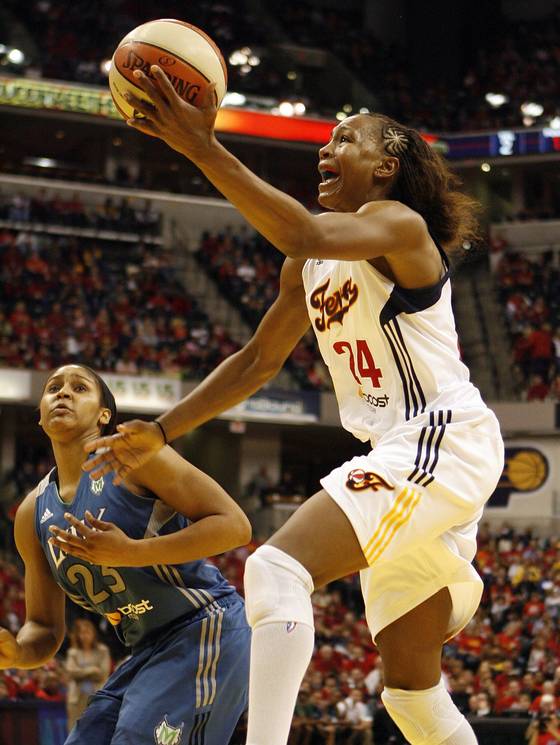
Catchings (35) has enjoyed a highly successful basketball career. Drafted third by the Fever in 2001, the forward has spent her entire WNBA career with Indiana, leading the team to their first championship in 2012. Catchings is a five-time WNBA Defensive Player of the Year, nine-time All Star, the 2012 Finals MVP, and won Rookie of the Year in 2002. At the international stage, she has played an important role for USA, winning the women's basketball Olympics gold medal the last three times (2004, 2008, and 2012) and the women's world championship gold medal twice. Catchings has also played for clubs in Russia, Poland, and Turkey.

In the RF Jr. NBA programme, youth players across Mumbai have learned the game through in-school sessions, clinics, and competitions. The city championship included a 5x5 team competition featuring the top eight boys and girls teams from across the city; a 3x3 team competition featuring more than 450 teams; and the Finals of the Hot Shot individual shooting competition, which saw one boy and one girl crowned the best shooters in the city.

Catchings is now headed to Chennai to host the inauguration of the RF Jr. NBA Championship in that city.

January 22, 2015

WNBA and international superstar Tamika Catchings to visit India for Jr. NBA city championships


One of the most successful WNBA and international basketball players of the past decade, American Tamika Catchings of the Indiana Fever is set to visit India next week to host the inauguration of the Reliance Foundation Jr. NBA city championships in Chennai and Mumbai. Catchings will tip off Chennai's Jr. NBA Championship on February 1st at the Santhome School which will see youth from schools all across the city participate. She will also be at the Dominic Savio School in Andheri East in Mumbai on January 28th.

“It is an honor to travel to India on behalf of the Reliance Foundation and the NBA to help teach basketball to young boys and girls in India,” said Catchings. “It is exciting that the sport I love is taking off in India and I am looking forward to working with these kids.”

Catchings (35) has enjoyed a highly successful basketball career. Drafted third by the Fever in 2001, the forward has spent her entire WNBA career with Indiana, leading the team to their first championship in 2012. Catchings is a five-time WNBA Defensive Player of the Year, nine-time All Star, the 2012 Finals MVP, and won Rookie of the Year in 2002. At the international stage, she has played an important role for USA, winning the women's basketball Olympics gold medal the last three times (2004, 2008, and 2012) and the women's world championship gold medal twice. Catchings has also played for clubs in Russia, Poland, and Turkey.

Catchings will be the third big name WNBA player to visit India over the last four years, following 2x champion Katie Smith in 2011 and 3x champion Swin Cash in 2013.

The Reliance Foundation Jr. NBA city Championship marks the culmination of three competitions that have been taking place across the city. There will be a finals of the 5x5 team competition featuring the top eight boys and girls teams from across the city; a 3x3 team competition featuring over 150 teams; and the finals of the Hot Shot individual shooting competition, which will see one boy and girl crowned as the best shooters in the city.

September 13, 2014

Phoenix Mercury sweep Chicago Sky to win 2014 WNBA title


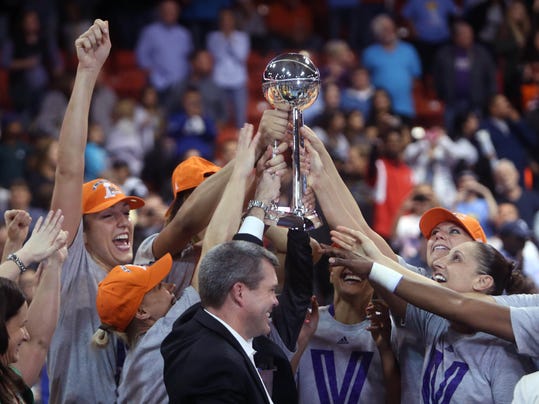
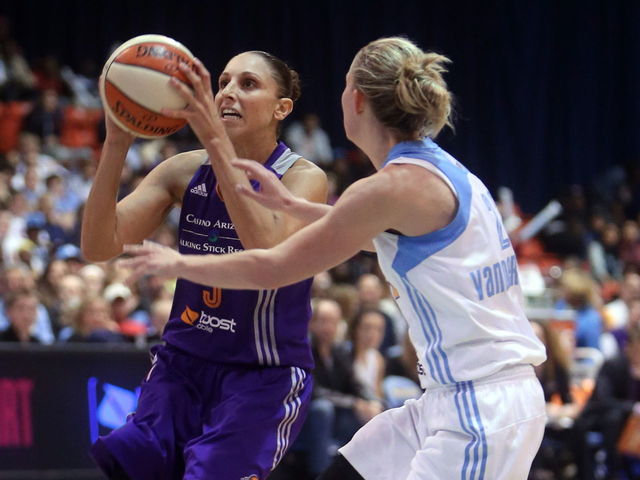
Diana Taurasi - one of the most decorated stars of the WNBA - helped lead the Phoenix Mercury to a 3-0 sweep of the Chicago Sky in the 2014 WNBA Finals, capped with a final 87-82 win in Chicago on September 12 in Game 3. The victory gave the Mercury their third WNBA title (2007, 2009, 2014).

The Mercury were the WNBA's best team all season, led by the All Star trio of Taurasi, Candice Dupree, and sophomore Center Brittney Griner, who was the number one pick in the WNBA draft the season before last. The Mercury finished with a WNBA-best 29-5 record in the season, finishing at first place in the Western Conference. They swept pass the Los Angeles Sparks in the First Round of the playoffs, beat the 2013 champions Minnesota Lynx in the Conference Finals, and handled a tricky Sky squad with relative ease in the Finals.

Despite finishing fourth in the East, the Chicago Sky upset first-place Atlanta Dream in the First Round and then beat the Indiana Fever in the Conference Finals.

Griner's presence helped the Mercury win Game 1 and 2 of the WNBA finals over the Sky by an average of 25 points each. But Griner was ruled out of Game 3 as a result of the eye injury she sustained in Game 2. Taurasi took matters into her own hands, scoring 24 points in the decisive Game 3, and aided by 24 points by Dupree, helped hold off the Sky. Taurasi was named the Finals MVP.

This was Taurasi's third title - all with the Mercury - and her second WNBA Finals MVP award. She added this accolade to her WNBA MVP award, her five scoring titles, seven All Star appearances, three NCAA national championships, three Olympic Gold Medals, and a FIBA World Championship for Women gold.

Minnesota's Maya Moore, who was the leading scorer in the regular season in the league, was the 2014 WNBA regular season MVP.

August 13, 2014

Indian basketball superstar Geethu Anna Jose to receive Arjuna Award this year


Geethu Anna Jose has done it all for Indian Basketball, and then some.

Perhaps the finest basketball player that Indian has produced - of any gender - in recent times, Jose has been the center-piece of India's Women's national squad for the last 10 years. The 29-year-old out of Kottayam, Kerala, has enjoyed a glittering career, which has included performing as one of the leading scorers, shot-blockers, and rebounders in all of Asia at FIBA Asia Women's Championships, leading India to gold medal wins at the Asian Beach Games and the 1st FIBA Asia 3x3 Championship. She finished as the top scorer in the 2009 FIBA Asia Championship and was MVP at the CommonWealth Games basketball tournament in 2004. At the club level, Jose has played professionally in Australia and in Thailand, winning MVP honours with the former when with the Ringwood Hawks. Back home in India, she has been a one-woman wrecking crew, winning almost every tournament she has participated in for her clubs Indian Railways or Southern Railway. As a senior, she led the Indian Railways women's squad to nine consecutive National Championship titles. She also became the first (and only) Indian to earn trials with the WNBA - the world's finest women's basketball league - in 2011 when she worked out with the Chicago Sky, Los Angeles Sparks, and San Antonio Silver Stars.

And now, this 6-foot-2 hoops living legend will finally be conferred the honour that she has deserved for years: Jose's name is among the 15 Indian athletes recommended for this year's Arjuna Award, the prestigious national award handed to sports-persons in India. Jose will become the 17th basketball player in India to receive this award, but only the first since 2001. She will also be only the second women's basketball player to win the Arjuna Award since Suman Sharma in 1991.

Despite her accomplishments, Jose's previous applications for this award had failed, and the Arjuna Award Selection Committee - led by former Indian cricketing legend Kapil Dev - only accepted her on the fifth try. "I'm glad that the government has begun to honour women hoopsters," she told Times of India upon hearing this news.

Named after the mythical hero of the Mahabharata Arjun, [and now quoting from Wikipedia] "the Arjuna Awards are given by the Ministry of Youth Affairs and Sports of the Government of India to recognize outstanding achievement in National sports. Instituted in 1961, the award carries a cash prize of 500,000 rupees, a bronze statuette of Arjuna, and a scroll."

[More from Wikipedia]"The Government has recently revised the scheme for the Arjun Award. As per the revised guidelines, to be eligible for the Award, a sportsperson should not only have had good performance consistently for the previous three years at the international level with excellence for the year for which the Award is recommended, but should also have shown qualities of leadership, sportsmanship and a sense of discipline."

Multiple sports-persons from various avenues are conferred the award every year. This year, the 15 sports-persons who have been recommended by the Selection Committee for the Arjuna Award are Akhilesh Varma (Archery), Tintu Luka (Athletics), HN Girisha (Paralympics), V Diju (Badminton), Geethu Ann Jose (Basketball), Jai Bhagwan (Boxing), R Ashwin (Cricket), Anirban Lahiri (Golf), Mamta Pujari (Kabaddi), Saji Thomas (Rowing), Heena Sidhu (Shooting), Anaka Alankamany (Squash), Tom Joseph (Volleyball), Renubala Chanu (Weightlifting) and Sunil Rana (Wrestling). The awards will be handed out on August 29 in New Delhi.

Surprisingly, no athlete was recommended for the coveted Rajiv Gandhi Khel Ratna award this year, which is India's highest honour for achievement in sports and given to the absolute top achievers. No Indian basketball player has yet won this award.

On a side-note, it seems like legendary Indian basketball coach Sankaran Subramanian was once again ignored from the short-list of recipients of this year's Dronacharya Award, the parallel award given for excellence in sports coaching in India. No basketball coach has ever been conferred this award, but for his tremendous achievements over multiple decades, Dr. Subramanian - who passed away last year - should receive this award posthumously.

Congratulations to Jose for her well-deserved achievement. She has been head and shoulders above any basketball player in the nation for years and is one of the few players we've ever had in our history that could stand among the best players in the continent. At 29 and recently married, Jose peak years might be the near rear-view mirror and she seems to be enjoying a period of semi-retirement. Still, hoop fans in India will hope that she will have a few more strong years on the court ahead of her.

For now, we hope that this honour brings more attention to the national mainstream audience of Jose's past accomplishments in the game. Furthermore, her conferment of the Arjuna Award can also shine the spotlight on Indian basketball and women's basketball in particular. She can continue to serve as a great role model for more young Indians hoping to follow in her footsteps. Despite her accomplishments, Jose never managed to lead India deep into the biggest FIBA Asia Championship or realize her WNBA dreams. But she went further than anyone else, and as a winner of the Arjuna Award, she can help show the way to the new generation of young ballers the way to realizing those dreams, too.

June 14, 2014

She’s Got Game: Women’s Basketball stands toe to toe with Men in India


This article was first published in my column on Ekalavyas on June 3, 2014. You can find the original post here.

Photo courtesy: Ekalavyas.com

As always, the women’s final was held first, a little bit earlier in the evening, before the prime-time crowds were expected to show up. Only a few of the other players, close friends, and some of the organizing officials sat through most of the game; looking around the arena, there were far more empty seats than occupied ones. As the game ended, anticipation arose for the men’s final which was to follow right after. Crowds doubled, tripled, and quadrupled. A calm arena had been turned into an energetic spectacle.

The scenes above don’t describe any one tournament – they are a glimpse of the sights and sounds at most sporting events. Throughout the sporting sphere in the country – and abroad, too – women who excel in popular sports like cricket, football, hockey, etc. are usually greeted with scarce attention from their Federations and scarcer crowds at their field of play.

Fortunately, for basketball in India, this is usually not the case. From the top level – where India’s best female players and national teams usually perform better than their male counterparts – to the grassroots – where young girls get an equal opportunity to shine as the boys – India’s women stand toe to toe with the men in the game.

For most of India – as it is in several other parts of the world – gender equality is still a work in progress. India still has a highly skewed child sex ratio (under age six) of 919 girls per 1000 boys. India stands 132nd out of 148 countries on the UNDP Gender Inequality Index. And women in several parts of India are at a disadvantage, facing limited access to resources, education, and are victims of gender-based violence. India has long been a patriarchal society where culture and custom has given social authority to men over women for thousands of years.

Perhaps it is because of these inequalities that, when given an opportunity, the discriminated gender has set out with a fire in their belly to prove a point and perform at a high level. For several years now, India’s women’s national basketball team has ranked much higher in the FIBA rankings than the men. While the men’s teams have struggled to break through to the top eight of recent Asian tournaments, India finished at an All Time best fifth place in the FIBA Asia Championship for Women last year. While basketball fans in India and abroad have been desperately searching for India’s answer to Yao Ming – the first of our nation to make it to the NBA – the closest Indian in the big leagues has actually been a woman: Geethu Anna Jose. Jose has played professionally in Australia and Thailand and came close to securing a spot in a WNBA roster a few years ago. Among Indian basketball fans, the names of female players like Jose, Varanasi’s “Singh Sisters”, Anitha Paul Durai, the successful girls from Chhattisgarh, and the youth brigade out in Kerala are as popular as the best-known male players.

Credit must be given to the Basketball Federation of India (BFI) as well as the various State Federations in the country who have managed to keep men and women’s basketball at relatively equal footing even though many have suffered from overall inefficiencies in other areas. A few years ago, the BFI’s late CEO Harish Sharma mentioned that as the BFI works to take the game of basketball to the next level, they would also maintain gender equality. “We will focus equally on men and women,” he had said, “Basketball is a gender-friendly sport!”

Indeed, it is. Or, it almost is. Despite having equal standing in almost every way (close to the same number of male and female teams participate in Indian national tournaments annually), the women still receive a smaller participating or medal-winning fee than the men.

In his excellent review of Indian Basketball for Fountain Ink magazine earlier this year, Ekalavyas’ own Gopalakrishnan R. reported that, while men in India receive employment on the sports quota in various government services, public telecom, banks, police departments, railways, and more, the women really have nowhere to go but the Railways.

“So when the Indian Railway boasts of a virtually unbeaten run in the last 20 years at the Senior National Championship,” wrote Gopalakrishnan, “It is simply because it is one of the few establishments that hires women!”

That ‘virtually unbeaten’ run by the Indian Railways women was finally stalled this year by Chhattisgarh, the rising stars of India’s women’s basketball, who won the Senior Nationals Women’s gold and ended Railways’ decade-long hold of the title.

Sometimes, an unlikely basketball success story can be traced back to the efforts of one individual. For Chhattisgarh, that individual has been Rajesh Patel, the coach of all of Chhattisgarh’s female teams of the sub-junior, youth, junior, and senior levels. Patel recruits talented players with potential at a young age from tribal and other disadvantaged economic conditions to the Bhilai Steel Plant in Chhattisgarh and then helps them reach that potential. Since the Chhattisgarh state was formed in 2000, Patel’s vision has come to reality, with the women winning gold at every level, and several of his protégés making their way to India’s National squad.

Kerala, Maharashtra, Delhi, and Tamil Nadu are also among the leaders of promoting women’s basketball on equal footing with the men. All these states – and several others who also have similar, successful models – have done a fine job of organizing tournaments with equal participation for both genders, a practice that has gone on to help produce top players from these states for the national squad. But once again, going back to Gopalakrishnan’s article mentioned above, opportunities for many women at the senior domestic level are few and far between.

At the international stage, India’s women have indeed been given the same opportunity to succeed as the men have. For the last few years, whenever a capable foreign coach has been hired for India’s national men’s teams (Bill Harris, Kenny Natt, Scott Flemming), the same has been done for the women (Tamika Raymond, Pete Gaudet, Francisco Garcia). Led by talents like Jose, the Sr women’s team finds themselves at 40th in the FIBA rankings (Men are currently 61st) and the Girls (U16) team are at 37th (Boys are 48th). India is now at fifth place among Women in Asia, behind only the unstoppable ‘big four’ of China, Chinese Taipei, Korea, and Japan. India’s women have been successful at FIBA Asia 3×3 competitions, too. While India’s male players have barely registered a blimp against the competition in Asia, Jose has been able to finish as Asia’s top scorer or be a part of All Tournament teams in recent FIBA Asia Championships.

India’s women do have a major advantage over the men when it comes to Asian tournaments: they have less competition. Higher-ranked nations in the men’s division like Iran, Jordan, and Qatar don’t field women’s basketball teams at all. India’s men have to play against tougher and larger number of opponents, and thus, struggle to emulate the success of the women.

Additionally, worldwide, women’s basketball is generally a lot more balanced than the counterparts in men. With the women’s game focusing on fundamentals and tactics a little more than athletic or physical ability, India’s women theoretically have had the chance to match closer to powerhouses around the world than the men do. While most Federations around the world have generally focused their attention on the men’s national sides, India’s efforts of keeping basketball ‘gender-friendly’ have helped the women stay competitive, participate in as many international tournaments as the men do, and receive the same level of coaching and physiotherapy.

At pretty much every level of the game, men’s basketball gets more attention and hype than the women. The NBA is more popular than the WNBA, FIBA’s Men’s Championships garner bigger crowds than FIBA women’s, and male players make more money and are given better sponsorships than their women counterparts. Considering this global gender imbalance, it isn’t shocking that the attention of fans and organizers in India is to find India’s Yao Ming or Wang Zhi Zhi and have an Indian player make it to the NBA.

But, it may well be more likely that the first Indian to make it to basketball’s biggest league will be a woman, and that big league will be the WNBA, rather than the NBA. Jose came agonizingly close when she earned tryouts with the Chicago Sky, Los Angeles Sparks, and San Antonio Silver Stars three years ago. If her successors are given the right opportunity, they could take one step further. Last month, India’s Women’s coach Francisco Garcia mentioned that young players like Kavita Akula, Poojamol KS, and Jeena PS all have the talent to play in professional leagues abroad. If, at an earlier age, India’s young stars are given the right guidance, training, and opportunity, we might finally find a talent to break through to the highest level of the game.

Let’s be real: Basketball is too minor an issue to solve India’s gender inequalities. But a basketball success story could add to the growing list of talented sportswomen in India, and become yet another small step away from the generations of patriarchy in the nation.

December 18, 2013

WNBA superstar Swin Cash is in India


Swin Cash of the Chicago Sky, who is one of the marquee players of the WNBA over the past decade and a superstar of women's basketball, is in India. Cash, who has won several team and individual accolades through her 11 year WNBA career, will be spending three days in Mumbai while promoting basketball at the grassroots level, especially amongst young girls.

Cash is amongst a very rare number of players to have had success at all three major levels - NCAA, WNBA, and Olympics. She won two NCAA Women's Division 1 Championships with the University of Connecticut in 2000 and 2002. She has won two Olympic gold medals with the US Basketball Team, three WNBA titles with her previous teams (Detroit Shock and Seattle Storm), a FIBA World Championship, and capped it all off with four visits to the WNBA All Star Game.

Cash was drafted by the Shock back in 2002, with whom she played for five years, winning two championships. She joined the Seattle Storm in 2008 and led them to a championship in 2010. In 2012, she was part of a blockbuster trade sending her to the Chicago Sky to play alongside fellow superstar Sylvia Fowles.

According to the Times of India, Cash will be helping to spread grassroots awareness for basketball in India during her visit, which lasts till December 20, 2013. Her presence will also help to support the growth of the Reliance Foundation Jr. NBA programme in the country. On December 18th she also appeared live on Radio 1 in Mumbai.

After an exciting summer that featured Chris Bosh's visit to India, it's refreshing to see a Women's superstar visit the country in a way to support girls' basketball players and provide them with a role model to aspire to as well.

October 11, 2013

Minnesota Lynx win 2013 WNBA Championship with a sweep over Atlanta


After a season that featured a lot of fresh faces and changes around the league, the Finals of the WNBA came down to a rematch from two years ago – between the Minnesota Lynx and the Atlanta Dream – but the result was very much the same: a 3-0 sweep for the Lynx, who captured their second WNBA Championship in three years after a third consecutive Finals appearance.

Two years ago, the star act of the show was Minnesota’s Seimone Augustus; this time around, Augustus took a backseat to 2011 Rookie of the Year and one of the most dangerous women in basketball – Maya Moore – who led Minnesota to victory with a Finals MVP performance. Minnesota had finished with the best record during the regular season for the third consecutive year – ever since Moore joined the league – and became just the second team in WNBA’s 17-year history to go undefeated in the playoffs (after the 2010 Seattle Storm).

Minnesota closed out the final game of the season by winning game three of the Finals against Atlanta 86-77 on October 10th, led by 23 points by Moore. The victory was sweet redemption after the Lynx had lost in last year’s Finals to the Indian Fever.

The 2013 WNBA season began in late May with optimism of the arrival of Brittney Griner, who was drafted by the Phoenix Mercury and touted as a game-changer for Womens’ basketball. Although she had a decent season, Griner struggled with injuries a little. The Mercury were good enough to get the third spot in the West behind the talents of Diana Taurasi and Griner. They were defeated by the Lynx in the Western Conference semi-finals.

In the Eastern Conference Finals, the Dream defeated last year’s champions Indiana Fever 2-0.

Los Angeles Sparks’ Candace Parker was named regular season MVP while Elena Delle Donne of the Chicago Sky won the rookie of the year award.

At the end of the year though, the story was all about Moore and the Lynx, who extended their dominance at the top of the WNBA and stamped their stake as the best women’s club team of this era.

October 22, 2012

Tamika Catchings leads Indiana Fever to 1st ever WNBA Championship

The 2012 WNBA Finals concluded with the Indiana Fever defeating the Minnesota Lynx 3-1 in the best-of-five series to win the WNBA title for the first time in franchise history. The Fever defeated the Lynx 87-78 in the clinching Game 4 to close out the series.

Click here to read full article.

September 8, 2012

Q&A: Geethu Anna Jose returns from Thailand with professional league experience

I got a chance to interview India's basketball superstar Geethu Anna Jose after her stint playing professionally in Thailand: about her experiences playing for the Sripatum University in Bangkok, her hopes of seeing a similar basketball league in India, and her thoughts about the future of her own career. Jose, as always, was completely frank and honest in her answers, providing interesting insight into the world where even India’s greatest women’s basketball player has to face struggles.

Click here to read full feature

October 9, 2011

Minnesota Lynx win the 2011 WNBA Championship


It was the perfect season for the WNBA's Minnesota Lynx, who started the year by getting the first pick in the WNBA draft, and ended it with a sweep of the Atlanta Dream to win their first ever WNBA Championship.

The Lynx sweeped the Dream 3-0 in the WNBA Finals - they celebrated the championship with a 73-67 Game 3 victory on Friday, October 7th. Finals MVP Seimone Augustus scored 16 points in the finale. The Lynx' first pick in the draft, Maya Moore, also contributed heavily to the championship. Moore was named the Rookie of the Year.

With Moore bolstering their lineup, The Lynx were the best team in the WNBA all season, ending the year with a league-best 27-7 record and finishing at the top of the Western Conference. Lynx went 7-1 in their three playoff series' to hoist the championship.


The 2011 WNBA season, the 15th season in league history, lasted four months, from June 3rd - October 7th. Tamika Catchings of the Indiana Fever won the league MVP award, but she couldn't get her team past the Atlanta Dream in the Eastern Conference Finals. The Lynx beat the Phoenix Mercury in the Western Conference Finals.

June 27, 2011

Zak Penwell: Indian Basketball’s New Workout Plan


Nothing fills a need better than what is exactly needed to fill that need. A perfect fit to an incomplete jigsaw puzzle.

Let me explain: What is the most common criticism against the performance of the basketball players in India? If you asked me, the answer woyld be fitness and athletic ability. For too long, our stars have been one step behind our athletically-charged opponents, and for too long, have Indians worldwide heard that they weren’t ‘athletic enough’ for basketball. Not explosive enough. Too Weak. Too Slow. Too Tired.

During the Asian Games basketball tournament last November, a well-coordinated Indian Men’s team showed flashes of brilliance under Coach Bill Harris, but were never fit enough to keep up their concentration for the entire duration of their games. Most recently, India’s finest women’s player Geethu Anna Jose, the only Indian to be offered trials with the WNBA, was overwhelmed by the strength of the American players she went against at the trials.

Player strength and conditioning was the great missing piece of Indian basketball’s jigsaw puzzle: it isn’t true that Indian basketball players aren’t athletic enough; we just haven’t been given the right guidance to develop our bodies to its complete potential.

Enter the missing piece: A month ago, American Zak Penwell was hired by the Basketball Federation of India (BFI) as its first-ever Strength & Conditioning (S&C) Coach. Penwell comes to India after combining a world of athletic-conditioning education and experience. He was brought alongside other American coaches Kenny Natt and Pete Gaudet, who will be working with the Indian Men’s and Women’s teams respectively as head coaches. Penwell, meanwhile, will focus on S&C for both teams, as well as the players on the junior national programmes.

“A sport like basketball has certain demands that every high-level coach will make,” said Penwell on the importance of his role with the Indian National sides, “They need to be good athletes, jump higher, hold their position, run faster, handle fatigue, concentrate and be sharper… My job is to give the players all the tools they need to perform at their best.”

Penwell believes that his role is more than that of just a fitness trainer – he prides on being a coach, instead, reaching out to players to increase not only their physical abilities but also to toughen them up mentally for their challenges. “At the highest level, the players need to focus on their skill and their tasks in in-game situations. If a ball-handler believes that he or she can dribble past an opponent, their legs shouldn’t betray him. A player should focus on their skills and tactics and not be held back by physical limitations.”

As the BFI’s Strength & Conditioning Coach, Zak Penwell will be responsible for developing and implementing specialized nutritional, strength training, and conditioning programs for all Indian national men’s and women’s teams. He will also advise Indian coaches throughout the BFI system to enhance and nurture the development of top basketball talent throughout the country.

Penwell comes most recently from Scotland’s Sportscotland Institute of Sport, where he worked with athletes from a range of national teams including swimming, basketball, sprint canoe, judo, rugby, golf, curling, triathlon, and field hockey. Since 2006 he has spent over 40,000 athlete contact hours in the weight room, with over 550 elite collegiate and international-level athletes. Penwell is a graduate of the U.S. men’s and women’s college basketball power the University of Connecticut, where he earned two degrees from the top Kinesiology program in America.

Bottom line: the BFI couldn’t have chosen a better fit for its needs in India. Penwell feels that the ‘perfect fit’ was mutual. “There is amazing potential for the game here, but little in the field of Strength and Conditioning,” Penwell said, “That is why it’s an exciting opportunity to start with a fresh slate, do the things the right way, and watch the right system flourish. My strengths fit perfectly with Indian Basketball’s needs.”

“I’m here to impart a championship mindset.”

Although Penwell has experience in assisting almost 20 different sports, he is in India for basketball and basketball alone. “Everything I train the players for in the gym or on the court will have a direct, practical application during game-time,” he said, “They should know how each exercise will translate directly to basketball.”

In his first few weeks working at the camp in Delhi for the Indian Senior and Youth National Basketball teams, Penwell has learnt the needs of the players and his approach to working individually with several of the men and women here. “The first goal for us here is that the players need to get stronger,” Penwell says, “Along with strength training, we will work on improving their agility and getting the basics right.”

Being strong and fit enough to avoid injury also plays a crucial role in success in basketball – no team likes to play the biggest competitions with its best players are on the bench nursing an injury. Injury Prevention will become a major part of Penwell’s focus.

Of all of the criticisms that might befall Indian players, here’s one that we can do little about: height. But Penwell has a plan of countering height by increasing conditioning in other areas, such as jumping ability (or ‘jumpability’, as he calls it), positioning, and being fitter to simply ‘outwork’ opponents on the court. “Our players have to have the stamina to keep performing even when their tired. It’s about Total Recovery – recovering to their full ability in the shortest amount of time.”

“I have no doubt of the player’s potential,” he adds, “All I ask for is a 100 percent effort and attention to detail. The athletes we have can be made into winners.”

During his three-year stint, Penwell hopes not only to improve the strength and conditioning of the basketball players in India, but to also revolutionise the field for all sports in the country. “Once people see the changes we produce in basketball, it can be a good model for other sports in the country,” said Penwell, “It should be a success story that others can follow.”

Already, the players at the National Camp are starting to show understanding and appreciation for Penwell’s work. Both the new coaches of the Indian national team – former NBA head coach Kenny Natt and former Duke/Vanderbilt/OSU coach Pete Gaudet – are seeing a more disciplined approach to player fitness and durability than in the past.

“By the time I’m done here, I hope to see basketball in India achieve things it has never achieved before,” Penwell says.

A perfect fit, indeed – because basketball lovers in India will walk step-by-step with Penwell so that all our dreams can be achieved.