In a pandemic-afflicted world without sport (or any outdoor activity), there is nothing that we needed more than 'The Last Dance' the documentary on Michael Jordan and the Chicago Bulls. In Episode 91 of Hoopdarshan, the biggest desi MJ fan on earth - Krossover founder/CEO Vasu Kulkarni - joins Kaushik Lakshman and Karan Madhok to discuss his early reactions to the documentary, his memories of becoming an MJ fan, the numerous times he met Michael Jordan in person, plus bonus stories of the Warriors dynasty and David Stern's favourite emoji.
Kulkarni is the Founder/CEO of video analysis service Krossover and a venture capitalist with Courtside Ventures. Raised in Bangalore, he can usually be found hooping in New York City on courtside at Warriors' games.
Hoopdarshan is the truest voice of Indian basketball, and since we're such hopeless fans of the game, it will become the voice of everything basketball related we love, from the NBA to international hoops, too. On every episode of Hoopdarshan, we will be inviting a special guest to interview or chat to about a variety of topics. With expert insight from some of the brightest and most-involved people in the world of Indian basketball, we hope to bring this conversation to a many more interested fans, players, and followers of the game.
Joining hosts Kaushik Lakshman and Karan Madhok in Episode 89 of Hoopdarshan is the great Micah Adams, the NBA Global Managing Editor for DAZN and co-host of NBA Soundsystem. One of the most astute minds working in the game today, Adams discussed his on/off court experiences from the All Star Weekend in Chicago, the ELAM Ending, Stats vs. Eye-Test, Kobe, his Mumbai trip for the NBA India Games, the Rockets, 76ers, and more.
In Episode 89, Kaushik and Karan discuss some of the latest news in Indian basketball too, including the first window of the 2021 FIBA Asia Cup Qualifiers, Indian youngsters at the BWB Global Camp, and the Wizards becoming the latest to bid to become 'India's team'.
Hoopdarshan is the truest voice of Indian basketball, and since we're such hopeless fans of the game, it will become the voice of everything basketball related we love, from the NBA to international hoops, too. On every episode of Hoopdarshan, we will be inviting a special guest to interview or chat to about a variety of topics. With expert insight from some of the brightest and most-involved people in the world of Indian basketball, we hope to bring this conversation to a many more interested fans, players, and followers of the game.
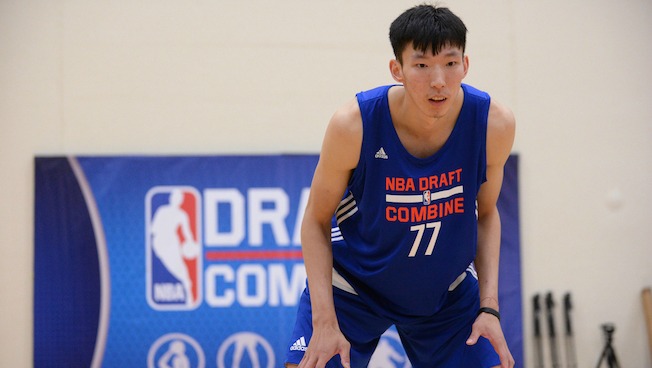
When Yao Ming announced his retirement in 2011, he left a 7-foot-plus hole in the hearts of the world’s most-populous nation. But months before Yao’s career officially ended, China already got a promise of the future. Proudly wearing China’s colours at the little know Turk Telecom youth tournament in Turkey, 15-year-old Zhou Qi helped his country to an unlikely gold medal, putting up 41 points, 28 rebounds, and 15 blocks in the semi-final against Germany and providing a game-winning encore with 30-17-8 against the hosts in the Final.
For the next five years, Zhou slowly turned his promise to reality. He made his name in China’s youth circuits, destroyed Asian opponents, and become a young star in the Chinese Basketball Association.
But now, the skinny (listed at 218 lbs), 7-foot-2, 20-year-old from the city of Xinxiang is ready to bulk up into an even larger pair of shoes: after years of success in China, the young man must prove himself all over again in the United States.
“I want teams and fans in the US to know, first and foremost, that I’m a team player,” Zhou says. “I wanna be in an environment where I can help my teammates to be the best they can be.”
“Today’s NBA is asking so much more from a single player. To be more than a single position. The game is much faster. I need to adopt to different styles of play. On offense, I must learn to attack from the outside, be both a perimeter and a post player. On defence, I must learn to guard guards as well as centers.”
Zhou hopes to find long-term success in the league. But even before he ever steps on an NBA court, he’ll know that the weight of Yao be hanging over his slender shoulders.
“I don’t feel any pressure. If I can take the torch from Yao, I hope I can have a good career and pass the torch to someone to else. Right now, I just want to be myself.”
Long before Sim Bhullar became the first person of Indian-descent to play in the NBA and Satnam Singh was the first Indian drafted to the world’s finest basketball league, a bunch of South Asians - Indians, Pakistanis, Sri Lankans, Bangladeshis, Nepalis – in the US and Canada met together in a sweaty gym for pick-up basketball in Chicago. And in Atlanta. And Dallas. And New York. And Vancouver.
They were Hindus, Muslims, Christians, and Sikhs. But more importantly, they were guards, forwards, and centers. They married their uniquely South Asian backgrounds with the thoroughly 'American' pastime of pick-up basketball. They created a world of their own to define themselves as both thoroughly desi as well as a part of the larger American hoop culture. On the court, their differences disappeared. The religions, languages, and ancestral nationalities didn't matter. They all shared a single hoop dream, and they relied on an inflated orange basketball and those sweaty gyms to to achieve that dream.
In his book Desi Hoop Dreams - Pickup Basketball and the making of Asian American Masculinity (New York University Press, 2015), Stanley I. Thangaraj arranges a marriage of his two areas of interest - Anthropology and Basketball - for a deep dive into how South Asian American men - desis - express their masculinity, cultural differences, and identity through basketball. The book is a revealing read that shatters many stereotypes of South Asian immigrants in the US and Canada and takes a scholarly look at how a subsection of the desi population found solace in basketball at both the grassroots level as well as the national stage in Indo-Pak Tournaments.
Thangaraj, an Assistant Professor of Anthropology at the City College of New York, has been intimately involved with the subject matter he now studies for decades. Thangaraj was born in Madurai (Tamil Nadu) in 1974 before his father, a professor of Theology, was recruited to Harvard University in Massachusetts in 1979. Thangraj was raised between India and the US, and the impact of the Bird-McHale-Parish era of the Boston Celtics left a major impact on him. A desi hoop dreamer was born. He played basketball in High School and discovered the Desi-American hoop circuit in college. He took part in Indo-Park Networks (IPN) around the country, specifically in Atlanta where he spent over 20 years, and in Chicago which has hosted IPN National tournaments since the '80s. Between 2006 and 2010, Thangaraj decided to focus his anthropological research on South Asian basketball culture in Atlanta, Chicago, and beyond, the observations and conclusions of which eventually led him to pen Desi Hoop Dreams.
South Asians have a long and proud history in the US, with many immigrants coming from India, Pakistan, etc. finding their niche fields of medicine, science, finance, engineering, and computing. But in Desi Hoop Dreams, we meet a subset of desis who refuse to be limited to the stereotypes - positive or negative - of the Indian 'model minority' in the USA. While their parents generally earned their respect through their intellectual superiority, here we meet a new generation of desis who want to prove themselves as physically imposing, too. Phrases like "man up" and "be a beast!" aren't just encouraging hollers during a basketball game; they are mantras to prove one's athletic strength and superiority both on and off the court.
Thangaraj balanced playing and researching in both casual and serious pick-up games, and the result is a fascinating insider look the complicated world of South Asian American basketball. His wide net of pick-up basketball characters reveal the complex inner relationships and pressures that come with being a South Asian athlete at a pick-up game. We meet South Asians originating from dozens of countries, including those from Africa, the West Indies, and Europe. We follow Muslim Americans to basketball courts in Masjids and discover the changing attitude of identity politics before and after 9/11. The author discusses how basketball eventually defines the culture of many of these players outside the court too, in social settings such as night-clubs.
The book also doesn't pull any punches from the dark side of what Thangaraj calls are the 'Brown Out' basketball communities. The communities he follows and studies often present moral contradictions in their cultural and gender understanding of identity. The book takes a sharp look at how the 'Brown Out' group immerses or excludes itself from other races in North America, women, and homosexuality.
The height of desi basketball culture collides together at the IPN in Chicago, which features some of the best South Asian basketball players and teams from US/Canada. Thangaraj witnesses how basketball helps in uniting desis on the court, and why the game addresses the complexities of masculinity among a diaspora of desis who are challenging racial stereotypes on the court.
I got an opportunity to briefly interview Stanley Thangaraj about Desi Hoop Dreams this week.
Hoopistani: What initially motivated you to work on this project?
Thangaraj: I came to Atlanta in 1988 and as an immigrant kid, and I was one of the only South Asians in my school. I didn't fit in, but I found basketball. The game was, racially, black or white for me until I got into college, and it was then that some friends invited me to the Indo-Pak Tournament (IPN).
I loved IPN basketball and I was offered to study it as an athlete in a PhD programme at the University of Illinois. I was so excited. I could spend all my time now just balling, although being a researcher does limit some of the things you could enjoy.
I wanted to highlight the complex, complicated lives of South Asian Americans. I wanted to present their lives and their dreams as a way to move beyond the simple portrayals of them as "nerds" or "terrorists" in USA media. I wanted to represent them on their own terms and showcase their lives on their terms.
Hoopistani: Having played in white/black basketball circuits and exclusively desi ones, how would you say that the format or style of the game is different among Desi-Americans?
Stanley Thagaraj. Photo by: Tau Battice
Thangaraj: If you look at spectrum of players in desi communities, you would say no, there is no difference. Only difference is that ethnically exclusively spaces have a lower level of play, because many of these young men haven't gone through organized basketball. These young men bring those histories with them. They know what it means to be stereotyped and marginalized. They bring that burden and baggage. When they ball, its a chance to ball on their own terms.
But you have a lot of guys who make it to the IPN tournament who have incredible talent and have played at the High School or Collegiate level in the States. They can compete in any sporting space in the US.
Hoopistani: Why would you say basketball, specifically more than other sports or activities, is able to play such a major role in some desi men to define their masculinity?
Thangaraj: Most of these young men did not choose basketball as their first sport. A lot of them were playing soccer, baseball, American Football. But basketball became unavoidable. In 1984, Michael Jordan entered NBA. By the late 80s, he became the most visible symbol of what it means to be cool and be a man. By the '92 Olympics, the 'Jordan' brand took over the world. Basketball became the most dominant way of what it means to be an urban man. Most of these young men grew up in the cities, and to them, to stake a claim as an 'urban citizen' meant playing basketball.
Plus, basketball is the most accessible sport. You can assemble a basketball hoop in no time and you can play anywhere. You can't do that with baseball and American Football.
Hoopistani: The book goes into great detail about the differences among desis themselves: North Indians, South Indians, Hindus, Muslims, Christians, Pakistanis, Sri Lankans, etc. Back home, these differences are a major factor of division between these communities. Were you able to see basketball become a uniting factor for these different communities in the USA?
Thangaraj: Yes and No. Basketball is a uniting force in the way that, very rarely, do you have a space where people of so many South Asian backgrounds share the space. We had South Asians from West Indies, Kenya, UK, India. Basketball brings together these communities that may not meet in any other space. It allows us to think that the Indian and Pakistani conflict doesn't translate here to the US.
When you are an incredible basketball player and are down with hanging out with ethnic or religious others, you get to play. For example, the Hindu and Muslim players of two teams - Maryland Five Pillars and Maryland Cobras - came together to form one strong team. The Chicago Domeinators became a team of Muslims and Sikhs together. Sports opened up doors for interpersonal interaction. If you can ball you can open any door you want.
One difference is the newly-arriving immigrant, whom they call the 'fob', who I've seen that the players have been reluctant to share their space with. It is ironic that the same players who have been minorities then turn around and create limits to sharing spaces across different generations of immigrants to the US.
Hoopistani: What are your thoughts on Indian basketball? India's most popular sport is cricket, which isn't exactly the most physical of sports unlike basketball, which you described in great depths in your book as a physical, tough sport that men believe can define their masculinity.
Thangaraj: Playing cricket is not seen as masculine in the US, but it is grounded in masculine identity in India and Pakistan. There is so much energy and growth in the conflict and rivalries in the sport there. In South Asia, it represents the 'best of men', but not here.
However, With increased immigration of desis here, cricket is rising. ESPN sometimes shows cricket in the USA because it is another opportunity for them. Now there is an affluent group of South Asians in the USA with potential to bring in more capital. This is a strategic move to open up the market for new consumers.
Basketball in India certainly as a lot of potential, even though there is some corruption and problems with infrastructure and coaching. The NBA is spending a lot of money in developing the game there. I witnessed the improvement in the talent level first-hand playing ball in South India several years ago. Athletically, India has the potential, no doubt. Players like Satnam Singh and youngster Prince Pal Singh have emerged out of Punjab in recent years. There 1.3 billion people, so, there will definitely be some great basketball talent.
It’s 1998, and there are only two types of basketball fans in India. Those who know everything about Michael Jordan. And those who know everything about Shah Rukh Khan.
It’s 1998. Michael Jordan, the greatest player of his time – and as history would remember it, the greatest player of all time – had just hit his ‘final’ shot to win a dramatic NBA title over the Utah Jazz in the summer (Two years later, he would return to pro basketball in a Wizards uniform). It would be title number six for MJ, and for basketball fans in India, the image of Jordan hitting the game-winning shot would leave an indelible imprint forever.
It’s 1998. Shah Rukh Khan, the biggest Bollywood star of his time – and as history would remember it, the biggest Bollywood star of all time – would star in the super-hit film Kuch Kuch Hota Hai, the first introduction of basketball to a mainstream Indian audience. To Bollywood fans in India, the image of SRK awkwardly dribbling against his eternal screen love-interest Kajol would leave an indelible imprint forever.
*
Kuch Kuch Hota Hai didn’t take place in India. Sure, we’re told that the two major settings of the film – the High School and the summer camp – are Indian, but nothing about them, except the language and the occasional sari, was truly desi. Instead, the film finds itself in a parallel perfect world created by first-time director Karan Johar, a world where East and West collided, where Rani Mukerji knew her shlokas as well as she knew her rock-n-roll. Where High School looked like a scene from the Archie Comics. Where there was no serious crime or poverty or politics. Where the most pressing issues to humanity were love triangles.
Where basketball – not cricket – was India’s favourite sport.
There is an adage among hoop analysts that the ‘NBA is a copycat league’, that a winning system shapes the next generation of teams around the league. This is why big men were all the rage for the Celtics, Rockets, and Pistons in the 80s, the hunt for athletic shooting guards began following Jordan’s dominance in the 90s, and small-ball became the blueprint for teams when the Golden State Warriors perfected the model.
Success breeds imitation, and the adage is no different in Bollywood. So, as he was coming off of a role as Aditya Chopra’s assistant director in the 1995 Bollywood classic Dilwale Dulhania Le Jayenge, 26-year-old Johar decided to adopt the formula of DDLG into his directorial debut. Also featuring the Shah Rukh and Kajol combo, DDLG became one of India’s most successful and its longest-running film. During the montage of the hit song ‘Mere Khwabon Mein Jo Aaye’, Khan gave a brief glimpse of his on-screen basketball “skills”, as he awkwardly dribbles and dunks in the rain.
How to make the perfect Indian romantic comedy? A pairing of India’s hottest on-screen couple, Khan and Kajol? Check. Exotic foreign locations and expensive international brands? Check. An unstoppable soundtrack with cross-generational hits? Check. Love triangles? We got two of them. The ‘coolness’ of the West in a clash with Indian sanskriti? All day. More basketball? Hell yes!
The roles of the main cast of characters in KKHH seemed well-defined. A traditionally ‘hot’ girl, a ‘tomboy’ girl, and the loveable guy in the middle. Kajol, the typecast ‘tomboy’, was dressed in the early posters of the film cradling a basketball with her hat on backwards. Here – Johar seemed to be saying – is a girl who does ‘cool’ the way those in the West seem to do it.
Johar put together this recipe and created and perfect Indian blockbuster for its time. Upon its release, KKHH was the most successful Indian film of 1998 and one of the highest- Bollywood films ever. It ran in Indian cinemas for 52 consecutive weeks. Overseas, it grossed more than any other Indian film had ever had until that point. It dominated the Indian Filmfare Awards in Jordanesque fashion, winning Best Film, Best Director (Johar) Best Actor (Khan), Best Actress (Kajol), Best Supporting Actor (Salman Khan, in an important cameo), and Best Supporting Actress (Mukerji).
KKHH caught Shah Rukh Khan and Kajol in the primes of their careers as they went on to remarkable fame in the Hindi film industry. Khan, in particular, developed to become the most bankable and popular Bollywood actor worldwide. After directing the hit debut, Johar made some of the most popular and lucrative films in contemporary Bollywood history, including Kabhi Khushi Kabhi Gham, Kahbi Alvida Naa Kehna, and My Name is Khan.
The legacy of KKHH is cemented forever for Indian audiences. But beyond the romance, the comedy, the hit songs, and the fashion trends it set, KKHH also brought basketball into the mainstream Indian consciousness. The basketball scenes from the movie introduced novices to the sport, while fans and players felt validated that their niche sport had briefly become a national sensation.
*
KKHH’s used basketball as a major plot device, unlike any Bollywood film before. Anjali (Kajol) and Rahul (Khan) are best friends who bond over basketball. Johar’s hoop-romance even pre-dated the 2000 Hollywood film Love and Basketball. However, while Kajol and Khan covered the flirtatious ‘love’ part well, there wasn’t much attention paid to the duo actually learning any real ‘basketball’ skills.
Never mind that. Early in the movie, we see Anjali and Rahul play in a full-court one-on-one game in a closed gym at their school (Khan was in his early 30s while playing a High Schooler, because Bollywood said so) that soon becomes extremely testy. Rahul, who always gets dominated by his platonic friend Anjali, resorts to cheat and foul to gain advantage. Anjali clearly wins this matchup and holds both a physical and a mental advantage over Rahul. Khan’s super-high, slow, one-handed dribble would go on to haunt Allen Iverson forever.
The scene also establishes questions over gender roles, which develop as a parallel story-line through the course of the film. Anjali is accused of crying like a girl, and then complains that she doesn’t want to be called a girl anymore. She is the third wheel in the romance between Rahul and Tina (Mukerji), but later in the film, when she makes her transformation to a more traditionally ‘feminine’ woman, Rahul is both attracted to her new avatar while simultaneously missing his tomboy, basketball-loving old friend.
Divya Singh, former captain of India’s women’s team and now a junior international coach, recalls how the basketball scenes and, specifically, Anjali’s character, reminded her own youth, when she was that rebellious athlete in Varanasi’s conservative society fighting to play a ‘boy’s game’.
“I remember it clearly,” Singh told me. “Kuch Kuch Hota Hai was the third movie I had ever seen. I was a junior player for Uttar Pradesh back then and all the senior players used to say that me and Trideep Rai (Varanasi-bred former India Men’s basketball captain) used to play and fight like Anjali and Rahul! Some of those fights even got really serious, and people in Varanasi used to joke that it was our story!”
“I truly loved that movie when it came out!” she added. “I could really relate to it, because I was a tomboy like Anjali. But I also used to laugh at the way Shah Rukh and Kajol played – they should’ve at least learnt how to play basketball for the movie!”
*
But it’s a scene in the second half of the movie that eventually went down in Bollywood Basketball lore. Rahul and Anjali are now ‘grown up’ and estranged. Tina, Rahul’s wife, is dead, but not before passing on a message to her daughter – also named Anjali – to help reunite Rahul with his old friend. The film shifts to the summer camp (‘Camp Sunshine’) setting, where the daughter is finally able to facilitate this reunion (I’m grossly over-simplifying here. Go watch the movie).
Except now, things are different. Anjali isn’t the tomboy anymore: she has exchanged her athletic gear for a ‘feminine’ sari and seems to have given up on her basketball past. Anjali is also now engaged to Aman (Salman Khan). The old friends find it hard to connect again. It’s awkward.
Basketball to the rescue! The daughter is aware of the friendly basketball rivalry between Rahul and Anjali from their past and, through some trickery and reintroduction of gender stereotypes (“girls can’t play basketball?”) she’s able to get Rahul and Anjali to shed their formalities and reprise their long-standing basketball rivalry at an outdoor court.
The one-on-one, full-court game, appropriately titled on YouTube as the ‘Basketball Affair’, is iconic, influential, and hilarious. Rahul keeps on his formal shirt and tie. Anjali plays barefoot in her sari (here are a couple of people taking David Stern’s Dress Code to much greater heights), which, in 2016 would’ve definitely been sponsored by Under Armor. After some flirtatious trash-talk, the game begins.
There is obviously no referee in this game, and Rahul is allowed to commit multiple violations in each possession. Anjali, at the 3:20 mark in the video, steals the ball, but must fix her sari before taking a jump-shot (#IndiaBasketball). Of course, no ‘sexy sari’ moment is complete without potentially-scandalous waist touching, and Rahul obliges, heightening the sexual and competitive tension between the two. Even though it’s a full-court game, both seem to be shooting at the same basket. Frustrated by Rahul’s sneaky improvements (and continued use of gamesmanship tactics to get unfair advantage), Anjali brings him down with a foul that would’ve made Bill Laimbeer proud. The two begin to argue the same way they used to as High Schoolers. Anjali gets flustered. The kids begin to chant that “girls can’t play basketball” (WTF?). Everyone laughs at Anjali.
There have been several great moments in basketball and Bollywood, and I wrote about them in greater detail for my blog six years ago. KKHH wasn’t the first Bollywood movie to incorporate basketball, and it certainly wouldn’t be the last.
“The basketball quotient in KKHH was a novelty at the time,” recalled Jamie Alter, Sports Editor of Times of India Digital and one of India’s premier 90s Bollywood experts. “It has not been paralleled since, with the buffoonery shown in Koi Mil Gaya and Dhoom 2’s (lame) attempt to make basketball in the rain sexy.”
“In 1998, basketball to the mainstream Indian audience was probably limited to Michael Jordan Chicago Bulls versus Utah Jazz and some very rare ONGC v Punjab games on Doordarshan,” he added. “So KKHH went a fair way in putting basketball into at least one segment of the public’s conscience, even if it was hardly authentic. There hasn’t been anything like that replicated with such dedication - though even now, thinking of Shah Rukh and Kajol bobbling along with a basketball makes me chuckle - and no heroine has tucked in the fall of her sari so emphatically as Kajol did during the summer camp face-off.”
In 2003, Hrithik Roshan would star in Koi Mil Gaya, which borrowed inspirations from ET, Forrest Gump, and Space Jam in its basketball sequence. Roshan and his team - the ‘Paandavs’ – receive special powers from an alien called ‘Jadoo’ to dominate their rivals. Please pay special attention to the 7:58 – 8:09 mark in the video, where Roshan completes pretty much the greatest move ever: he intercepts a shot, jumps, does three body flips in mid-air to land his feet on top of the oppositions rim, and then drop the game winner. Incredible.
Three years later, Roshan would be showing off his questionable basketball skills again, this time as super criminal Aryan in the film Dhoom 2. Roshan plays a one-on-one game in the rain with Aishwarya Rai, which also doubles as a metaphor for the international heist lifestyle. It’s in this scene that he drops the immortal line – which currently serves as the opener to my Hoopdarshan podcast: “Yeh international game hai Sunehri. Deemag se khela jata hai, gussey se nahi” (This is an international game, Sunehri. You have to play with your mind, not your anger).
But KKHH, indisputably, had the biggest impact. Vishesh Bhriguvanshi, captain of India’s men’s basketball team, recalled how many of his small town and village acquaintances were introduced to the game of basketball itself because ofthe film alone.
“This was the first time that basketball was shown in a big Indian movie,” Bhriguvanshi told me “It became a ‘cool’ thing because basketball was looked at as a fancy game, and we felt even better because there were two big stars playing our favourite sport. I had many school friends who didn’t know what I did for a living until I said that I play ‘basketball, just like that movie!’”
Divya Singh agrees about the film’s impact, too. “A lot of youngsters started playing basketball after that movie. And they started dressing like Shah Rukh Khan and Kajol, too. It became a style statement.”
*
It may still be a smaller sport relative to cricket, but basketball is a lot more popular in India than it was 16 years ago. India continues to steadily improve at the international level and even pulled off a historic win over China in 2014. The NBA has made major inroads in India, opened up an office in Mumbai, and has set up grassroots programmes the country. An Indian – Satnam Singh – has even been drafted into the NBA. Suffice to say, the Indian mainstream recognizes basketball as more than that vaguely ‘western’ way of Rahul and Anjali to flirt in KKHH.
Yet, the film’s continuing legacy on Bollywood and basketball is undeniable. Amar Acharya, an Indian-American and a well-known NBA blogger and masthead for SLC Dunk, told me continued familiarity with Bollywood helped him share something with other NRIs (non-resident Indians) of his age, and with desis around the world. But the basketball angle in KKHH took it even further.
“Basketball in KKHH codified in my mind the possibility of basketball being a medium infrastructure sport for the middle and upward economic classes of my motherland,” Acharya said, “In a place of cricket, Kabaddi, and field hockey, there was something that could be a step up – a sport for the developing classes who themselves were stepping up in line with greater educational opportunities, and a better life than their parents before them.”
Alter believes that KKHH remains Karan Johar’s defining movie and the one that helped define, much like its predecessor DDLJ, the landscape of modern Hindi film romances. “So did basketball play a role in shaping the images of two of Bollywood’s biggest stars, and undoubtedly the modern era’s most famous on-screen couple? Absolutely.”
*
Even after the iconic summer camp basketball scene, the KKHH basketball love story doesn’t end before one more twist. The game rekindled the Rahul-Anjali friendship, and even laid the groundwork for future romance. But things change when Anjali’s fiancé Aman Mehra – played in a memorable cameo by the other Bollywood superstar in the film Salman Khan – makes a surprise visit to Camp Sunshine on a rainy evening.
Rahul, in his forlorn depression, does what all hoop fans do at moments of stress: he hits the court. Aman sees him practicing, and is terribly impressed by Rahul’s awkward basket followed by uncoordinated bounce ups of the ball. In a weird American accent (Aman is an NRI living in London and that was Salman Khan's “research”) he says, "Wow wow wow, amazing man, too good, just like Michael Jordan, my man, you're too good."
And with that, he brings the basketball premise of KKHH full circle, perfectly marrying Bollywood's 'Badshah' Shah Rukh with the baddest badshah to ever hit the basketball court: Michael Jordan. Everyone, including India’s most famous actor in one of the biggest films of All Time, wanted to be Like Mike.
Fast forward. Tears are shed. One wedding is replaced by another. Cue song.
*
1998 was the summer that Jordan retired, and everyone – from Kobe Bryant and Allen Iverson to LeBron James and Kevin Durant – tried to fill the void. In their own way, Johar, Khan, Kajol, and everyone associated with KKHH tried to fill a void, too. Where Jordan’s Bulls dynasty ended, the Johar and Khan dynasty began, starting with KKHH and continuing through to a whole host of similarly-themed romantic comedies.
Soon enough, directors influenced or opposed to Johar’s formula found success in Bollywood. By 2016, Michael Jordan and Shah Rukh Khan became crying memes and kids wanted to grow up to be Steph Curry.
But KKHH was never forgotten, and its magic was never duplicated. And as a legion of Indian players and fans will attest, the film’s legacy continued to have an unexpected, memorable impact on Indian basketball.
Whenever I play basketball at my favourite court – the ‘Benares Club’ in my hometown Varanasi – my friends feature among them the usual gang of universal pick-up hoops personalities: the slow, lumbering, but effective post-player; the mid-range wizard; the pesky little ball-hawker; the fast-break specialist; the veteran who gives sage advice about passing first and shooting second; the one player only on court to intimidate and collect fouls; the fearless athlete driving into the basket; the indiscriminate chucker.
Now, anyone who has played basketball in India – especially in pick-up games – would’ve noticed how much the game relies on fast-breaks. Too often, one player of the defensive team doesn’t really play defence and instead, waits out on the wings. If a defensive rebound is secured, a teammate pitches the ball forward (Kevin Love / Wes Unseld inspired) to the player who sprints down the length of the court, making a beeline to be positioned right below the opposing basket for an easy layup before the opponents can catch up. This play is risky because it puts extra pressure on defensive possessions, but when it works, the faster/fitter team can pile up points in a hurry.
This ‘technique’ has been used by many in my friends circle, too, but recently, I let my imagination think ahead of itself, and imagine a slightly different, future scenario. In this imaginary scene, there’s a fast-break opportunity, but the player who had sprinted down to the other end of the floor didn’t wait for the ball below the opposing basket. Instead, he took a sharp left turn to the corner of the court to place himself an inch outside the three-point line. Milliseconds later, another teammate on offense turned right to position himself on the other end. The defensive players who made it back in time had to spread in two directions too, leaving the middle wide open. The ball moved around from one corner to a player in the middle to the other corner before it was shot.
Splash!
And just then, we were introduced to another important pick-up personality on the court, a character that hadn’t been valued or trusted too much in our parts in the past because, well, his speciality used to seem too damn unlikely to become a regular weapon in our offense. He was the three-point sniper.
He used to be just the shorter guy who had developed an outside shot as a survival instinct, his way of staying relevant on the court if he didn’t have the size, strength, or athleticism to bang down in the post or the handle to move with the ball and create his own shot. But now, he began to appear everywhere and was emulated by everyone else. The fearless athlete was shooting threes, the mid-range wizard was stepping out, the indiscriminate chucker didn’t need to be told twice, the foul-collector joined into the fun, and even the lumbering post-man got himself some range.
Basketball had changed. Outside had become the new inside. Threes were the new dunks.
And the root cause of this metamorphosis was this little, scrawny guard causing havoc thousands of kilometres away in California.
*
Basketball has a certain set of rules, and to a first-timer, remembering them all can seem tiresome. But the beauty of the game is that most of the rules are quite intuitive, and where basketball truly leaps into greatness is within the gaps between the rules. It is these gaps that bring in the creativity, the style, and the personality to the game. Everyone approaches the game differently, every unstoppable style is countered by a defence to stop it, and that defence evokes a new offensive style, calling the need for a new defence scheme, and so on and so forth. Basketball becomes a chess match, with each manoeuvre further evolving and developing the game.
And it is the NBA – the finest basketball league in the world – that is the forefront of the game’s evolution and its changing styles. Since it is the gold standard of basketball that young players aspire for, aesthetics and tactics adopted by the best players and teams in the NBA eventually trickle down to young players in NCAA Division 1, High School, and grassroots basketball around the world. Soon, it is not just the players, but many coaches and trainers who begin to adopt those tactics in their teaching of the game.
Basketball is a team game, but NBA history has been defined by game-changing individuals who have crashed the party with their own unique style of dominance and nudged a shift in the game’s philosophy over the years. Last month, the 99% Invisible podcast went into great detail in explaining how the game shifted from the biggest men to the smallest ever since its inception. When basketball was grounded in the NBA’s earliest years, players like George Mikan used their size and passing ability to become the best and stand tall over their competitors. Soon, the likes of Bill Russell and Wilt Chamberlain added a breath-taking athletic ability to that size, Kareem Abdul-Jabbar dominated college ball with his size so much that they had to ban dunking for a decade, and big men like Shaquille O’Neal became unstoppable all the way into the 90s because no one could match their combination of size, strength, and skill. Of course, mirroring the NBA, ‘taller’ was considered ‘better’ in basketball in the rest of the world, too. The ball went in to the big men first, who would scope out the defensive schemes and decide the best mode of offense for himself or his teammates.
But slowly, the perimeter player began to take over. It started in earnest with Magic and Bird, and then, the era of the swingman launched the NBA into a new direction with Michael Jordan, Kobe Bryant, and into the 2000s, LeBron James. Instead of playing inside-out, many of these teams centred around talented swingman used these perimeter stars to have the ball in their hands a lot and creating plays for themselves and for others. These players were faster than the big men and had a better ability to create their own shot and beat opponents off the dribble. Since they were smaller, more fans around the world related to these players, and the Jordanesque “Hero Ball” was born.
Which brings us to current day. The three-point shot was introduced in the ABA and later in the NBA in the 70s, and its ascent over the next few decades was slow and steady. But in the last few years, the numbers have skyrocketed. From 2.77 threes per attempted per game in 1980, NBA teams are now attempting nearly 24 threes a game. At the top of this revolution are players like Damian Lillard, James Harden, Klay Thompson, and Paul George.
And the three-point King – in every sense of the word – Stephen Curry.
*
Curry – the reigning MVP who is in line to become the MVP again – is having a season that is shattering NBA history. Apart from leading the league in scoring (30.7 ppg) and an All Time best Player Efficiency Rating (32.99), Curry has made more threes already in a season than anyone in history with over a month left in the season, (he’s number 2 and number 3 on that list), made 300 threes in a season, has broken the streak of most games with at least one three made, and is making over 5.1 threes per game, by far the best rate in NBA history. In a league that has featured Larry Bird, Reggie Miller, Ray Allen, and more, Curry is already the greatest shooter of All Time – and he’s still only 27!
More than the numbers however, are the emotions that Curry has evoked in the basketball world. He has made the three-pointer the sexiest thing in the game. Curry’s range continues to get farther and farther away from the basket. He is making 25 to 30 footers with ease, and that game-winning shot over the Thunder a few weeks ago – his casual confidence to even try that shot and then make it – disoriented the world’s understanding of how even to play defence against someone that skilled. Just like Wilt Chamberlain, Michael Jordan, and Shaquille O’Neal in the past, he has become an offensive problem that will need a creative, evolved defensive solution.
Curry is also the most popular player in the NBA: his jersey sells more than any other and he would’ve been the leading All Star vote-getter had it not been Kobe Bryant’s last season. Many players have been compared to Michael Jordan over the last 15 years, but Curry’s level of night-to-night dominance and the circus that follows his greatness makes him in many ways the closest one (for a short term). The Warriors, gunning for Jordan’s Bulls record of 72 wins in a season, have become the league’s most fascinating traveling bandwagon. Decades from now, we’ll see young players in remote parts of Earth wearing ‘Warriors # 30’ jerseys the way we see ‘Bulls # 23’ today.
Curry isn’t the only one, but he has been the front-runner of the three-point revolution, and the NBA’s smartest analytic minds will tell you that if a good shooter takes (and makes) a high percentage of their threes, it is far more effective than the same shooter making a higher percentage of their twos (and particularly, the less effective long-twos). Even the maths is now telling us that if you can shoot above a certain percentage from behind the arc, then shoot away.
Of course, no revolution comes without its complaints. A few months ago, Curry’s former coach Mark Jackson mentioned that, despite his talents, Curry was ‘hurting the game’. “What I mean by that is that I go into these high school gyms, I watch these kids, and the first thing they do is they run to the 3-point line,” Jackson said, “You are not Steph Curry. Work on the other aspects of the game.”
Curry’s (and others’) penchant for the three-point line seems to have put the mid-range game on life-support, and even many of today’s talented bigger players (DeMarcus Cousins, Anthony Davis, Karl Towns) are moving further and further away from the basket on offense. No wonder Brian Shaw – former Laker player and Nuggets coach – in India last week complained that the Warriors’ success was only due to a lack of good Bigs in today’s game.
Mark Jackson is right in some ways, and wrong in many others. Sure, none of us are Steph Curry, but then again, none of us have been Magic Johnson, Michael Jordan, Shaquille O’Neal, Kevin Garnett, Allen Iverson, or LeBron James either. Those athletic, talent, or size limitations haven’t stopped young players from around the world emulating their favourite stars. Big guys want to flex and bang inside like Shaq, bring some finesse to the game like Garnett, or copy Kareem Abdul-Jabbar’s sky-hook. Wingmen want to dominate from the perimeter through scoring like Jordan or Kobe or by running the floor as All-Round players like Magic or LeBron. The smallest guys on the court relied on their speed like Iverson or Isiah Thomas. These models of excellence seem practically unachievable, but if we’re not going to try and be like the best, why even try?
And now, there’s Steph Curry, who is the Abdul-Jabbar of perimeter players, making a three-pointer look as easy as the big man’s traditional sky-hook. Because of Curry’s size – or lack thereof – he has further democratised basketball, making excellence look like a tangible, achievable goal, even for those without otherworldly genetic blessings.
But, hey, Mark Jackson is right: None of us are actually Steph Curry, who is a once-in-a-generational talent. He is blessed with speed, genius, and puts in more hard-work into perfecting his art than most beings on Earth. He is transforming the game as we speak, in real time, hitting his sixth and seventh three while we’re still tweeting about his third and fourth.
Curry’s exploits are changing the approach to the three-point-line, and thus, the entire approach to attacking and defending in the game of basketball. There will soon come a time among the younger generation of ballers where a three-point shot becomes a bigger weapon even in the arsenal of pick-up games than the humble two-pointer.
*
Out on our court in Varanasi, my imagination is suddenly crashed by reality. Sure, the players on offense are spreading wide instead of running into the basket, but their efforts are coming up short. None of us have close to the speed, release, accuracy, form, and perfection to our shot that Curry has.
Instead of expecting a splash, there is a whole lot more dry clangs off the rim.
The ball is rebounded by the defensive side, who throw it forward for a quick, fast-break possession, too. But this team stays within their limits, and goes for the easiest, most reliable scoring opportunity: a bee-line to the basket and an easy lay-up. Maths always wins, and until we can shoot threes with the accuracy of the NBA’s new greats, the easiest shot in the game is still the best shot in the game!
In early October, Hoopdarshan co-host Karan Madhok traveled to McLeodganj and Dharamshala - hill-stations in the Indian Himalayas home to a vibrant community of Tibetan refugees - with photographer Angad Sodhi to cover a basketball tournament among the refugees. The epic trip turned into a story for the upcoming issue of SLAM Magazine (# 195) encapsulating together sports, politics, and travel. In Episode 23 of Hoopdarshan, host Kaushik Lakshman, Karan and Angad talk about the story behind the story, featuring how basketball bonds the refugee community together, the Tibetans' relationship with China and India, unforgettable characters from McLeodganj, and the quest for the perfect momo.
McLeodganj is home to the 14th Dalai Lama - in exile from Tibet to India since the late 50s - and his Temple. Dharamshala hosts the Tibetan Government-in-Exile. Both towns have thus become hosts to tens of thousands of Tibetan refugees over the past few decades and exist as idyllic worlds of peace, spirituality, and surprisingly, basketball. This episode should be heard as a preview or a companion piece to Karan and Angad's work on SLAM Magazine, the print edition of which will be available in US in early January and worldwide soon after. It will also be published on SLAMOnline.com soon.
Hoopdarshan aims to be the true voice of Indian basketball, and since we're such hopeless fans of the game, it will become the voice of everything basketball related we love, from the NBA to international hoops, too. On every episode of Hoopdarshan, we will be inviting a special guest to interview or chat to about a variety of topics. With expert insight from some of the brightest and most-involved people in the world of Indian basketball, we hope to bring this conversation to a many more interested fans, players, and followers of the game.
Kobe Bryant, one of the greatest, most popular, and most intriuging basketball players of All Time announced his retirement at the end of this NBA season a few days ago, via a poem entitled ‘Dear Basketball’ on The Players Tribune.
#MoreWins is the theme of Episode 16 of Hoopdarshan, the finest podcast on Indian Basketball. Hosts Kaushik Lakshman and Karan Madhok are joined by Bengaluru-raised tech entrepreneur Vasu Kulkarni, who has turned his start-up 'Krossover' into a must-have service for NBA, College, and High-School coaches in North America and beyond. In a candid chat, Kulkarni spoke to us about how growing up and learning hoops in Bengaluru shaped his ambitions, how Krossover is furthering advanced analytics in basketball, and meeting God... er, Michael Jordan.
Born in the USA, raised and honed in Bengaluru, and making his way back Stateside via the University of Pennsylvania, Vasu Kulkarni has turned his passion for basketball into a profession and a business that is, in turn, helping the development of the sport itself. Kulkarni is the founder and CEO of Krossover and can be currently found perfectly balancing the scales between tech entrepreneurship and basketball addiction. You can learn more about him from an interview on Hoopistani last year.
Hoopdarshan aims to be the true voice of Indian basketball, and since we're such hopeless fans of the game, it will become the voice of everything basketball related we love, from the NBA to international hoops, too. On every episode of Hoopdarshan, we will be inviting a special guest to interview or chat to about a variety of topics. With expert insight from some of the brightest and most-involved people in the world of Indian basketball, we hope to bring this conversation to a many more interested fans, players, and followers of the game.
Pau Gasol is one of the many NBA stars to have visited India in recent years. Photo: Karan Madhok
I remember the first time I watched the NBA on TV. It was the mid-90s
and I was more interested in watching Duck Tales on Doordarshan than
‘alternative’ games like basketball on Star Sports. The definition of sport
used to begin and end with cricket. Although I’d heard of names such as Michael
Jordan or Magic Johnson, they hardly meant anything to me.
I remember catching a brief glimpse of a regular season game between the
Utah Jazz and Orlando Magic, featuring stars like Karl Malone and Penny
Hardaway. A few years later, my interest spiked when the Los Angeles Lakers
signed this rookie named Kobe Bryant, who was making every basketball fan
excited for the future. I began to play basketball more often, and thus, I
cared more about the highest level of the game. The names seemed larger than
life: Payton. Iverson. O’Neal. Rodman. Miller. Robinson. Garnett, and more.
I watched the Jazz once more in 1998. This time, they were in the NBA
Finals, and by sheer luck, it happened to be the final game in a Bulls uniform
for a certain Michael Jordan. I saw the steal, the push-off, and the last shot. The seeds of a love
affair had been sowed. A year later, Allan Houston, Latrell Sprewell, Marcus
Camby, and Larry Johnson carried the eighth-seeded New York Knicks to an
improbable Finals’ appearance, and in the process, the team won me over as the
primary object of my affection.
Those who have followed the NBA in India from the early internet or
pre-internet days will attest: it wasn’t the easiest love affair to have. We
were limited to two or three early morning live games a week. We got our hands
on SLAM Magazine occasionally, played NBA Live 99 on our computers, and waited
10 minutes each time on a dial-up network for the old nba.com website to load.
It was all worth it though, because the challenge of access made us
treasure the NBA even more. There were no casual fans: you either cared deeply
about the NBA or you had never heard about it at all. While many of my friends
discussed Sachin and Ganguly or The Undertaker and Kane, I wanted to jump like
Vince Carter and pass like Jason Williams.
Fast forward to the present day, and the smaller, more connected new
world has made life wonderfully easier for the new Indian NBA fan. The internet
has been a boon. Now, even thousands of miles away from Los Angeles or New
York, you can follow your favourite players minute-by-minute updates on social
media like never before. NBA highlights are only just a couple of YouTube
clicks away. The League Pass has made almost any game accessible live through
the course of the season every day. There is no bit of news, rumour, or meme
that escapes the attention of a fan.
TV broadcasts have improved dramatically, too. From the time of two
games a week, Sony SIX and Ten Sports double and tripled that number, and now,
we are at the apex of NBA viewing options in India: Last year, Sony SIX signed
a deal with the NBA to broadcast an NBA doubleheader nearly every day of the
season, showing up to 14 games live
weekly. That schedule is likely to continue again this year, making an NBA
game as essential part of an Indian breakfast as that cup of masala chai or
filter coffee.
Perhaps the biggest step forward over the last half decade is how,
instead of the Indian fan constantly reaching out to find the NBA, it’s the NBA
that has reached back to find the Indian fan. The NBA’s presence in India has
grown steadily over the past six years. Now, the NBA has an India-specific website, an office in Mumbai, and staff dedicated
to further help grow their presence in the country. Over the past six years, dozens of NBA players have visited
India to hold clinics, take part in charity events, and promote the game.
There was a time when finding an old Michael Jordan poster among scraps in a
random stationary shop in Mussoorie was one of the highlights of my year. Those
days are long gone. From social media interactivity to regular, easy access to
all types of NBA related information, jerseys, and other products, nothing is
too out of reach for a fan anymore. The power of the NBA’s most popular teams
and superstars have made names of places like San Antonio, Oklahoma City, and
Cleveland seem almost as familiar as Ranchi, Aurangabad, or Coimbatore. The NBA
has taught me – and many other fans – more about North American geography than
any school-teachers ever could have.
Once known only among small niche circles, basketball has become one of
the fastest-growing sports in India. Viewership of live NBA games – according
to NBA India Managing Director Yannick Colaco – went up by over 200 percent last
year. NBA India has close to half a million fans in India on Facebook.
Everything – from jersey and merchandise sales to celebrity endorsements – is on the upswing
in India.
The new Indian NBA fan lives in a world where an Indian (Vivek Ranadive)
owns an NBA team (Sacramento Kings). That owner has plans to bring the NBA’s
Commissioner for a trip to India next month and is looking
forward to hosting India’s first-ever NBA exhibition
game.
When I asked Ranadive a few weeks ago about why he felt
that India can be a special destination for the NBA and basketball, he replied,
“I
think that basketball is destined to be the premier sport of the 21st century.
It’s a game that can be played by boys, by girls, indoors, outdoors, by one
person, a few people, in cities, in villages, in rich countries, poor
countries. It doesn’t require a lot of space. I don’t expect it to surpass
cricket as the national pastime [in India], but I think it can be a strong number
two... I think basketball is perfect for the Indian situation…”
It
is in this exciting new environment that the new NBA season begins over the
pond in North America. Just like it has been over the last few years, I’m
excepting another transformative season for NBA fans in India, where the
numbers of online followers, TV watchers, merchandise customers, and most
importantly, NBA-inspired basketball players in India will all rise.
Indian
basketball fervour will never match China, where it is estimated that there
are 300 million basketball fans. While it will remain a niche activity
here in comparison to cricket or football, NBA basketball is carving out its
own unique space in the Indian sport ‘fanosphere’. Rest assured,
there is much optimism in the air for Indian NBA fans and the future is much
brighter than the past.
If you’re already an old fan of the game, rejoice, for we are at the
cusp of the NBA’s golden years in India. If you’re not on the NBA bandwagon,
now would be a good time to jump in. Just like the English Premier League (EPL)
before it, the NBA is primed to become one of the favourite foreign leagues for
more and more mainstream Indian sports fans to follow.
When I look back to 20 years ago, it’s strange to imagine a world where
NBA access to me was limited to little more than a couple of games per week,
old trading cards and repeat broadcasts of ‘Space Jam’. Today, it gives me
immense pleasure to see a large number of Indian fans embracing the game and to
see their love affair become into a smoother ride. Like Ranadive said, basketball
can be perfect for the Indian situation. I hope that 20 years from now, the NBA
would have helped the rise of basketball as a sport across every city and
village in our nation.
The referee
called foul and the player stepped on to the free-throw line. The chant broke
out from the majority of 17,000 NBA devotees packed inside the MasterCard
Center in Beijing, China, watching the Lakers play the Warriors in the first of
their two pre-season exhibition games in the country, on October 15th.
Fans had flocked the arena in jerseys and presumed allegiances to both teams,
but when it came down to it, attendees in both Laker and Warrior jerseys
started chanting Kobe’s name.
The only
problem was, Kobe wasn’t the player shooting the free throws. He wasn’t even on
court. He wasn’t dressed for the game at all. He sat on the bench amongst the
assistant coaches in a business suit, still nursing his healing Achilles
tendon. The chants continued nevertheless, in a vain attempt to perhaps see him
change into Laker gear and step on court, or simply acknowledge their
existence, or maybe just see his face flashed once more on the jumbotron.
The chants
continue, whether it’s Pau Gasol or David Lee or Stephen Curry or Steve Blake
on the free throw line. They continue during the timeout, they continue at the
halftime break, and they continue well after the game ends and the players exit
to the locker rooms.
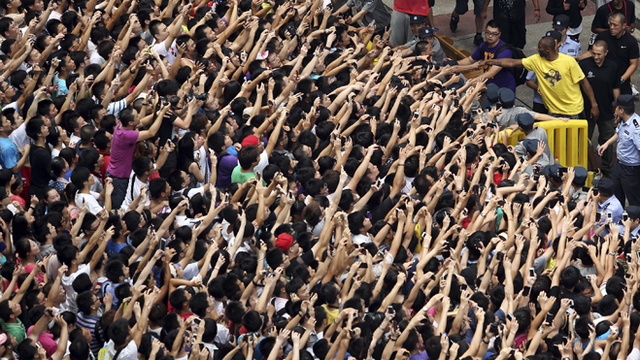
Outside the
arena, following a 100-95 Warriors win, Beijing briefly turns into bizzaro
Downtown LA. Kobe jerseys, T-shirts, hats, mouse pads, iPhone covers, bags,
scarves, and pretty much anything else that could possibly be merchandized are
being hawked. The subways are full of fans of all ages in Kobe jerseys. The NBA
may have held the game at a neutral venue, but with the Mamba on deck, the
Lakers were always going to be the home
team.
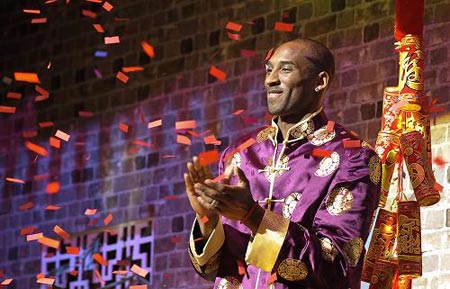
Such is the
impact in China of the cult of Kobe. While Bryant has collected championship
rings, All Star accolades, an MVP award, and legendary status back home in
America over the course of his 17-year-career, he has also been able to
cultivate a unique following in the world’s most populous country. In China,
Kobe has developed into more than a man. He’s a myth. He’s spoken of in
reverence, and alluded to like a demi-god.
For a
country that has long thrived on the socialist philosophies of ‘we’ rather than
‘I’, China have a complicated history with personality cults, starting with the Supreme Commander himself. With changing times, a new
type of celebrity obsession has hit the Chinese youth, and everyone from
Rihanna to Justin Bieber to David Beckham draw colossal numbers of screaming
fans with their every move.
Basketball
has long been one of the favourite sports, and with the success of Yao Ming,
the NBA has become by far the most popular sporting league in China. Yao is
considered one of the country’s greatest ambassadors and is a role model for
many, but now that he’s settled back in China, his presence isn’t as novel as
it once used to be. Amongst current NBA-ers, LeBron James has dominated Chinese social media (renren, sina weibo, tencent weibo,
youko, etc.) more than any other Western celebrity over the past year. Tracy
McGrady attracted big crowds in every Chinese small town where he CBA team
visited last season, and was even welcomed by 2,000 screaming fans when he first landed at the Qingdao
airport. Derrick Rose, Kevin Durant, and of course, Jeremy Lin are a big deal here, too.
But nothing
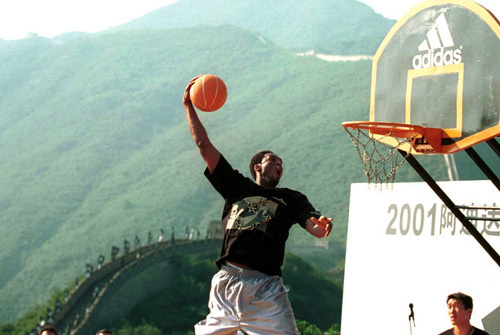
matches the strange and wonderful veneration of Kobe. It started in the last
90s, when a young Kobe began to host basketball camps around China. The
mainstream popularity of the NBA in the country synchronized with the Shaq-Kobe
three-peat, and by the time Yao became an NBA mainstay superstar, Kobe was
hitting game-winners on the regular and scoring in the 40s, 50s, 60s, and 80s.
By the time
he had won his fifth championship, the legend of Kobe in China was sealed.
Mamba was visiting the country nearly every off-season and visiting smaller
off-beat towns to get closer to more and more hardcore fans. He was part of the
US Olympic Basketball squad that won the 2008 gold medal in Beijing, and in
front of the crowd at the same MasterCard center, it was Kobe that memorably stepped up as the brightest star in a team
full of superstars to defeat Spain in the Final. On the side, he became
involved with charity projects and set up the Kobe Bryant China Fund, which
ended up raising millions to help those affected by natural disasters in the
country.
Judy Seto,
a trusted physical therapist of Bryant, reveals many of the strangest
stories about
Kobe’s popularity in China, and she adds that, “He’s made an effort to
cultivate that relationship [with China] every year. And it’s not just, ‘Let me
make this stop at this store.’ It’s, ‘Let me hold this clinic to work with some
of the kids and spend some time with them. Let me understand what this city has
in terms of culture or the main manufacturing or what’s the main draw.’”
Before the
Lakers-Warriors exhibition in Beijing, NBA Commissioner David Stern tried to
explain the Kobe phenomenon in China. “Well first of all, he’s playing
for the Lakers,” Stern said, “He’s been playing for a very long time, as
viewership and interest in our game has grown dramatically. And he has come to
this country quite often and understands what it is to cultivate a fan base
which totally understands that he has, shall I say, the heart of a champion.
His Chinese fans totally expect him, beyond all odds, to make a full recovery
from his injury because they have come to have enormous confidence in his
ability and his determination. I think that’s because he’s shown the ability
and determination at different stages of his career to win, to play at his
highest and to elevate his teammates.”
Bryant, however, slightly deflects the answer from himself
when speaking on his own popularity. "If you go back to the States, fans
have gone through this progression of hero marketing,” he told
Mike Bresnahan of LA Times, “They kind of lived through that in the '80s
with Michael [Jordan] and Magic [Johnson] and having the fanaticism
of fans. With so many [U.S.] media outlets, I think it's evolved to something
beyond that, where we're a little bit more desensitized by celebrities. Out here,
not so much. It's something that's kind of relatively new.”
In recent years, the two championships for the Miami Heat,
coupled with the forgettable years for the Lakers, have boosted LeBron’s
popularity amongst the newer, younger NBA fans, many of whom are more active on
Chinese social media. China likes winners, and yet, despite the fact that
Kobe’s last meaningful playoff game came over three years ago, fans have
remained loyal to him. Regardless of the problems of the present – the injury,
the age, and the declining roster – the Myth of Kobe is secured. “China likes
him because he is always working so hard, and he always wants to win,”
describes Sun Yimeng, an editor and writer for SLAM China and one of the most
famous Kobe fans in China, “I have seen grown men crying in his
presence because he inspires them so much.” She also tells the story of a fan –
one of many – who bought a Mercedes-Benz ‘Smart Car’ simply to put his name
into a lottery of those (in the thousands) with a chance to meet Kobe. “Luckily
for him,” she adds, “He won!”
The love for Kobe reached its peak in the player’s darkest
on-court moment. When Kobe went down with the Achilles injury to the Warriors
at the end of last season, Weibo – China’s version of Twitter – erupted
with good-will messages for Bryant. Kobe, who has over 2.3 million
followers on Weibo, posted a photograph of himself preparing for surgery on his
account. Within 24 hours, the photo had accumulated 45,000 comments and
forwarded over 70,000 times. ‘Pray for Kobe’ and ‘God Bless Kobe’ became
amongst the most popular trending topics in the country, and fans didn’t hold
back with their emotional outpouring of their favourite Kobe memories, their
wishes, and their determination to believe that Bryant would be back to his
best again. (Jason Q. Ng compiled a fascinating, long
list of Weibo comments for Kobe post his injury).
Outside the borders of Mainland China, down to Hong Kong,
eastwards to Taiwan, and then around in other Asian nations who are slowly
falling deeper in love with the NBA, the Kobe mania continues. In Taiwan, Kobe
is in commercials with
the country’s most popular entertainer Jay Chou. In the Philippines, the crowd
at the recent Rockets-Pacers exhibition game chanted
Kobe’s name at his former Laker teammate Dwight Howard. In India, where
basketball is still a minor sport, fans on Facebook ran a
petition to try and get Kobe to visit the country.
While Kobe – and LeBron, too – are the dominant NBA
personalities amongst most of China and Asia in the present, there is a special
place still saved for the man who was once bigger than the sport of basketball
itself. In China, legions of followers still swear by
the gospel of Michael Jordan, and to many of Asia, interest in the NBA is still
stuck in a 90s time-warp. According to the Financial Review, back in 1992
during MJ’s heyday, a survey taken by students in China revealed that Jordan was considered the most
influential person of the twentieth century.
Jordan made way for Iverson, Iverson for Yao and McGrady,
and then, to the new era of LeBron, with Rose and Durant and others. And then
there’s Kobe, who has survived all the post-Jordan eras and maintained his
popularity and relevance in world basketball.
“Kobe! Kobe! Kobe!”
The venue now is Shanghai, and it’s the second of two China
preseason games on October 18th at the Mercedes-Benz Arena. A loud
cheer greets Shanghai’s proudest son – Yao Ming – who waved at the fans in
attendance. An even louder cheer was saved for Kobe Bryant, who via
Philadelphia to Italy to Los Angeles become a legend to a country of hundreds
of millions of basketball fans.
Bryant didn’t play in either game in China. The Lakers lost
both games. But it didn’t matter. Fans screamed. Fans cried. He was mobbed
everywhere he went. Some got to see him in person. Some saw on him on the
jumbotron. Some watched him with pride on the Television, excited that he was
back in their country. And others sent him messages online.
The chants never stopped. And the cult of Kobe continued.