Showing posts with label Dallas Mavericks. Show all posts

September 7, 2019

Biopic of India's first NBA draftee Satnam Singh in production by Zee Studios


Satnam Singh is, arguably, figuratively and literally, the biggest name in Indian basketball. Raised in a nondescript village in Punjab, the young man grew to be a 7-footed beast with tantalising basketball potential, won a scholarship in one of the world's finest sports academies, and eventually, made history by becoming the first Indian to be drafted in the NBA, the world's finest basketball league. Although he never played for the NBA, Satnam played pro in the G-League and in Canada, and the 24-year-old continues to represent the Indian national team.

His incredible story, right up to the point of the night he was drafted, was documented by Roman Gackowski's memorable Netflix documentary One in a Billion in 2016. Now, for the first time, Satnam's journey will be told in fictionalised motion picture, the first-ever basketball biopic in India.

Production company Zee Studios recently announced that they will produce an original digital film based on the inspirational journey of Satnam Singh. The film will be available to be streamed "soon" (no confirmation date given yet) on their on-demand streaming platform, Zee5.

"In our country where basketball has miles to go before it enjoys the same kind of popularity cricket does, it's time we encourage other sports" said Ashima Avasthi, Head and VP, Zee Studios Originals. "Satnam Singh's extremely difficult yet heart-warming journey needs to be told and celebrated. We are excited to work with him on this film! With the explosion of digital content consumption in India, there's a huge market for digital first content, both films and web shows. We are working towards producing a mixed portfolio of premium digital content—web shows and films—across languages and genres for all digital platforms."

Aparna Acharekar, Programming Head, ZEE5 India said: "We are constantly on the lookout for engaging content that our audiences will enjoy and appreciate. This is a special film that we are creating with Zee Studios. An inspiring story that talks about the talented basketball player Satnam Singh's journey, hustle, struggle and triumphs."

Satnam is rumoured to be assisting with the development of the film. There has been no information released yet about the director or cast of the movie. Casting the big man himself will, of course, be a challenge: Satnam is 7-foot-2 and 130 kgs, with a very specific body type and international level basketball skills. It is difficult enough to find actors to play-act athletic capabilities of sports-persons; but in Satnam's case, the physical dimensions are going to be yet another challenge.

"It feels unreal that a film is being made on me!" said Satnam, regarding the news. "As a sportsman, I have always loved films based on sports, and I feel honoured that this film is my story. What excites me most is that this is a basketball film, the first of its kind. I hope that the film will boost the game and more kids will want to try it out. There is huge potential for the game to grow in India if only more people come out in support of it."

Sports biopics in India are a lucrative business. As a matter of fact - outside of cricket, of course - films about Indian sports end up performing much better in the eyes of the common public than the sports themselves. The formula has been devised and repeated for films like Dangal, Bhaag Milkha Bhaag, Mary Kom, M.S. Dhoni: The Untold Story, Paan Singh Tomar, Azhar, and many more in recent years. With the arrival of streaming entertainment, the options of sporting stories in cinema will get its inevitable boost.

This is of course, exciting news for Indian hoops for Satnam to join (in a smaller, digital way) the ranks of other great Indian athletes with biopics. The film will be facing the challenge of following up the excellent One in a Billion, which followed Satnam to his village, to the IMG Academy, to NBA trials, and to the draft, and featured interviews with several luminaries involved with the game including Mark Cuban, Vivek Ranadive, and Adam Silver. I was honoured to be featured in the film, too, relaying my experiences of observing Satnam's journey from close quarters over the years.

I fear that, unless somehow perfectly cast, the issue of size and imitable skills in whatever actor cast to play Satnam will prove to be a major hindrance for the upcoming biopic. Beyond that, I hope that the writers and director ensure to get the basketball background information correct for his film, along with Satnam's intriguing off-court struggles and successes.

July 10, 2019

4 years after becoming first Indian to be drafted into the NBA, Satnam Singh's draft rights have been traded to the Memphis Grizzlies


It takes nuclear fusion of the intergalactic level to give birth to a star, a minor big bang. Often, these stars die in spectacular supernovas. But sometimes, they just whimper away in silence, disappearing into the dark universe.

Four years ago, Satnam Singh's entry into the NBA began with a bang. The Dallas Mavericks made the 19-year-old, 7-foot-2 center the first Indian to be drafted into the NBA. His 2015 drafting was a major moment in Indian basketball history, spawning optimism for the growth of the game in India and a Netflix documentary detailing the astonishing story that ended with him wearing that Mavericks hat.

Four years later, and without a single NBA game under his belt, Satnam dalliance with the Mavs has ended in a quiet whimper. The Mavericks announced on Monday, July 8 that they were trading the draft rights to Satnam Singh from 2015 along with two future second-round picks to the Memphis Grizzlies, in return for point guard Delon Wright. It will now be up to the Grizzlies to decide if they wish to offer Satnam a contract, waive their draft right, or retain the rights without having Satnam under contract the way the Mavericks did for the past four years.

It is a question of curious NBA legalese on how the Mavericks were able to hold on to Satnam's draft rights since 2015. Satnam isn't the only one; the Mavericks have a habit of drafting players and retaining their rights for long terms, including Finland's Petteri Koponen who was drafted in 2007 by the Philadelphia 76ers, and whose rights the Mavs have held since 2011. Ben Zajdel of The Smoking Cuban dug deep into the NBA's Collective Bargaining Agreement and explained the rules in more layman terms:

Essentially, this means that as long as a player is under contract with a non-NBA team and gives the NBA team that drafted him no indication he plans to play in the NBA, they retain his draft rights. The process can go on for more than a decade, apparently. If an international player is no longer under contract with a non-NBA team and informs the team that holds his draft rights he intends to play in the NBA, they must tender him an offer within the next year, or he becomes a rookie free agent.

The draft rights for Satnam essentially meant that he can play for no other team except for the one's that hold his rights - which was the Mavericks, and which will now be the Grizzlies.

Even though he has been absent from realising his NBA dream, Satnam has been actively pursuing many other avenues of pro basketball. After he was first drafted, he spent two seasons playing for the Mavericks' affiliate Texas Legends. He returned to India to play a bigger role in the national team from 2017-18 and try his hand at 3x3 basketball. Last year, he took upon a new journey: Canada's National Basketball League, where he played for the St. John's Edge that made the NBL Finals.

Now, just when it seemed that Satnam's NBA affair was over, his name popped up in the news stream again, heading to a new team. Perhaps, a fresh start? Remember, we are still speaking of his draft rights, not his contract itself. No one yet knows what the future holds. When I reached out to Satnam about his thoughts on the trade, he was in the dark as the rest of us.

"I don’t know yet about anything," he said. "I hope I get soon some good news."

We in the Indian basketball world are hoping for the same. Hopefully the quiet decay of the star is only the beginning of something new, the start of another journey in Satnam's universe.

April 25, 2019

Former NBA champ Harrison Barnes to visit India next week


Harrison Barnes probably didn't think that his summer would unfold this way. The former NBA champ (with the Golden State Warriors) started the 2018-19 season with the Dallas Mavericks, but was traded before the deadline in February to another rebuilding squad, the Sacramento Kings. And, less than two months into his stint with Sacramento, Barnes is not a representative for the Kings in the opposite end of the globe, carrying the team's flag to India in anticipation for the biggest offseason yet in Indian NBA history.

In October this year, the NBA will hold two preseason games in India - between the Kings and Indiana Pacers - for the first time in history. Barnes, a smooth-scoring forward and the newest member of the Kings, will be visiting India to promote the continuing growth of basketball in the country and the upcoming NBA India Games 2019 from April 28 - May 3, 2019, announced the NBA.

Barnes will first stop in Delhi NCR on April 28 to attend the Reliance Foundation Jr. NBA National Finals at The NBA Academy India. He will then travel to Mumbai for live television appearances on Sony Ten 1 and Sony Ten 3's NBA wraparound shows on April 30, before returning to Delhi on May 3 to attend the National Finals of the fourth ACG-NBA Jump, India's national basketball talent search programme.

"This trip to India will be a great opportunity for me to get a sneak peek of the local culture before the upcoming preseason games in Mumbai this October," said Barnes. "I look forward to being a part of that historic event, and I'm excited to help support the NBA's various basketball development initiatives in India."

A 6-8 forward, Barnes was drafted into the NBA 7th overall in 2012 by the Golden State Warriors, where he grew into a solid foundation piece as the team - led by Stephen Curry, Klay Thomspson, and Draymond Green - developed into a championship contender. He was in the Warriors starting lineup as the team won the 2015 NBA title and remained an integral part of the team that won a record 73 games in the 2015-16 regular season, only to lose in the Finals to the Cleveland Cavaliers. To make room for their historic acquisition of Kevin Durant in 2016, the Warriors let Barnes go to the Dallas Mavericks. He played two-and-a-half years in Dallas before being traded to Sacramento in exchange for Zach Randolph and Justin Jackson.

In 28 appearances with the Kings, Barnes averaged 14.3 points and 5.5 rpg. The 26-year-old will serve a veterans role for the Kings squad that will visit India, who are boosted by exciting young players like De'Aaron Fox, Buddy Hield, Bogdan Bogdanovich, and Marvin Bagley.


November 14, 2018

The Crossover Godfather himself, Tim Hardaway, is visiting Mumbai and Bengaluru for NBA India events


Before there was Allen Iverson, or Kyrie Irving, or Stephen Curry, Jamal Crawford, or Jason Williams, there was the godfather of killer crossovers, Tim Hardaway. Before the Golden State Warriors conquered the world with their Splash Triplets, there was the Run-TMC era. Before Wade and Shaq, and later, the Big Three bought championships to Miami, Hardaway led the team to a then franchise-best 61 victories. Before the time when the smallest guy on the court - the quick-footed, sharp-shooting, point guard - became an impossible to stop weapon, there was Hardaway, UTEP Two-Stepping his way to five NBA All Star appearances and becoming one of the most iconic guards of the 90s.

This week, Hardaway (52) will visit India to promote the growth of basketball and NBA India's recently announced McDonald’s NBA-themed promotion. and promote the growth of basketball. On Tuesday, November 13, Hardaway made his first stop in Mumbai to lead a clinic at the NBA Basketball School in Jamnabai Narsee, Juhu. On November 14, Hardaway will visit the McDonald’s restaurant on High Street Phoenix to meet with fan. On November 15, Hardaway will meet and greet with fans at the McDonald’s outlet in Lido Mall, Bengaluru. Hardaway will return to Mumbai for live television appearances on Sony Ten 1 and Sony Ten 3’s NBA wraparound shows on Nov. 17 to discuss the ongoing NBA season.

"Basketball has taken me to many places around the world and I’m excited to be in India to meet with the fans and do my part to further the development of the game," said Hardaway.

Hardaway was drafted 14th overall by the Golden State Warriors in the 1989 NBA Draft and named to the NBA All-Rookie First Team in 1990. He was part of the Warriors' iconic (but short-lived) crew "Run-TMC", that included him, Mitch Richmond, and Chris Mullin. His most productive season was with the Warriors in 1991-92, when he averaged a career-best 23.4 ppg. Hardaway was traded to the Miami Heat midseason in the 1995-96 season. In 1996-97, Hardaway finished a career-best fourth in NBA voting, selected to the All NBA First Team, and led Miami to 61 wins. Hardaway also played short stints with the Dallas Mavericks, Denver Nuggets, and Indiana Pacers, before retiring from the NBA in 2003. A five-time NBA All-Star, he averaged 17.7 points, 3.3 rebounds, and 8.2 assists in his career and was named to an All-NBA Team five times.

Hardaway returned to the NBA in a coaching role in 2014, and served as an assistant coach to the Detroit Pistons till the 2017-18 season. Hardaway's son, Tim Hardaway Jr., was drafted to the NBA in 2013 and is currently playing for the New York Knicks where he is the team's leading scorer.

Seriously, Senior Hardaway was legit. Here's proof:


October 4, 2018

Eight Indian coaches selected to attend NBA China Games in Shanghai and Shenzhen


The 2018 NBA preseason is underway, and per their annual tradition, the NBA will be holding two exhibition games in China this month. The 2018 NBA China Games will feature back to back matchups between the Philadelphia 76ers and Dallas Mavericks in Shanghai (October 5) and Shenzhen (October 8). Like every year, these games provide an amazing opportunity for NBA to feed their growing popularity among Chinese fans.

This year, the NBA is lending out a hand to some basketball lovers in India, too.

Eight Indian coaches from around the country, based on their performances at the various Reliance Foundation Jr. NBA programme events this year, have been selected to travel to China to attend the NBA China Games. The coaches will take part in the NBA Fan Day event in Shanghai on October 4 and then attend the two games in Shanghai and Shenzhen later in the week.

Indian coaches travelling to China for this programme include Jose Sebastian (Thiruvanathapuram), Shabana Patel (Mumbai), Ravi Kumar (Bengaluru), Ganesh Prabhu (Chennai), Ishwar (New Delhi), Tua Ghatak (Kolkata), Ibrahim Rose Khan (Hyderabad), and Ravinder Kaur (Punjab).

"It was quite unexpected and took me by surprise," said Sebastian to The New Indian Express. "I think this is a reward for all the hard work I have put in over the years. We will be watching two games of the highest standard and also meeting with coaches from across the globe -- all valuable experiences that I can put to good use in my coaching."

Even though its just the preseason, the coaches will be hoping to relish some top-notch NBA action and glean from coaches like Brett Brown and Rick Carlisle on the sidelines. Plus, there are so many more questions to consider before the start of the NBA season from the two participating teams. Will Embiid have social media access in China? Can Fultz shoot again? Does Simmons want to shoot? Is Nowitzki going to play? Will Doncic showcase his potential for being the rookie of the year?


September 7, 2018

Indian basketball player Satnam Singh signs with St. John's Edge of Canada's NBL


Satnam Singh's sensational basketball journey - from far-off Punjabi village to the elite IMG Academy to the NBA Draft, the G-League, and the Indian national team - has taken another new twist. On Thursday, September 6, the St. John's Edge of Canada's National Basketball League (NBL) announced that they have signed Satnam to a one-year contract for the 2018-19 season.

Satnam - a 7-foot-2 center from Ballo Ke village in Punjab - is the first and only Indian to be drafted to the NBA (Dallas Mavericks) and the first Indian to play in the G-League (Texas Legends). After two years with the Legends, Satnam returned to play for India's national team back home for the past one and half years. He was also the subject of the Netflix documentary "One in a Billion" in 2016.

After playing for the IMA Academy in Florida from age 14-19, Satnam declared for the 2015 NBA Draft and was picked 52nd in the second round by the Mavericks. He never made an NBA appearance but played for the Mavericks' Summer League team and their G-League affiliate, the Legends. During his two seasons with the Legends, Satnam averaged 1.5 points, 1.4 rebounds and 7.1 minutes per game. He shot .410 (16-for-39) from the field and .588 (10-for-17) at the free throw line. He has played for India at various major international events, including the three senior FIBA Asia Cups/Championships (2011, 2013, 2017).

The contract and negotiation with St. John’s Edge and Satnam was facilitated by Cornerstone Sport, a sport management and talent representation agency, which exclusively manages Indian skipper Virat Kohli, KL Rahul, and others. Bunty Sajdeh, CEO, Cornerstone Sport, said, "India is a young, emotional country and always looking for icons to look up to. And Basketball as a sport has always been popular in India. Satnam Singh, his journey this far and now signing with the Edge in Canada gives us all someone to look forward to, to follow and encourage."

"I am really excited to be a part of St John’s Edge," said Satnam. "It's a very proud moment, and I am sure this will encourage many others to pick up basketball as a career. I am very thankful to everyone who supported me and helped me become who I am today."

I interviewed Satnam briefly on Friday morning, where he added, "I am happy that I will get playing time, which I didn't get in my stint with the NBA/G-League. I had been in India for one and a half years and didn't find any opportunities beyond the Indian national team. I want to make the most of this chance to improve my game as much as possible over there. I feel that I will play with a lot of good players who will help me improve, and from there I hope to make it back to the NBA."

Dough Plumb, Head Coach, St. John's Edge said in a press release, "We’re excited to add Satnam to our team, he brings a history of NBA and International playing pedigree to our team. It’s remarkable to truly understand where he’s come from and where he is today. This is a great signing not only for our organisation but for our league."

The NBL of Canada was founded in 2011 and expanded to ten teams - including the St. John's Edge - in 2017. In their inaugural season in 2017-18, the Edge finished second in the Central Division and were defeated in the Division Finals (league semi-finals) by the eventual winners, London Lightning.

October 23, 2017

Short of NBA opportunities, basketball trail-blazer Satnam Singh returns to India


This article was first published in my blog for The Times of India Sports on October 12, 2017. Click here to read the original piece.

In the climactic moment to the documentary about him “One in a Billion”, Satnam Singh is in New York City, being driven to the 2015 NBA Draft. It is a life-changing convention that turns selected amateur athletes into full professionals in the world’s most-prestigious basketball league. Even at 19, Satnam has already lived numerous lifetimes: with the help of basketball, he has gone from a small, nondescript Punjabi village to an American education and world-class basketball training at the IMG Basketball Academy in Florida.

Now, he is en route to discover his destiny, suited in his sharpest gear, but looking as nervous as you would ever see a seven-foot giant. He is about to find out if years of toil and turmoil will lead him to the ultimate glory: a selection in the NBA, making him the first Indian citizen to be drafted into the league in its seven-decade history.

In the car on the way to the Barclay’s Center in Brooklyn, Satnam talks to the agents and friends and mentions how Yao Ming opened the door for basketball in China. Someone tells him encouragingly, that he, too, has already opened the door. Satnam, in broken English, a language barrier that haunted him in his days at the IMG Academy, responds, “Just opened the lock,” he says with a sly smile. “Not door. Just opened the lock.”

A few hours later, history will be made. The NBA’s Deputy Commissioner will call Satnam’s name on behalf of the Dallas Mavericks with the 52nd pick of the draft. A young man’s life—and an entire country’s basketball expectations—will never be the same again.

Little did Satnam know that, his words on Draft Day would become a self-prophecy. After being drafted, Satnam spent the next two years with the Maverick’s affiliate team in the NBA’s minor basketball league (NBA G-League) team Texas Legends. He played only 7.1 minutes per game in 27 appearances over two years, averaging just 1.6 points and 1.4 rebounds. The NBA dream and those over-enthused Yao Ming comparisons seemed to loom too far in the horizon.

Satnam was right: by getting drafted, he had only unlocked the possibility of an Indian even making it into the conversation of NBA athletes. The door for him still remained shut.

Earlier this week, frustrated with lack of opportunity and playing time, Satnam told gathered reporters at an event organised by the General Nutrition Centre in Mumbai that he had decided to return to India to develop his game.

“I had a big problem with no playing time at NBA,” Satnam said to India Today. “I would lose my mind.”

Now, he is hoping that India, and added opportunity, will help him showcase his skillset again. With additional competitive time on court, he hopes to improve this game as well as attract the attention of scouts again.

“If I play here, I will get more game time and my game will improve,” he said to The Field. “I just want to play and work on my skills and moves. If I want to improve my game, I will need somebody who I can work with.”

His decision is somewhat surprising, considering that Satnam joined fellow Punjabi baller TJ Sahi to comment last month that there was “no future” for basketball in India and aspiring players should look for opportunities abroad.

The lack of elite-level competition and no full-time professional league has hampered the growth and opportunities for numerous Indian basketball stars, which is why, many of our top current players—Amritpal Singh, Vishesh Bhriguvanshi, Amjyot Singh—are looking for professional opportunities abroad. Satnam, who blazed the trail (while still being the youngest of them all) seems to have taken a step back to his roots.

“Now I have come back to India. I will play for the Indian team,” Satnam said to India Today. “I will work on my game as much as I can. I will play for Punjab, any small tournament. I want playing time. The more I play my game will improve.”

Satnam’s last foray with the Indian national team - at the prestigious FIBA Asia Cup in Lebanon in August - didn’t go as well as he would have expected. He was not in ideal game shape and was behind Amritpal, Amjyot, and Arvind Annadurai in the big man rotation. He played less than nine minutes per game and couldn’t help India as they lost all three of their preliminary round games.

If he continues to stay fit, however, he should have no trouble eventually getting playing time in India. He will likely play for Punjab in national tournaments and hopefully find a place for himself in the UBA Basketball League. He will have to evolve his style to fit into the faster pace of the game, which was part of his struggle in breaking into the Texas Legends line-up back in the United States, too.

By returning to India for more playing opportunity, Satnam will be sacrificing the exposure, facilities, and competition that was available to him in the US. Could playing without a fully professionalised league, against inferior opponents, with worse coaching and infrastructure, truly help him find future international opportunities?

From farming in the Ballo Ke village in Punjab to rubbing shoulders with the best in the basketball world, Satnam has already taken Indian basketball further than anyone before him. Indeed, he has unlocked the door to the NBA. Hopefully he - or a successor — will kick it wide open very soon.

May 21, 2017

For The Future


The NBA opened a first-of-its-kind Academy in India. We spoke to Deputy Commissioner Mark Tatum to find out why.

I originally wrote this article for SLAM Magazine's website on May 11, 2017. Read the original feature on SLAMOnline.com here.

In only his second year as the NBA’s Deputy Commissioner, Mark Tatum shook hands with history. And those hands, he says, were so large that his own palms completely disappeared.

Tatum was on stage at the Barclays Center in Brooklyn to call the 52nd pick of the 2015 NBA Draft, a little-known 7-1 giant out of Punjab. That young man, Satnam Singh, turned out to be the first Indian player ever to be drafted into the NBA. “I was so thrilled to be a part of that,” says Tatum, “to know that I’ll be part of that history.”

Tatum—and the NBA—haven’t stopped shaking hands with India since. Last summer, he visited the country with Robin Lopez and Seth Curry to attend a Jr. NBA Elite Camp in Noida, a city close to the country’s capital, New Delhi. Tatum is back in the country, helping the NBA launch its most-ambitious investment in India yet: an elite basketball academy where the League will develop top young male and female prospects from around the country. The NBA’s hope is that the results will pay off longterm to build a stronger basketball culture in the country.

On Tuesday, the NBA announced the official opening of NBA Academy India at the Jaypee Greens Integrated Sports Complex in Greater Noida. Twenty-one elite male prospects, who were selected following a three-month, nationwide basketball talent search, will receive scholarships and training the first-of-its-kind academy.

The NBA says that the Academy in India will employ a holistic, 360-degree approach to player development with focuses on education, leadership, character development and life skills.

The official opening of NBA Academy India follows the launch of academies in Hangzhou, Jinan and Ürümqi, China; Thies, Senegal; and the planned launch of NBA Global Academy in Canberra, Australia. The Academies include educational development for top international male and female prospects and mark the NBA’s most significant investment in elite player development.

While the Academy will serve to the top-of-the-line prospects in the country, the NBA has taken steps to reach deep into the grassroots to make basketball more ubiquitous around India. Over the last few years, the Reliance Foundation Jr. NBA program has trained millions of young players and instructors. The NBA also launched an ‘NBA Basketball School’ earlier this year in Mumbai, with plans to open more in the near future.

We caught up with Tatum over the phone from Mumbai earlier this week to discuss the ambitions for the Academy, the challenges and opportunities presented by India, and more.

SLAM: What has been your very first impression of India and of the basketball talent available for the NBA Academy?

Mark Tatum: My first impression was that the players had a true understanding of the game, and I was impressed by their willingness and desire to learn. I remember Seth [Curry] was teaching them how to shoot and Robin [Lopez] was taking them through drills. I remember vividly a couple of big, young gentlemen listening intently to what Robin had to say. They had knowledge and a passion to want to get better.

SLAM: Cricket is India’s most important sport and basketball is still not popular in the mainstream—no India-born player has played in the NBA. Why did the NBA show so much interest in India and choose to invest in this massive venture?

MT: India has 1.3 billion people. We think it has the potential to be the next China for the NBA. I had the opportunity to call out Satnam Singh’s name as the 52nd pick in the draft—I think it was inspiring and will inspire more Indian kids to play. The sport is really growing in popularity here. Our Jr. NBA program reached six million youth and we have taught five thousand physical education teachers since 2013. We have seven million Facebook fans from India, and that number is growing at a rapid pace.

This Academy is really the next step in helping to develop elite talent in the marketplace by providing best-in-class training and development. For us, it’s a longterm opportunity and investment.

SLAM: Many in India believe that the best-case scenario is to follow that China model. The two countries have similarly large populations and potential, and if India can get a breakthrough like Yao, it would be huge for basketball and NBA in the country. But what do you think India can offer to the basketball world that perhaps differs from any other model?

MT: India is unique in the size of its middle-class population and how young the demographic is. In terms of basketball, China is a very mature basketball market: they have been playing the sport for over a hundred years. The game was brought there in the early 1900s! For us, the opportunity in India is to get more younger kids and more instructors teaching basketball, playing in schools and having a younger demographic who likes action. These youngsters are multi-talented. They are engaged in digital and mobile activities, which the NBA is perfectly suited for.

SLAM: The Academy aims to employ a “holistic, 360-degree approach to player development with focuses on education, leadership, character development, and life skills.” Why has the NBA chosen to taken this additional responsibility for youth development outside the basketball court?

MT: We believe basketball and sport have benefits beyond the sport. Life lessons from team sports, specifically basketball, can help improve individuals and society. The lessons that I learned growing up playing basketball and baseball growing up were: how to be a good teammate, how to respect others, the values of hard work, that if you work hard at something you can get better at it. You learn how to overcome adversity and learn how to lose too. For us it’s about more than basketball on the court – there can be really valuable life lessons that individuals learn from the game.

SLAM: There are already NBA Academies in China, Africa, and Australia. Many of them follow the NBA’s basic curriculum and philosophy in coaching and player development. Each culture is different, and India obviously has its own separate set of challenges and opportunities. What will be the approach for the Academy that will be unique to India at the grassroots level?

MT: I think the opportunity is that, in a short amount of time, there are kids here who have been identified through a national scouting network. What’s so positive is the level of talent we’re seeing from young kids in a market where basketball infrastructure hasn’t been great. It is a huge opportunity that we’re excited about.

The challenge is that there hasn’t been a strong culture of basketball for over a century. How do you quickly build that culture? How do you expose these kids to the best competition in the world? The academy concept is really going to help with that. We’re going to accelerate the development with access to best coaches and best trainers. They’ll have a chance to travel and play against other academies in China, Australia, Africa, and potentially, teams in the US. This is a tremendous opportunity and we have some of the top prospects in the country.

SLAM: You played a part of Indian basketball history two years ago when you called out Satnam Singh’s name in the draft. When you were informed of the Mavericks’ pick, did you feel that this was going to be a historic moment?

MT: Oh yes, I remember that moment so vividly! I was thrilled to be a part of history. Earlier on draft day—all the draftees were at one hotel—I spotted Satnam and went up to say hello to him. He was so nervous and excited about the prospect of hearing his name. I said, ‘Satnam, I hope I get to call your name tonight’.

How the draft works is that I wait in a room in the back. I get a card handed to me, and when I saw his name, I began to smile from ear to ear. I knew how happy he would be and what a huge moment it would be for the youth in India. So, I went out there. I knew where he was sitting, glanced at him, and called his name. it was an exciting moment for me, for him, for the country, for the history of the NBA. We’ll look 10-20 years from now and realize what a big day it was.

I know that he is working hard—he is very talented, very skilled. He had a decent season in the D-League and I think he learned a lot. I still view him as a young big man who has an opportunity to make it.

SLAM: From what you know of India’s potential, how long do you feel it would be for India to produce a decent NBA talent?

MT: There will be lot of divergent pathways. Some kids play in Division I colleges in the United States; some will play in the D-league; some will play in other leagues around the world. We’re hopeful that in the next five-to-ten years or so that we’ll see an NBA talent coming through these academies.

May 1, 2017

The company of giants


India has made basketball history without their most popular basketball player. Now, as Satnam Singh returns to the national team, could he lead the team to further greatness?

This article was first published in my blog for The Times of India on April 21, 2017. Click here for the original piece.

Years before he made history by becoming the first Indian player to be drafted into the NBA, Satnam Singh was asked to punch far above his weight. He was a 15-year-old giant when he was selected to make his debut for India’s men’s national team in 2011 by head coach Kenny Natt. Natt had decided to inject some youth and size into the men’s roster for the Middle Asia Zone qualifiers in New Delhi. Satnam was to become the youngest-player to ever don a Senior India basketball jersey, but a couple of other teenage Punjabi talents – Amjyot Singh Gill and Amritpal Singh – were picked to make their senior debuts, too.

I was present at the Thyagraj Stadium for that qualifying round – Natt, Satnam, Amjyot, and Amritpal’s first senior international outings – when India showed glimpses of their future potential with comfortable wins at home against South Asian opponents. Later that year, this team headed to China for the FIBA Asia Championship and underperformed, but the seeds of the future had been sown. In these three teenagers, India had found the size they were looking for.

Fast forward nearly six years, and the Indian basketball side finds itself in much better shape. Natt provided the spark, which was lit brighter by his successor Scott Flemming, and it continued to shine even after Flemming’s departure. Over the last few years, led by Amjyot, Amritpal, star shooting-guard Vishesh Bhriguvanshi, and a deep supporting cast, India has twice defeated Asia’s top-ranked team China in international competitions, and most recently, had their best basketball performance in nearly three decades with a 7th place finish at the 2016 FIBA Asia Challenge in Tehran.

Although we have improved on various fronts, the true key to unlock this ‘golden era’ of sorts has been the maturation of our bigs. Amjyot (25 – 6-foot-8) and Amritpal (25 – 6-foot-10) have become one of the most formidable frontcourts in Asia, and their talents have taken them to play professionally in Japan, declare for the NBA’s D-League, and be invited to the NBL Draft Combine in Australia. Right behind them, players like Palpreet Singh Brar and Rikin Pethani have given us depth in that frontcourt, too: Palpreet (23 – 6-foot-9), in particular, has improved rapidly and became the first Indian to be drafted in the NBA D-League last year (although he never earned a roster spot). Veteran forward Yadwinder Singh (30 – 6-foot-6) is still an important part of the national team and impressed at the NBA Combine recently in Australia, too.

The only one missing from the equation has been Satnam (21 – 7-foot-2), the young man who became the poster boy of Indian basketball when he was drafted to the NBA by the Dallas Mavericks in 2015. Satnam, who was recruited to play at the IMG Academy in the United States as a 14-year-old in 2010, hasn’t played for India since 2013. Instead, he has spent the last few years improving his skills in the USA and playing for the NBA D-League team Texas Legends.

His absence has allowed Amjyot, Amritpal, and Palpreet to blossom into stars and India has, ironically, made basketball history without their most popular basketball player.

In a few months, it is all set to change. The 2017 FIBA Asia Cup – Asia’s most-prestigious basketball championship which will feature top teams from Oceania for the first time – is set to take place in Lebanon in August. With Amjyot, Amritpal, and Bhriguvanshi already in top form, India were looking poised to make some major noise and significantly improve their low FIBA World Ranking (currently 53rd). But earlier this week, the BFI announced that Satnam will be returning to the national team after a four-year hiatus. If all the available players are healthy, India will have its best-possible pool of talent to choose from for Lebanon.

The reunion of Satnam with Amjyot, Amritpal, and Yadwinder, alongside the younger wave of big men in contention like Palpreet, Pethani, Arvind Arumugam, Aravind Annadurai, and Ravi Bhardwaj have given India a sudden embarrassment of riches in the power forward and center positions. Counting the backcourt, only twelve can make the final roster for the FIBA Asia Cup; whoever will be appointed the team’s head coach (the last man in charge was Bhaskar Sappaniambalam for the Super Kung Sheung Cup in Hong Kong) will have the headache of sifting through these company of giants to pick six for Lebanon.

Furthermore, the coach will have to decide if he will continue to start with the successful duo of Amjyot and Amritpal and relegate Satnam – he of worldwide hype and NBA D-League experience – to the bench.

My pick for the starting five will be to stick with Amjyot and Amritpal; between the two of them, they have given India incredible frontcourt versatility over the last three years and formed a close bond from playing together in Japan. Amritpal, an elite post defender, plays closer to the basket on both ends of the floor. Amjyot has developed into a threat from both the perimeter and the post and helps space the floor for Amritpal in the middle. Satnam is a solid rim protector, can finish from inside and out and is stronger than both Amjyot and Amritpal. But he is slower on his feet and inexperienced with the national team.

At the FIBA Asia Challenge last year, India defeated Philippines and China to enter the Quarter-Final stage, where they were stopped by eventual winners, Iran. Iran featured Hamed Haddadi, the 7-foot-2 behemoth dominant center, who tormented India with 17 points and 23 rebounds in this crucial game. It will be in situations like these, going against elite strong players in the post, where Satnam’s presence will be most valuable, and India’s depth at the big man position will give us a fighting chance.

The bigger problem for India, however, is going to be in the backcourt. While Bhriguvanshi has proven to be one of the finer Asian players in his position, India have no other players who can consistently challenge to match the talent and athleticism of other international guards. Expectations will be high for TJ Sahi, Akilan Pari, and rising youngster Baladhaneshwar Poiyamozhi, but without better perimeter options, the Indian lineup will remain flawed.

Despite this unbalance, one of the secrets to India’s recent success has been the team’s chemistry and comfort-level with each other. My hope is that Satnam can intermingle his game smoothly with our other top players without disturbing this chemistry. The best-case scenario for India will be if he can master the delicate equilibrium between being at his individual best while playing within the team system.

All of Asia and Oceania’s top qualifying teams – China, Philippines, Iran, Japan, Lebanon, Australia, and New Zealand – will be sending their best-possible rosters for the prestigious tournament this year. With Satnam, Amjyot, Amritpal, Vishesh, and Palpreet on the roster, India may have, on paper, our greatest team ever. Could they lead the national team to further greatness?

January 24, 2017

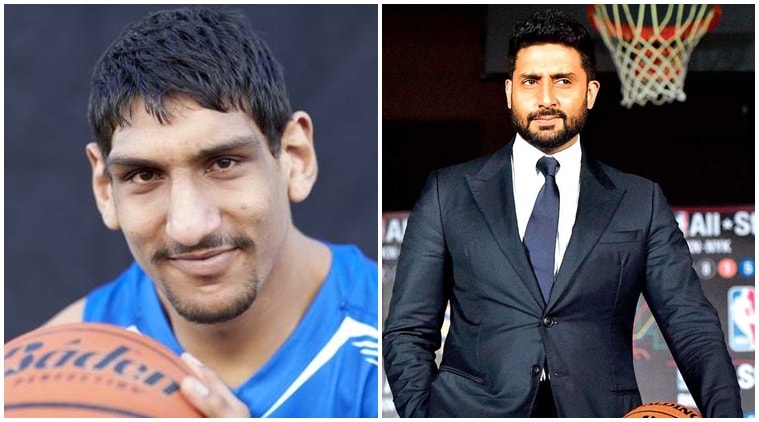
Abhishek Bachchan ready to play Satnam Singh in a biopic - if Satnam wins an NBA championship


The following statements are the truth:

- Abhishek Bachchan is an Indian actor, star of Bollywood hits like Dhoom, Dostana, Bunty Aur Babli, Guru, and Sarkar, and the son of India's most-respected actor ever, Amitabh Bachchan.

- Satnam Singh was the first Indian basketball player to be drafted into the NBA in 2015 and plays for the D-League team Texas Legends. His extraordinary story from poor Punjabi village of Ballo Ke to the NBA Draft was captured in the recent documentary One in a Billion.

- Bachchan is apparently a huge NBA fan, specifically of the Lakers, and has had interactions with the Laker great Magic Johnson. He was the first (and only) Indian to ever take part in the NBA All Star Celebrity Game in 2015, displaying his exceptionally limited basketball skills. He was also the brand ambassador of India's NBA Store and has often professed his hopes to help basketball grow in India.

- A few days ago, Satnam Singh said that, if a biopic was made of his life, Indian actors Akshay Kumar and Abhishek Bachchan would be "best suited" for the role.

- On Monday, Bachchan responded to the story on Twitter by saying that he would do the biopic - for free, too - if Satnam can win an NBA championship.

- Bachchan is 6-foot-2 and 40-year-old. Satnam is 7-foot-1 and 21-years-old. Satnam knows how to play basketball. Bachchan knows how to act.

- Satnam has yet to play an NBA game. Although he is never going to be an NBA star, there is still a possibility that the big guy gets signed on to a fringe role by an NBA team. Satnam's chances of winning an NBA championship would depend highly on a perfect situation of playing for a team that both has the space/requirement for a big guy of his skillset and the talent to beat the top contenders in the league for the title. Think DJ Mbenga from the 2009-2010 back-to-back champion Lakers' squads.

The following statements are the 'alternative facts':

- The Golden State Warriors will sign Satnam as a backup, where he immediately becomes 'The Splash Singh'. Satnam will join a roster that already includes Stephen Curry, Kevin Durant, Klay Thompson, Draymond Green, and Andre Iguodala. He would be the umpteenth big man option behind Green, Zaza Pachulia, JaVale McGee, David West, Anderson Varejao, Kevin Looney, James McAdoo, and Damian Jones.

- In the 2017 NBA Finals - round three between the Cavaliers and the Warriors - Golden State would lose Draymond Green after another accidental kung-fu reflex moment, Zaza to the Georgian parliament, McGee after he Shaqted-a-Fool one too many times, Varejao and David West to old age, and Looney, McAdoo and Damian Jones to foul trouble. In this moment of desperation, they would call upon The Behemoth of Ballo Ke, The Punjabi Premier of the Paint, to save the day in Game 7. In seven invaluable minutes of action, Satnam would set up important screens for open jumpers for Curry, Durant, and Thompson, outrebound Tristan Thompson, deny LeBron easy access to the basket, and pick up six quick fouls to destroy Cleveland's comeback momentum.

- Warriors will win the 2017 NBA Title and Satnam Singh will get his championship ring.

- In 2020, when Abhishek Bachchan is in his mid-40s, he will requires the help of India's finest computer graphic designers to make him a foot taller and 30-years younger. He will play Satnam from age 15-25 in India's greatest sporting biopic film of all time.

- 'King Singh: The Sikh With Da Sickness' will break all the box office records, win Bachchan all the Filmfare Awards, and become India's choice for Oscars' 'Best Foreign Language film', obviously winning that award, too.

- The film's popularity will make basketball one of the most popular sports in India and earn Satnam an honorary place as 'Basketball Ambassador' in the Hall of Fame.

- Satnam will eventually co-star in a travel show alongside Stephen Curry called 'The Curry-wallahs: Basketball and Butter Chicken from Ballo Ke to the Bay Area'.

Thank you for your time.

December 26, 2016

Billion to One


I talked to Satnam Singh about his inspirational new documentary on Netflix, which chronicles his stranger-than-fiction journey from India to an NBA Draft pick.

This article was first published on SLAMOnline.com on December 13, 2016. Read my original piece here.


Here are two worlds.

World No. 1 is the Ballo Ke village, district Barnala, in the heartland of the India’s north-western state of Punjab. Ballo Ke is not on the map. Its population of eight hundred people—mostly poor, disenfranchised farming families—live among paddy fields, separated from the rest of civilization by hours, which are traveled along a bumpy dirt path. Electricity came here late, and mobile phones rarely connect. Ask for a cup of chai and someone will milk a buffalo in front of you. It’s dusty all the time.

World No. 2 is the Barclays Center in Brooklyn, NY, opened in 2012 as one of the swankiest multi-event facilities on the planet. It cost over a billion US dollars to construct. Its tenants include the Brooklyn Nets, an NBA franchise valued in the billions which plays under the electrical charge of flashing jumbotrons, on-court laser shows, and machine guns spewing T-shirts into the stands. Since 2013, it has hosted the NBA Draft in a room full of some of world’s richest CEOs, VPs, agents, and future basketball superstars.

These worlds are polar opposites of culture, economy, and lifestyle. And yet, through the course of one of the most inspiring stories in all of sports, one young man—Satnam Singh—lived through it all, marrying the dichotomy of the marginalized third-world with the highest stakes of the world’s richest basketball league, and journeying through it all while carrying the improbable hopes of a billion-strong country on his wide shoulders.

The summary, if this was a piece of fiction, sounds too improbable to be true. But truth is often stranger than fiction, and over the last decade, that story actually took place: Satnam, the son of a farmer from Ballo Ke village, used both nature (his size) and nurture (hard work) to make history when the Dallas Mavericks picked him in the 2015 NBA Draft.

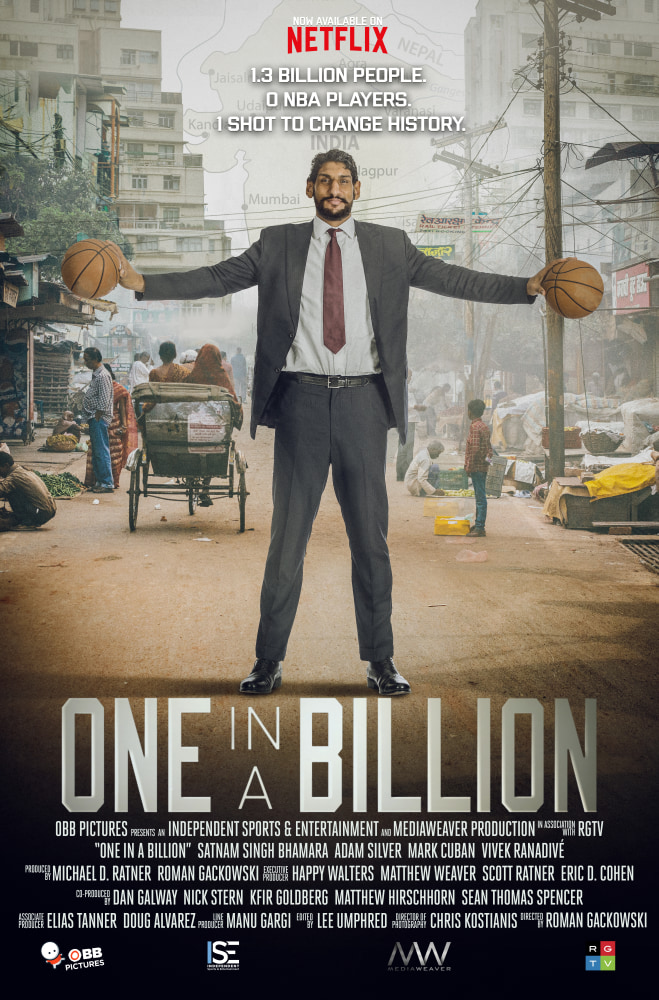
Satnam’s entire life is the equivalent of Kevin Garnett screaming “Anything is Possible!” on infinite loop. Now, his journey’s been encapsulated in the feature-length documentary One in a Billion, directed by Roman Gackowski, and released worldwide on Netflix on December 6. OBB Pictures partnered with Media Weaver and RGTV to produce this project. For a year and a half of filming, Gackowski followed Satnam as he visited his tiny farming village in Punjab, India, finished his time at the IMG Basketball Academy, Florida, and got drafted into the NBA on that fateful night in New York City.

The film shows the wild extremes lives that Satnam leads, in his farm in the Ballo Ke, where he is gifted a goat upon his return and walks around paddy fields in basketball kicks, and later, in the IMG Basketball Academy, one of the world’s finest facilities for youth basketball development. We see him take jumpshots on basketball courts in Punjab and meet high-level NBA executives and coaches at draft combines in the US.

Also featured in the film are individuals who have played a role in the life of Satnam or in basketball at large over the years, including NBA India’s former Director of Operations Troy Justice, NBA Commissioner Adam Silver, Dallas Mavericks owner Mark Cuban, IMG Academy Basketball coach Dan Barto, former India national team coach and now-IMG Academy director of basketball Kenny Natt, basketball agent Travis King, Secretary General of Punjab Basketball Association Teja Singh Dhaliwal, Sacramento Kings owner Vivek Ranadive, VP of Kings’ basketball operations Vlade Divac, Satnam’s family, including his father Balbir, and many more. SLAM senior editor Abe Schwadron’s pre-draft interview with Satnam also makes a cameo. (And after closely following Satnam’s journey over the past seven years, I sat down for an interview that’s featured in the documentary, too.)

Satnam Singh is the true star here, though. Through old photographs, stories, footage, and the lead-up to draft day, the documentary paints the picture of a young man who stood up to the responsibility of shouldering a moment in history.

On the day of the film’s worldwide release on Netflix, I spoke to director/producer Roman Gackowski, producer Michael D. Ratner, President/CEO of OBB Pictures, and Satnam Singh himself to learn more about the story behind One in a Billion.

SLAM: What first attracted you to Satnam’s story and this project?

Gackowski: Michael and I had worked together in the past and were looking for a project to collaborate on. Michael wanted a different kind of storyline and this was the one that specially struck a chord. He brought it up to me; we both felt it was a deep human interest story, and it felt even greater once we started pursuing it. As a lifelong sports fan, it blew my mind that a country with the population of India had never produced an NBA player, especially when you look at the way the NBA has evolved over last 25-30 years with their international exposure. There was a curiosity as to why that was. The story was fascinating from the beginning and Satnam was an interesting character.

Ratner: I was working on an ESPN 30 for 30 documentary and I wanted more sports stories that are about character and are inspirational. I was talking to different agents, and Travis King, who had been following Satnam, mentioned him. I was fascinated by this potential underdog story. We knew the stakes were high, and we couldn’t predict the ending—if he would actually get drafted. There are 1.3 billion people in his country and nobody had made it before. The final moment when I wanted to do this was when I spoke to Troy Justice [formerly of NBA India] who knew Satnam personally and told me he was a special young man. Troy was absolutely right! There is a scene in the movie, before the draft, when Satnam says that he has only opened the lock to basketball in India, but the door is still closed. This story is still going on, the end of the story is not written yet.

SLAM: Satnam, how did you first react to the news that there are people interested in a documentary about you? Was it strange having a film crew follow you around as you went through some of the most important moments of your life?

Singh: The documentary crew came with me to India, I remember, and my Dad asked me, ‘Why are they doing this?’ I told my Dad that they wanna focus on where I’m from and let people know who I am. Then I told myself, ‘These people are spending a lot of money for you, if you don’t work hard and you don’t do anything, it won’t be good for you’. So, that’s why I knew I need to work hard. I needed to go open the lock. That became my goal, to not disappoint my family, the investment by IMG, by the film crew. I did everything that they needed. As I say in the film: right now, I’ve only opened the lock. I’m only in the D-League. I need to go further and open the door to the NBA.

SLAM: What were the most challenging aspects of filming this story?

Gackowski: Going to his village, for sure, it was a different environment. Thankfully, the producers had put us up with the right people for this project, so we had the support we needed. The thing that struck me most was to see the differences: Satnam was 14 when he left his home, his family, and went literally halfway around the world. When you see the world he grew up in, to see where he was then, and then to IMG Academy in Florida, it’s another world. That was a story that we tried to tell. There were difficulties working around language, but we had set ourselves up in a position to tell the story. Satnam is a really good, true human being, who was trying to do so much for not just himself but his family and his country. You kinda get invested in a guy like that. When we were going along with him, everybody on the crew felt so close to him and kept on asking about him. We were rooting for him and were so happy how it eventually turned out. I know Satnam felt so much stress and pressure before the draft. All of us felt the same way.

SLAM: Satnam, when you see your whole journey in this film, from your village to NBA, what does it make you think?

Singh: When I watched the movie, I realized how much nicer the court is now back in Punjab! It wasn’t so nice when I started playing basketball there! I came to the USA in 2010. When I came here I said ‘Damn! If only we had the same opportunity in India!’ I was lucky I got a great opportunity and had coaches to help me here. I know my body changed, I learned a new language, changed the way I talked to people. But I don’t like to change my attitude of where I’m from. My background is important to me. You should never forget where you come from. Even if I have a million, billion dollars: money and the new people you meet matter less. The most important thing in my life is to understand where my family is, to understand how much I had when I first came here, and why I came here. I came here to play ball, make a name for myself, make history for India. That’s why I have only one focus.

SLAM: What do you hope that viewers take from One in a Billion?

Ratner: I hope that the viewer walks away feeling optimistic and engaged, and understand that they have watched a story that is still being written. This is a feel-good film. The climactic scene honestly tugged at my heart. When you watch it, you see the math the agents are doing for him to be drafted and you feel the pressure, too. Yes, the movie wouldn’t have been a failure if he hadn’t been drafted, but to be picked, it made it matter so much more. There’s something unbelievable there, the feat of him being drafted, shaking the deputy commissioner’s hand. This was a true Cinderella Story, a risk for this young man who worked hard, flew across the world away from his country, and made history. The commissioner [Adam Silver] said that Satnam could really open the door for NBA in India. Now the goal is for him to be on the NBA court. To play in his first NBA game.

SLAM: What did you learn about Satnam by getting to know him and interviewing the people close to him?

Gackowski: I come away with the understanding that he is an incredibly brave, dedicated, and pure individual. It was a big deal for him to come to the USA because there were people from his village, his family, his coaches, who had a lot of expectations. They didn’t quite understand what the journey would be for him. Satnam was still young when he first went out. There were a lot of expectations but he said to himself, ‘No matter what, I’ll take this on my shoulders. I’ll do this’.

He came to the USA and didn’t know the language. He was trapped and he fought through it. He took the risk. There’s some powerful moments in the films as he spent years learning the language, feeling lost, trapped, while he was working hard to be able to understand be productive on court and in the classroom. There was a scene when a coach talked to him and he understood, and it was a breakthrough moment! You could feel that it someone in his life had just turned the lights on!

He tells you to take a risk, to be brave. He did everything he could possibly could to get to this level. Troy Justice said in the documentary that Satnam is the kind of player who would run through the wall for you, and he literally will. If he hadn’t accomplished this, it wouldn’t have been for a lack of trying. That’s what we see in the film: he’ll do it and do it the right way. And he doesn’t just do it for himself. It’s for everyone involved, for his parents and coaches in India and the USA.

SLAM: Satnam, the movie is over, but your basketball career goes on. You’ve already made history. If there was a sequel to the story, and you could write it, what would you like to see.

Singh: Having them [the documentary crew] around motivated me more, it gave me more help to have a strong mind and work hard. Maybe I’ll have one more documentary again. The same movie or a different kind—about what I can achieve in my next step!

December 7, 2016

Satnam Singh documentary "One in a Billion" is now streaming on Netflix worldwide!


Here's a pitch for a movie: a poor farmer's son from rural India learns basketball and becomes the first of a country of 1.3 billion to be drafted into the NBA.

The summary, if this was a piece of fiction, sounds too improbable to be realistic. But the truth is often stranger than fiction, and over the last decade, that story actually took place: Satnam Singh, the son of a farmer from Ballo Ke village in Punjab, used both nature (his size) and nurture (hard work) to make history when the Dallas Mavericks picked him in the 2015 NBA Draft.

Released worldwide to stream on Netflix on December 6, 2016, "One in a Billion" tells Satnam's comprehensive story so far in great detail. The documentary was produced by OBB Pictures and directed by Roman Gackowski. For a year and a half of filming, Gackowski followed Satnam as he finished his time at the IMG Basketball Academy, got drafted to the NBA, and visited his village in Punjab. He also interviewed several close individuals connected with Satnam's story from this childhood, his education, and his professional career.

If you know Indian basketball, you know the ending of the story already. "One in a Billion" takes us back to the beginning. It brings to screen the surreal story behind Satnam's real life. Some of the strongest moments are when the documentary crew follows him into the hinterlands of Punjab as he visits his family, introduces his friends, and lays on the very farm he grew up in. These scenes are juxtaposed with scenes a few months later at the IMG Academy, one of the finest facility of youth sports development around the world. The documentary introduces viewers to Satnam's family, his coaches, teachers, and his agent. We see him direct the way deep into his Punjabi village. We see agent Travis King's pitch to Satnam, we see him visit draft combines and get suited up for the draft, perform at pre-draft workouts with various teams in the NBA.

One of the most powerful scenes in the film is when Satnam - who has struggled in IMG because of his weak English proficiency - realises that his English has now become good enough to converse freely. "I just wanted to keep talking," he says joyfully. Of course, the moment at the Barclay's Center in New York City when NBA Deputy Commissioner drafts Satnam into the NBA is Satnam and the film's crowning moment.

Also featured in the film are individuals who have played a role in the life of Satnam or in basketball at large over the years, including NBA India's former Director of Operations Troy Justice, NBA Commissioner Adam Silver, Dallas Mavericks owner Mark Cuban, IMG Academy Basketball coach Dan Barto, IMG Academy and former India national team coach Kenny Natt, basketball agent Travis King, Secretary-General of Punjab Basketball Association Teja Singh Dhaliwal, owner of the Sacramento Kings Vivek Ranadive, VP of Kings' basketball operations Vlade Divac, Satnam's family, including his father Balbir, and many more. As I have been tracking Satnam's story closely for several years and offer an international perspective on Indian basketball, I was featured in the documentary as well.

Satnam Singh, however, is the of course the star of the documentary. Through old photographs, stories, footage, and the lead-up to draft day, the documentary paints the picture of a young man who stood up to the responsibility of shouldering a moment in history. Satnam says early in the movie, citing the responsibilities his father told he has for his family and India, that "It's a lot!" The documentary shows a humble young man going out into the big world of NBA basketball where everyone except himself seemed to have a well-carved space. Satnam, instead, created his own space, breaking through the giant wall with his 7-foot frame and coming out on the other side as an ever-smiling, ever-vulnerable, gentle giant.

Go and watch "One in a Billion" now! If you already know the story, it will open your eyes to understand the man in the middle, the details of his struggles, and the joy of his triumph. And if you don't know it yet, well, get ready for an inspirational tale, against all the odds, of an Indian star's success.

November 30, 2016

Former NBA champion Shawn Marion is matrixing it up in India this week

ShareThis

Back in 1999, in the good ol' days before the Y2K scare and smartphones, technology was a lot more mysterious and opaque for the average person with a Hotmail account. It was in these times that The Wachowski Brothers began to promote their upcoming, enigmatic film, 'The Matrix'. "What is the Matrix" asked the promos leading up to the movie; we didn't know anything about it, but we were told it was going to be something special, something futuristic, something intelligent, something difficult to understand. When it was released, it went on to become one of the most popular and influential movies ever, whilst still remaining special, intelligent, beyond easy comprehension.

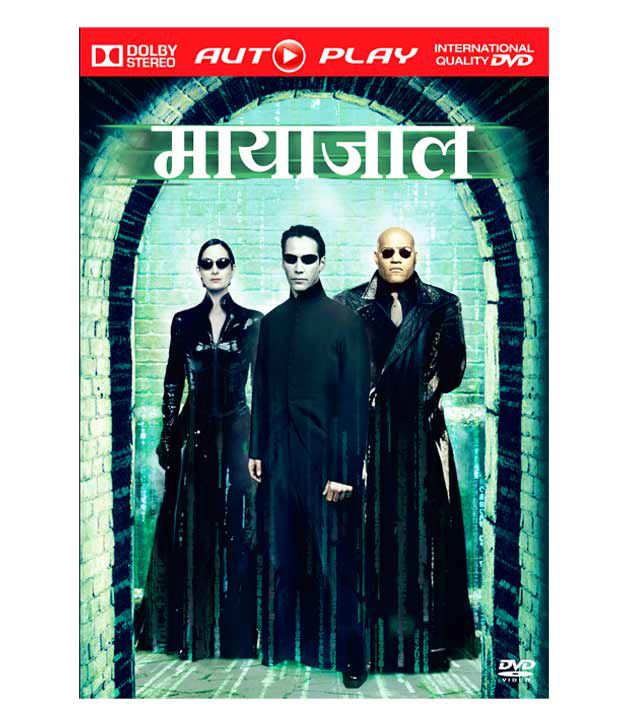
What is the Matrix, indeed? In India, the film was released dubbed in Hindi as 'Mayajaal', the web of the Maya, or the illusionary world around us. It was a translation befitting the enigma and illusory shroud of the original. I saw the posters, but I regret never watching the dubbed version itself to hear whoever voiced Keanu Reeves's "I know Kung Fu" in Hindi.

Four months after the film's international release (so, probably right about the time we would've seen it in India!), the Phoenix Suns picked up a mercurial, hard-to-define, 6-foot-7 forward Shawn Marion with the 9th pick of the draft from UNLV. From his rookie season onwards, this forward showed that he could do a little bit of everything, score inside, outside, defend, dribble, attack, rebound, pass. In the time when the NBA was still strict about its positional definitions, he was a peak into the future, a player who excelled both at the physical and cerebral parts of the game, a do-it-all forward who has become the precursor to every small ball "big" that NBA lineups now thirst for (I'm looking at you, Draymond!).

Over the course of a successful - if a little underrated - sixteen year career, Marion became a multiple-time All Star and All NBA Third Teamer, played a crucial role for the mid-2000s Suns, one of the entertaining teams in history, and won an NBA title late into his career with the Dallas Mavericks. The 2005–06 NBA season in Phoenix was perhaps the best of Marion’s career. He was the only player in the NBA ranked in the top 20 in points, rebounds, steals, blocks, field goal percentage and minutes. He finished the season leading the Suns in points per game (21.8), rebounds per game (11.8), blocks per game (1.7), and steals per game (2.0). By the end of his career, he joined an exclusive four-man club in NBA history, which includes Karl Malone, Kevin Garnett and Hakeem Olajuwon, to record 17,000 points, 10,000 rebounds and 1,700 steals.

Marion's game was something special, something futuristic, something intelligent, something difficult to understand. During pre-season of his rookie year, broadcaster Kenny Smith nicknamed him 'The Matrix', and it became his persona in the NBA forever.

Now, a year and a half after his retirement, Mr Matrix himself is in India to show us the Mayajaal side of that persona!

NBA India announced today that Shawn Marion will arrive in India on November 30 for a five-day visit of Mumbai. During his stay in Mumbai, Marion will be a part of the Reliance Foundation Jr. NBA programme activities. On Thursday, December 1, he will chat with fans in India live on NBA India's Facebook page. He will visit New Delhi to conduct a Jr. NBA camp at the ITL Public School on December 2. Marion will be present at the inauguration of the 2016-17 ACG NBA Jump programme, which will take place on December 3, 2016 at Mumbai University Indoor Basketball Stadium, Kalina. He will feature on Sony Six’s Sunday show – NBA Around the Hoop – on December 4.

"I’m really looking forward to visiting India for the first time," said Marion. "It will be an incredible experience to interact and share my love and knowledge of the game with young Indian boys and girls."

By the time he retired in 2015, Marion had played for the Suns, the Miami Heat, the Toronto Raptors, the Mavericks, and the Cleveland Cavaliers. He will most be remembered for being the glue that kept together the mid-2000s Suns, which were led by Steve Nash and assisted - when healthy - by Amar'e Stoudemire. They were the original run-n-gun 'smallball' team, preceding the upcoming dominance of the Golden State Warriors, and Marion was the original 'tweener' forward capable of playing big or small (on both ends of the floor) as the lineup required. Although his numbers were down by 2011, he played an important role as a starter for the Mavericks squad that upset the Miami Heat 4-2 in the Finals to win the NBA championship.

November 24, 2016

Health, Wealth, and Ringzzz


Where I write Diwali greetings cards with Squad Goals for each NBA team.

This feature was first published in my column for Ekalavyas.com on November 7, 2016. Read the original version here.

Photo courtesy: Ekalavyas. Image by Harshika Jain


It is of some fortune for NBA teams that the new season is starting off around the same time as billions of Indians around the world celebrate Diwali, the beginning of a fresh, new year. Just replace the LED lights with some diyas, tune down the sound of the DJ with some fireworks, and turn our attention to the demigods on the court.

Diwali is synonymous with greeting cards and large parcels of gifts, usually consisting of diabetes-inducing laddoos and addictive kaju-kishmish combinations, as friends pass on their good wishes to each other. Some need wishes of better performance in their exams, some for good health, and some for financial stability.

What wishes do the NBA teams desire? Of course, the ultimate goal of each team is to eventually win a championship (yes, even the 76ers, despite what seems like a ‘process’ as pain-inflicting and long as the whole of the kal-yug). But what are their realistic aims for the 2016-17 season? Every team, from the Warriors to the Nets, will start the season with the same record, 0-0. Where do they hope to go from there? With the new season and the new year on the Hindu calendar on the way, here are some of my wishes for each squad.

Atlanta Hawks: A new guest is in your house, a guest that calls your city his home. May Dwight Howard find peace in his hometown next to Paul Millsap, may Dennis Schröder not falter as the lead point guard, and may you survive the loss of Al Horford to remain a playoff contender in a rebuilt year for the Eastern Conference.

Boston Celtics: May the arrival of Al Horford from Boston bring you prosperity. The mantle for ‘second-best’ in the East is up for the taking, and we shower blessings for Coach Brad Stevens to figure out a perfect formula with the depth at his disposal to give you that mantle.

Brooklyn Nets: You suffer from lack of talent and lack of a future First Round draft pick. Wishing that you’ll do the decent thing to trade Brook Lopez away from his pain. When things look dark, put more wax in the diya for some optimistic light: at least you could get a season of semi-Linsanity with Jeremy Lin back in New York.

Charlotte Hornets: May Coach Clifford’s defensive intensity stay as consistent as ever, but for you to return to the playoffs, you will need Kemba Walker to have some help on offense, too. Hopefully the gods will fix Michael Kidd-Gilchrist’s jump-shot so that he can master basketball as well as Arjun mastered the teer-kaman.

Chicago Bulls: You see that box of Diwali sweets that just rolled up to your house? Sure, the chocolates, bundi-wallah laddoos and barfis, look amazing right now, but remember that you can’t just have all the sweets, you need a balanced diet. You are blessed with the ‘Three Alphas’ in Rajon Rondo, Dwyane Wade, and Jimmy Butler, but where is the outside shooting coming from? You are very intriguing, my Bulls, and a few healthy options in your diet could make you a surprisingly dangerous playoff team.

Cleveland Cavaliers: Your Diwali night was the ring ceremony, where you raised your banner and were celebrated as returning champions, and your Big Three of LeBron-Irving-Love is similar to the triumphant return of Ram-Laxman-Sita from Lanka. Lakshmi has been good to you in recent years. Your goal is to stay healthy, the East is yours for the taking but don’t underestimate it. Returning to the NBA Finals is a must, and after that, may you repeat your Ramayan once again with another title for Cleveland.

Dallas Mavericks: Here’s wishing that you don’t let people forget about you. You have a good coach (Carlisle) and a solid, if aging, backbone (Nowitzki). May your new additions – Barnes and Bogut – slide in seamlessly into the lineup, and your point guard – Deron Williams – show more consistency.

Denver Nuggets: Yes, you are sure to go through some of the bumps in the road. That is a part of youth, dear Nuggets. Don’t be down with failure this season, you must keep a long-term approach. May your brigade of exciting young players – Emmanuel Mudiay, Nikola Jokic, Jamal Murray, Jusuf Nurkic, Will Barton – grow into great talents. 

Detroit Pistons: May Guru Dronayacharya, I mean, Stan Van Gundy, be a positive influence on you and may Andre Drummond learn to make his free-throws. Many believe that you have the ability to become the surprise team in the East: my wish is that improved performances by Drummond, health for Reggie Jackson, and consistent outside shooting brings the chants of ‘DET-ROIT-BAS-KET-BALL’ back to the playoffs.

Golden State Warriors: Congratulations, for better or worse, you are heading towards a mythical season. Diwali is not a time for negative wishes, but so much negativity has been showered upon you recently that you must turn it into a feeling a revenge and retribution. You blew a 3-1 lead, the worst job of defending an advantage at home since Raavan in Lanka; nothing but a championship ring will be good enough. I wish great chemistry to Durant, Curry, Green, and Thompson and I wish for a historical season in the Bay.  

Houston Rockets: You do not need my blessings for offense: between Coach Mike D’Antoni and James Harden, you will have no trouble with the prosperity of points. But life is all about balance, my Rockets, and without defence, you can wave those post-season dreams goodbye. I wish to you the gift of more defensive intensity so that you are not just fun to watch, but successful, too.

Indiana Pacers: Count your blessings, dear Pacers, I’m sure only the intervention of Lord Dhanvantari helped Paul George return to the court and back to superstar status. I wish to you more continued health for PG-13 as he makes an ambitious bid for the MVP award. You are in arm’s reach away from the Eastern Conference Finals, and I wish that your role players – Myles Turner, Monta Ellis, Jeff Teague, Thaddeus Young – can provide George the supporting cast he needs.

Los Angeles Clippers: I wish to you to stop complaining, dear Clippers. Sure, you’ve never been past the Second Round despite a wealth of talent, but you are blessed with a strong, consistent core of Blake Griffin, Chris Paul, and DeAndre Jordan. You can be a legitimate challenger to the Warriors in the West: my blessings for you to figure out some team chemistry issues so you may finally make franchise history.

Los Angeles Lakers: Kobe has gone, crossing over the river from the Maya to the Atman, achieving basketball immortality and Nirvana. This is a good opportunity, young Lakers, for you to start over in the mortal with new deities to worship. Sure, you will lose a lot, but you should stay in track for a strong rebuild. May D’Angelo Russell, Brandon Ingram, Jordan Clarkson, and Julius Randle, form a strong young core and the distractions of the great Swaggy P kept to a minimum. The latter will need some extra prayers.

Memphis Grizzlies: Lakshmi’s blessings of prosperity have been especially kind to Mike Conley, who now has the richest contract in the NBA. Times are changing in the league, but you remain the same. I wish for health for Marc Gasol, offensive output and shooting from Chandler Parsons, and for Conley to live up to his contract and make Lakshmi proud. May the dominance of the gritting and grinding era never end.

Miami Heat: Life has its ups and downs. A few years ago, you were blessed with the NBA’s best players, had championships, a great coaching and management staff, and weather to attract the top free agents. The top players are gone but you must count your blessings because all the rest is still intact. Starting new without a long-term loved one – Dwyane Wade – is never easy. I wish you a relatively painless rebuild.

Milwaukee Bucks: There are some curious creatures in the universe with the power to astonish, surprise, and leap into greatness with the finesse of a hiran. In Giannis Antetokounmpo, the ‘Greek Freak’, you have one such special creature, a hiran, I mean, a Buck. I wish you the best for the ‘Point Giannis’ experiment and for him to make a tantalising young duo along with Jabari Parker. You have my blessings to jump back to a playoff spot in the East.

Minnesota Timberwolves: This Diwali, I won’t offer you any good fortune: you already have been showered with luck by Lakshmi after adding Karl-Anthony Towns, Andrew Wiggins, Zach LaVine, and Coach/President Tom Thibodeau in recent years. But fortune is only half the job: now, you need to follow Guru Thibodeau’s lead and become the hardest working team in the NBA. A long-awaited return to the playoffs is near.

New Orleans Pelicans: Do you know that some souls have a third-eye chakra, a part of the brain that sees more than the physical realms of the two eyes, that can see into the people of humans and into the future of the universe. This is a very special gift, and you, dear Pelicans, have a special soul with the ‘third eye’ in Anthony Davis. His has the shape of a unibrow, but the results are the same: dominance. At times, the talent around Davis could make this season seem depressing: I wish continued health for Davis and consistent play from his teammates to make sure the future remains bright.

New York Knicks: One of the most contentious traditions of Diwali is gambling, and this Diwali, you have really gone for a high-stakes gamble, adding Derrick Rose and Joakim Noah to a squad with Carmelo Anthony and Kristaps Porzingis. I wish that all these maha-yoddhas mesh together to thrive in your holy triangle and you treat those long-suffering fans with deep playoffs action.

Oklahoma City Thunder: Don’t feel alone Russell Westbrook, the brother by your side has left you for Bay-area pastures, but you have some decent teammates around you: Steven Adams, Victor Oladipo, and Enes Kanter. Perhaps no individual has as much pressure to carry team like Westbrook does. Hanuman moved a mountain, remember. Westbrook would himself say: “Why not?”

Orlando Magic: You confuse me Magic-wallahs. What’s up with all the bigs? Remember, the holiday season is a time of generosity, too, and each generous act returns to one with greater goodness. Trade away some players, give away some players, edit and sharpen your roster. You have a good coach in Frank Vogel and some interesting pieces – I wish Aaron Gordon develops into a star and you have some real jadoo in Orlando in the future.

Philadelphia 76ers: Remember, Diwali didn’t happen in a day. It took Ram, Laxman, and Sita the suffering of exile from their kingdom, a kidnapping, a battle, and a long stroll back to return to Ayodha triumphantly. You have been broken down, but every depth leaves room for a rebuild. Nurse your injuries and enjoy your precious gifts. I guess what I’m trying to say is: trust the process.

Phoenix Suns: Believe in your karma, Suns. A decade before the Warriors free-wheeling, three-point-shooting style revolutionised the NBA, you did it first and nearly perfected the art. You have an inexperienced team right now, but the fruits of your labour will come back to bless you in the future. Be patient. Devin Booker is the real deal.

Portland Trail Blazers: May Damian Lillard truly become an MVP-level talent and may your role players grow to greatness besides him. After the first three teams, the Western Conference is there for the taking; with Lillard as your leader, may you improve on your playoff performances from last year and even go a step further.

Sacramento Kings: I hope that when he inaugurated the new arena – the ‘Golden 1 Center’ – your Indian-born owner Vivek Ranadive decorated with ample diyas and agarbattis and held a grah-puja to court the blessings of all the gods. You are going to need it. The only true raja among those Kings is DeMarcus Cousins. May he find basketball nirvana in the league – even if it means a trade for him and a few new faces for you.

San Antonio Spurs: The last two decades have been your satya yug, a time where paradise has come on Earth, and you have enjoyed unprecedented, continued success. Now that the leadership of Tim Duncan is over, may the good times continue with Kawhi Leonard as your franchise player. May you be blessed with one more title and some much-needed smiles for Kawhi.

Toronto Raptors: You were blessed with a franchise-best season last year. How do you follow up with the rising expectations? You know what to expect from Kyle Lowry and DeMar DeRozan, but I wish that Jonas Valanciunas will develop into a game-changing center this year so you can continue to become an elite team in the East with a realistic chance of upsetting the Cavaliers.

Utah Jazz: Do you know the story of Satyavadi Harishchandra, an ancestor of Ram? At one time, he was a great, rich king, just like you were a great contender with Stockton and Malone. But by the manipulation of Vishwamitra, Harishchandra lost everything and spent years in suffering. You, our Jazzy friends, have suffered a lot in recent years too. But remember, Harishchandra’s tragic story had a happy ending, and he came to rule Ayodha. You have an uber-talented young core: may your tapasya pay off so you return to the playoffs and become one of the surprise teams in the West.


Washington Wizards: Listen, I get it, brothers fight, it’s been happening forever, from Pandavs and Kauravs to Cain and Abel. The tension between your talented backcourt of John Wall and Bradley Beal is worrisome but not unfixable. Without pukka-dosti, a good bond between your backcourt, your playoff chances will be dim. I wish you camaraderie and positive vibes for the rest of the season.