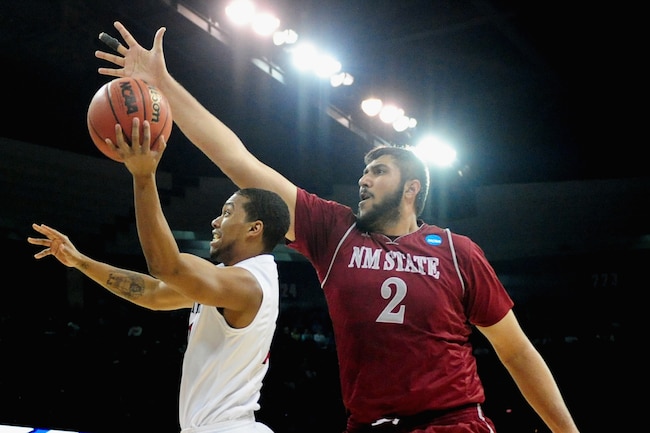
Showing posts with label New Mexico State. Show all posts

April 9, 2015

The Birth of Mahatma Grande


After years of climbing up the ranks, from High School to College to the D-League, 7-5 Canadian giant Sim Bhullar finally saw his NBA dream becoming a reality: he was signed to a 10-day contract by the Sacramento Kings last week and made his first appearance in 16.1 seconds of action against the Timberwolves last night. It was a nice moment that a only a handful of basketball players ever get to experience: the feeling of putting on an NBA jersey, stepping on an NBA court, and finding his name permanently enshrined in the box scores of NBA history.

But of course, you know the story by now, and you know why Bhullar's 16.1 seconds were more significant than most others. With one small step on court, Bhullar took a giant leap for desis worldwide, becoming the first player of Indian-origin to ever play in the NBA. Unlike the usual hungama and tamasha that we Indians like to associate with most of our accomplishments, Bhullar's appearance was largely subdued. His entire debut was only a shade longer than the maximum length of an Instagram video. He touched the ball just once (inbounding it to a teammate), and finished with a box-score of ducks 0-0-0-0-0. A day later, Bhullar scored his first two points in one and half minutes of action in the Kings loss to Utah. And with these humble beginnings, another NBA barrier was broken and a giant was born.

Bhullar's status has soared in recent days, too, with strong performances in the D-League to provide him his foundation and the Kings' contract taking his popularity through the roof. Basketball-loving Indians from India, Canada, the United States, the United Kingdom, Australia, and in every nation on every continent on the globe who have long dreamt of the day that one of their own – a desi – would achieve the highest benchmark of the hoop dream and play in the NBA, and in Bhullar, they finally saw that dream achieve reality.

Of course, there is a shade of cynicism amid the optimism, too. The Kings are owned by the NBA's only Indian-born owner, Vivek Ranadive, and thus it has no surprise that the franchise chased him after the draft, assigned him to their affiliate D-League team, and signed him for the NBA (after their own playoff hopes were finished) just in time for the annual Sikh Community Appreciate Night. There have also been voices, such as the excellent Amar on SLC Dunk, who say that the NBA has overstated Bhullar's Indian connection to reach out to the billion-strong population in India instead of focusing on his Canadian basketball roots. It will be up to him to prove that he can be a useful NBA contributor and more than just a publicity stunt - and I believe that he has the skill-set and potential to continue proving his doubters wrong.

Nothing can take away Bhullar's achievements, as he gave his blood, sweat, and tears to the game and made the most of his combination of talent and size to realize his individual hoop dream. The son of Punjabi immigrants to Canada has now played and scored in the NBA. Many more players of Indian-descent - and hopefully of Indian citizenship - will do it after him, but he will always be the first. That first moment on court lasted just 16 seconds, but that's 16 seconds more than you, me, or any other player with some Indian in his blood-stream has ever played.

So let's celebrate the big man's milestone and feast on some butter chicken (like I ever needed an excuse to do that!). Let's get down with the Sikh-Ness! Let's celebrate the birth of Mahatma Grande, the greatest nickname that the giant Canadian-Indian could have possibly asked for (word to @scottostler). Sim Bhullar has finally broken the desi-NBA barrier; hopefully he can inspire many more to follow in his footsteps and bring a lot more masala to our favourite basketball association.

September 14, 2014

The New Kingdom?


With the NBA’s first Indian owner Vivek Ranadive and first Indian-origin player Sim Bhullar, the Sacramento Kings are setting their sights at conquering basketball’s next great frontier

I wrote this feature for SLAM Online, and it was originally published on their website on September 3, 2014.

Up by three points with less than four minutes to go in their Preliminary Round game against China, India were on the cusp of history. If India could hold on to their lead, it would give them their first victory over Asian giants China in over 70 years of international competitive basketball.

Held in Wuhan, China this year, the FIBA Asia Cup featured nine or ten of the top teams of the continent. China had chosen to field mostly a second-string roster for this tournament, but nevertheless, they featured many players (like 18-year-old NBA prospect Zhou Qi) who would have a role in the upcoming Chinese Basketball Association (CBA) season. The Indian national team had no basketball professionals. A win over China – weakened squad or not – would be unprecedented.

Meanwhile, back home in India, hardly anyone knew of this game or the tournament at all. Basketball is a niche sport in a country of 1.2 billion people – the world’s second-largest population after China – most of whom weren’t even aware if India even had a basketball team. Beyond cricket – which is India’s most-loved and nearly-exclusive national pastime – there is much ignorance among the general public about the country’s exploits in other sports. This ignorance unfortunately extends to the larger Indian diaspora across the world too, from the United States and Canada to Britain and Australia.

“Do Indians even play basketball?” many wonder.

Back over in Wuhan, the 12 Indians of the national squad were playing basketball all right. After decades of 20, 30, 40, or 50 point losses to China in the past, here was an Indian team suddenly confident to be within close grasp of the impossible. They had blown a double-digit early lead already, fallen behind to the Chinese in the second half, and then bounced back again. Now, the score read 55-52 in India’s favour, with 4:07 remaining in the final quarter.

Limited to mostly Asian tournaments over the past few decades, the Indian team had been minnows against the continent’s giants, happy to compete for participation points rather than any medals. India’s current FIBA world ranking (61) sees them trail behind the likes of the Virgin Islands and Cape Verde, two countries with a combined population of a little more than Dehradun, India’s 76th most populous city. Despite some baby steps towards recent improvement, India have also made a habit of dramatic late-game breakdowns. A late three-point lead over China, in China, felt more like a house of cards ready to collapse. 

While India tried to survive those remaining four minutes, thousands of kilometres away in the Western Hemisphere, there were a couple other Indians flirting with history. Last year, Mumbai-born Vivek Ranadive had become the first Indian majority owner of an NBA team when he purchased the Sacramento Kings. While Ranadive’s Kings struggled on court, the software tycoon focused on pushing the team’s brand off-court in his attempts to tie in his team with the country of his birth and use his unique opportunity to make the Kings into “India’s Team.”

Meanwhile, a Canadian born to Indian-immigrants in Ontario grew to become a 7-foot-5 inch behemoth and win a couple of back-to-back Western Athletic Conference (WAC) tournament MVP awards in two years at New Mexico State. This giant – Sim Bhullar – declared for the NBA draft, went undrafted, and was promptly picked up by Ranadive’s Kings for their Summer League squad. Coincidently, on the same day that India played China in Wuhan, Bhullar made his Summer League debut for the Kings against the Hornets in Las Vegas.

A month later, on the same day that India celebrated its 67th Independence Day, the Kings announced that they had signed Bhullar to a contract, officially making him the first player of Indian-origin in the NBA. With one signature, a racial barrier had been broken in the league and the Kings had taken another calculated step towards their outreach to India.

Ranadive stressed the importance of Bhullar’s cultural heritage and its influence on the Indian audience. “I’ve long believed that India is the next great frontier for the NBA, and adding a talented player like Sim only underscores the exponential growth basketball has experienced in that nation,” Ranadive said in a press release, “While Sim is the first player of Indian descent to sign with an NBA franchise, he represents one of many that will emerge from that region as the game continues to garner more attention and generate ever-increasing passion among a new generation of Indian fans.”       

Over the past year, Ranadive’s Kings have hosted Indian-culture nights, launched the NBA’s only Hindi-language website, and even released a classic video reaching out to Indian fans to vote DeMarcus Cousins into the past All Star Game. Ranadive also expressed his desire to take the Kings to India for the NBA’s first-ever exhibition game there.

Blake Ellington, an associate editor with sactownroyalty.com, spoke to me recently from the perspective of Kings’ fans about the team’s ‘Indianization’, “Sacramento is a small market and Kings fans enjoy it when the team is on national television or involved in things like Vivek's efforts to expand the NBA into India,” he said, “The Kings held a Bollywood Night last season and the fans were exposed to some elements of Indian culture, and they seemed to have a good time with it… I think Kings fans do have sort of a kinship with India now.”

Just days after his signing was made official, Bhullar joined Ranadive to headline the largest-ever ‘India Day’ parade through New York City. While two other members of the Sacramento Kings – DeMarcus Cousins and Rudy Gay – headed off to Spain to represent Team USA internationally, Ranadive and Bhullar were globalizing the Kings by reaching out to the Indian community in Sacramento, India, and worldwide.

On-court, the 21-year-old Bhullar – who will be the NBA’s tallest player next season – is still a work on progress. It would be unlikely for him to get an opportunity to be anything more than a fringe contributor in Sacramento, but he has the ambitions to prove his doubters – many who believe that he was signed for business rather than basketball reasons – wrong.

Photo: Karan Madhok for Ekalavyas.com
“I just wanna get better,” Bhullar told me in an interview a few weeks ago, “I want to change my game to fit the NBA game. I want to get more comfortable with the league and prove all those who doubt me wrong. I’ll respond to [the critics] by just producing, by just doing what I do.”

Ellington believes that Bhullar still has a way to go before becoming an impact player for the Kings this season. “He isn't quick enough (at the moment) to compete with NBA-level players – we saw that on display in the NBA Summer League. He will probably get an opportunity to play on the Kings' D-League affiliate, the Reno Bighorns. This will be good experience for him and maybe with some extended playing time there he will work himself into a spot where he could get some minutes on the Kings roster… So is it cool that the Kings signed the first NBA player of Indian descent? Absolutely. Do I expect him to do much for the Kings this season? No.”

Off-the-court, Bhullar’s impact in India will be felt if he truly can become a role model to a people who need a basketball star to inspire the next generation. Indian basketball players – in India or abroad – rarely made the jump into mainstream consciousness. The best players in India’s national squad like Amjyot Singh, Amrit Pal Singh, or Vishesh Bhriguvanshi are barely recognized outside the small, core basketball circles in India. Success for Bhullar could promote the Kings and the NBA in India, and if basketball gets more popular in the country, the spotlight could also shift on the exploits of India’s own star players.

But for a brief moment in July, those star Indian players did enjoy their moment in that spotlight. India had played inspired defence to keep the Chinese at bay. And now, with a little over four minutes left on the clock, Bhriguvanshi dribbled the ball across the three-point arc. He had locked eyes with the athletic Amjyot Singh, who – aided by two picks from his teammates – found a clear lane to the rim. Bhriguvanshi lobbed the ball up high to the inside, and Amjyot caught it and slammed it down to give India a five-point lead. The alley-oop ignited the entire Indian bench, as the players screamed and threw their towels up in celebration. The home crowd were shell-shocked in silence.

India survived the last three minutes of the game with a couple more clutch plays on both ends, and when the final buzzer sounded, India had won 65-58. Head Coach Scott Flemming (formerly an assistant with the NBDL’s Texas Legends) had led India to the unthinkable: a basketball victory over China. The overall performance – capped by Amjyot’s electrifying clutch alley-oop finish – were the product of an unfamiliar, confident Indian side, a squad that casually brushed away decades of failure to announce the coming of a new India. 

For once, both mainstream and social media in India took notice, the news trended on Twitter and went viral across the nation. Only success and hype can capture the attention of the notoriously-fickle Indian audiences, and India’s success at Wuhan displayed a small fraction of basketball’s potential to Indians if it is developed and promoted the right way.

In a country of over a billion people, even that small fraction represents a number in the hundreds of thousands. It is these hundreds of thousands – or millions – that Ranadive and the NBA is counting on to turn into basketball’s next kingdom. China is famously the world’s largest basketball market, with some estimates counting around 300 million hoop fans in the world’s most populous nation. As the Chinese market gets more saturated, India presents a tantalizing new face for the sport.

“What Yao Ming did for China, we hope players like Sim will do for India,” said Ranadive at the Summer League, “I have this vision — I call it NBA 3.0 — where I want to make basketball the premier sport of the 21st century.”

While he strives hard to get in shape and improve his eventual on-court impact, Sim Bhullar’s broad shoulders will also be carrying the hopes of the South Asian (or desi) basketball community across the globe. This is a heavy burden on a 21-year-old NBA rookie who is only looking to secure his professional future and make a place for himself in the world’s toughest basketball league. But so far, Bhullar has responded to this extra responsibility with great aplomb.

“I don’t feel any pressure,” Bhullar said, “I grew up in Ontario, Canada, and my parents came from India. I know that all the hard work that has been put leading up to this situation has paid out. I wanna be a role model: hopefully, I’ll get to see four or five more Indian-origin players in the NBA; that will be a great feeling!”

“Do Indians even play basketball?” they ask. Hopefully, Bhullar’s journey, coupled with the success of other Indian basketball players, can put to rest any further questions.

August 15, 2014

It's official: Sacramento Kings sign Sim Bhullar to a contract & make him the NBA's first desi ever!


And now, officially, a player of Indian-descent has become a part of the NBA family. If you've been following the desi-hoops noises in recent years, you wouldn't be surprised to hear that this player is the 7-foot-5 Canadian giant Sim Bhullar. And of course, it wouldn't surprise you that the team which picked him is the Sacramento Kings, the first and only NBA franchise whose majority owner is an Indian.

As India awoke to celebrate Independence Day on August 15th, thousands of miles away in a different time zone, Bhullar - born to parents that immigrated from Punjab, India to Toronto, Canada several decades ago - announced via his own Twitter account that the Kings had signed him to his first NBA contract. Further details of the contract haven't yet been announced, but the rookie minimum this year is $507,366, and it can be assumed that it's a non-guaranteed deal to participate in training camp with the Kings from October.

Bhullar, who played the last two years for New Mexico State University (NMSU) and won the Western Athletic Conference (WAC) tournament MVP honours in both years declared for the 2014 NBA draft earlier this summer, but wasn't picked by any NBA team on draft night. Only a few days later though, the Sacramento Kings signed Bhullar to join their Summer League roster for Las Vegas, with hopes that the giant Center could earn a potential roster spot.

He didn't exactly make waves at Vegas, but he wasn't given much of an opportunity to make even a tiny ripple. Bhullar only hit the floor in four games at the Summer League for the Kings, playing just about two and a half minutes per game. He only attempted and scored one basket (so, that's a 100 percent from the field!) and grabbed just two rebounds in a total of 10 minutes of action through the entire tournament.

Meanwhile, the Kings did pretty well at the Summer League without much help from Bhullar, as they won the tournament with a final triumph over the Houston Rockets.

Despite his near-absence from meaningful Summer League action, the Kings chose to sign Bhullar, officially making him an NBA player. Bhullar will now attend training camp and will have a chance to prove that he can be a part of the roster on Opening Night of the 2014-15 season.

Despite the odds against him, the big man's chances are looking good. At this point, the only other listed Centers for the Kings are DeMarcus Cousins (aka Boogie Smooth, the people's champ, who needs to be an All Star this season) and Aaron Gray, who was traded to the Kings last December but only played around 10 minutes a game in Sacramento last season. Cousins is the literally and figuratively the centerpiece of this franchise, but if Bhullar can prove his worth to Coach Mike Malone, he may be able to earn some spot as Cousins' backup Center.

In all likelihood, Bhullar will make the team but probably not play too often. Despite his dominant years in college, he may have a much tougher time keeping pace with the speed of the NBA. That said, Bhullar has indeed gotten in much better shape and lost a lot of weight over the summer, and we hope that the hard work that he has put in to improve both his game and his conditioning can reap him some rewards.

Of course, all of this smells like a marketing ploy hatched by the Kings and their Indian-born owner Vivek Ranadive. In just over a year as the new owner of the team, Ranadive has shown great creativity in promoting the team to their existing and potentially new fans. It is all too well known by now that the billion-plus population of India is basketball's most exciting (relatively) untouched market, and many are hoping to capitalize on that potential fanbase. Ranadive's Kings have of course taken the lead in this matter, Over the past year, Ranadive’s Kings have hosted Indian-culture nights, launched the NBA’s only Hindi-language website, and much more. When Bhullar was added to the Summer League roster, the Kings even announced him as 'Indian' under the 'Nationality' column of the team-list, which had to be corrected after a few of us complained on Twitter.

So yes, Bhullar's official signing to the Kings will continue to the trend of popularizing the Kings (and thus, the rest of the NBA) to India. Bhullar's jersey sales won't exactly skyrocket - since most Indians are still new to the NBA - but there should be a noteworthy bump for sure. Hell, I might go buy one, too. Here's a guy who seems to love Butter Chicken almost as much as I do AND he could play backup minutes to Boogie Cousins? That's a no-brainer.

But the big question for the big man now is, can he prove that he's more than just a marketing tool? Bhullar has made desi ballers around the world extremely proud, and now, the next step is to silence all the doubt and the hate by proving that he really does belong in the NBA. The Kings could sure use strong contribution from a talented young big man who can be a beast on defense, a soft touch around the basket, and a wingspan to strike fear in all opponents. He has improved dramatically over the past two years, and hopefully he keeps improving to have a more well-rounded game for the upcoming NBA season.

UPDATE: Kings' owner Ranadive commented on Bhullar's signing, further signifying the India connection in this move:

“I’ve long believed that India is the next great frontier for the NBA, and adding a talented player like Sim only underscores the exponential growth basketball has experienced in that nation,” said Ranadivé. “While Sim is the first player of Indian descent to sign with an NBA franchise, he represents one of many that will emerge from that region as the game continues to garner more attention and generate ever-increasing passion among a new generation of Indian fans.”      

July 27, 2014

Giant Strides: Sim Bhullar leads with a big step forward for Indians in Basketball


 This article was first published in my column on Ekalavyas on July 12, 2014. You can find the original post here. 

Photo Courtesy: NMSU / Ekalavyas
I’m waiting for the day that this news isn’t a big deal. That a brown-skinned with South Asian features gets signed to an NBA team’s Summer League roster, and the rest of the brown-skinned, South Asian world doesn’t freak out about it. I’m waiting for the day when such an announcement is a regular occurrence that doesn’t make us raise our eyebrows or make us scramble to identify the player’s racial feature or heritage. For the day that this relatively minor bit of news doesn’t attract our breathless attention.

But, for the better of the Indian diaspora, this news is indeed a game-changer. And that’s because Sim Bhullar has become the first, the first of a community with one of the largest populations on planet Earth to break a major barrier in the hoops world. In this small step, he has taken a massive stride, and for that, he deserves all the attention that his currently being showered upon him.

The 21-year-old Bhullar is not a small man. At 7-foot-5, he is a giant on the basketball court capable of dwarfing the biggest fellow players even in the world’s ‘tallest’ sport. He wears size-22 shoes on his massive feet, and with each gargantuan step, covers much more of length of the court than his smaller counterparts.

Last week, as the hoops world tuned in to watch the finest young players get drafted into the basketball’s greatest league – the NBA – Bhullar and his size-22s took a very small step forward: Less than a day after being spurned and going undrafted in the NBA, he signed a Summer League contract with the Sacramento Kings.

While most of the serious NBA media showered their concerns on the young superstars on Draft Night or the upcoming stars on the league’s free agency market, Sim Bhullar’s tiny ripple made a massive dent. When the Canadian-born Indian – whose parents moved from Punjab to Toronto 30 years ago – signed the contract with the Kings, he became the NBA’s first-ever player of Indian-descent.

The Summer League offer is still a long way to go before the ‘NBA Dream’ is fully seen into reality and Bhullar actually makes the final cut of the Kings’ (or another team’s) roster. Bhullar will likely have to star at the league in Las Vegas over the next month and perhaps even prove his way up from the NBA’s Development League, but it brings him one step closer to becoming the first desi to ever play in the NBA. And thus, be brings all the desi basketball lovers from around the planet – from Toronto to Jalandhar by way of Birmingham, Houston, and Indore – one step closer to our collective dream.

For those who have closely followed his progress, the story is well-known by now. Sim and his brother Tanveer grew in height and in basketball skill with the same phenomenal acceleration and began to earn some fame in High School. The ‘Giant Bhullars’ moved from Canada to the USA to better develop their skills, playing at the Kiski School in Pennsylvania and the famous Huntington Prep School in West Virginia. For college, Sim was recruited to play for the New Mexico State Aggies in the Western Athletic Conference (WAC) in Division 1 of the NCAA. A year later, his 7-foot-5 brother Tanveer followed.

Sim played two successful seasons for New Mexico State. He was named WAC tournament MVP twice, as he led the conference in blocks (3.37 per game) and shooting percentage (64.8) and helped his team reach the NCAA national tournament in both seasons.

But two months ago, the 21-year-old giant decided to forego his final two years of college eligibility and declare for the NBA Draft. Instantly, he captured the imaginations of South Asian basketball fans everywhere, who were hoping that there would be an NBA team out there willing to take a chance on the biggest prospect – vertically, at least – of this year’s draft class. He went undrafted, but disappointment swiftly turned into elation as it was soon announced that he would be joining the Sacramento Kings.

Of course, there is a sense of cynicism among many about this news. Ranking fairly low in the eyes of most scouts among available prospects, Bhullar’s name wasn’t called after complete 60 picks in the first and second rounds of the NBA draft. Despite his size, and abilities, few have been expecting Bhullar to be physically ready to handle the frenetic pace of an NBA game, the highest level of the sport of basketball in the world. And yet, despite his perceived weaknesses, the Kings gave him a chance.

Which should be surprising, but it isn’t. The Kings are owned by Vivek Ranadive, the first and only Indian-born owner in the NBA and the man most aggressively pushing for the sport of basketball to gain popularity back in his homeland. Over the past year, Ranadive’s Kings have hosted Indian-culture nights, launched the NBA’s only Hindi-language website, and his point guard Isaiah Thomas visited Mumbai and Chennai this offseason. The Kings were one of the few teams where Bhullar had a pre-draft workout, and it seemed to be an open secret that they would be among the frontrunners to bring his 7-foot-5 presence to the NBA.

This is where the cynic speaks up, claiming that Bhullar was given a chance by the Kings more for his potential commercial outreach to you and I – the fan of Indian basketball – than for the skills that he can bring for them on the court. In that case, mission accomplished: the Kings and Ranadive, through Sim Bhullar, indeed, now have India’s attention.

But now, it will be up to Bhullar to prove that he is more than just a marketing tool. That he deserves a shot in the NBA for the talent he brings on-court instead of the hype that he brings off of it.

Bhullar will become the tallest active player in the NBA if he signs onto the Kings’ roster for the season. He has a long wingspan and big hands. He’s a great rebounder on both ends of the floor, has a soft scoring touch around the basket, and can absolutely shut down opponents once he gets his positioning on the defensive end of the floor. Although he seems to have lost a lot of weight over the summer, Bhullar still needs to get better conditioned and also work on further developing his post-game. There is a lot of room for improvement in the young man’s game, which is actually a good thing given that he has shown the willingness to improve so drastically in the past two years and can get much better in the future.

Off the court, Bhullar’s effect, like his size, can be massive. If he eventually does become the first Indian-origin person to play in the NBA, he could be in the unique situation to b an inspiration for Indian basketball players everywhere. If he stays with the Kings (or their affiliate D-League team, the Reno Bighorns), expect Ranadive to use Bhullar as a vehicle to boost his outreach to India and fulfil his dreams of making the Sacramento Kings into “India’s home team”.

Several months ago in this column, I had written about the importance for Indian basketball to have role models for the next generation to look up to. India still lacks a home grown basketball star that has captured the imaginations of the fans and the media; Bhullar may be Canadian by nationality, but his cultural heritage and background will not go unnoticed by the country of his roots. Bhullar, to his credit, has embraced his role as a potential role model for the Indian community and has shown a genuine desire to help accelerate the rise of basketball in India.

As a basketball fan and an Indian, I have been elated to hear that there is an NBA team out there – owned by an Indian, no less – who is willing to give a real chance to a basketball player of Indian origin. But it would make me even happier if Bhullar shines on the court and proves that he belongs, so much so that we would be ready to look past the colour of his skin to appreciate his basketball talents. It would be fantastic to see Bhullar’s “Indianness” celebrated because of his play on-court, instead of using his heritage a substitute to fill in the gap and to simply tell an interesting story about a bit player in the NBA’s fringes.

Bhullar is inching closer to breaking one of the last racial barriers in the NBA, and this is why him stepping into a ‘Kings’ jersey for the Summer League is a big deal, why this one small step by this giant is a giant stride for Indian basketball. 

June 28, 2014

Simmering Summer? Undrafted Sim Bhullar signed by the Sacramento Kings


It's 2014, and we live in a world where the difference between a historical moment and a forgettable one can be made in under 140 characters.

In case you haven't been paying attention, the NBA Draft was conducted yesterday, a selection to bring in the top amateur and international talents into the world's finest basketball league. After 60 selections over two rounds, one big name went uncalled. That name was of Sim Bhullar. 7-foot-5 by height. Canadian by nationality. New Mexico State by foregone alma mater. And most importantly for our discussion here, Indian by race.

Bhullar was the closest that an Indian-origin basketball player had yet come to be drafted into the NBA, and he missed his chance...

... Until a few hours ago, this happened:


Through a simple tweet, TNT's NBA correspondent David Aldridge informed the world (via Bhullar's agent) that the Sacramento Kings are set to sign Sim Bhullar. Since then, there have been no further confirmations or denials of this news, but there certainly has been a whole lotta reaction to it. For the first time, a player of Indian-origin had been signed by an NBA team. It may not be the 'Yao Ming' moment for the diaspora of South Asians worldwide, but it's certainly a major first step into breaking one of the last racial barriers in the NBA.

The fact that it was the Kings who took the plunge with the massive center is no surprise at all. Around this time last year, the Sacramento Kings became the first NBA team to have a majority owner that was born in India: Vivek Ranadive. While the team itself hasn't made any major improvements on court, Ranadive's vision and off the court efforts have transformed the culture around the franchise. Ranadive has already placed importance in reaching out to the untapped market of basketball fans in India and has hopes to turn the Kings into India's favourite team in the near future. It seemed obvious that the team with most interest in reaching out to Indians will be the team that reaches out to the one Indian with (fringe) NBA potential. And now, the obvious seems to have happened.

Bhullar is still far away from actually securing a 'real' NBA contract and suiting up for a team at this point. As a first step, he'll be playing for the Kings in their Summer League team in Las Vegas next month, from July 11-21. Bhullar will have to prove that he belongs among other young rising prospects here. For the past few years, despite his successes with New Mexico State University (NMSU), he was questioned for his motor on court and doubted if he could truly handle the pace of the game at the NBA level. The Summer League will be a shade of what he can expect.

From there on, if Bhullar doesn't make to the final cut of the Kings' roster straight away, he'll probably hope to get a chance with a few teams in the NBA's D-League, including the Reno Bighorns, who are the single-affiliate D-League team of the Kings. If he is able to develop his game from there, he could have another chance of earning an NBA call-up.

It is also my fantasy/Christmas wish/Diwali wish to see Bhullar play alongside DeMarcus Cousins one day to form the most lovable big man tandem of all time. #BoogieBhangra

There is of course, eventually, the overseas option as well. But, as former NMSU state guard (and Euro-ball experienced) Billy Keys suggested to the Las Cruces Sun-News, the wear and tear of travel in Europe and elsewhere abroad could be detrimental to a big man like Bhullar; persisting to play in the US/NBA would really be the best option.

Worst-case scenario? Bhullar was drafted by the Harlem Globetrotters two days before the NBA draft, along with American Football player Johnny Manziel, real football player Landon Donovan, and a guy who holds the Guinness World record for the longest basketball shot. So there's that.

For now, let's remain optimistic that it'll be a 'simmering summer' for Sim in the Summer League. Let's go our various brown/desi/Indian gods and good luck charms and do what we have to do to hope that the big guy gets his chance with the NBA. Let's place good luck charms with lemons and chillies outside the Sleep Train Arena and hope that Bhullar stays clear of too much ghee in his diet. Fingers crossed and all that - an Indian guy (by way of Canada) is nearly in the NBA. The big day of desi-hoops reckoning cometh!

April 26, 2014

Sim Bhullar declares! Will he become the first Indian-origin player in the NBA?


One step closer, y'all!

Yes, the rumours which have been flying around for the past 10 days are now true and confirmed. According to New Mexico State, 7-foot-5 sophomore Sim Bhullar, born in Canada to parents from India, has officially declared for the 2014 NBA draft, foregoing his two remaining years of college eligibility. If he is drafted by an NBA team on June 26, 2014, Bhullar could become the first player of Indian-origin in history to have a place on an NBA roster.

Sim Bhullar is a big young man; this news is bigger.

You probably already know Bhullar's story by now: The 21-year-old giant was born in Toronto to parents who had immigrated from Amritsar, India. Sim and his younger brother Tanveer (also a giant) grew up and didn't stop growing. They made a name for themselves at the Kiski School in Pennsylvania, at the Huntington Prep School in West Virginia, and one by one, both joined New Mexico State to play for the Aggies in NCAA Division 1. Sim was named the 2013 and 2014 Western Athletic Conference (WAC) Tournament MVP and led the league in blocks (3.37 per game) and shooting percentage (64.8). Last year, he had a major breakout, capturing the imaginations of fans domestic and across the oceans. He helped the Aggies reach the NCAA tournament both years and finished this season with averages of 10.2 points and 7.2 rebounds. His team had a 50-21 record over the past two years for a 70.4 winning percentage.

"I have always dreamed of playing professional basketball and I have decided to officially pursue this by entering my name into the NBA Draft," said Bhullar. "I want to thank my family, friends, coaches, and teammates for all their support during this decision making process. Most importantly I want to thank all the Aggie fans who have followed and cheered us on. The support and love I received here has made my time in Las Cruces an amazing college experience. Aggie Up."

Now that he has declared, Bhullar has a real chance of becoming the first to cross a threshold never crossed yet in the world's greatest basketball league. Indians (or South Asians in general) - despite our massive diaspora across the planet - haven't exactly turned the basketball world on fire. Despite the big numbers, Indians are generally underrepresented at the highest levels of the game (here is a short short-list of every Indian-origin player to ever play NCAA D1 basketball) and back home in India, we are still some steps away from having that one international game-changing talent. Bhullar may not be Indian by nationality, but he is Indian by ethnicity; his progress has been followed by the diaspora closely for several years, and a lot of brown-skinned people - from various corners of the world - will be pumping their fists or doing some bhangra if Bhullar's name is called on draft night.

There are some who have questioned Bhullar's declaration, and the reasons for the criticism are understandable. Despite his awesome size, talent, and potential, Bhullar is still an unfinished product. He has barely been in game shape for the NCAA in the last two years, and at this point, he is nowhere close to being in shape to handle the speed of the NBA. Additionally, by declaring now, he will lose the opportunity to play for New Mexico State with younger brother Tanveer. Tanveer was a redshirt freshman last season and thus never suited up for an official game in Aggies colours next to his brother. The combo of 7-5 Sim and 7-3 Tanveer, two big bad Indians dominating everything in sight, would've been pretty awesome.

Additionally, another year in college would've improved Sim's game and raised his profile among NBA scouts a little more. Currently, DraftExpress ranks him 96 among prospects, although his declaration may raise his standing significantly. Bhullar and his camp must obviously believe that he can impress NBA scouts at and teams at pre-draft camps enough between now and the end of June to be drafted. Some might say that this decision was made too soon, but if Bhullar believes it's the right time (with his market value on the rise) let's just wait and see if it is.

If I had to predict, I'll probably say that the best-case scenario for Bhullar is that he gets picked late in the second round of the draft, somewhere between 45-60. Every NBA team could use a 7-5 behemoth off the bench to be a monster on the defensive end who creates matchup problems on offense in limited minutes. Additionally, NBA teams could also see the 'Indian' marketing angle, and the potential of reaching out to a whole new set of people never before represented in the league.

You know what would be cool? If somehow, the Kings - the first/only NBA team owned by an Indian (Vivek Ranadive) - somehow get their hands on Bhullar. Ranadive has already been pitching hard for Kings to be 'India's team' and has taken various steps to reach out to the Indian audience. The Kings even featured a shooting shirt with their team name in Hindi for 'Bollywood Night' a few weeks ago. Having an Indian wear a shirt with किंग्स in the front makes perfect sense. Also, can you imagine Bhullar coming off the bench for DeMarcus Cousins? I'm already taking credit '#BoogieBhangra' which is going to break Twitter in a few months.

Anyways, we are obviously hoping that Bhullar not only gets drafted but also enjoys a decent NBA career. Any success for him will influence millions of other Indians playing basketball all around the world, without a role model from their own community at the highest level to look up to. Sim Bhullar could be that role model, and his presence among the world's best basketball players in the NBA will not only break a major barrier but also help encourages those million others to continue believing in their basketball dreams.

March 21, 2014

Indian Basketball needs role models to inspire the next generation


This article was first published in my column on Ekalavyas on March 10th, 2014. You can find the original post here.

TJ ‘Air India’ Sahi dunks over a taxi during a dunk contest as part of the 2011 Indian basketball All Star weekend at the Mastan YMCA Courts in Nagpada, Mumbai. 

I may call myself a die-hard basketball junkie now, but when I was a kid, I wanted to grow up and be Sachin Tendulkar.

I wasn’t good at cricket, but I played it a lot because everyone I knew played cricket. From the grassy fields of my school to the concrete gullie behind my house, we made everything our little pitch. Cricket was the sport, everything else was the alternative.

I had Sachin posters gracing the walls of my bedroom and Sachin’s face on my pencil-box for school. Like most casual fans of the sport in India, I only paid attention to cricket scores when Sachin was playing and turned off the moment he got out. Even as I grew older and lost interest in cricket, I could never switch off my fandom for the man we call ‘God’. I screamed with my friends when Sachin scored 200 against South Africa. I celebrated when his teammates hoisted him on their shoulders when they won the World Cup. I shed a tear watching his farewell speech.

It’s no secret that kids look up to athletes, and most of us – if we were sports fan growing up – were inspired by an athlete as a role model, whether it was Jordan or Ronaldo, Federer or Kobe. But if you were Indian, with a few exceptions it’s more than likely that the athlete was a cricketer. If not Sachin, it was Dhoni, or Ganguly, or Dravid, or one of the countless others.

Ever since cricket went from being a pastime to a religion in the early-to-mid-80s, India has rarely been able to produce idols in any other sport. Blame it on the lack of media attention, on the dysfunction of sporting bodies behind other athletes, or simply, a lack of success at the international level.

Although overshadowed by cricket, there have definitely been success stories to motivate and inspire across most other Indian sports. Over the last three decades, the likes of Leander Paes, Viswanathan Anand, Abhinav Bindra, Sushil Kumar, Yogeshwar Dutt, Mahesh Bhupati, Dhanraj Pillai, Bhaichung Bhutia, PT Usha, Mary Kom, Anju Bobby George, Saina Nehwal, and many more have garnered national and international success and fame. While their respective sports might not make the Times of India front pages or spike TRPs on Indian sports channels as much as cricket, these sportsmen and women have at least charted a path to follow for aspiring young ‘alternative’ sportsmen and women.  

Unfortunately, we haven’t been able to find the same type of role model in basketball. The mainstream public in the country won’t be paying attention until an Indian player makes a mark at the international stage, to stand among the best in the world and hold their own. Outside of the niche basketball circles, the names of most of India’s finest basketball talents are unknown. The closest a truly famous person came to dribbling a basketball in India was back when Shahrukh Khan was playing trap-defense on a sari-clad Kajol in ‘Kuch Kuch Hota Hai’.

But if you ask among those niche basketball circles in India, you will hear several names. You will hear of past greats like Ajmer Singh or Ram Kumar. You will be schooled on dominant players like Jayasankar Menon or Sozhasingarayer Robinson. You will catch up with those headlining the scenes in the present day, like Vishesh Bhriguvanshi, the explosive TJ Sahi, the Singh Sisters from Varanasi, or Anitha Paul Durai.

But the name you’re likely to hear more than any other is of the great Geethu Anna Jose. Jose has been the most dominant player in India for the last decade and is perhaps one of the greatest players we’ve ever had. She was the first Indian to play professionally in Australia, enjoyed a professional stint in Thailand, and was even given a trial by three WNBA teams in 2011. Domestically, the Kerala-born superstar has dominated nearly every tournament she took part in. She has been the lynchpin of India’s national women’s team and the only Indian player to match the talent and output of Asia’s finest.

Jose’s successes over the past decades brought her and her sport some much-needed attention, but her popularity never reached out to the masses like it deserved to. Jose has been a role model to serious basketball players in India, but to the common man or woman, she’s just another woman who could pass by any Indian airport or shopping mall without anyone raising an eyebrow in recognition, unless the eyebrow is being raised to remark on her height.

Indian basketball needs celebrities. We need our best players to be recognized on the street. We need fans to request photos with them. We need their accomplishments to be celebrated nationwide.

But for that to happen, our best players need to have some accomplishments first. The never-ending cycle of bad results leading to less exposure leading to loss of interest from young players and lack of funding and then to more bad results has continued for decades. The only way out of this ruthless cycle is an anomaly, a tangent of talent that can ignite national interest in the sport.

Luckily, when a country has over 1.2 billion people, that tangent might not be too far away. The challenge is to find it and nurture it so it can blossom into its full potential.

Four years ago, India discovered one such ‘needle in a haystack’ in the form of a 7-footed 14-year-old phenom straight out of a non-descript village in Punjab. Satnam Singh Bhamara was discovered while dominating the Youth and Junior national tournaments for Punjab and immediately picked out by IMG Reliance to be sent for expert training at the IMG Academy in Florida. Bhamara has been there since, honing his skills, and occasionally returning to India to take part in the bigger national tournaments or represent the Senior National team. While he has developed into a solid big man with flashes of brilliance, many fear that even for him, the discovery of talent might’ve been too little too late.

There has also been a rising number of non-resident Indians from the US, Canada, or elsewhere who have started to rise within American college or High School ranks and have offered a ray of hope to Indians back home. While these players may not have Indian nationality, and thus, can’t contribute to the national teams in India, they have been able to instil the belief that basketball excellence has little to do with ones DNA or race and more to do with one’s opportunities, training regimes, and of course, dedication.

At the top of the totem pole of these Indian-origin talents right now is Canadian-Indian Sim Bhullar. A 21-year-old, 7-5 giant, Bhullar currently NCAA Division 1 college ball for New Mexico State, and even made some waves with his performances leading up to the NCAA national tournament last year. If Bhullar can continue to develop in the next few years, he could have an outside shot at the NBA.

In last month’s column, I spoke about how a professional basketball league in India – whenever it does get launched – could revolutionize the sport and propel its popularity into a much higher gear. The league would also be a platform to create basketball heroes and heroines, idols who fans can look up to and relate to at the same time. Of course, the dream of every hoop fan in the country is to see an Indian name don an NBA jersey or the captain of the Indian national team hoist up a FIBA international trophy. That day isn’t here yet, but we are indeed getting closer. And when that day becomes today, the vicious cycle of ineptitude might finally be broken, and Indian basketball players might enjoy the star status that they deserve.

Now here’s a story. Three years ago, Mumbai’s famous Mastan YMCA courts in the Nagpada area began to play host to what then became an annual tradition, the Indian Basketball All Star Weekend. In 2011, the event’s organizers first brought together the best men and women players in India to the outdoor court for the two-day event, which included a dunk contest, three-point shootouts, and All Star games.

If you don’t know, Nagpada is a mostly-Muslim minority neighbourhood in India’s financial capital, an overcrowded bustling area of slumdogs in the city of millionaires. This iconic basketball court is where some of the nation’s finest have honed their craft and where poor young children mingle with international-level players. Nagpada is known for its kebabs, its crowds, its chawls, and its basketball. The All Star Weekend events were free for anyone to attend, and hundreds of local fans – mostly kids – sat on the floor courtside cheering through the exciting two days.

I was there covering the event in its first year, and TJ Sahi, one of India’s most popular basketball players, was participating in the dunk contest and the All Star game. Sahi is an explosive point guard who earned the nickname ‘Air India’ for his incredible athleticism and successes for India and Punjab.

Some of the Indian stars were at the court early on the first night, and while they waited for the competitions to begin, Sahi sat in a far corner separated from the rest of the players but surrounded by a dozen local kids. He was signing autographs and giving dribbling tips to the kids, who looked up in awe with admiration and respect. About an hour later, Sahi’s celebrity status was etched in the kids’ memories forever: he channelled his inner Blake Griffin for a spectacular dunk over a kali-peeli Mumbai taxi to win the Dunk Contest.

What happened in Mumbai that night – like what happens in Indian basketball events around the country on most nights – was barely noticed by those who didn’t attend and barely reported to the outside world. But it made a mark on those who were there and convinced at least a few of those youngsters to grow up and become the next TJ Sahi.

It was just another small example of a basketball role model being born in India. The moment was an untamed and totally desi glimpse of the future. Hopefully we can have many more moments like it in the road ahead, and those Sachin and Dhoni posters are eventually replaced by Indian faces motivating the next generation on the basketball court.