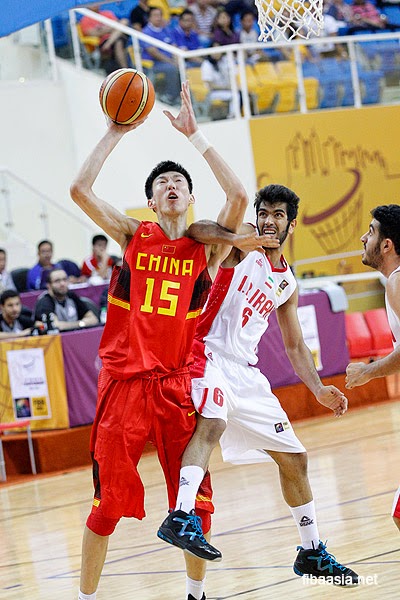
Showing posts with label Zhou Qi. Show all posts

July 10, 2016

In Your Face: Zhou Qi


I originally wrote this article for the August 2016 edition of SLAM Magazine (SLAM No. 200).

Xinjiang, 7-2, C

When Yao Ming announced his retirement in 2011, he left a 7-foot-plus hole in the hearts of the world’s most-populous nation. But months before Yao’s career officially ended, China already got a promise of the future. Proudly wearing China’s colours at the little know Turk Telecom youth tournament in Turkey, 15-year-old Zhou Qi helped his country to an unlikely gold medal, putting up 41 points, 28 rebounds, and 15 blocks in the semi-final against Germany and providing a game-winning encore with 30-17-8 against the hosts in the Final.

For the next five years, Zhou slowly turned his promise to reality. He made his name in China’s youth circuits, destroyed Asian opponents, and become a young star in the Chinese Basketball Association.

But now, the skinny (listed at 218 lbs), 7-foot-2, 20-year-old from the city of Xinxiang is ready to bulk up into an even larger pair of shoes: after years of success in China, the young man must prove himself all over again in the United States.

“I want teams and fans in the US to know, first and foremost, that I’m a team player,” Zhou says. “I wanna be in an environment where I can help my teammates to be the best they can be.”

“Today’s NBA is asking so much more from a single player. To be more than a single position. The game is much faster. I need to adopt to different styles of play. On offense, I must learn to attack from the outside, be both a perimeter and a post player. On defence, I must learn to guard guards as well as centers.”

Zhou hopes to find long-term success in the league. But even before he ever steps on an NBA court, he’ll know that the weight of Yao be hanging over his slender shoulders.

“I don’t feel any pressure. If I can take the torch from Yao, I hope I can have a good career and pass the torch to someone to else. Right now, I just want to be myself.”

October 4, 2015

China romp to FIBA Asia 2015 title; India improve to 8th place


China, one of the top basketball teams in the continent, hosted Asia's biggest basketball tournament, the 2015 FIBA Asia Basketball Championship (ABC) in Changsha from September 23 to October 3. Featuring four seven-footers, the hosts were the biggest team in the tournament, were backed by fervent home support and put in the longest duration of practice in preparation for this tournament. All of this resulted in the obvious conclusion: after coming up short in 2013, China showed their class over the competition this year by going undefeated through the course of the 2015 FIBA ABC to win the gold medal and automatically qualify for the basketball tournament at the Rio Olympics next year.

Closer to home, despite losing their final three games at the tournament, Team India returned from Changsha with their heads held high, making it to the Quarter-Finals of the tournament for the first time since 2013 and finishing at their highest position (8th) in the last 12 years.

The tournament's finale featured two of the biggest hoop-loving nations in Asia: China and 2013 silver-medalists Philippines. While China had qualified for the final with an unblemished record, the Philippines had a rockier journey - including an opening night loss - but had up made up for their hiccups with strong performances at the biggest moments. The final on Saturday, October 3rd was a defensive, ugly game of basketball, but China rose to the challenge to take care of business when it most counted. China took an eight point lead by halftime, dominating against the Philippines who struggled shooting the ball from the field all night. China's size had enough advantage over Philippines' Andray Blatche (17 points) to nullify his efforts all night. Guo Ailun scored a game-high 19 for China while young talent Zhou Qi added 16 to go with 14 rebounds. China held on to their advantage and won 78-67.

Earlier on Saturday, 2013 champions Iran survived a topsy-turvy game against Japan to win 68-63 and secure third place at the tournament. Mohammadsamad Nik Khahbahrami was fantastic all night, scoring 35 points to pace Iran's victory. Keijuro Matsui led Japan with 18. After Iran took a 12-point lead in the first quarter, Japan came storming back to make it a two-point game by halftime, and continued their momentum to lead 48-44 at the end of the third period. Iran saved their best for last, and Khahbahrami's hot shooting carried them to a win.

At the semi-final stage on Friday, Japan and the Philippines were deadlocked for three quarter before Jayson William (20) helped his team overcome a tough-shooting night and carried them to the final with a 81-70 win. Andray Blatche scored 22 for Philippines while captain Donaldo Hontiveros added 18. For Japan, Makoto Hiejima scored a game high 28 and Joji Takeuchi added 18. In the previous semi-final, the winners of the last eight FIBA ABCs - China and Iran - squared off. China started the game off aggressively, taking a 21-12 early lead, and kept up the momentum to win this clash of titans. China overcame 18 points and seven rebounds by Mohammadsamad Nik Khahbahrami and 16 and 11 by Hamed Haddadi.

China's Yi Jianlian was named the MVP of the tournament.

Despite domestic turmoil, the 2015 FIBA ABC turned out to be a fruitful tournament for Team India. India sent a tweaked 12-member squad to Changsha, featuring new head coach Sat Prakash Yadav and minus the presence of many veteran players, but they did well enough to finish the tournament with a 3-6 record at 8th place.

India were placed in Preliminary Round Group A along with reigning champions Iran, eventual fourth-place finishers Japan, and Malaysia. India's start against Malaysia was on the right foot. Dominating offensively, India blew out the game in the first three quarters and relaxed in the fourth to cruise to a comfortable 102-73 victory. Amjyot Singh collected 24 points and 10 rebounds for India, point guard Akilan Pari added 18 with six assists, and Yadwinder Singh had 16 and seven rebounds in India's win. Malaysia's Ivan Yeo had 18 points and 10 rebounds in a losing effort.

The going got much tougher for India in the second game against Iran, who started the game on a 27-11 run, leaving India chasing the scoreboard for the next three quarters. India showed some heart to close the gap to nine at halftime, but they were outclassed by Iran after halftime, who went on to win 88-66. Mohammad Hassanzadeh Saberi A had 18 for the winning side, overcoming a fantastic 27 point-9 rebound performance by Amjyot Singh.

India started off on a good foot against Japan, leading 18-15 at the end of the first quarter, but eventually, the Japanese pace and shooting was too much for the Indians to handle. Japan reclaimed the lead at halftime and kept on the pressure in the second half all the way to a 83-65 win. Joji Takeuchi was unstoppable with 22 points and 19 rebounds in Japan's win. Makoto Hiejima added 19 in Japan's win. India were paced by captain Vishesh Bhriguvanshi (24 points, 8 rebounds, 5 assists) and, as usual, by Amjyot Singh (19 points, 10 rebounds).

India's solitary victory against Malaysia was good enough to qualify them for Second Round Group E, where they opened their accounts against the upstart and thus-far undefeated Palestine side. In what turned out to be the country's most crucial game, India relied on a brilliant, clutch performance by Amjyot Singh (32 points, 11 rebounds) to inch past Palestine 73-70. It was a crucial win for India, who, after a positive start, found themselves trailing by four at halftime. But Amjyot helped India bounce back up in the second half and keep up the lead until the end of the close second half. Bhriguvanshi helped out with 17 for India. Sani Sakakini (23), Jamal Abu Shamala (21), and Salim Sakakini (16) were Palestine's leading scorers.

India were caught napping early in their contest early next morning against Hong Kong, who came out stronger than expected and gave India a run for their money. Once again, it was the class of Amjyot (26 points, 12 rebounds) that proved to be the difference maker. India were down by five early and trailed 39-34 at halftime. But they finally gained the lead halfway in the fourth quarter and held on to their advantage en route to a 76-71 win. Yadwinder Singh had 18 points for India and Bhriguvanshi added 16. Chun Wai Wong (21), Siu Wing Chan (17), and Duncan Reid (16) were Hong Kong's leading scorers.

Fueled by two recent wins, India started off well against the Philippines in their last Second Round game, and led 17-16 at the end of the first quarter despite a tough-shooting night from their star Amjyot Singh. Eventually however, Philippines put their stamp on the game, playing efficient and unselfish basketball to blow India out easily, 99-65. Terrance Romeo led Philippines with 20, while India were paced by Bhriguvanshi (21) and Amrit Pal Singh (18 points, 13 rebounds).

Despite this loss, India's win against the Palestine was enough to ensure that they finished in a top four position in Group E and qualified for the tournament's Quarter-Final, where they faced the mighty Chinese. Ensuring that there would be no repeat of India's FIBA Asia Cup heroics from last year, China showed no mercy to India, dominating the game on both ends to win easily, 104-58. Yi Jianlian had 21 points and seven rebounds for China. For India, captain Bhriguvanshi impressed with a game-high 22 points while Yadwinder Singh added 16.

Out of semi-final contention, India were relegated to the 5-8th place classification games. They first played against Korea, and despite a semi-competitive start, India couldn't keep up with the frenetic offensive pace of their opponents for the rest of the game. Korea dominated India on the way to a 117-72 win, led by Tae Young Moon (22) and Sung Min Cho (10). Amjyot had 24 for India in the loss while Amrit Pal Singh added 18.

India's final game of the tournament was against Qatar, and they finished matter with a sour taste left in their mouths. India came out soft against Qatar, who opened up a 21 point halftime lead and left India with too much of a gap to cover after the break. Mohamed Hassan A
Mohamed scored 28 for Qatar and Mohammed Abdullah and Abduallah Matalkeh added 16 each. Amjyot Singh led India with 21 while Arvind Arumugam made the most of his minutes to score 16.

The Qatar loss was perhaps India's only underachievement of the competition, as they won all the other games where they were favoured to, and went a step further with the crucial win over Palestine. Their 8th place finish sees them finish in the top 10 for the first time in a dozen years.

India should be most proud and excited by the performances of 23-year-old Amjyot Singh, the Chandigarh-born player who is currently playing with the Tokyo Excellence of Japan's D-League. Amjyot, India's leading scorer, finished as the fourth-best scorer of the entire championship (20.9 ppg) and the ninth-best rebounder (8.3 rpg). He also played the tournament's third-most minutes (37 mpg). Captain Vishesh Bhriguvanshi enjoyed a good showing in Changsha, too, averaging 14 points and 4.8 assists per game, good for second-best in Changsha. Although Center Amrit Pal Singh wasn't as consistent as expected, he did a good job defensively and was strong on the boards. The performances of forward Yadwinder Singh and point guard Akilan Pari were also commendable.

India did especially well since they rolled out a team without the likes of Narendar Grewal, Pratham Singh, Rikin Pethani, Joginder Singh, Prasanna Venkatesh, and of course, new NBA-draftee Satnam Singh. The lack of so many talents completely deprived India of a deep bench, and thus, the big three of Amjyot, Amrit Pal, and Bhriguvanshi were forced to play big minutes and carry a heavy burden all tournament. Although they did well for stretches, fatigue eventually caught up with them and India missed a chance to spring a few more surprises. India could've finished a spot or two higher in the rankings if they were at full strength in Changsha.

Still, the performance showed that India - particularly Amjyot - are continuing to take strong strides in improvement in the continent and will continue to evolve into a team to fear over the next few years.

Final Standings
  • 1. China
  • 2. Philippines
  • 3. Iran
  • 4. Japan
  • 5. Lebanon
All Tournament Team
  • Yi Jianlian (China) - MVP
  • Guo Ailun (China)
  • Zhou Qi (China)
  • Jayson William (Philippines)
  • Mohammadsamad Nik Khahbahrami (Iran)

August 29, 2014

China win third successive FIBA Asia U18 Championship in Doha; Disappointing India finish last


While at the senior level, Iran had replaced China as Asia's most dominant side in recent years, the Chinese showed another glimpse of why their future stars might be ready to reclaim their nation's hoops honour. For the third consecutive time, China won the FIBA Asia U18 Championship, hoisting the title in the tournament's 23rd iteration in Doha (Qatar) after a convincing victory over Iran in the final. China played fantastic basketball through the course of the 10-day tournament and made this their 11th victory overall in Asia's most prestigious junior basketball tournament.

China, who suffered a close call in winning the gold in Ulaanbaatar in an overtime game against Korea two years ago, had no such troubles this time around. They dominated the final early, breaking out to a 16-0 scoring run in the first quarter and holding on to a huge 36-19 lead by halftime. China kept their command on the game in the second half and had turned the game into a blowout before the beginning of the final quarter. China's most-accomplished young player Zhou Qi only made an appearance in the second quarter, by when his team had already grasped on to complete control of the game. Zhou still ended up with a game-high 16 points to lead his side to victory.

2012's silver-medalists Korea had to settle for Bronze as they bounced from an early deficit to beat Chinese Taipei 70-58 on Thursday. Korea's Kyongwon Kim was unstoppable, beasting his way to 26 points and 17 rebounds to lead his side to victory.

Earlier on the semi-finals, China exorcised the ghosts of recent senior-team defeats to Chinese Taipei by easily handling their neighbours 92-50. Chinese Taipei had no answer for China's duo of Rui Zhao (19) and Yuchen Zou (16), while Zhou Qi contributed 13 points and 17 rebounds off the bench. Only Yung-Cheng Sun (16) cracked double figures in scoring for Taipei. Iran were led by Navid Rezaeifar (18) and Mohammad Yousuf Vand (17) as they bounced back from a double-digit deficit at halftime to completely dominating the third quarter against Korea en route to a 78-60 semi-final win. Hyunwoo Jeon led with 16 points for the Koreans in the loss.

While the Chinese celebrated in Qatar, India's under-18 dream of continuing the same Cinderella success of their seniors was shot down early in the competition. After stuttering in qualifiers against Sri Lanka, India were placed in Group A of the tournament with China, hosts Qatar, and Malaysia. Despite the presence of the tournament's favourites China, there were hopes that good performances against the other two teams in the group could help see India go further than the past in the tournament.

Alas, India's performances dipped even further from their 10th place finish at the same tournament two years ago. India started off their campaign against the hosts Qatar. But despite a neck-to-neck first quarter, India were completely dominated in the second, being outscored 30-6 by their opponents. Down by 25 points at halftime, India pressed hard in the second half to make a comeback, but the damage had already been done. Qatar's Abdulrahman Mohammad Saad was unstoppable, tallying a breathtaking statline of 40 points, eight assists, and six rebounds against India. Abdelrahman Rehia Abdelhaleem added 26 and 10 rebounds as the duo paced the hosts to a 86-73 victory. Mahipal Singh had 20 points, six rebounds, and five assists for India in a losing cause.

India got their first and only win of the tournament against Malaysia early the next day. Although India started slow and turned the ball over several times, they bounced back from a small deficit in the first quarter to take control of the rest of the game. The duo of Gurvinder Singh Gill (24 points and 17 rebounds) and Mahipal Singh (22 points and seven rebounds) paced India to a 73-64 win. Yi Hou Wong scored 17 for Malaysia off the bench.

A month ago, China's Zhou Qi was part of the team which were surprisingly beaten in a historic win for India's senior squad at the FIBA Asia Cup. This time, Zhou Qi and the junior side were not messing around and went out to seek redemption. China dominated India on all fronts from the opening tip to the final buzzer, blowing out the Indians for a sixty-point victory. The final scoreline read 100-40 in China's favour, a lop-sided result that would come to haunt the Indians a few hours later. Zhou Qi paced the way with 21 points and seven rebounds for his side while Yuchen Zou added 19 and nine.

Right after India's loss to China, Malaysia played inspired basketball against the hosts Qatar to defeat them 78-70, and thus won their first-ever contest in the U18 FIBA ABC. This victory left India, Malaysia, and Qatar all tied in points behind China in Group A, with only two of teams able to progress and join the Chinese in the tournament's second round. Unfortunately, due to their worse point differential, India were the odd ones out. Despite their victory over Malaysia, India would finish fourth in their group and their tournament ended in sudden, heartbreaking fashion.

Because they didn't qualify for the Second Round, India played no further games and were adjudged to finish 13th in the tournament, tied with Iraq for last place (there was no 13/14th place playoff).

India also suffered some distraction when FIBA's 'No Headgear' policy sprung controversy again. India's Anmol Singh was made to remove his turban during warm-up of India's first game against Qatar. In their second game against Malaysia, Anmol was allowed to play with his turban for the first 10 minutes, before FIBA officials asked him to remove his turban again. The latest incident occurred a little over a month after FIBA forced two of India's senior team Sikh players - Amrit Pal Singh and Amjyot Singh - to remove their turbans during the FIBA Asia Cup. Back at home, the outraged Basketball Federation of India (BFI) once again complained to FIBA for this discriminatory policy and urged them to change the rules.

The tournament was a disappointing finish for a team which had the chance to prove that India's future could continue the optimism that basketball in the country had recently felt all around. While this team definitely had some talent, they showed a lack of maturity and experience, especially when they found it difficult to counter long periods of pressure and scoring runs by their opponents. There is no easy solution for this except the same thing that coaches and media in India have harped on for years: all our teams need more quality games to give them more experience of high-level play so they are better prepared for all international basketball situations in the future.

Captain Gurvinder Singh Gill (aka "Gary") finished as the team's leading scorer with 17 points per game and is a sure-shot to eventually graduate to the senior side in a few years. Another rising young talent - Narender - led the entire tournament fray in assists with 6.3 assists per game. He also finished top five in three-point percentage. Gill was a top five score in the championship. Of course, all of these numbers should be taken with a grain of salt since India only played three games.

Apart from the win over Malaysia, there won't be any other positive memories for Coach Jora Singh and his side to bring back from Doha. But just like we hope to use positive results as a pedestal to propel ourselves higher, let's hope that this negative result can be used as motivation for all the players involved to bounce back stronger in the future.

2014 FIBA Asia U18 Championship - Final Standings
  • 1. China
  • 2. Iran
  • 3. Korea
  • 4. Chinese Taipei
  • 5. Philippines

July 14, 2014

Wonder of Wuhan: India should build on historic win over China to spark a basketball revolution


Sometimes, revolutions don't need pomp and noise, or confetti or loud celebrations. Some revolutions aren't greeted with cheering voices or waving flags. Some revolutions happen in stunned silence.

The last five minutes of India's historic first-ever win over China - perhaps the greatest win in 78 years of India's international basketball history - were played under an eerie hush. The game was talking place at the Wuhan Sports Center in Wuhan, the most populous city in Central China. This was the 5th FIBA Asia Cup, a biennial tournament held between 10 of the top teams on the continent. This is a relatively smaller tournament than the more highly-regarded FIBA Asia Basketball Championship (ABC), and the local Chinese fans only filled up a fraction of the 13,000-seat arena in Wuhan's Zhuankou suburb.

The hosts, favourites to win the tournament after winning their first two games and defeating Asian champions Iran in the process, were confident against India. The fans were out with vuvuzelas, balloon clappers, and there were animated MCs and scantily-clad cheerleaders to boost their spirits. Yet, nothing could divert their horrifically stunned attentions away from the upset on court. As the clock ticket away in the game's final minutes and it seemed that India would achieve the impossible, the arena grew quieter. Each squeak of a shoe sole on the polished wooden floor reverberated across the gymnasium. Each word of encouragement from the Indian bench to the heroes on court could be heard by every fan, media-person, and official in attendance.

And in this silence, India found joy: the team nicknamed the 'Young Cagers' - led by Head Coach Scott Flemming - finally grew up, and announced the coming of age of all of Indian Basketball with a memorable win. All the odds had been stacked against India, who are ranked 61st in the FIBA World Basketball rankings compared to China, who are 12th and are tops in Asia. India had lost their first game against Japan a day ago while China were riding a positive streak behind a talented youth movement. Yet, the final score read 65-58 in India's favour, and a milestone for Indian hoops was achieved.

Expectations, as they always are in such high-level Asian tournaments, were low for India. Always the minnows against other giants of the game, India returned without a win at bottom place in the previous iteration of the FIBA Asia Cup in Tokyo two years ago. In last year's FIBA Asia Championship in the Philippines, India showed some improvement, but were still defeated in blowout fashion against top teams like Iran, Korea, and of course, China, who beat India 79-45, just 11 months ago.

In the world of an Indian basketball follower, low expectations are the norm. We prematurely resign ourselves to embarrassing losses against the Chinas and the Irans of the continent, and hope for the best against teams ranked closer to our stature, like Kazakhstan or Bahrain. Rarely has India's senior men's team won a meaningful game of basketball in the past several decades, a hypnotizing lull of losses upon losses that numbed Indian media and fans into submission to the point of ignorance. China regularly expects to defeat India by 30, 40, or 50 points per contest. Coming into this tournament, India were once again ignored as outsiders with a seventh or eighth place finish (out of 10) as best-case scenario. Apart from the minuscule, almost-irrationally passionate fanbase of Indian basketball, the mainstream continued to not pay the team any attention.

Perhaps this was why, despite qualifying once more for a major Asian FIBA tournament, there were no mainstream media-houses from India covering the event, and the games itself weren't shown on any TV channel back home. China were stumped and India were absent, and, outside of the cheers and hoots from the victorious Indian locker-room, there was nothing but silence.

It was only through the power of the internet live commentary and social media that we were able to get the word out, and once the news leaked, it quickly went viral. Thousands of supporters of the Indian hoops cause were made aware of the news that no other traditional media outlet had covered. The players and the coaches who had made this achievement possible - ironically - couldn't even hear the online applause, finding themselves stuck behind the Great Firewall of China and unable to access the hysteria of Indian fans thousands of miles away.

One of those voices online was of Bobby Sharma, the senior VP of global basketball for IMG Worldwide, the company which, in their partnership with Reliance and the Basketball Federation of India (BFI) is hoping to usher in India's first professional basketball league in coming years. Sharma congratulated the BFI by calling this upset a 'monumental watershed moment'. Indeed, the achievements of those 12 men on court and their coaches in one simple game could be the springboard that India needs to finally take that basketball leap we have long been dreaming of.

Indian basketball will always remember the day - July 13, 2014 - that they eclipsed the mighty Chinese. This victory is set to change India's attitude and approach looking forward at all our basketball encounters in the future. If this team indeed has the ability to beat China, then it prepare with a realistic mentality of having a shot in every match-up, against any opponent. There are no reasons to throw in the towel before any game, and every Indian team from here on out should look up at Wonder in Wuhan on July 13 and find the motivation to do it again.

Perhaps, more young Indians back home, disillusioned that the game has no future in India, will start believing in the amazing possibilities of sport once again. The achievements of our best players should inspire countless others to remain geared towards a career in basketball, and motivated to recreate and build upon the success of the current squad.

Perhaps, with increased attention from the Indian mainstream after this victory will shine a spotlight on India's national teams and force our media and our sponsors to acknowledge them. Maybe this leads to greater financial rewards for our players, the majority of whom come from poor families and chose basketball as their only way to a stable job.

This win means a lot many of India's individual players, who are on various points in their careers. Vishesh Bhriguvanshi, India's captain and most consistent performer in recent years will relish this game forever. Pratham Singh was India's fourth-quarter hero, and sank several clutch three-pointers to give India the lead for good. Amjyot Singh played fantastically on both ends of the floor and showed elite athleticism against China's 7-foot-1 prodigy Zhou Qi. Yadwinder Singh, India's energy bar, lifted the team with his hustle on the defensive end. Amrit Pal Singh was a farmer at age 19 when he discovered basketball; just four years later, he was controlling the defensive paint against Chinese bigs. The likes of Joginder Singh, Narendar Grewal, Rikin Pethani, and more in the rotation have etched their names in Indian hoops history forever.

And the man who should be celebrated with special plaudits after this historical night is Head Coach Scott Flemming. After 32 years of coaching experience in the USA, most recently with the NBDL side Texas Legends, Flemming chose a different challenge, coming to India to try and make a difference in a country on the basketball hinterlands. Two years after his appointment, he isn't only the longest-serving foreign coach in India, he is also one of the most successful. Flemming led India to a gold medal victory at the Lusofonia Games this January and a first place finish at the South Asian Basketball Championship. But this was, by far, his biggest win with India.

The FIBA Asia Cup is still in process. India play their third and fourth Preliminary Round games against Indonesia and Iran on Monday and Tuesday respectively. They've almost ensured qualification for the Quarter-Final stage. Coach Flemming has spoken optimistically of India's ability to continue performing basketball miracles.

For now, this victory is a wake-up call for Indian basketball to start believing in its potential. We beat China on the court yesterday, but China basketball are miles ahead in the longer marathon. Our best basketball facility is only as good as 50-60 of what Chinese Tier 2 or Tier 3 cities possess. China's young talents are trained and developed from a young age to maximize their potential. All of the players in China's national team are professionals in the well-established Chinese Basketball Association (CBA). They have developed NBA talent in the past and have the resources to develop more such talent in the future. They have much better coaching down to the grassroots level and have much more money to pump into their various basketball federations. India, meanwhile, have an unbalanced and mostly disorganized grassroots nursing system, don't have the infrastructure to provide our top talents and don't have enough support from the common public that rarely looks beyond cricket (or the FIFA World Cup) when the word 'sport' is uttered. Worst of all, internal politics stunts any real growth and there is rarely any motivations from those who are in the basketball fraternity to rise higher, as many stay content to swivel around in lower mediocrity.

And yet, if India can beat China despite being completely overshadowed across every sphere in the basketball world, imagine what we could do if we actually put in an honest effort to improve hoops in the country, from the grassroots to the top, instead of making the sport into just another way for bureaucrats to enjoy a small morsel of power?

Team India's moment - this Wonder of Wuhan - was a silent revolution indeed; but let's hope that the reaction to this moment is loud, energetic, and points to a brighter future for Indian basketball.

UPDATE: Thanks to FIBA, now we have the entire game tape of India's historic win over China on YouTube. Check it out here:


August 14, 2012

India's U18 Boys’ head to 22nd U18 FIBA Asia Championship in Mongolia

India’s U18 Boys’ squad has been announced for the 22nd U18 FIBA Asia Championship, which will be held in Mongolia’s capital city Ulaanbaatar from August 17-26, 2012. After spending time in camp in New Delhi for the past month, the 12-man roster to represent India at this event was released by the Basketball Federation of India (BFI) on Sunday. Here is an India-centric preview of the upcoming tournament!

Click here to read full feature