Showing posts with label Yi Jianlian. Show all posts

October 4, 2015

China romp to FIBA Asia 2015 title; India improve to 8th place


China, one of the top basketball teams in the continent, hosted Asia's biggest basketball tournament, the 2015 FIBA Asia Basketball Championship (ABC) in Changsha from September 23 to October 3. Featuring four seven-footers, the hosts were the biggest team in the tournament, were backed by fervent home support and put in the longest duration of practice in preparation for this tournament. All of this resulted in the obvious conclusion: after coming up short in 2013, China showed their class over the competition this year by going undefeated through the course of the 2015 FIBA ABC to win the gold medal and automatically qualify for the basketball tournament at the Rio Olympics next year.

Closer to home, despite losing their final three games at the tournament, Team India returned from Changsha with their heads held high, making it to the Quarter-Finals of the tournament for the first time since 2013 and finishing at their highest position (8th) in the last 12 years.

The tournament's finale featured two of the biggest hoop-loving nations in Asia: China and 2013 silver-medalists Philippines. While China had qualified for the final with an unblemished record, the Philippines had a rockier journey - including an opening night loss - but had up made up for their hiccups with strong performances at the biggest moments. The final on Saturday, October 3rd was a defensive, ugly game of basketball, but China rose to the challenge to take care of business when it most counted. China took an eight point lead by halftime, dominating against the Philippines who struggled shooting the ball from the field all night. China's size had enough advantage over Philippines' Andray Blatche (17 points) to nullify his efforts all night. Guo Ailun scored a game-high 19 for China while young talent Zhou Qi added 16 to go with 14 rebounds. China held on to their advantage and won 78-67.

Earlier on Saturday, 2013 champions Iran survived a topsy-turvy game against Japan to win 68-63 and secure third place at the tournament. Mohammadsamad Nik Khahbahrami was fantastic all night, scoring 35 points to pace Iran's victory. Keijuro Matsui led Japan with 18. After Iran took a 12-point lead in the first quarter, Japan came storming back to make it a two-point game by halftime, and continued their momentum to lead 48-44 at the end of the third period. Iran saved their best for last, and Khahbahrami's hot shooting carried them to a win.

At the semi-final stage on Friday, Japan and the Philippines were deadlocked for three quarter before Jayson William (20) helped his team overcome a tough-shooting night and carried them to the final with a 81-70 win. Andray Blatche scored 22 for Philippines while captain Donaldo Hontiveros added 18. For Japan, Makoto Hiejima scored a game high 28 and Joji Takeuchi added 18. In the previous semi-final, the winners of the last eight FIBA ABCs - China and Iran - squared off. China started the game off aggressively, taking a 21-12 early lead, and kept up the momentum to win this clash of titans. China overcame 18 points and seven rebounds by Mohammadsamad Nik Khahbahrami and 16 and 11 by Hamed Haddadi.

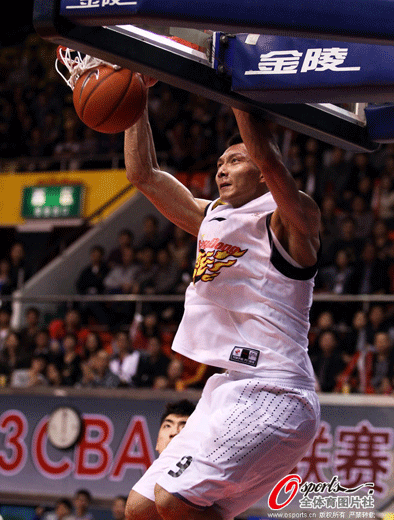
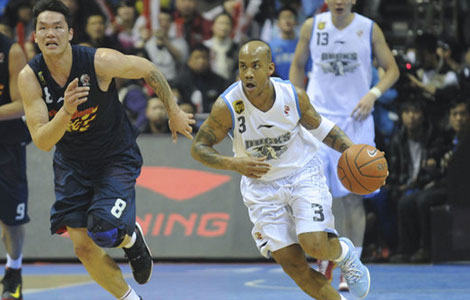
China's Yi Jianlian was named the MVP of the tournament.

Despite domestic turmoil, the 2015 FIBA ABC turned out to be a fruitful tournament for Team India. India sent a tweaked 12-member squad to Changsha, featuring new head coach Sat Prakash Yadav and minus the presence of many veteran players, but they did well enough to finish the tournament with a 3-6 record at 8th place.

India were placed in Preliminary Round Group A along with reigning champions Iran, eventual fourth-place finishers Japan, and Malaysia. India's start against Malaysia was on the right foot. Dominating offensively, India blew out the game in the first three quarters and relaxed in the fourth to cruise to a comfortable 102-73 victory. Amjyot Singh collected 24 points and 10 rebounds for India, point guard Akilan Pari added 18 with six assists, and Yadwinder Singh had 16 and seven rebounds in India's win. Malaysia's Ivan Yeo had 18 points and 10 rebounds in a losing effort.

The going got much tougher for India in the second game against Iran, who started the game on a 27-11 run, leaving India chasing the scoreboard for the next three quarters. India showed some heart to close the gap to nine at halftime, but they were outclassed by Iran after halftime, who went on to win 88-66. Mohammad Hassanzadeh Saberi A had 18 for the winning side, overcoming a fantastic 27 point-9 rebound performance by Amjyot Singh.

India started off on a good foot against Japan, leading 18-15 at the end of the first quarter, but eventually, the Japanese pace and shooting was too much for the Indians to handle. Japan reclaimed the lead at halftime and kept on the pressure in the second half all the way to a 83-65 win. Joji Takeuchi was unstoppable with 22 points and 19 rebounds in Japan's win. Makoto Hiejima added 19 in Japan's win. India were paced by captain Vishesh Bhriguvanshi (24 points, 8 rebounds, 5 assists) and, as usual, by Amjyot Singh (19 points, 10 rebounds).

India's solitary victory against Malaysia was good enough to qualify them for Second Round Group E, where they opened their accounts against the upstart and thus-far undefeated Palestine side. In what turned out to be the country's most crucial game, India relied on a brilliant, clutch performance by Amjyot Singh (32 points, 11 rebounds) to inch past Palestine 73-70. It was a crucial win for India, who, after a positive start, found themselves trailing by four at halftime. But Amjyot helped India bounce back up in the second half and keep up the lead until the end of the close second half. Bhriguvanshi helped out with 17 for India. Sani Sakakini (23), Jamal Abu Shamala (21), and Salim Sakakini (16) were Palestine's leading scorers.

India were caught napping early in their contest early next morning against Hong Kong, who came out stronger than expected and gave India a run for their money. Once again, it was the class of Amjyot (26 points, 12 rebounds) that proved to be the difference maker. India were down by five early and trailed 39-34 at halftime. But they finally gained the lead halfway in the fourth quarter and held on to their advantage en route to a 76-71 win. Yadwinder Singh had 18 points for India and Bhriguvanshi added 16. Chun Wai Wong (21), Siu Wing Chan (17), and Duncan Reid (16) were Hong Kong's leading scorers.

Fueled by two recent wins, India started off well against the Philippines in their last Second Round game, and led 17-16 at the end of the first quarter despite a tough-shooting night from their star Amjyot Singh. Eventually however, Philippines put their stamp on the game, playing efficient and unselfish basketball to blow India out easily, 99-65. Terrance Romeo led Philippines with 20, while India were paced by Bhriguvanshi (21) and Amrit Pal Singh (18 points, 13 rebounds).

Despite this loss, India's win against the Palestine was enough to ensure that they finished in a top four position in Group E and qualified for the tournament's Quarter-Final, where they faced the mighty Chinese. Ensuring that there would be no repeat of India's FIBA Asia Cup heroics from last year, China showed no mercy to India, dominating the game on both ends to win easily, 104-58. Yi Jianlian had 21 points and seven rebounds for China. For India, captain Bhriguvanshi impressed with a game-high 22 points while Yadwinder Singh added 16.

Out of semi-final contention, India were relegated to the 5-8th place classification games. They first played against Korea, and despite a semi-competitive start, India couldn't keep up with the frenetic offensive pace of their opponents for the rest of the game. Korea dominated India on the way to a 117-72 win, led by Tae Young Moon (22) and Sung Min Cho (10). Amjyot had 24 for India in the loss while Amrit Pal Singh added 18.

India's final game of the tournament was against Qatar, and they finished matter with a sour taste left in their mouths. India came out soft against Qatar, who opened up a 21 point halftime lead and left India with too much of a gap to cover after the break. Mohamed Hassan A
Mohamed scored 28 for Qatar and Mohammed Abdullah and Abduallah Matalkeh added 16 each. Amjyot Singh led India with 21 while Arvind Arumugam made the most of his minutes to score 16.

The Qatar loss was perhaps India's only underachievement of the competition, as they won all the other games where they were favoured to, and went a step further with the crucial win over Palestine. Their 8th place finish sees them finish in the top 10 for the first time in a dozen years.

India should be most proud and excited by the performances of 23-year-old Amjyot Singh, the Chandigarh-born player who is currently playing with the Tokyo Excellence of Japan's D-League. Amjyot, India's leading scorer, finished as the fourth-best scorer of the entire championship (20.9 ppg) and the ninth-best rebounder (8.3 rpg). He also played the tournament's third-most minutes (37 mpg). Captain Vishesh Bhriguvanshi enjoyed a good showing in Changsha, too, averaging 14 points and 4.8 assists per game, good for second-best in Changsha. Although Center Amrit Pal Singh wasn't as consistent as expected, he did a good job defensively and was strong on the boards. The performances of forward Yadwinder Singh and point guard Akilan Pari were also commendable.

India did especially well since they rolled out a team without the likes of Narendar Grewal, Pratham Singh, Rikin Pethani, Joginder Singh, Prasanna Venkatesh, and of course, new NBA-draftee Satnam Singh. The lack of so many talents completely deprived India of a deep bench, and thus, the big three of Amjyot, Amrit Pal, and Bhriguvanshi were forced to play big minutes and carry a heavy burden all tournament. Although they did well for stretches, fatigue eventually caught up with them and India missed a chance to spring a few more surprises. India could've finished a spot or two higher in the rankings if they were at full strength in Changsha.

Still, the performance showed that India - particularly Amjyot - are continuing to take strong strides in improvement in the continent and will continue to evolve into a team to fear over the next few years.

Final Standings
  • 1. China
  • 2. Philippines
  • 3. Iran
  • 4. Japan
  • 5. Lebanon
All Tournament Team
  • Yi Jianlian (China) - MVP
  • Guo Ailun (China)
  • Zhou Qi (China)
  • Jayson William (Philippines)
  • Mohammadsamad Nik Khahbahrami (Iran)

February 1, 2015

Global Citizen


Having started his pro career in China, Congolese-American hoop star Emmanuel Mudiay has already shown he has the talent and courage that legendary careers are made of.

by Karan Madhok. Photos by Yin Di.

This feature was originally published in the March 2015 edition of SLAM Magazine (SLAM No. 185). You can also find it on SLAMOnline.com.

It’s 2014, and 18-year-old Emmanuel Mudiay is learning about a new city. As he tries to familiarize himself with Guangdong in Southern China, he dabbles in learning a little bit of Mandarin, embracing the new culture, dealing with the bumps and grinds on the basketball court and the attention a blossoming star gets off of it.

It’s 1999, and 3-year-old Mudiay has picked up a basketball for the first time in his life. He knows what the round object is, but beyond feeling the texture of the ball, he doesn’t think much of it. In Kinshasa, the capital of Congo and Mudiay’s birthplace, there are more pressing matters to consider, like the Second Congo War, which turns into the deadliest conflict on Earth since World War II.

It’s 2002, and Mudiay has a basketball in his hands again. He’s 6 years old and playing in his first organized game. The texture of the ball may not have changed as much, but everything else in his life has. Mudiay’s family has left the violence and the hunger of central Africa behind them. He’s in Dallas, TX, settling into a new country, a new culture.

We’re back in 2014, and that bouncy ball has changed his life. Mudiay has just wrapped up his stellar high school years as a consensus All-American, and convinced scouts that he is set to become one of the NBA’s top Draft picks. He seems to be destined to take the popular one-and-done route through college. He has even committed to the SMU Mustangs. Only, he decides to break from tradition, refuses to let NBA rules determine his chosen path, forgoes college and goes pro.

In November of 2014, Emmanuel Mudiay plays his first official professional game of basketball, representing the Chinese Basketball Association’s (CBA) Guangdong Southern Tigers. A few months before the start of the CBA season, Under Armour inks him to a lucrative, multi-year contract that will span his time in China and a (hopefully successful) early NBA career, reaffirming the faith of many in the young guard’s potential.

Before an ankle injury sidelines him just 10 days into the season, Mudiay shows glimpses of dominance for a team with championship aspirations.

Mudiay’s China adventure took a twist toward uncertainty after his injury. At the time of writing, Guangdong had replaced Mudiay in its lineup with former Detroit Piston Will Bynum, and there was no official confirmation from the team that Mudiay would take the floor again before the CBA season concludes. That said, we spoke to a source in the US who is close to Mudiay’s camp who assured us that Emmanuel has every intention of getting healthy and finishing his season in Guangdong, and that the Southern Tigers are (smartly) happy to have him.

Regardless of any uncertainty around Mudiay’s future, it’s guaranteed to be as interesting, if not more so, than his past.

You’ll hear from him a lot more in the coming months, whether he is helping Guangdong make a push for the CBA championship or impressing scouts at pre-Draft workouts in preparation for the NBA.

From Congo to Dallas to China, Mudiay has already charted a course that has taken him further at 18 years than most people get to go in their lifetime. But for the young phenom, this is just the beginning; With an ambitious, long-term plan for his future, Mudiay wants to leave no doubt that his tomorrow will be better than his yesterday.

In China, I speak to Mudiay about the journey and struggles of yesterday, the juncture at which he stands today, and his ever-so-bright tomorrow.

“It’s a blessing,” he says, “It makes me happy, but at the same time, I’m not satisfied. I’m still working as if I’m struggling. That’s my mindset and I’ll work like that ’til the last game I play in my career. I don’t wanna see nobody in my family, my kids, my grandkids, struggling for money. I know I’m still young, but I think that far ahead.”

***

Mudiay was just an infant in Kinshasha, capital of the country formerly known as Zaire, when he lost his father. After the First Congo War, Zaire became the Democratic Republic of Congo. Peace didn’t last much longer: By 1998 the large-scale Second Congo War displaced and destroyed the lives of millions in Congo and nearby nations, mostly from disease and starvation.

“I don’t remember much of that time,” Mudiay says. “I just remember that my mom and my brothers had to all take care of each other.”

In 2001 - when Emmanuel was 5 years old - his family was granted asylum to the USA and found a home in Dallas. The adjustment to a new culture was much easier for him as the youngest member of the family. “For me, it was OK,” he recalls, “but for my older and middle brother it was a little bit different. They were older. But eventually, we all settled.”

The rest has been pretty well-documented history. Mudiay grew into a 6-5 point guard, blessed with the explosiveness, strength, open-court athleticism to match the world’s best and the size to overpower many others who play his position. He excelled at Arlington (TX) Grace Preparatory and then Prime Prep (of Deion Sanders’ fame/infamy) in Dallas, capping off his high-school career with invites to the Jordan Brand Classic and the McDonald’s All-American Game, as well as a commitment to nearby SMU, where he could have had a chance a play for legendary head coach Larry Brown.

But instead of heading to SMU, Mudiay took the road less traveled to play professionally overseas to fill in the year between high school and the NBA. He chose China over college, a decision that came with its share of doubts and questions in the basketball world.

“I didn’t wanna see my mom and my family struggling no more,” Mudiay says. “They’re my motivation. My family is good now, but I’m thinking about their kids, my kids…I never wanna see them struggle.

“My goal is to be in the NBA, but right now, I’m just trying to get better and learn as much as I can to get to the next level. People are gonna talk, and whether it’s good or bad, I only care about my team and let God decide the rest.”

Mudiay’s decision has rubbed some critics the wrong way, as they fear his decision might boost the tide of young players choosing big money in leagues like China instead of a shot at college. Even Coach Brown—who still maintains a strong relationship with Mudiay—told a few publications back home that, although he was excited for the young Emmanuel’s future, he wasn’t too high on the precedent that it might set for others.

When I shared Brown’s comments with Mudiay, his response displayed a maturity far beyond his years. “He’s right,” Mudiay says. “I got a lot of respect for Coach Brown. I know he’s proud of me and what I’m doing. But this decision is not for everybody. The opportunity was there for me so I took it. Some people might wanna do it, some might not. It’s different for everyone.

“I’m here with my family and that’s helping me a lot. Your circle has to be strong. For the long run this was the better choice for me. [Coach Brown] is probably right: This is not for everybody. But for me it was the best thing. If more players do it, I hope that they’ll be mentally ready and have the right people around them.”

Before his ankle sprain in late November, Mudiay’s early performances in China displayed glimpses of the potential that has made so many scouts rank him as one of the top picks in the upcoming NBA Draft. By his third professional game, he had notched a triple-double. In Guangdong’s win over Qingdao, Mudiay had 29 points, 9 rebounds, 7 assists and 4 steals. Through the 10 games he played in before the ankle injury and before we went to press, Mudiay was averaging close to 18 points, 6 rebounds and 6 assists per game in China.

But CBA stats should be taken with a pinch of wei jing. This is a league where, a month into the new season, undrafted American Errick McCollum was averaging over 40 points per game. Former Brooklyn schoolboy hero and short-time Sacramento King Quincy Douby channeled his inner Wilt Chamberlain a couple seasons ago by dropping 75 points in a game, a CBA scoring record.

In most cases, the foreign or “import” players in the CBA (usually, each team is allowed only two) are handed the responsibilities of dominating every aspect of the team’s play on the court and the stat sheets. But Mudiay’s Guangdong has long been an exception to the rule. The Southern Tigers usually have a much more democratic approach, where each player—even the most talented imports, such as Mudiay—have had to play as a part of the system instead of becoming the system itself. Currently, Guangdong features seven players from the Chinese national team, including four-time CBA MVP and former NBA Lottery pick Yi Jianlian.

“Most teams want [the import players] to just score,” says Mudiay of his time with Guangdong. “But here, they want us to be part of the team, not just focus on scoring. We have a game-plan to follow, of course, but Coach [Du Feng] lets me play my game, whether that’s finding teammates or scoring myself. Whatever the ‘D’ shows me, that’s how I play. Being a point guard, you have to be a leader from Day One. I’m an 18-year-old, directing 30-year-old men on court.”

***

It’s the end of 2014 and as he tries to capitalize on the present moment, Emmanuel Mudiay—still a few months shy of his 19th birthday—is keeping a watchful eye on the future.

I ask Mudiay if he has already charted a vision for the rest of his career. He leaves no doubt that there is already a highly detailed blueprint. “Oh yeah, I know what I want by the time I’m 40 years old. I won’t be satisfied until I’m in the Hall of Fame. I won’t be satisfied until I’m that successful. Everybody says that they want to be the best, but when I say it, believe me, I really mean it,” Mudiay emphasizes.

“I love new challenges—I’m going through one right now. So anything that comes by way, I’ll be ready. No doubt, my goal is to be the No. 1 pick. It takes a lot of hard work, but I’m putting in that work and I’m keeping my faith. Honestly, it’s all faith. I’m a very spiritual person. Everything I do—sports, school—I just have to credit God before any decision. It’s been a blessed journey and it’s far from over. I’m only 18, but the best is yet to come. I’ll keep working.”

July 11, 2013

Yao Ming’s ‘Team America’ vs Team China: Random notes from a (very) random night of basketball in Beijing


I wrote this feature for SLAM Online, and it was originally published on their website on July 2, 2013.

The starting five checked out of the game at halftime, were each member was patted on the back by Coach Yao Ming and Assistant Coach Tracy McGrady as they headed to the bench. Joakim Noah, Metta World Peace, Luis Scola, George Hill and Kyle Lowry—the not-entirely-American starting five of the team erroneously named “Team America All Stars”—were then replaced for the third quarter by a bunch of elementary school kids. On the other side, the Chinese National team were replaced by their mini-mes, too. On the “American” bench, John Wall and Ricky Rubio watched while McGrady enthusiastically coached the 10-year-olds. Metta joined in to give a pep-talk, too. All this was happening while Chinese cheerleaders dressed like one of the Mario Brothers danced in the middle of the floor and the crowd of several thousand chanted McGrady’s name like he had just been named Finals MVP.

Wait, wait, I’m getting ahead of myself here. Sorry. That’s what happens when you’ve just witnessed the zaniest exhibition game on this side of the globe (or any side of the globe, for that matter) to kick off the NBA offseason. On July 1, the Yao Ming Foundation organized its third charity game between the Chinese National Basketball Team and a group of Yao’s super-friends (from his time at Houston, mostly) playing under the Team America moniker against Team China, featuring the host country’s finest players. With little expectations, I set out to witness this event at the MasterCard stadium in Beijing, the same stadium that hosted the 2008 Olympics gold medal game.

First, let’s do a roll call shall we? The following were present at the game, either participating in the game or watching from the sidelines: Yao Ming, Tracy Mcgrady, Joakim Noah, Metta World Peace, Luis Scola, George Hill, Kyle Lowry, Ricky Rubio, Chris Singleton, John Wall, Damian Lillard, Jrue Holiday, Chinese players Yi Jianlian, Wang Zhelin, Sun Yue, Liu Wei, Wang Zhi Zhi and super-famous Brazil and Real Madrid soccer/futbol player Kaka. Yes, that Kaka.

(Bonus: Here’s a hilarious picture of Kaka with Yao and Wang Zhi Zhi from the day of the event.)

Yao has held this event twice in the past six years, with Steve Nash and Baron Davis amongst those to have starred in it in the past. But as far as I know, this year was the “biggest” show. It had everything. Drama (Joakim Noah’s clutch defense), excitement (Noah on the offensive end, Tracy McGrady coaching) and World Peace (Metta). And all this for a good cause, to support the primary school in China that’s funded by Yao’s foundation and his other charitable efforts for children in poverty-stricken areas in China.

Here are some of my notes from the game:

- Metta was working on his jump-shot a lot pre-game, and it was looking like the opposite of pretty.

- Chinese fans really, really love Tracy McGrady. This goes back to T-Mac’s time with Yao in Houston, and of course, McGrady’s stint playing in China last season. I was thoroughly impressed by the variety of McGrady jerseys in attendance, with fans donning his jerseys from Toronto, Orlando, Houston, New York and Detroit. No one seemed to commemorate his time with the Spurs, though. Fans chanted his name throughout and cheered for him louder than anyone else. When Team America took the floor, Metta was announced first and McGrady last.

- Those were the same fans wh would soon be very disappointed to discover that McGrady wouldn’t be suiting up and instead would be Yao’s assistant coach.

- Kaka—who played no part in Brazil’s Confederation Cup victory the same morning—gets asked to speak to fans before the game.

- Yao is the biggest human being I’ve ever seen.

- (Speaking of Yao, this all took place the same day he skyped with Dwight Howard and pitched him to join the Houston Rockets)

- While Yao had gotten Metta, Noah, George Hill etc. to volunteer to play in the game, the surprise attendees were four point guards: John Wall, Ricky Rubio, Damian Lillard and Jrue Holiday, who just so happened to be in Beijing at the same time for an adidas promotional event. Wall, Lillard and Holiday watched from the Team America sidelines in street clothes, but Rubio couldn’t resist and changed into gear to check into the game minutes in the first quarter.

- The Yao-and-McGrady coached Team America fielded Noah, World Peace, Scola, Hill and Lowry as its starting five.

- Team America’s first shot was a Metta three and a Metta miss.

- Despite spending a season in China, McGrady feigned ignorance to the existence of Wang Zhelin, one of the brightest young Chinese prospects and possible draft pick next year. Wang had a pretty dominant start to the game for Team China. Wang, 19 (supposedly), is a talented, mobile 7-footer, and was definitely the center-piece for China’s team. We hope T-Mac knows him now.

- Joakim Noah doesn’t have an off switch, and he decides to play playoff defense from the get-go. He is aggressive and emotional on the other end, too, dunking emphatically, taking ill-advised long twos, and on one occasion, playing the role of a point guard while trying to beat his man off the dribble. Good times.

- Watching Yi play in this game (and for his CBA team Guangdong in the past), it’s clear that being in China raises his confidence to another level; he plays with the swagger of a superstar. He takes a far more aggressive role in the offense. It didn’t amount to much in this game, but at least he was trying.

- In two consecutive possessions in the second quarter, Metta attempts to inbound the ball from his own end with a heave pass to the running Chris Singleton all the way on the other end of the floor. Two turnovers.

- Luis Scola’s under-the-radar career went a little further under when he joined the Suns, but the big Argentinian definitely still has some of the prettiest back-to-the-basket post moves.

- Rubio checks in to the surprise and delight of the fans. He looked a little rusty throughout the game, but was aiming to please.

- Rubio and Metta on the same team is my dream come true.

- The crowd breaks into “Mai Di” chants (that’s McGrady’s Chinese name) on numerous occasions, urging him to play. But it’s to no avail.

- The game itself is a pretty even, low-scoring affair, with the American side not taking things too seriously yet (except for Noah) and the Chinese side looking quite rusty.

- After halftime, quite inexplicably, the two participating teams get replaced by two teams of Chinese primary school-kids (presumably from Yao’s foundation school) wearing the same jerseys as the actual teams that now sat on the bench. For the next 10 minutes, the kids play a full-court game on a lowered rim and with a smaller ball. This surprisingly turns out to be a more entertaining affair than the “big-boys” game, as the kids ran helter-skelter end to end and each basket was greeted by rousing applause. McGrady was promoted to Head Coach for the kids, and took this brief job as primary tactician very seriously, mock-arguing with the refs on the sidelines, stepping out on the court animatedly and shouting tactics to his young players during the timeouts. As a matter of fact, this was the most animated I had ever seen McGrady.

- I initially assume that the game is just an extended half-time show, but my Chinese friend clarifies that the kids have just played the third quarter of the game, and the accumulated scores will count when the real teams return for the fourth quarter.

- By the time the fourth quarter does begin, Team America and Team China hit the floor again with China leading 42-40. Team America stops messing around and perks up on the defensive end. Noah is a monster, commanding the post to shut down all comers. The result is two-fold: the “Americans” begin to get a lot of fast-break opportunities that lead to breathtaking dunks and the Chinese players then retaliate by shifting into higher gear, too. Suddenly, we have a game!

- America’s crunch-time lineup is the starting five again: Noah, Scola, World Peace, Lowry and Hill.

- Noah continues his dominance on both ends of the floor, blocking several shots and scoring on numerous occasions. He ultimately ends up being the difference as Team America pulls through for a 61-58 victory.

- Hugs, cheers and applause for Yao.

And, that wraps it up. Watching basketball in China is always an awesome, if surreal, experience, which includes ingenious chants from the fans, a conglomerate of different and sometimes random NBA jerseys (I saw a guy in a Celtics Larry Bird uni a few rows in front of me), inappropriate arena music, a lot of laughs from the crowd, awful, sweet popcorn (this one is a personal pet-peeve) and awkwardly gyrating cheerleaders.

Mix those ingredients with an invasion of random NBA players, and the end result was a pretty memorable night of basketball. Thanks for the fun times, Yao.

March 31, 2013

Guangdong sweep Shandong to win 8th Chinese Basketball Association Championship


The Chinese Basketball league is now 18 years old, just entering its state in adulthood. And in its 18th season, the league took another big jump into respectability, featuring a better-than-ever mix of new superstar players and well-coached teams. But by the time the dust settled and the CBA Finals came to an end, the glory belonged to one of the league’s traditional powerhouses again. The Guangdong Southern Tigers, in their 11th consecutive trip to the CBA Finals (!), won the title in a dominating 4-0 sweep over the Shandong Lions. This victory gave Guangdong their eighth CBA Championship, tying them with the Bayi Rockets for most championships won in China.

After a surprise loss to the Beijing Ducks in the Finals last year, Guangdong made sure that there will be no upsets this time around. Guangdong beat Shandong by an average of 13 points per game in the four-game sweep. Yi Jianlian of the Southern Tigers – who was named the domestic MVP of the league – also won the Finals MVP award, averaging 20 points and 11.3 rebounds per game in the Finals. In the clinching game at home in Guangdong, Yi had 24 and 13 to lead five players in double figures to win the game 94-74 and lift the trophy.

The result was never in doubt. Guangdong have been the most consistently dominant team in China for over a decade, and after a surprise loss to Beijing in the Finals last year, bounced back this season on a mission for redemption. Guangdong went 28-4 through the course of the season, finishing at top place in the league. Guangdong have the advantage of featuring the top Chinese players, many of whom comprise the backbone of China’s national team. Returning from an unsuccessful NBA stint, Yi Jianlian was back to becoming the poster-boy of the league and the best player for Guangdong. The team also featured Wang Shipeng and Zhu Fangyu. Unlike many other teams in China, Guangdong made better use of the foreigners in their squad, who weren’t asked to dominate but asked to become a part of the system. In the playoffs, Ike Diogu and Donald Sloan became an important part of their rotation, while Terrence Williams was cut at the end of the season and joined the Boston Celtics.

Guangdong continued their dominant run into the post-season, going undefeated throughout to win a championship, defeating Zhejiang and Xinjiang 3-0 and 3-0 in the first and second rounds respectively before the Finals sweep over Shandong.

It was the end of a fairytale season for Shandong. The Lions ended last season as one of the worst teams in the league, but the addition of Jordanian Zaid Abbas to the core of American players Jackson Vroman and Pooh Jeter helped this team finish in second place in the season and pull an surprising 3-0 victory over the defending champions Beijing in the semi-finals of the playoffs.

Guangdong’s victory once again highlights the disparity of talent and coaching in the league. Out of the 18 CBA seasons, two teams – Bayi and Guangdong – have won 16 of the titles. Bayi dominated the league in its early days, but ever since other teams began to pay big money to talented foreign players, Bayi – the Army team who doesn’t allow foreigners – slowed down. And ever since, the championship has mostly belonged to Guangdong. The only other teams in China to lift the titles have been the Shanghai Sharks with Yao Ming back in 2002, and the Beijing Ducks led by Stephon Marbury last year.

This season, which began with the hype of former NBA All Stars like Tracy McGrady and Gilbert Arenas joining the league, finally belonged to a Chinese player, Yi Jianlian. Yi, who got his start in Guangdong, tried his luck in the NBA, and then returned to Guangdong and to glory again. The scary thing about Guangdong’s dominance is that the team and the system seem to have gotten stronger as the season progressed, and there is no reason why they wouldn’t be at the top of the hill once again this time next year. Even a potential loss of Yi to the NBA (if he gets a chance to return) may not stand in their way.

February 25, 2013

Chinese Basketball Association: Regular Season Round-Up & a Preview of the Playoffs


This article was first published on February 19, 2012 on Court Side.

China’s Basketball Calendar roughly parallels their zodiac calendar. By the first week of February, the Year of the Dragon concluded in China, and the Chinese New Year also coincided closely with the end of the regular season of the Chinese Basketball Association (CBA). Now begins the Year of the Snake, and the CBA playoffs will begin about two weeks into the New Year. It’s a time for fresh beginnings and new starts. Once the haze of the festival celebratory fireworks clears, the picture ahead will get clearer.

The professional league in China has taken major strides forward each year since its inception just 18 years ago. This year, a slew of more stars including Tracy McGrady, Gilbert Arenas, and the returning Yi Jianlian joined the league that already featured big names like Stephon Marbury and several big name Chinese superstars. It made for an exciting few months of basketball. The questions now begin as we look ahead: Who has the best chance of moving forward to capture the CBA championship? Who will be the big surprises and the big disappointments? Which team can leave the Dragon behind and welcome the Snake with fireworks on court?

Eight of the 17 total teams in the league have qualified for the post-season, which is set to begin on February 27th. The eight qualified teams play the first round of the playoffs in a best-of-five challenge, before moving to best-of-seven in the semi-finals and Finals, which will conclude around the end of March.

The teams who have qualified for the playoffs are: Guangdong, Shandong, Beijing, Xinjiang, Liaoning, Guangsha, Dongguan, and Zhejiang.

Last year’s finalists, winners of seven CBA championships, and by far the strongest team this season, the Guangdong Southern Tigers are looking in top form to return to the Finals for the 11th straight year! Guangdong have become China’s marquee team, featuring many of the best players from China’s national squad and boasting of the league’s best record over the past decade. Guangdong finished the 32-game 2012-13 season with just four losses, decimating nearly every team that came in their way. Guangdong feature China’s best player – Yi Jianlian – who returned to the CBA this season after an unsuccessful NBA stint to boost his already powerful side. They are perfectionists, replacing their successful coach mid-season to add an even more successful coach, and replacing their foreign import Terrence Williams at the end of the season to add Donald Sloan – formerly of the Cleveland Cavaliers – to their roster.

Beijing Ducks – led by former NBA All Star Stephon Marbury – were the surprise winners of last year’s CBA title in their first-ever visit to the Finals. Despite a few minor hiccups, Beijing continued to be amongst the league’s elite this season behind the efforts of Marbury (who was amongst the league’s leaders in points and assists), Randolph Morris, Li Gen, and Zhe Ji. Like last year, Marbury has gotten his teammates involved more in the regular season before taking over in the playoffs. Will Guangdong – or any other opponent – find a way to stop him this time around? The Ducks face Zhejiang Guangsha Lions in the first round.

Finishing in the bottom four last season, CBA’s best ‘Asian import on hire’ Zaid Abbas (from Jordan) joined the Shandong Lions this season and helped completely change the fortunes for his new side, assisting other solid foreign imports Pooh Jeter and Jackson Vroman to help take this underdog side to second place in the league. But question marks remain if this team now has the mettle to carry on their hot streak into the playoffs. Their first round opponent are the Dongguan Leopards.

Those with an outside bet to challenge for the title could be the Xinjiang Flying Tigers of China’s cold far West, featuring veteran Mengkte Bateer and talented imports James Singleton and Von Vafer. Xinjiang will first have to deal with fifth place Liaoning Dinosaurs in the first round.

The first round could see an intriguing 1 vs. 8 matchup between Guangdong and the eighth-seeded Zhejiang Golden Bulls. While Zhejiang only barely managed to scrape into the postseason ahead of Shanxi and Bayi, they feature one of the league’s most entertaining scorers in Quincy Douby as well as forgotten former NBA big man Eddy Curry.

Outside the playoff picture, one of the revelations in the CBA this season was Shavlik Randolph of the Foshan Long Lions. Randolph was the CBA’s leading scorer (32.7 ppg) and finished the season third in rebounds (14.4 rpg). He missed the playoffs, but his performance could make him in high-demand in the CBA (or the NBA?) for the future.

Also missing the playoffs were two high-profile former NBA All Stars, both of whom who saw their teams finish in the bottom four: Tracy McGrady and Gilbert Arenas. McGrady had a decent individual season for the Qingdao Eagles, but his efforts weren’t enough otherwise to save his poor team from a last place finish in the league. Gilbert Arenas showed glimpses of form for the Shanghai Sharks, but he missed more than half the season to injury and his squad suffered in the constant flux, finishing at 14th place.

But the ones left behind are the past; they’re the ones slain by the Dragon and unable to compete with the Snake. Now we look ahead: Will Guangdong get back to the top of Chinese Basketball? Will the Ducks bring the title back to China’s capital? Or will the New Year bring a new champion?

January 31, 2013

Hoops Route: A journey across Asian Basketball


This feature was first published on Court Side News on January 26, 2013.

To understand Asian Basketball presents the daunting task to try and understand what binds Asia in itself. Separated by seas, mountains, Great Walls, culture, religion, and many, many languages, it is a continent like no other. And yet, despite its magnitude and its separations, the dozens of nations of the world’s largest continent remain tied together in the same cluster of brilliance and chaos. For thousands of years, the continent remained connected with trade routes like the Silk Road. Now, it is the rising economies, the populations, and its diversity that give the continent its unique identity.

And it’s sport, too. While Football and Cricket are two of the most popular sports in Asia, the popularity of basketball has been rising at an exponential rate. China, Japan, the Philippines, India, Indonesia, and several hoops-strong Middle Eastern nations are contributing to the growing population of basketball players across the world. Although they are not at the level of teams from the Americas or Europe, Asian nations have been steadily rising with their national teams and their professional leagues. And as these nations rise economically, there is bound to be a time – sooner rather than later – that the populated continent begins to make bigger splashes in world basketball.

Here is a brief overview of Asian hoops.

We start where the Silk Road starts (or ends, if you work in the other direction!) – China! The most populous nation in the world is also the continent’s strongest basketball representative. While the country’s own estimates of ‘300 million basketball players’ (the entire population of the United States) might be a tad too exaggerated, it is still one of the most hoops crazy nations on the planet.

China has dominated Asian champions for years and only seems to be getting better. They have made more appearances in the Olympics Basketball tournament (8) than any other Asian nation. In recent years, they only seem to be getting better. China has produced a handful of NBA players (more than any other Asian nation) in the past, led by Asia’s biggest ever superstar, Yao Ming. Players like Wang Zhi Zhi, Yi Jianlian, Mengte Bateer, and Sun Yue have flirted with the NBA in the past, too.

China also features one of the most powerful basketball leagues in Asia, the CBA. At 18, it’s still a relatively young league compared to the rest of the world, but it has grown in strength considerably since its inception and is now becoming a viable option for many of the world’s best talents outside the NBA. While the league still suffers from growing pains – like some lackadaisical quality, an uneven bridge of talent between foreign and local players, and refereeing scandals – it has improved every year and has a brighter horizon.

Challenging China’s dominance in Asia are a trio of Middle-Eastern nations who boast of athletically gifted players who regularly spring a surprise over the Chinese sides. Iran, Lebanon, and Jordan are the three strongest sides from the West Asian Basketball Association (WABA) region. Iran, who are two time champions of the FIBA Asia Championship, are a regular threat and even played in the 2008 Beijing Olympics. They feature Hamed Haddidi, a Center who has dominated Asian competition and is currently a fringe player on the Memphis Grizzlies. With Yi’s return to China, Haddidi is the only Asian still in the NBA. Outside of Haddidi, some of the best known players from this region include Samad Nikkah Bahrami (Iran), Fadi El Khatib (Lebanon), and Sam Daghlas (Jordan). Top clubs from the WABA nation take part in the annual WABA League, one of the most hotly contested club competitions in Asia.

Unfortunately, Women’s Basketball doesn’t get the same interest and attention in several WABA countries, and their teams lag behind other powerhouses in Asia.

On the Eastern end of China’s massive borders are three neighbours who are regular contenders, especially in the Women’s divisions: Korea, Japan, and Chinese Taipei. They have their faint NBA credentials: Japan’s Yuta Tabuse and Korea’s Ha Seung-Jin have both made NBA appearances in the past. All the countries have well-organised – if not necessarily competent – domestic leagues. Chinese Taipei hosts the popular William Jones Cup tournaments for Men and Women annually.

The Philippines have one of the most interesting legacies in Asian hoops. The basketball-crazed nation has been infected with the hoops bug for over a century thanks to their historical American influence. They have won 8 titles in the FIBA Asia Championship (second only to China) and have made several memorable Olympic appearances. Their best days might be behind them, but the national team has seen a recent resurgence. Their chances for future glory have been further boosted as they will play host to the 2013 FIBA Asia Championship. The Philippines also boast of a popular league – the PBA – and have perhaps the most culturally-inbred love of hoops out of all nations in Asia.

We’ll finish our brief Asian hoops-de-joie with India. If China is Asian hoops promise fulfilled, India is the continent’s sleeping giant. Together, the two nations comprise of a third of the world’s population. For most of China, the sport of choice is basketball, but in India and its South Asian neighbours, it is Cricket that dominates proceedings. Despite the large numbers and improving economic status, India is still not a consistent sporting nation outside of Cricket, and basketball, amongst other sports, suffers from this. There is no league in India and the best players have to make do with semi-pro status. The national teams are still far away from challenging Asia’s best, and no individual yet has made a name on the global scale. India’s biggest success story is of Women’s star Geethu Anna Jose, who has dominated Asian competitions and came close to a WNBA contract.

Despite its current state, India represents the hoops potential for all of Asia. Long has the continent been a sleeping giant in basketball, hounded by disregard to the sport, mismanagement, and archaic training regimes compared to their North American or European counterparts. Just as the status of these nations has risen in recent decades in other fields, so will improvements eventually come in sports, and particularly for our interest, in basketball.

And hopefully, the continent’s powerhouses can turn potential into reality and consistently produce world class basketball talent.

October 31, 2012

CBA Webchat: T-Mac, A Retooled Guangdong Offence and Jianbings

A few days ago, I took part in a web-chat with two of the best English-language basketball writers in China - Andrew Crawford, the writer Shark Fin Hoops, and Jon Pastuzek, the man behind NiuBball. This was the first time that I have participated in a webchat with them, and as a relative newcomer to Chinese hoops, it served as an important introductory conversation. The chat was first published on Shark Fin Hoops.

The Chinese basketball season is about a month away from starting and in anticipation of this, cash has been flashed and some well-known NBA players will be plying their trade in China this season.

Andrew Crawford: Karan, as its your first time talking CBA hoops with us, why don’t you give people an idea of who you are and your writing background?

Karan Madhok: Well, I’m a basketball writer from India and have worked with the Basketball Federation of India, NBA.com/India, and SLAM Magazine. I keep a blog about basketball in India called ‘Hoopistani‘. I moved to China just over 3 months ago so I’m still new to the CBA and Chinese hoops.

AC: Great stuff. Do you think you’ll chose a team to follow this year or are you going to stay neutral the whole time!

KM: Oh, I’m definitely choosing the Beijing Ducks for 2 obvious reasons. 1) I live in Beijing and I’m already a fan of the city and 2) Call me crazy, but I’ve been on the Stephon Marbury bandwagon for over a decade now, following his career through its ups and downs, vaseline eating and championships. Oh and 3) The Ducks and have the coolest name in the CBA!

AC: That they do. Well, you’ve picked a fine time to arrive in the capital- I was hoping to get you on the Sharks bandwagon but alas. Since you brought up Stephon Marbury, lets neatly segway into another NBA player whose been around for a while- Tracey McGrady has signed with the Qingdao Eagles. Guys, do you think T-Mac can still do it or is this more about both sides making money off this?

KM: Well, this is definitely about the money first and foremost. Qingdao benefits, McGrady benefits, everyone’s happy. But for McGrady, I think there is still some (very) faint hope that this stint will give a him a chance in the NBA again once the CBA season ends. I don’t expect him to be a Marbury-type loyalist to basketball in China – at least not yet, anyways. Whether or not he gets a shot with the NBA again (and I’m not sure he will), McGrady will be using Qingdao for the stats and the money, and Qingdao will use McGrady for the money and the fans.

Still though, this is a logical next move for him. McGrady has definitely been very popular in China since the Yao days, and a star like him will no doubt bring some more excitement to the CBA.

Jon Pastuszek: Obviously, money plays a big factor when these big name NBA guys sign in China. But, whereas last year there were some players making well into the seven figures, T-Mac’s contract this season is reportedly quite reasonable by CBA standards. This is more of a long-term thing for him. McGrady, a la Stephon Marbury, will aim at building his brand inside the Chinese market. He’s already hugely popular among fans and the belief is that if he can stick around and build Qingdao into a winner, he’ll become an even bigger name out here.

About his play, there’s a few questions: Can his body hold up to 30+ minutes a night? Is he explosive enough to get to the basket consistently? How is he going to handle the pressure of having to score 25 to 30 points a night?

With his height and versatility, he will find ways to effect the game beyond scoring the ball, but in the CBA, imports are expected to put the ball in the hoop… and with seven Chinese players leaving the team this off-season, including Li Gen, he won’t have much help around him to alleviate that pressure.

AC: Absolutely- the Li Gen point is crucial in my books. I know last season, Qingdao were happy to let Lester Hudson call the shots but they always had a solid Plan B in Li. Cai Liang was also a decent player for them too and he’s gone as well so it really is all about the star player this season.

After the K-Mart/Patty Mills/ Wilson Chandler drama last season, how do you think T-Mac will handle his debut year in China. Qingdao is obviously a very nice city but it certainly isn’t Orlando or Houston!

JP: While not Orlando or Houston, or even Beijing or Shanghai, Qingdao is actually a very pleasant city by the coast and one I think McGrady could get used to. He’s been to China several times before and he says he is aware of all of the issues he’ll have to face, so I don’t think living here will be an earth-shattering adjustment for him. Unless his body chooses not to cooperate and his play suffers as a result, I think he will adapt just fine.

KM: I have never been to Qingdao, so it won’t be fair for me to comment on how McGrady can fit in. But I believe that if guys like JR Smith and Kenyon Martin can go to the hinterlands of China, then McGrady will be okay, too. In the end, if the money is good, he’ll be good. Plus, he’ll enjoy the type of popularity here that he has never experienced in his career. That will be worth it all.

AC: Just behind T-Mac in terms of the wow factor is probably Yi Jianlian coming back to China and playing for his home team, the Guangdong Tigers. The fact that the Tigers now have an already strong local roster that is now reinforced by getting a Chinese NBA caliber player as well as still having room to add two overseas imports has to make the favorites going into the start of the season?

KM: From what I’ve been able to gather in my short time here, it seems that Guangdong are primed to be the favourites again. The NBA imports may get all the hype but it will be the familiarity of Yi coming back to his old system that will really propel this team.

JP: I’ve almost always been a subscriber to the belief that the reigning champions come into the season as the favorites. And with a Beijing team that made a big addition themselves with Li Gen, I still think they’re the favorites.

But, Yi is obviously a massive signing for them. Not only is he an NBA-caliber seven footer, he’s one who has no playing time restrictions because he’ll be registered as a Chinese player. Yet, while he’ll be force this year, Guangdong didn’t play well in the time that he was with the team last year during the NBA lockout, and I think there will be an adjustment period as his team gets re-adjusted to playing alongside him. Having too much talent is one of those good problems, though, and I think Guangdong is certainly the odds-on-pick to get back to the Finals.

AC: The third and final ‘ big’ name we should talk about is Gilbert Arenas- again with Guangdong. That signing looks to be all but done and Agent Zero is on his way to Guangzhou. On paper, this is an excellent move- a scoring PG like this will be an asset on any team but he’s a little crazy to say the least!

KM: This is a high risk/high reward move of course: either Arenas just shoots them out of contention or he somehow manages to play with Yi and build a championship.

JP: Like T-Mac, the issue with Gil will be his body’s ability to deal with 30+ minutes a night. If he really is healthy. like some reports have suggested, and he has some of that explosiveness he had a few years ago, he’ll be a problem for opponents. I question if this is really what Guangdong needs right now, especially with Yi coming back. Historically, this is a team that thrives when they get “system foreigners,” like Smush Parker and Lester Hudson, ones who understand that the team doesn’t need their imports to dominate offensively. Last season, they had a similar import in Aaron Brooks, and while he played very well, he struggled to run good offense and get his teammates good looks in the Finals against Beijing. Critics of this argument will say that Arenas is bigger and stronger than Brooks and will be able to effect the game in more ways than just scoring, but I don’t believe its ever been within Arenas’ nature to be a distributor. There’s a lot of potential for Guangdong to be an explosive offense, but whether the pieces fit together is something that I’m not too sure on.

AC: Have there been any other moves that have caught your eye? I really like the Hudson move to Dongguan and the Elijah Milsapp signing by my Sharks is also a nice bit of business. Millsap’s got that unknown quality to him but everyone’s excited about him in the city and he’ll hopefully provide a ton of dynamism between the 2 and 3 spots.

JP: I’m with you on Hudson, he should be a great fit with the Leopards. But I’m surprised you didn’t mention D.J. White, who if healthy is going to have a huge season in Shanghai. I like what Xinjiang has done, burying the hatchet on James Singleton and whatever beefs were there from two years ago, and bringing Von Wafer to play alongside him. I think Wafer is going to shred the nets this season and Singleton, as always, will do all of the little things in between that has made him such a good player in this league over the last three years. And I’m totally buying the culture change in Foshan: New coach, three good imports and a complete Chinese roster overhaul. Maybe they’re not a playoff team, but they’ll be much improved.

AC: I think for me, White’s NBA resume implies he’ll be a strong signing so I’m more instinctively drawn to the ‘what could be’ of Milsapp rather than the ‘what we know’ about White. This could easily be a case of preseason optimism but he’s quick and can make shots from all over the court so I’m hoping he could be Shanghai’s own Marcus Williams but time will tell on that one. Viz Foshan- any sort of culture change within that organisation can only be for the better because they’ve been nothing but mediocre for several seasons.

Is there a team in the league who is desperately screaming out for a certain individual/kind of player to help them in the upcoming season?

JP: Jiangsu needs bigs like I need jianbings in the morning, which is why they signed one of the bigger centers on the market, Garret Siler, and I’m looking into buying a jianbing skillet to put in my house. OK maybe just walking three minutes outside my house will do, but you get the point. Siler will help, but he is not a 36 minute a night kind of guy and I don’t think their Chinese are good enough to play consistently well when he’s off the court. I like Siler if he’s in shape, but I think they still are lacking in that area. I think Pooh Jeter will be solid for Shandong, but with Sui Ran already there at point guard, I’m surprised they didn’t go with a ball-handling wing. Maybe they’re committed to developing Ding Yanyuhang this season.

AC: Jianbings for life! That said, I don’t think even those delicious turnips ones I get on the corner of Wuding Lu and my apartment over in SH are going to help out Jiangsu this season. They were truly, truly bad and even my love for Meng Da’s oddness and Nanjing as a city can obscure the reality that the Dragons bouncing back to anything respectable this season is going to be tough.

Alright gents- There’ll obviously be a preview before the the first round of games starts but with the CBA season now a month away from starting, how excited are you about Chinese basketball in 2012/13?

JP: think it’s going to be a great season. For once, there’s actually some parity in the league — not just at the top of the league, but also in the middle part of the standings. Overall, I think the quality of the league top to bottom is as good as its ever been. The CBA is getting better and better every year: The level of foreign players, Chinese players and coaching continue to be on the upward. And as we saw last year during the Finals, fan interest is at an all-time high. Excited to see how it all plays out this year.

KM: I’m really excited obviously since this will be my first time to witness the action first-hand in China. The CBA is becoming one of the most-hyped leagues in the world. Of course, there can be a lot of criticisms and drawbacks of the way certain things are done here, but coming from India, the CBA model is a good one to follow to see how a league should be built and developed. This season, Yi is back, McGrady and Arenas are on board, and I live in the city of the Ducks and Marbury. What’s not to love?

AC: Indeed. I’ll gladly second Jon’s point about the upcoming season. There is so much to get excited about. For me personally, its been a massively long offseason and the sooner I get my three nights of basketball the better. Now I’ve got a season under my belt from last year, there’s a whole range of teams I want to see the Sharks crush, players I want to see crossed up and fourth quarter shoot-outs I want us to sneak out off by a point. Can’t wait. Thanks for your time guys- we’ll have to do this again before the season starts in late November

June 16, 2012

Asia’s Finest: The past, present, and future of Asian Players in the NBA

On the launch of the Basketball Without Borders Asia camp in Tokyo – a 4-day event where current and former NBA players interact and train young Asian hopefuls – the NBA’s Senior Vice President Kim Bohuny held the firm opinion that Asia’s will have definitely have a future presence in the world’s best basketball league.

“I wouldn’t say that Asia is underrepresented,” Bohuny said, “What the NBA would like to do is just really work with FIBA and FIBA Asia to invest in development here. You have many talented young players and I really believe that the future of the region is very bright.”

Click here to read full article.

November 18, 2011

NBA's loss is CBA's gain


When the NBA and it's players failed to agree on a Collective Bargaining Agreement (CBA), and thus, put an end to the current lockout, there is another CBA that seems to have gained: the Chinese Basketball Association. And now that the NBA's player's union has disbanded, and the 2011/12 NBA season is seemingly slipping away, China will start looking like an even more attractive destination for NBA players.

Of course, going overseas isn't a newly-discovered option for former NBA players - bit players who couldn't find NBA jobs and those who were past their prime have occasionally taken the leap overseas and taken their talents to Europe, South America, and in rare occasions, to Asia.

But the change in economy has also directly influenced the change in preferred basketball-player destination. The NBA, which is the richest and the most competitive basketball league in the world, is obviously the dream destination for every basketball player in the world. But the NBA is no more (for now): and so, during this lockout, more and more players are thinking China. Europe is in serious recessions, while China has become the world's second largest economy. It also happens to be a country crazy about hoops - of course, the cultural barrier in the Far East as compared to Europe may be a tougher hurdle for the average NBA player - but the CBA has rising competitiveness and relative financial strength in its favour. No team outside the NBA can really match NBA salaries, but in today's economy, it seems that the CBA comes the closest.

The CBA was only founded 16 years ago - in 1995. The first American player to play in the league was James Hodges. There are 17 teams in the league.

The first American to play in the CBA was James Hodges, back in 1996. Since then, former NBA players slowly made their way back and forth, but the biggest breakthrough in NBA to CBA history was the arrival of former All Star and Timberwolves/Nets/Suns/Knicks/Celtics guard Stephon Marbury. One of the most exciting (and possibly crazy) players in the NBA, Marbury shocked the world when he joined China's Shanxi Brave Dragons in 2010. Since then, Marbury has played for the Foshan Dragons and has now signed for the Beijing Ducks. In the process, he has become one of the most popular players in China, all while also promoting his shoe company there. For a former perhaps-nutcase, Marbury has flipped his career around for the better with the China move.

Now, to promote their own talent, Chinese teams have quite stringent rules for allowing foreign players on their rosters and for the playing time that the foreign players get. All teams except the Bayi Rockets can have a maximum of two foreign players, although the bottom five teams in the league are allowed to sign an additional Asian player to their roster. When facing an opponent in any game, the foreign players are allowed to play a combined total of six quarters, except for when teams are facing the Bayi Rockets, in which case the foreigners can play up to five quarters.

Why the Bayi Rockets exceptions, you ask? Well, the Rockets are China's Army Team, and thus, they feature only Chinese players. The Bayi Rockets also happen to be the squad that beat up players from the Georgetown University team in a 'friendly' game a few months ago. They also happen to be the most successful team of the CBA, winning 8 of the 16 titles so far.

Until last season, a few former NBA players did manage to make their impact on the, although none of them were as well known as Marbury. These included former Kings player Quincy Douby (Xinjiang Flying Tigers), who was last year's China All Star MVP, former Knick/Hawk Randolph Morris (Beijing Ducks), former Spur/Clipper/Bobcat Marcus Williams (Shanxi Brave Dragons), former Clipper/Mav/Wizard James Singleton (Guangdong Southern Tigers), former Rocket/Wizard Mike Harris (Shanghai Sharks), former NBA journeyman Andre Emmett (Fujian Sturgeons). Another former NBA big name - Steve Francis - had a shot with the Beijing Ducks, but it never really worked out. Former Kings player Bonzi Wells had a pretty successful 1 season in China with the Shanxi Brave Dragons.

Still, nothing prepared China for what was going to happen across the pond this year. When the NBA went into lockout, most of the players took the wait-and-see approach before deciding on their futures overseas. But some of them were more proactive and decided early. Now, compared to basketball leagues in other countries, China has strict rules that are still keeping NBA-ers at bay: once a player signs with a Chinese side, he has to play the whole season. In other countries, players can break their contract and return to America if the lockout ends; not in China.

But many players have made the jump eastwards anyways, and from the looks of things, many more are now considering it. Already, a major portion of the former Denver Nuggets have traded the Rocky Mountains for the Great Wall: Wilson Chandler (Zheijiang Lions), Kenyon Martin (Xinjiang Flying Tigers), and JR Smith (Zheijiang Golden Bulls) signed for CBA teams a few months ago. They were joined by the Nets' Dan Gadzuric (Jiangsu Dragons), and the Hawks' Josh Powell (Liaoning Dinosaurs). Chinese stars Yi Jianlian of the Wizards also headed back to his homeland to play for the Southern Tigers, who are the league's defending champions.

And a few days ago, the Suns' Aaron Brooks became the latest to accept a contract with the Chinese team, signing with the Southern Tigers. Chinese teams have been showing interest in bringing over Shane Battier, too.

And of course, there was a major push a few months ago for Kobe Bryant - it didn't resolve to anything back, but since the NBA's status has gone from bad to worse, I'm sure that even the Mamba would be thinking about expanding his horizons. Kobe would definitely become the biggest basketball name in country, and perhaps the best NBA player to ever play in an overseas league. But Chinese fans shouldn't get too carried away about that, yet, as he has a lot more international options and offers to choose from.

The NBA, our favourite league, is unfortunately slipping. Who knows when, and if, there will be a settlement between the two sides, especially now that they're going to court. But the NBA's loss has become the CBA's gain. And while the world's best basketball league in the world's strongest economy squabbles and shuts down over money matters, the second-strongest economy in the East seems to be becoming a brighter option for the basketball starved players.

September 26, 2011

2011 FIBA ABC Review: China win final over Jordan; India end 14th


Oh, it was all good just a few weeks ago. In India's first game at the 2011 FIBA Asia Basketball Championship, we held a seven point lead in the final quarter over Lebanon, a team ranked 26 places above us in the FIBA world rankings. We ended up losing that game, by the way, and then, losing everything else that came in our way. A week later, our campaign ended with a loss to Indonesia as we finished the championship at 14th place. That was a depressing finish to my cautiously optimistic hopes before the tournament. Now, the tournament is over, and after weeks of unpredictable and exciting basketball, there is a familiar name at the top of the rankings.

In front of an electric crowd in Wuhan, hosts China rose to the top of FIBA Asia after a silver medal two years ago by edging out the tough Jordan side 70-69 in a classic final of the championship on Sunday. Led by tournament MVP Yi Jianlian, China claimed the gold medal and booked their place in the 2012 Olympic Games basketball tournament in London.

The final win was a culmination of a perfect 9-0 record in the competition. China lifted the FIBA ABC trophy for the 15th time.

Jordan walked out of the arena with their heads held high having entered the gold medal game for the first time. Jordan did extremely well beyond expectations to keep the contest even till the final buzzer. Despite finishing 2nd in their preliminary round group, and fourth in the second round group, Jordan did the impossible by defeating last year's champs Iran in a classic Quarter Final and then getting a win over a strong Philippines side in the Semis.

For China, Yi accounted for 11 of his team-high 25 points in the third quarter. Yi also had 16 points in the final. Yi continues to confound me, as he is such a dominant force back home but a super-flop in the NBA. Supposed to be China's next big thing after Yao, Yi has bounced around 3 NBA teams in the past four years, and has put up just 8.5 ppg in the course of his career, where he has never been able to earn major NBA minutes. He had his worst year with the Wizards last season, playing only 17.7 minutes a game and putting up just 5.6 ppg. He comes back home and completely DOMINATES Asia, averaging 16.6 ppg and 10.8 rpg as MVP of the championship.

Rasheim Wright was at the vanguard of the Jordanian cause in the Final with a game-high 26 points.

Earlier on Sunday, the 3rd/4th place match-up between Korea and Philippines was also a nail biting affair, won by Korea 70-68. Sungmin Cho led the way for Korea with 20 points. The high-scorers for Philippines were Marcus Douthit (27) and Jim Alapag (17).

Final Standings:

  • 1. China
  • 2. Jordan
  • 3. Korea
  • 4. Philippines
  • 5. Iran

    All Tournament Team:

  • PG: Osama Daghles (Jordan)
  • SG: Takuya Kawamura (Japan)
  • SF: Samad Nikkah Bahrami (Iran)
  • PF: Yi Jianlian (China) - MVP
  • C: Hamed Haddadi (Iran)

    Meanwhile, the Indian contingent completed the tournament with a 1-4 record to end at 14th place. That record is misleading, by the way, because India didn't exactly 'win' a single game at the tournament: we were handed a victory in our 13-16 classification game over Qatar without even playing them. Qatar were made to forfeit their games after their players 'deliberately lost' a couple of earlier games after five of their players were disqualified without proper nationality documentation.

    And we started off as well as we possibly could! Grouped with tough Lebanon and Korea, and with Malaysia, a team we were expected to beat, India needed just one win to move on to the next round. India played without a consistent starting lineup: Vishesh Bhriguvanshi, Jagdeep Singh, and Yadwinder Singh were our regular starters, and the other two places were rotated between Hareesh Koroth, TJ Sahi, and Trideep Rai.

    We almost got our one win unexpectedly, against Lebanon. After trailing by 13 at the end of halftime, India went on an epic third quarter run, perhaps the finest quarter of basketball played by the Indian men's team in recent history, as they outscored the superpower Lebanon 32-14 behind a barrage of three and two pointers by Hareesh Koroth and TJ Sahi.

    Less than two minutes away from the final buzzer, India held a one-point lead and were on the verge of making history. But a heroic performance by Lebanon's Jean Abd El Nour denied India its chance at history, as Lebanon survived to win 71-68. El Nour scored eight of his game-high 24 points in the dying minutes of the game to defeat the enthusiastic Indian outfit.

    Hareesh Koroth had 20 points for India and TJ Sahi added 18.

    The game against Malaysia the next night was to be our make or break game: we are ranked much higher than them, and if we had won, we would've immediately improved to our 13th place ranking from 2009 and had a chance to move into the final 12. But an end game burst by Malaysia saw them emerge as 71-67 winners and virtually clinched their place in the second round, giving India another last-minute heartbreak.

    The game swung back and forth like a pendulum: India fell back once again at halftime in this match-up trailing to their opponents by 16 points at the break. But once again, India showed their third-quarter resolve, outscoring Malaysia 24-12 in the period and bringing the game close again. The fourth quarter see-sawed between both the sides, and with the game tied in the final minutes, lower-ranked Malaysia made a final run to edge out a close win.

    Malaysia were led by Ban Sin Ooi, who scored 20 points in the game, although the game's best individual performance came from India's experienced big man Jagdeep Singh Bains, who had a heroic 25 points and 11 rebounds in the loss.

    We were never expected to challenge Korea in our final group game, and we didn't: Korea scored the first eight points of the game and only grew in strength thereafter before romping through for a 84-53 win against India on Saturday to complete their Group A engagements with an all-win record. It was India's third consecutive loss in the tournament, which saw them finish at the bottom of the group and eliminated from the second round.

    Trideep Rai’s 11 points was the only double digit score for India. Despite the disappointment, coach Natt looked at the positives after the game and commented: "We have a long way in terms of going anywhere in Asian competitions. But I think we are making a start with this young team."

    Out of the Second Round and forced to settle for 13-16 qualification, India got a lucky break when we were handed a 20-0 win against Qatar because of the forfeit. We played Indonesia in the 13/14th place match, a team that, with all of our revamped efforts we should've defeated. But like our effort against Malaysia earlier, we once again came up short. India trailed most of the way in the competitive game and failed to close the gap between the two sides, as Indonesia won 84-75.

    India’s sharp-shooter Hareesh Koroth continued his bright showing at the championship, with 22 points off the bench to lead all scorers in the game. India were close the whole game, and trailed by just seven points at halftime. Indonesia continued to slowly extend their lead, and a decent fourth quarter by the Indian side was a little too late to prevent the loss.

    This tournament was the first large scale international exposure for the Indian team under new NBA coach Kenny Natt. Despite the low ranking, India showed flashes of their potential under the new coach, highlighted with the near-upset of Lebanon in their first game. It's tough to say why we under-performed against Malaysia and Indonesia, but perhaps the near-slaying of the giants Lebanon, and the eventual loss, may have been crushed the players' spirits a bit.

    This tournament also gave the chance to several young Indian players to gain valuable experience, and the likes of Amjyot Singh and Amrit Pal Singh stepped up to make their contributions to the squad. Amjyot is the one player who really excites me for the future: playing limited minutes of the bench, Amjyot led India in rebounding (7.3 rpg) and had several important hustle points. Amjyot also averaged 1.8 blocks per game, good enough for second-place in the tournament, only to Iran's Hamed Haddadi, who plays for the Memphis Grizzlies!

    With 1.8 steals per game, India's TJ Sahi finished at joint first place with Sun Yue (China), Osama Daghles (Jordan), and Ibrahim Ahmad (UAE) in steals average.

    Our best player was Hareesh Koroth, who led the team in scoring (15.3 ppg) and was our only consistent scoring threat. Jagdeep Singh played pretty well, too, averaging 12.5 ppg and 6.0 rpg in the championship.

    The biggest disappointment was Vishesh Bhriguvanshi, our former captain and a personal favourite of mine. Playing major minutes, and usually, a major offensive force, Vishesh had 17 points TOTAL in the tournament, averaging just 4.3 points per game shooting an awful 16 perfect from the field. Ugh!

    All the stats above, by the way, were compiled by Siddharth Sharma for SportsKeeda.

    At the end, our ranking actually fell one place from 13th to 14th this year. So, where do we go from here? I made a note in a post last week about India's glaring weakness - the point guard position - and Coach Kenny Natt's desperate need to find a consistent general to lead our side. Beyond that, the future doesn't look too bad for us, actually. This tournament ended on a sad note, but we have a *very* young squad who will only get stronger with this experience. I am talking about our young under 20 bigs Amjyot and Amrit Pal who are on a fast-track to improvement. And of course there's 15 year old Satnam Singh Bhamara, who got limited minutes in the tournament but will be better off with the exposure of this big stage.

    Natt had only a few months with this team to not only raise the talent level of the players at hand, but to also attempt to change the culture and improve the system of hoops in India. With this championship over, he now has two more years until the next one, two more years to train the future crop of Indian players, and to help us make that long-awaited 'baby step' improvement on the international stage.

    Congrats for the win China; and India will be looking forward to 2013.