Showing posts with label Stephon Marbury. Show all posts

May 11, 2017

My Other Home


When his NBA career ended, Stephon Marbury ventured to China and impacted the country beyond his wildest dreams.

I originally wrote this article for SLAM Magazine's website on May 1, 2017. Read the original feature on SLAMOnline.com here.

On a cool October evening some five years ago, I was among the approximately ten thousand fans that flocked into the Wukesong Sports Center—now known as the LeSports Center—in Beijing for an exhibition game. I had moved from India to China just a few months before and this was my first chance to see my new “local” team, the Beijing Ducks, in preseason action. There was a special sense of electricity in the air: the visiting team was a troupe of retired and amateur American players, headlined by the almighty Allen Iverson and the ever-entertaining Jason Williams.

But even the presence of The Answer and White Chocolate himself wasn’t enough to steal the spotlight from the home team. The Ducks feature a rabid base of perhaps the Chinese Basketball Association’s most passionate fans and a few months before this game, these fans were rewarded with their first CBA title.

When the starting line-ups were announced, the biggest cheers were reserved for the new messiah of Chinese basketball. In my beginner’s Chinese, only three syllables stood out from the PA announcer: “Ma Bu Li”, the man who rose to heroic heights to deliver Beijing their elusive title, whose statue now stood by the parking lot outside the famous arena.

Stephon Marbury.

A pregame incident gave the first hint of true lore of Marbury in one of the world’s most populous cities. A few young fans were called midcourt to answer questions from the hype-man at the game, and a friend translated for me. One girl, aged around 10 or so, was asked who was her favorite Chinese player on the Ducks—each CBA team is allowed only two or three foreigners and the rest of the roster is packed with China’s finest. With little hesitation, the girl screamed out, “Ma Bu Li”.

Everyone laughed, then cheered, and there was no clarification or follow-up. Her answer immediately made complete sense. Born in Coney Island, Brooklyn, in another time, in another life, Stephon Marbury was once the quintessential great New York City player. At the height of his NBA career, he was a scoring superstar point guard years ahead of his time, and one of the most loved and complicated players of his generation. But now, he was here. He was in China.

And he was one of them.

I spent three more years in Beijing and during the course of this time, Marbury brought two more championships to the Ducks, made memorable playoff runs every year, and became a cultural icon in China. He was featured on Chinese national stamps, acted in a musical about his own life, became the first foreign athlete to receive a Chinese permanent residency (green card), named a ‘Model Citizen’ of Beijing, and a museum was built in his honor.

But after six years with Ducks, the 40-year-old is parting ways with the organization. Unlike some of his previous basketball breakups, the goodbye to Beijing has been congenial; Marbury was grateful for what the team and the city meant to him, and hopes to continue playing basketball elsewhere.

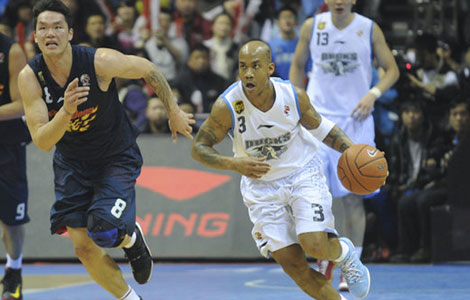
Beijing and Marbury forged a city-to-player relationship like no other. The playoff nights at the Wukesong in particular, were epic, where fans in those ubiquitous white and light-blue Marbury Ducks jerseys (I bought one, too!) roared for him pregame, chanted his name at every heroic moment, cried in joy alongside him when he shed tears over the championships.

“I’ve said it once and I’ll say it again: I think they – Beijing – are the best fans on the planet,” Marbury told me in an interview I conducted with him for SLAM at his apartment in Beijing two years ago. “The energy that they bring towards the players and the atmosphere in Wukesong is different and it’s rare. And it’s consistent throughout the whole game. They’re very knowledgeable, they understand the game, they know when someone’s shot isn’t going, and they know when someone needs to be encouraged. You can’t really put a price tag on that or compare it to anything.”

Former NBA players had taken their talents to China before, including the great lockout journey to the East that included JR Smith, Wilson Chandler, Patty Mills, and Kenyon Martin, and during my time in the country, former All Stars like Tracy McGrady and Gilbert Arenas. But none of them embraced the ‘Middle Kingdom’ like Starbury. He embraced the culture, food, language, and the people like none other, and they embraced him back. For him, China was not just a stepping stone, it was the destination. Later this year, he will even release a film called My Other Home about his journey East, from New York to Beijing.

This comfort in what he often called his ‘new home’ was evident when I met him. “Beijing is home,” he said. “I mean, America’s gonna always be home. But this is where I live at, this is home. This is where my life is at – here in China.”

“At first, it was a trying time because it was all brand new,” he said of his early years in China, when he played two losing seasons in for Shanxi and Foshan. “I was ready to do something different and be a part of something different. I wanted to evolve to a new area in my life and in basketball. It was a trying time because of the culture barrier and not being able to speak the language and not being able to communicate.”

“I understand the culture now. I love the food. I now know why people do what they do when they do it. Even though I can’t speak the language as well as I would like, I know a little bit more than when I first came here.

“It’s just growth.”

April 19, 2017

The unlikeliest duo - Aamir Khan and Stephon Marbury - promoted their movies in China together


I lived in Beijing for three years and, in my time, played a lot of pick-up basketball with the locals. There was a clear language gap with the guys I played with, since they spoke limited English (and no Hindi) and my Mandarin was almost nonexistent. In the universal language of basketball, however, we managed. I will never forget the one time when I was taking part in a 3x3 game, and a Chinese teammate discovered, in his broken English, that I am from India.

"India?" he asked. "Okay, so you be Raju. I will be Rancho, and he," he pointed at our third teammate, "is Farhan."

I was confused. "What do you mean?"

"You know, like the 3 Idiots! You are from India, right?"

I laughed out loud - his first reference to India was 3 Idiots, Aamir Khan's iconic film about the struggles of college life in India (and a perfect 3x3 basketball team team). I discovered that the film had been a cult-favourite in China, too.

Well, here's an even stranger story. Earlier this week, Aamir Khan was back in China to promote his new movie, and this time, his paths crossed with one of the most iconic basketball players of our generation: Stephon Marbury.

Aamir Khan is an Indian cinema legend, who has acted, directed, or produced some of the most memorable and successful Indian films, including several of my personal favourites. Stephon Marbury is a star American basketball player, whose career made him an icon in the NBA and a celebrity in China. The point guard is one of my favourite All Time players - his Knicks' jersey is the first I ever owned!

A few days ago, this unlikely duo shared the stage to meet with distributors for their respective sports films, and in the process, completely blow my mind.

Khan was in China this week to promote his film Dangal, which he produced and played a starring role in, based on the true story of the Phogat family's success in Indian wrestling. Dangal was released in India in December. Marbury, meanwhile, starred as himself in a Chinese biographical basketball documentary about his own life, My Other Home. It was the distributors of both these sports films that brought Khan and Marbury together in Beijing to promote their respective releases in China.

Marbury reserved some heavy praise for Khan on two posts on his Instagram page:

Chilling with #bollywood LEGEND #aamirkhan As we tease the movie screen distributors with his movie and my movie. Never in my life would I have thought up until now my path would lead towards acting and being paired with a living legend in another profession. I'm deeply humbled and completely thankful for all that God has done for my family and I in this life. #starburymovement #starbury #LoveisLove

BBALL by me and Wrestling by #aamirkhan #bollywood Legend Two sport movies coming soon. The anticipation is getting closer #myotherhome


Khan, whose films have broken box office records around the world, is also the most popular Bollywood star in China due to movies like 3 Idiots, Dhoom 3, and PK. To promote Dangal he attended events in three major Chinese cities: Beijing, Shanghai, and Chengdu.

Marbury, of course, is no stranger to transnational popularity. He was once considered the biggest basketball star out of New York, became an iconic NBA player for the Timberwolves, Nets, Suns, Knicks, and Celtics, before contentiously ending his NBA career. Marbury has since played in China for Shanxi, Foshan, and eventually, in Beijing, where he found career nirvana: he won three CBA titles with the Beijing Ducks, saw a statue of himself erected outside the MasterCard Center in Beijing, has stamps bearing his image in China, has starred in a musical play about himself, and been awarded a Chinese green card. His film My Other Home will be about his basketball journey in the US and China.

A few years ago, I interviewed Marbury in depth while in Beijing about finding home in China for SLAM Magazine.

Now, thanks to the magic of cinema, Bollywood and Basketball have again crossed paths in a surprising way. I'm wishing the best to both these legends in their ventures ahead. Now that Marbury has gotten some acting experience, perhaps Khan can find a place to cast him in his next blockbuster. Considering that they have the pulse of the audience in two of the world's most populous countries, I'm expecting this fictional future Star/Khan venture to break every record conceivable.

November 25, 2016

Review: Greg Pearson's "Maybe Next Year" is for the sports optimist in all of us


At first, it seemed like an arbitrary decision. I liked the colours on Patrick Ewing's jersey on his old basketball card. I became enamoured with Allan Houston's baseline fadeway, Latrell Sprewell's cornrows, and Marcus Camby's tattoos. I saw a team carry out a series of upsets in 1999 to become the first eighth seed to ever make the NBA Finals. And, sitting in India thousands of kilometers away from New York, I decided to myself, "Okay, this is my team. Now, I like the New York Knicks."

Over the next few years, the surprise and elation of 1999 would turn into suffering and embarrassment, but, in a perverse fashion of strange self-misery, my liking of this team turned into love. I loved the Knicks even during the Tim Thomas - Keith Van Horn era, loved them when they traded for Stephon Marbury (my first NBA jersey!) and tried to make the Eddy Curry - Zach Randolph duo work. I cringed, but continued to love them even as Isaiah Thomas committed errors and sins, as the team sunk to bottom-status depths, and found small pleasures in the David Lee 'era'. I was boosted when the team signed Amar'e, elated when they got Carmelo Anthony, and downright ecstatic with Linstanity happened. I raised a sceptical eyebrow when Phil Jackson made Kristaps Porzingis the fourth pick and turned into a unicorn worshippers soon after the greatness of Lord Zingis Khan was understood. And throughout a 17-year period of playoff disappointments and ugly records, I continued to rock the blue-orange-white. The pain, I believed - that I still believe - makes the pleasure all the more worth it.

What seemed like an arbitrary decision has become a defining characteristic. My personality as an adult is permanently dyed with that blue, orange, and white. I've visited New York only a few times in my life, watched just one game at the Mecca of the Madison Square Garden, and yet, I feel worthy to celebrate the Knicks' history, cheer with every big win, and throw my hands up in frustration at every moment of sorrow. There is a sense of optimism in this type of irrational fandom, a hope that, if the present is bad, maybe the future will be better. Knicks have only won two NBA titles, both in the early 1970s, a decade or more before I was even born. And after every wasted season, I think to myself, well, hell, at least there's next years!

I divide sports fans into two distinct brackets, and the bracket they fall in go on to define their higher philosophy in life: the pursuit of success versus the pursuit of loyalty. There are sports fans who are promiscuous with their fandom, following success wherever it may lead them. And then there are those who stay faithful to one life, through its bitter pains and occasional joys, following one team no matter where it leads them.

In the newly-published book Maybe Next Year (McFarland, 2016), newspaper writer and editor Greg Pearson profiles the fans of the latter category in various North American sports, both professional and collegiate, to discover a thread of optimism that somehow keeps them going and keeps their spirits high, even during the worst of times. The book features more than 100 loyal followers of 23 teams, who explain their reasons for never giving up. One of those followers featured, in a New York State of Mind, is me!

Pearson's guidelines for choosing his fans was simple: he focused on teams that hadn't won a championship for forty or more years, covering a couple of generations of shared grief, often passed down from parents to children. Some of the memorable fanbases featured include the Detroit Lions, the New York Jets, the Philadelphia Eagles, and the Cleveland Browns. In the basketball world, fanbases of the Phoenix Suns, Denver Nuggets, Atlanta Hawks, and New York Knicks talked about their years of pain and optimism. Pearson also included the Sacramento Kings, who moved to the city 31 years ago but were saved from relocation through fan efforts and a purchase by Indian-born owner Vivek Ranadive in 2013.

The most pertinent chapter in the book is the first, which features on the Chicago Cubs, who hadn't won an MLB World Series since 1908. The Cubs serve as the book's opening, and perhaps, also its happy conclusion. The night before Maybe Next Year arrived at my doorstep, they defeated the Cleveland Indians in the 2016 World Series and broke a 108-year title drought!

Reading through Maybe Next Year was therapeutic in a way. It made me realise that I am not alone: us loyal fans keep going through the ups and downs (mostly downs), no matter what the result. So the next time you jump on the bandwagon of the 73-9, Curry-Durant Warriors, tip a hat to those hardcore Warriors fans who lived through 40-years of near-misses, of Run-TMC, Chris Webber, Jason Richardson, the "We Believe" team, and Baron Davis. After decades of irrelevance, they found their year in 2015. The Cubs waited over a century for 2016. Perhaps, one day, our favourite teams will have their year, too.

July 17, 2015

Come Home With Me


After a topsy-turvy NBA career, Stephon Marbury's unlikely journey brought him peace and success in China.

by Karan Madhok

This feature was originally published in the August 2015 edition of SLAM Magazine (SLAM No. 190). You can also find it on SLAMOnline.com.

What is Home?

Home was Coney Island, the Brooklyn neighborhood that birthed his game. Home was Georgia Tech, the college that developed his early stardom. Home was Minnesota, the city with the NBA team where he played his first few seasons in the NBA. For some stretches, home was New Jersey, Phoenix and Boston. Home really felt like home back in New York when the Knicks traded for him.

Home, now, for Stephon Xavier Marbury, is Beijing, China. It’s a spacious apartment in a high-rise building in the heart of the city, surrounded by other high-rises and shopping complexes that have contributed to this historic city’s transformation into a concrete jungle. Home is a couple of metro stops away from Tiananmen Square, in the capital of the most populated nation in the world, of a civilization thousands of years old.

It’s here—at home—where I find Marbury, a month after he turns 38, on a cold afternoon in late March. It’s been only a few days since he led the Beijing Ducks to their third Chinese Basketball Association (CBA) title in four years and grabbed the finals MVP award. I find him relaxed, alone at his apartment, draped in his 361° brand t-shirt and sweatpants, eating a Subway sandwich for lunch and listening to the Drake mixtape out of his smartphone.

It’s here, at home, where he finally talks to SLAM again. Where we talk about his journey: his NBA career, his rise, his departure, his resurrection in China. It’s here, at his new home, where I ask about his old one. About his brothers, about his friends in the NBA, about Coney Island.

I ask him if he ever gets homesick.

“No.”

“Never?” I ask, “When you think of what ‘home’ is?”

“This is home,” he says, staring directly at me. “Beijing is home. I mean, America’s gonna always be home. But this is where I live at—this is home. This is where my life is at. Here in China.”

There seem to be two separate lives to Stephon Marbury: “Starbury” in the US, “Ma Bu Li” in China. Starbury was the high school phenom from Brooklyn who broke New York City records and was a cult hero even before getting selected fourth overall by the Timberwolves in the heralded 1996 NBA Draft. He was the score-first point guard much ahead of his time who, despite enjoying strong individual highs, never quite found permanence in the League. Nearly every team he was a part of was happier to see him gone, and by his last NBA years, he was reduced to a mere caricature of pro basketball careers gone wrong. He was blasted by critics, maligned by legal cases against him, suffered personal loss and live-streamed a nervous breakdown.

So, at age 32, he packed up and left. Left the League, left the country and left what he now calls the “negative energy” behind. He traveled nearly 7,000 miles, crossed the Pacific and resurrected his career in China. Former NBA players had taken their talents to China before, but no one who had previously done so had a higher profile than him. The Chinese named him Ma Bu Li, and after two years of teething troubles in Shanxi and Foshan, he joined the Beijing Ducks, making the team and the city his home in 2011.

“At first, it was a trying time, because it was all brand new,” he says of his early years in China. “I was ready to do something different and be a part of something different. I wanted to evolve to a new area in my life and in basketball. It was a trying time because of the culture barrier and not being able to speak the language and not being able to communicate.

“I understand the culture now,” he adds. “I love the food. I now know why people do what they do when they do it. Even though I can’t speak the language as well as I would like, I know a little bit more than when I first came here. It’s just growth.”

The growth off the court correlated with success on the court, and despite his age, Marbury has remained The Man (there’s the annual CBA legend of “Playoff Marbury”) for the Ducks, leading them to back-to-back-to-back championships. I suggest that, if he stayed on his traditional route in the NBA, his role would’ve probably gotten smaller as he got older, and I ask if it’s been tougher to continue playing at a high level with age.

“I wouldn’t necessarily say that if I was playing in the NBA, if I got older, that my role would’ve changed,” he answers with characteristic defiance. “How I played in the NBA and how I play now is the same. It’s no different. But I think playing here, you have to do more, because a lot more is required out of the foreigners [CBA teams are usually only allowed two foreign players each—Ed.]. So consistency is something that plays a major role here in being able to score, play defense, trying to get everybody involved to do all of the different things that are needed to play at a higher level.”

Back in the NBA, being a point guard is perhaps the deepest and toughest gig in the League now, with damn near every team featuring an All-Star or All-Star-potential starting PG. I try to make him imagine that alternate universe, the universe where he’s still playing in the NBA, having never attempted the China experiment. What kind of role do you see yourself in if you were still in the NBA? I ask.

“I see myself as a starting point guard,” he says. “I probably wouldn’t be as dominant as when I was younger, but I would definitely still have my same attributes on court. My style wouldn’t be any different.

“[Allen] Iverson and myself, we kinda changed the dynamic of how the traditional point guards played,” he continues. “Now, when you see the athletic guards that are dunking and doing the things that they are doing, Iverson and myself, we came in doing things like that, which changed the perspective of how people viewed the point guard. We took a lot of flak because we came in and changed the game.”

Are there any younger guys that you see a bit of yourself in?

“I like Derrick Rose,” he answers. “I like Westbrook, too. But Derrick Rose is my favorite. I like the kid Curry, too. He’s having a really good year.”

***

Maybe home exists not in a specific, physical place, but in the legend built by history. By words and photographs by scribes, illustrators and photographers. By the journals that time will preserve—in paper and online.

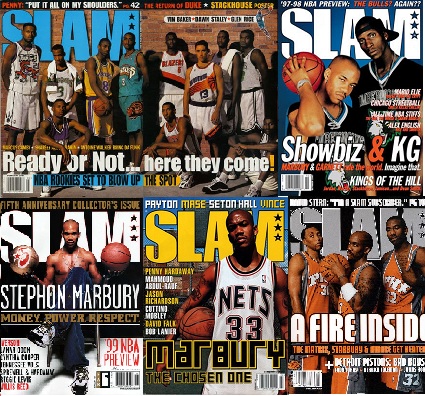
Marbury began when SLAM did. He was the magazine’s first-ever high school diarist and appeared on a multitude of SLAM covers over the years. I pull out my phone to slide through photographs of those old covers. Each evokes a different reaction, a different moment in his career, telling a story through images a thousand times better than through words.

We see the cover of SLAM 15, featuring the legendary 1996 Draft class, a class that gave the League Marbury and AI, as well as Kobe Bryant, Steve Nash, Ray Allen, Shareef Abdur-Rahim, Peja Stojakovic, Antoine Walker and more. I ask if he truly believes this class was the greatest ever.

“By far.”

Do you compare it to 2003? LeBron, Wade…

“It’s not…” he interrupts me. “No class can mess with our class.”

We scroll next to see the famous “KG and Showbiz” cover, featuring the exciting but ultimately ill-fated pairing of Kevin Garnett and Marbury in Minnesota at the end of Steph’s rookie year. He doesn’t react.

I show him the cover of SLAM’s fifth anniversary special in January of 1999. He was on the cover again, posing in Coney Island, a few years later. He was traded to the Phoenix Suns in 2001 and appeared on the 75th issue cover with Shawn Marion and Amar’e Stoudemire.

“Anytime you get on the cover of a magazine, especially SLAM Magazine that all of the kids like to go buy and read about, it’s cool. All the times was different times in my career,” he remembers. “It was all good times.”

When the times were good, they were great. Starbury was named Third-Team All-NBA in 2000 and ’03, and played in the ’01 and ’03 All-Star Games. For the majority of his career, he was the only player since Oscar Robertson to average 20 points and 8 assists per game.

But his greatest day in the NBA, he says, was his very first one. “When I got drafted, that was the best time. Everything else was just basketball and business. It was nothing more and nothing else. Making it to the NBA was my only thing. That was the only dream that I had as a kid.”

Did you have any regrets?

“No.”

None at all?

He shakes his head.

Marbury’s NBA dream seemed to turn into a nightmare in his last few years in the League. After not returning to the Celtics in 2009, the world around him began to collapse. The low-point came during an infamous live-stream from his bedroom as he spoke about depression, ate Vaseline, lip-synched “Barbie Girl” and broke down crying.

Earlier this year, Marbury finally opened up about his suicidal thoughts during that dark period to HBO’s Real Sports, and about eventually making it out to the light.

“That interview was fascinating,” I told him, “because very few individuals could talk about the dark days so openly. Was that a tough process for you? To be so open about it?”

“No,” he answers, “It’s something that happened. I don’t mind telling something that happened, that went on in my life. During those days, no one knew what was going on. Nobody knew I had lost my aunt, my coach, my father, all within a month. When we were burying people, you know, it wasn’t really anyone’s business. That was my life. That was something that I was going through in my trying times.”

His voice begins to crack as he speaks, but he doesn’t stop.

“Speaking about that was important for people to have a different understanding, because things have changed,” he continues, “because things have changed for the better. It’s a different story. It’s triumph. Some people think, ‘Oh, you play basketball, you make money, you live this life,’ that you’re exempt from the natural crisis of what goes on in human life, as far as being in an emotional state because of something that has happened. For me, sharing was easy. I said that because I wanted people to understand what was going on with
me, what pushed me and what motivated me.”

Maybe Home is where the love is?

While delivering three championships to Beijing in the last four years, Marbury has also become a true cultural icon in the city. A statue of him stands outside the MasterCard Center where the Ducks play. Last winter, he was the subject and the star of the play I Am Marbury that was staged for a few days in Beijing. The China Post has released a collection of stamps and post cards in his honor. He was the only non-Chinese person named in the list of Beijing’s Top 10 Model Citizens of 2014. The Chinese, especially Beijingers, have accepted Marbury as their own. And he is fully accepting the nation, too, applying for a Chinese Green Card (permanent residency) this year.

“I’ve said it once and I’ll say it again,” he says. “These are the best fans on the planet. I don’t say that loosely because I play in Beijing and I love Beijing. Whenever you have fans that bring that type of energy, it’s different and it’s rare. And it’s consistent throughout the whole game. The fan base—you can’t really put a price tag on that or compare it to anything.”

Home is different for us all. For some, it’s a physical place; for some, it’s a feeling; for others, it’s their legacy. For Marbury, it seems that home is where he can continue to find bliss in his first true love: basketball.

“Basketball is everywhere,” he smiles. “It’s not just the NBA. The game has changed. Basketball is global. I know I wasn’t the first American to come to China and I won’t be the last. I’m just the American who came here and did it my way. I came here. I’ve been real. I was open. I left myself completely vulnerable for people to understand me.

“I can play as long as I want. Honestly, it depends on my body. When my body says ‘That’s it,’ then I’ll stop. So, I could say that I want to play another two-three years. It’s fun right now. It’s fun winning. So you’re driven to continue to work hard because the success of winning feeds you.”

And you want to keep winning in Beijing?

“Why not?”

Do you see yourself in China long-term?

“I’m not going,” he says. “This is my home. I’m going nowhere.”

April 6, 2015

The Mighty Duck


This article was first published with the cover story of the 143rd edition (2015 - No. 4) of SLAM China magazine. Here is my original English version.

Stephon Marbury’s evolution has helped create a basketball dynasty in Beijing

It’s a rare moment when an icon and a community find perfect resonance with each other, a bond that eventually offers unconditional love from one to another. Watching a Beijing Ducks game in Beijing – especially during the playoffs at the MasterCard center – provides a glimpse of that type of resonance. On nights when Stephon Marbury is heroically carrying the Ducks to victory, pushing the team forward with big performances every night, the city parallels his passion and intensity off the court. Both of them feed into each other, until they make a monster that few in the CBA can conquer.

Last week, Marbury led Beijing to their second consecutive CBA title and their third in fourth years, deservedly winning the Finals MVP award. He’s now 38, and has played for nearly two decades professionally in Minnesota, New Jersey, Phoenix, New York, Shanxi, and Foshan. But it was in Beijing that the star point guard finally found fulfilment, and in return, the city made him a basketball deity.

“This is home,” he tells SLAM a few days after celebrating the title victory – his third – in Liaoning, “Beijing is home. America will always be home. But this is where my life is at, here in China.”

Marbury has shown Beijing and China love, and China has showed him love back. After over five years playing and living in the country, he has also overcome the early trials and tribulations to find peace, both on and off the court.

“It was a trying time because it was all brand new,” he says of his early years in China, when he went from being an NBA star to a point guard from Shanxi and Foshan, “I was ready to do something different and be a part of something different. I wanted to evolve to a new area in my life and in basketball. It was a trying time because of the culture barrier and not being able to speak the language and not being able to communicate. But for the most part it was cool, because I knew it was just part of the experience.”

“I understand the culture now,” he adds, “I love the food. I now know why people do what they do when they do it. Even though I can’t speak the language as well as I would like, I know a little bit more than when I first came here. It’s just growth.”

The growth off-the-court corresponded to success on-court, and with the Ducks, Marbury found a clique that finally brought him championship success. Part of the reason is team continuity, as the Ducks have had the same two foreigners (Marbury and Randolph Morris) and much of the same roster over the last four years.

When I ask him what the secret is to the team’s success, he says that it has always been about looking ahead. “[It’s about] our preparation from the beginning of the year. So now, our focus is on the next year. Everyone is aware of what we have to do for next year. We’re enjoying the championship but in the back of our mind we know that we have more work to do. We know where have to get better, where we have to improve. No one is relaxing right now. Everyone loves this feeling. We like winning. For the most part, everyone is conscious of living in the moment of now, but knowing in the future what we have to do to continue to stay stable as one of the top teams.”

And of course, having a city that resonates and encourages him and his teammates every moment of every game helps, too. “I’ve said it once and I’ll say it again,” Marbury stresses, “I think they – Beijing – are the best fans on the planet. The energy that they bring towards the players and the atmosphere in Wukesong is different and it’s rare. And it’s consistent throughout the whole game, not in spurts or just the fourth quarter, it’s all throughout the whole game. They’re very knowledgeable, they understand the game, they know when someone’s shot isn’t going, and they know when someone needs to be encouraged. All of that contributes to why they are the best fans. You can’t really put a price tag on that or compare it to anything. I know the energy that they gave me from the way that they go about cheering for us.”

NBA and foreign players have played in China before Marbury, and they’ll come to play in China after he retires, but there may never be anyone like him again, an individual who embraced the culture and a city and they embraced him back. And as he basks in the afterglow of another CBA title, Marbury sets his eye ahead for more success in China and with Beijing in the future.

“I wanna win more championships here,” he says, “It’s fun right now. It’s fun to be winning, and you’re driven to continue to work hard to keep winning”

October 13, 2013

Where European & Chinese hoops clash: Real Madrid beat Beijing Ducks in Beijing


It was a clash of two very different philosophies of basketball, and yet, once the referee sent the ball in the air for the tip off, the flow of the game itself took over to dominate all other cultural and philosophical differences. On Friday, October 11th, one of the Chinese Basketball Association's (CBA) most-popular franchises - the Beijing Ducks - hosted one of the most historically successful European basketball team's - Spain's Real Madrid - in a pre-season exhibition that turned out to be far more intriguing than anyone imagined. After a topsy-turvy encounter, Madrid used a timely fourth quarter run to speed past Beijing to a 92-86 victory.

The Euroleague's CEO Jordi Bertomeu was in attendance too, to overlook the game's proceedings.

The Ducks, who won the CBA title in 2012 and were in last year's semi-finals, hosted the game in Beijing's MasterCard Center. This game was the first time that Real Madrid - who were runner-up in the Euroleague last season - faced against a Chinese opponent in their long history. It was the last game of the pre-season for Real Madrid, who were coming off the Endesa Super Cup title against Barcelona.

A little over a month ago, the Chief Business Development Officer of the Euroleague Roser Queralto announced the game in Beijing with the proclamation that Chinese and European teams play quite a similar game, and an on-court interaction could strengthen the relations of both the leagues. While the playing styles rooting from Spanish and the Chinese tactics weren't exactly the same, the final result was an evenly-matched contest.

The Beijing Ducks of course feature former NBA All Star Stephon Marbury, who had been their hero and leader en route to their maiden CBA title in 2012. Marbury proved to be unstoppable for the Madrid defense, and slashed and shot his way to 25 points. The chief benefactor of Marbury's kick and drives or rebounding off his missed opportunities was his American teammate Randolph Morris, who kept the Ducks close with a game-high 28 point performance.

It was a back-and-forth contest throughout, and while Beijing mostly relied on their two American imports for offense, Madrid spread the ball around to keep their top contributors Jaycee Carroll, Sergio Rodriguez, and Tremmel Darden involved. The Ducks made a surprising third-quarter run to lead 63-57 before the final period began. The game continued to be close in the fourth quarter, and the score was tied 77 all with just five minutes left on the clock. Madrid finally broke out to a 13-3 run to put the game past Beijing, and settled on a 92-86 win.

Madrid will now begin their regular season back in Spain against Valladolid, while Beijing have to wait till the end of November for the start of the CBA season.

August 27, 2013

Questions, and the Answer


Earlier this week, Allen Iverson indicated that he would officially announce his retirement, bringing an end to years of speculation of whether he’ll ever get an opportunity to wear an NBA jersey again. It was the end to a career that ignited the basketball-loving world for most of the past decade.

In the near future, Iverson will probably receive his accolades, mostly from the Philadelphia fans who became an extension to his family. He will have the jersey retired and will hear words of respect from his peers. But no matter the tribute at his retirement parties, it could never truly capture the adulation that Allen Iverson’s career once deserved.

Click here to read full feature

February 25, 2013

Chinese Basketball Association: Regular Season Round-Up & a Preview of the Playoffs


This article was first published on February 19, 2012 on Court Side.

China’s Basketball Calendar roughly parallels their zodiac calendar. By the first week of February, the Year of the Dragon concluded in China, and the Chinese New Year also coincided closely with the end of the regular season of the Chinese Basketball Association (CBA). Now begins the Year of the Snake, and the CBA playoffs will begin about two weeks into the New Year. It’s a time for fresh beginnings and new starts. Once the haze of the festival celebratory fireworks clears, the picture ahead will get clearer.

The professional league in China has taken major strides forward each year since its inception just 18 years ago. This year, a slew of more stars including Tracy McGrady, Gilbert Arenas, and the returning Yi Jianlian joined the league that already featured big names like Stephon Marbury and several big name Chinese superstars. It made for an exciting few months of basketball. The questions now begin as we look ahead: Who has the best chance of moving forward to capture the CBA championship? Who will be the big surprises and the big disappointments? Which team can leave the Dragon behind and welcome the Snake with fireworks on court?

Eight of the 17 total teams in the league have qualified for the post-season, which is set to begin on February 27th. The eight qualified teams play the first round of the playoffs in a best-of-five challenge, before moving to best-of-seven in the semi-finals and Finals, which will conclude around the end of March.

The teams who have qualified for the playoffs are: Guangdong, Shandong, Beijing, Xinjiang, Liaoning, Guangsha, Dongguan, and Zhejiang.

Last year’s finalists, winners of seven CBA championships, and by far the strongest team this season, the Guangdong Southern Tigers are looking in top form to return to the Finals for the 11th straight year! Guangdong have become China’s marquee team, featuring many of the best players from China’s national squad and boasting of the league’s best record over the past decade. Guangdong finished the 32-game 2012-13 season with just four losses, decimating nearly every team that came in their way. Guangdong feature China’s best player – Yi Jianlian – who returned to the CBA this season after an unsuccessful NBA stint to boost his already powerful side. They are perfectionists, replacing their successful coach mid-season to add an even more successful coach, and replacing their foreign import Terrence Williams at the end of the season to add Donald Sloan – formerly of the Cleveland Cavaliers – to their roster.

Beijing Ducks – led by former NBA All Star Stephon Marbury – were the surprise winners of last year’s CBA title in their first-ever visit to the Finals. Despite a few minor hiccups, Beijing continued to be amongst the league’s elite this season behind the efforts of Marbury (who was amongst the league’s leaders in points and assists), Randolph Morris, Li Gen, and Zhe Ji. Like last year, Marbury has gotten his teammates involved more in the regular season before taking over in the playoffs. Will Guangdong – or any other opponent – find a way to stop him this time around? The Ducks face Zhejiang Guangsha Lions in the first round.

Finishing in the bottom four last season, CBA’s best ‘Asian import on hire’ Zaid Abbas (from Jordan) joined the Shandong Lions this season and helped completely change the fortunes for his new side, assisting other solid foreign imports Pooh Jeter and Jackson Vroman to help take this underdog side to second place in the league. But question marks remain if this team now has the mettle to carry on their hot streak into the playoffs. Their first round opponent are the Dongguan Leopards.

Those with an outside bet to challenge for the title could be the Xinjiang Flying Tigers of China’s cold far West, featuring veteran Mengkte Bateer and talented imports James Singleton and Von Vafer. Xinjiang will first have to deal with fifth place Liaoning Dinosaurs in the first round.

The first round could see an intriguing 1 vs. 8 matchup between Guangdong and the eighth-seeded Zhejiang Golden Bulls. While Zhejiang only barely managed to scrape into the postseason ahead of Shanxi and Bayi, they feature one of the league’s most entertaining scorers in Quincy Douby as well as forgotten former NBA big man Eddy Curry.

Outside the playoff picture, one of the revelations in the CBA this season was Shavlik Randolph of the Foshan Long Lions. Randolph was the CBA’s leading scorer (32.7 ppg) and finished the season third in rebounds (14.4 rpg). He missed the playoffs, but his performance could make him in high-demand in the CBA (or the NBA?) for the future.

Also missing the playoffs were two high-profile former NBA All Stars, both of whom who saw their teams finish in the bottom four: Tracy McGrady and Gilbert Arenas. McGrady had a decent individual season for the Qingdao Eagles, but his efforts weren’t enough otherwise to save his poor team from a last place finish in the league. Gilbert Arenas showed glimpses of form for the Shanghai Sharks, but he missed more than half the season to injury and his squad suffered in the constant flux, finishing at 14th place.

But the ones left behind are the past; they’re the ones slain by the Dragon and unable to compete with the Snake. Now we look ahead: Will Guangdong get back to the top of Chinese Basketball? Will the Ducks bring the title back to China’s capital? Or will the New Year bring a new champion?

December 24, 2012

Internationally Known: Tracy McGrady arrives in China with great expectations.

I wrote this feature as the cover story for SLAM China 2012 No. 23 where it was published in Chinese. The original English version was first published on SLAMOnline.com on December 18, 2012.

It’s an afternoon practice session at the Qingdao University Gymnasium. It’s a big city debut in the evening in Shanghai. It’s the NBA All-Star Game in Los Angeles. It’s the first round of the NBA Playoffs in Houston. It’s him as an athletic 18-year-old straight out of high school in Toronto. It’s him in his mid-30s as a veteran in China.

No matter what jersey he’s wearing, no matter the time or age, no matter the opponent, Tracy McGrady’s on-court demeanor rarely changes. Without the ball, he moves slowly, almost seeming to lumber painfully from one side of the court to the other. Once the whistle blows and the game begins, he speeds up a little, but his body language still gives the impression of lethargy, of being a little too relaxed, of being a little too disoriented.

But blink and you may miss the sudden spurt of energy, a sudden flash, an unexpected spin around an opposing defender, a perfect catch of the ball, a sudden spark of complete concentration, of complete orientation, a couple of quick dribbles to beat the next defender, a quick jump shot, a perfect swish.

Tracy McGrady may have landed in China as a professional just a few months ago, but a little bit of China has always been in the man who local fans now adoringly refer to as “Mai Di.” NBA players have a variety of different training regimes, but there is one—the practice of Tai Chi—that seems to be inherent in Mai Di’s game, whether or not he realizes it. Tai Chi—China’s centuries-old form of exercise and martial art—is a system of slow meditative physical exercises, designed for relaxation, for balance of health, for defensive training.

Walk down through any public park in Beijing, Shanghai, Guangzhou, or McGrady’s new home of Qingdao, or anywhere across the country, and you’ll see Tai Chi in action. Young and old (well, mostly old!) Chinese practitioners exercising in slow physical meditation. Not every form of physical workout needs to be externally grueling; Tai Chi proves that the slow, almost lethargic-looking form of exercise can perform wonders, can offer the perfect internal balance, can prepare its subject physically, mentally and spiritually for grueling tests of the body and the mind ahead.

From Auburndale High School to the Mount Zion Christian Academy, from Toronto to Orlando, from Houston to New York, and from Detroit to Atlanta, Tracy McGrady—probably unwittingly—honed his Tai Chi skills. In the process, he became the best high school player in the US, became the ninth pick in the NBA, won a Most Improved Player award, was named to the All-NBA First-Team twice, became an NBA scoring champion twice, and played in seven consecutive NBA All-Star games. He became one of the most popular players in the world, and most importantly, one of the finest basketball players in the world.

And in 2012, he arrived in China, the land where Tai Chi has flourished, to flourish with his own command of Tai Chi Basketball. He arrived in the city of Qingdao to guide the city’s DoubleStar Eagles to greater heights than they have ever before.

*****

The Chinese Basketball Association is at its most advanced stage yet. The league has never been better. The talent level in each team stronger than ever before, there is more balance in the league than ever before, and with each passing year, the league gets richer and more popular across the world. There are also a high number of talented foreign players spread across the league, many of whom have been big names in the NBA in past years.

Foreign players have been hitting up Chinese shores for over a decade, but the most-hyped breakthrough first came when Bonzi Wells came in to play for the Shaanxi Brave Dragons. An unsuccessful stint by Yao Ming’s former teammate Steve Francis followed, but the league truly came into global attention when Stephon Marbury bought his talents to China. Marbury’s journey eventually took him and the Beijing Ducks to their first CBA championship in 2012. A year ago, during the lockout in the NBA, a multitude of NBA players—including Wilson Chandler, Kenyon Martin, JR Smith, and Aaron Brooks—all chose to play professionally in China.

Looking around the CBA today, the list of foreign players can sometimes read as a list of the NBA’s ‘Where Are They Now?’ Mike Harris, Rashad McCants, Shavlik Randolph, DJ Mbenga (McGrady’s former teammate in Qingdao), Al Thornton, Quincy Douby, Josh Boone, James Singleton, Von Wafer, Randolph Morris, Sundiata Gaines, and Ike Diogu are earning their salaries far from home in China. Marbury is still leading the Ducks’ offense. This year, multiple-time All-Star Gilbert Arenas finds himself (chilling on the injury list) in Shanghai.

But let’s be real: Tracy McGrady has arrived this season as the biggest foreign name in the history of the CBA. Never before has an American star of his caliber played in front of China’s local audiences, been a teammate to their own players, represented a team of one of their own cities. Tracy McGrady, the man who played 15 fruitful years in the NBA. Tracy McGrady, the man who averaged 19.6 points, 5.6 rebounds and 4.4 assists per game through his career. Tracy McGrady, who once scored 13 points in 35 seconds.

That Tracy McGrady is now playing in China.

*****

Qingdao is a beautiful city on in the Shandong Province on China’s East Coast. It’s one of the cleanest and greenest of the major cities in the country, and even earned the title of China’s Most Livable City in 2009 and 2011 by the Chinese Institute of City Competitiveness. The city is home to beautiful German-style architecture, pleasant beaches, wide roads, mountains spotting across the city limits, and most-famously, to China’s well-known Tsingtao Beer. Like McGrady, the city is laid-back and easy-going.

The Qingdao Eagles were formed in 2003, and since then, the city’s professional basketball team hasn’t yet had any memorable seasons in the CBA. They have featured a few half-decent foreign players in the past—like Dee Brown and Ivan Johnson—but the squad was never good enough for a playoff run.

But with McGrady’s addition this year, their fans—young and old—are expectant of great things.

“I used to be a big fan of Shandong’s basketball team for more than 10 years back in the old days,” says Zhao Quan Min, a fan who showed up at the Qingdao University Gymnasium to watch McGrady and the Eagles play against the Bayi Rockets, “But I never really followed the new Qingdao Eagles. Of course, I used to like McGrady back when he used to play with Yao in the Houston Rockets. So it’s great that he’s here in our city.”

When asked about his expectations for the team this year, Zhao smiles and without a hesitation replies, “A championship.”

McGrady’s move is helping to bring non-basketball fans to the stadium, too. Wang Bi started coming to Qingdao’s home games after she heard about McGrady’s signing. She says she has been a fan of Mai Di for the past eight years. When asked why, she answered, “Because when I saw him on TV, he was so handsome, and cool!”

On game night, another group of fans sitting in the upper stands let their large banner—unfurled widely across the rows—do the talking: ‘T-Mac comes—Can Championship Be Far Behind?’

Speaking to reporters, McGrady admitted he knows little to nothing about his opponents in China. He’s new here, and he’ll learn. The CBA won’t be an easy league for him and his team, and there are no guarantees of success. But the city of Qingdao expects, and the fans are excited. Now, the pressure is on McGrady to deliver.

Or so we think. Because as the man himself claims, there is no pressure at all.

China loves basketball, and McGrady, who spent the best-remembered years of his career in Houston with China’s greatest player, Yao Ming, is rightfully loved in China. He has been a superstar in the US, and his arrival in China has been greeted with frantic fan frenzy. He was mobbed by fans as he first walked out through the airport, he is mobbed by fans screaming out his name at every home game, he has fans of other teams cheering for him, he has the attention of every person in the 1.4-billion strong country that cares for basketball, and even of a great number of those who don’t.

In the middle of this frenzy, this outpour of love and attention, McGrady seems as calm as ever.

“There’s no pressure!” McGrady exclaimed a day after his first home game in Qingdao—a loss to the Foshan Long Lions—when we asked him if he felt any burden of being the biggest basketball star to arrive in China, “No pressure. I just play ball. That’s all that I know to do.”

McGrady has had a rough start to his career with the Eagles, and the team has gone through a major transition phase since finishing ninth last season, their best ever finish since the team’s inception in 2003. Gone are last year’s All-Stars Li Gen and the American Lester Hudson. In came McGrady and former NBA player DJ Mbenga, who was soon replaced after a rough start by the American Chris Daniels. To put it bluntly, the surrounding cast in the team around McGrady is weak, but that is the price that the team has to pay for signing a former NBA superstar. Speaking to reporters, McGrady made clear that one of his goals is to help his Chinese teammates get better.

The Eagles finished last season with a 16-16 record, their best ever finish in the CBA. After a rough start to this season, the team fired their Korean head coach Kang Jung-Soo and promoted junior coach Zhang Shizhang to the top post. Unfortunately, as the new coach is learning, success won’t be too easy, even with T-Mac’s talents. Nine games in, McGrady’s Eagles are the worst team in China. At the time of writing, they were 0-9 and T-Mac was still looking for his first win in China. The team will have to work hard and figure out their identity if they plan to fulfill their first goal: to start winning games. The fans’ dreams of the playoffs, or that improbable championship, will have to wait for later.

But will there be a later? With the exception of Marbury, many foreign players have the tendency to use China has just a stepping stone or a phase in their career. There are no guarantees if McGrady will be in Qingdao, or even in China next season. McGrady sounded non-committal about his future too.

“I’m not thinking about long-term plans right now,” he said. “I don’t think that far ahead. I go day-by-day. I don’t know what the future holds for me.”

*****

If he doesn’t have a clear future, then McGrady will have to make the most of his present time with the team. And whether or not he likes to admit it, this is a team that is under major spotlight this season, and with every loss, the pressure on the players is going to increase exponentially. China loves McGrady because they love basketball superstars. But China loves winning even more.

Marbury—another great talent from the NBA who couldn’t find success back home—was able to turn it around and win an elusive championship with the Beijing Ducks in China. Marbury always had fans in China, but becoming a champion turned him into a legend. A statue of him—paid by the Ducks’ fans—stands outside the Wukesong/MasterCard stadium where his team won the CBA Finals last season.

McGrady will have no problem having individual success in China, putting up big stats (he’s currently averaging over 25 points, 4 assists and nearly 6 rebounds per game), and in the process, remaining extremely popular. He has been a great individual player and a popular one before, in the NBA. But he was never too successful with his team, and never tasted the sweet success of an NBA Championship. Now in China, he has to turn his fortunes like Marbury did and turn individual brilliance in to team success.

There will be questions and concerns constantly surrounding him. He’s in his 30s now and is being expected to carry a heavy load for the Eagles. Will he be able to do it on a consistent basis at this age? He has also been constantly hampered with injuries in the past, injuries that cut short what could have been an even better career.

The journey ahead won’t be easy. There will be loud noises screaming at McGrady on court and loud fan frenzy chasing him off of it. There will be the need to win and to entertain, to dominate and to help others in his team dominate. To stop his opponents and go somewhere neither he nor his new team has never been before.

Luckily for McGrady, he is already blessed with one weapon for the road ahead. He may look calm, slow, and a little too relaxed at times, but don’t be fooled: because like the art of Tai Chi makes one move gracefully to become stronger, McGrady has the graceful talent to come out stronger than ever on the basketball court. The eyes won’t always show it, but a switch will constantly flip off and on—multiple times a game—when he turns the calmness into deadliness, the lethargy into swift concentration.

When he becomes the most dangerous player on court.

October 31, 2012

CBA Webchat: T-Mac, A Retooled Guangdong Offence and Jianbings

A few days ago, I took part in a web-chat with two of the best English-language basketball writers in China - Andrew Crawford, the writer Shark Fin Hoops, and Jon Pastuzek, the man behind NiuBball. This was the first time that I have participated in a webchat with them, and as a relative newcomer to Chinese hoops, it served as an important introductory conversation. The chat was first published on Shark Fin Hoops.

The Chinese basketball season is about a month away from starting and in anticipation of this, cash has been flashed and some well-known NBA players will be plying their trade in China this season.

Andrew Crawford: Karan, as its your first time talking CBA hoops with us, why don’t you give people an idea of who you are and your writing background?

Karan Madhok: Well, I’m a basketball writer from India and have worked with the Basketball Federation of India, NBA.com/India, and SLAM Magazine. I keep a blog about basketball in India called ‘Hoopistani‘. I moved to China just over 3 months ago so I’m still new to the CBA and Chinese hoops.

AC: Great stuff. Do you think you’ll chose a team to follow this year or are you going to stay neutral the whole time!

KM: Oh, I’m definitely choosing the Beijing Ducks for 2 obvious reasons. 1) I live in Beijing and I’m already a fan of the city and 2) Call me crazy, but I’ve been on the Stephon Marbury bandwagon for over a decade now, following his career through its ups and downs, vaseline eating and championships. Oh and 3) The Ducks and have the coolest name in the CBA!

AC: That they do. Well, you’ve picked a fine time to arrive in the capital- I was hoping to get you on the Sharks bandwagon but alas. Since you brought up Stephon Marbury, lets neatly segway into another NBA player whose been around for a while- Tracey McGrady has signed with the Qingdao Eagles. Guys, do you think T-Mac can still do it or is this more about both sides making money off this?

KM: Well, this is definitely about the money first and foremost. Qingdao benefits, McGrady benefits, everyone’s happy. But for McGrady, I think there is still some (very) faint hope that this stint will give a him a chance in the NBA again once the CBA season ends. I don’t expect him to be a Marbury-type loyalist to basketball in China – at least not yet, anyways. Whether or not he gets a shot with the NBA again (and I’m not sure he will), McGrady will be using Qingdao for the stats and the money, and Qingdao will use McGrady for the money and the fans.

Still though, this is a logical next move for him. McGrady has definitely been very popular in China since the Yao days, and a star like him will no doubt bring some more excitement to the CBA.

Jon Pastuszek: Obviously, money plays a big factor when these big name NBA guys sign in China. But, whereas last year there were some players making well into the seven figures, T-Mac’s contract this season is reportedly quite reasonable by CBA standards. This is more of a long-term thing for him. McGrady, a la Stephon Marbury, will aim at building his brand inside the Chinese market. He’s already hugely popular among fans and the belief is that if he can stick around and build Qingdao into a winner, he’ll become an even bigger name out here.

About his play, there’s a few questions: Can his body hold up to 30+ minutes a night? Is he explosive enough to get to the basket consistently? How is he going to handle the pressure of having to score 25 to 30 points a night?

With his height and versatility, he will find ways to effect the game beyond scoring the ball, but in the CBA, imports are expected to put the ball in the hoop… and with seven Chinese players leaving the team this off-season, including Li Gen, he won’t have much help around him to alleviate that pressure.

AC: Absolutely- the Li Gen point is crucial in my books. I know last season, Qingdao were happy to let Lester Hudson call the shots but they always had a solid Plan B in Li. Cai Liang was also a decent player for them too and he’s gone as well so it really is all about the star player this season.

After the K-Mart/Patty Mills/ Wilson Chandler drama last season, how do you think T-Mac will handle his debut year in China. Qingdao is obviously a very nice city but it certainly isn’t Orlando or Houston!

JP: While not Orlando or Houston, or even Beijing or Shanghai, Qingdao is actually a very pleasant city by the coast and one I think McGrady could get used to. He’s been to China several times before and he says he is aware of all of the issues he’ll have to face, so I don’t think living here will be an earth-shattering adjustment for him. Unless his body chooses not to cooperate and his play suffers as a result, I think he will adapt just fine.

KM: I have never been to Qingdao, so it won’t be fair for me to comment on how McGrady can fit in. But I believe that if guys like JR Smith and Kenyon Martin can go to the hinterlands of China, then McGrady will be okay, too. In the end, if the money is good, he’ll be good. Plus, he’ll enjoy the type of popularity here that he has never experienced in his career. That will be worth it all.

AC: Just behind T-Mac in terms of the wow factor is probably Yi Jianlian coming back to China and playing for his home team, the Guangdong Tigers. The fact that the Tigers now have an already strong local roster that is now reinforced by getting a Chinese NBA caliber player as well as still having room to add two overseas imports has to make the favorites going into the start of the season?

KM: From what I’ve been able to gather in my short time here, it seems that Guangdong are primed to be the favourites again. The NBA imports may get all the hype but it will be the familiarity of Yi coming back to his old system that will really propel this team.

JP: I’ve almost always been a subscriber to the belief that the reigning champions come into the season as the favorites. And with a Beijing team that made a big addition themselves with Li Gen, I still think they’re the favorites.

But, Yi is obviously a massive signing for them. Not only is he an NBA-caliber seven footer, he’s one who has no playing time restrictions because he’ll be registered as a Chinese player. Yet, while he’ll be force this year, Guangdong didn’t play well in the time that he was with the team last year during the NBA lockout, and I think there will be an adjustment period as his team gets re-adjusted to playing alongside him. Having too much talent is one of those good problems, though, and I think Guangdong is certainly the odds-on-pick to get back to the Finals.

AC: The third and final ‘ big’ name we should talk about is Gilbert Arenas- again with Guangdong. That signing looks to be all but done and Agent Zero is on his way to Guangzhou. On paper, this is an excellent move- a scoring PG like this will be an asset on any team but he’s a little crazy to say the least!

KM: This is a high risk/high reward move of course: either Arenas just shoots them out of contention or he somehow manages to play with Yi and build a championship.

JP: Like T-Mac, the issue with Gil will be his body’s ability to deal with 30+ minutes a night. If he really is healthy. like some reports have suggested, and he has some of that explosiveness he had a few years ago, he’ll be a problem for opponents. I question if this is really what Guangdong needs right now, especially with Yi coming back. Historically, this is a team that thrives when they get “system foreigners,” like Smush Parker and Lester Hudson, ones who understand that the team doesn’t need their imports to dominate offensively. Last season, they had a similar import in Aaron Brooks, and while he played very well, he struggled to run good offense and get his teammates good looks in the Finals against Beijing. Critics of this argument will say that Arenas is bigger and stronger than Brooks and will be able to effect the game in more ways than just scoring, but I don’t believe its ever been within Arenas’ nature to be a distributor. There’s a lot of potential for Guangdong to be an explosive offense, but whether the pieces fit together is something that I’m not too sure on.

AC: Have there been any other moves that have caught your eye? I really like the Hudson move to Dongguan and the Elijah Milsapp signing by my Sharks is also a nice bit of business. Millsap’s got that unknown quality to him but everyone’s excited about him in the city and he’ll hopefully provide a ton of dynamism between the 2 and 3 spots.

JP: I’m with you on Hudson, he should be a great fit with the Leopards. But I’m surprised you didn’t mention D.J. White, who if healthy is going to have a huge season in Shanghai. I like what Xinjiang has done, burying the hatchet on James Singleton and whatever beefs were there from two years ago, and bringing Von Wafer to play alongside him. I think Wafer is going to shred the nets this season and Singleton, as always, will do all of the little things in between that has made him such a good player in this league over the last three years. And I’m totally buying the culture change in Foshan: New coach, three good imports and a complete Chinese roster overhaul. Maybe they’re not a playoff team, but they’ll be much improved.

AC: I think for me, White’s NBA resume implies he’ll be a strong signing so I’m more instinctively drawn to the ‘what could be’ of Milsapp rather than the ‘what we know’ about White. This could easily be a case of preseason optimism but he’s quick and can make shots from all over the court so I’m hoping he could be Shanghai’s own Marcus Williams but time will tell on that one. Viz Foshan- any sort of culture change within that organisation can only be for the better because they’ve been nothing but mediocre for several seasons.

Is there a team in the league who is desperately screaming out for a certain individual/kind of player to help them in the upcoming season?

JP: Jiangsu needs bigs like I need jianbings in the morning, which is why they signed one of the bigger centers on the market, Garret Siler, and I’m looking into buying a jianbing skillet to put in my house. OK maybe just walking three minutes outside my house will do, but you get the point. Siler will help, but he is not a 36 minute a night kind of guy and I don’t think their Chinese are good enough to play consistently well when he’s off the court. I like Siler if he’s in shape, but I think they still are lacking in that area. I think Pooh Jeter will be solid for Shandong, but with Sui Ran already there at point guard, I’m surprised they didn’t go with a ball-handling wing. Maybe they’re committed to developing Ding Yanyuhang this season.

AC: Jianbings for life! That said, I don’t think even those delicious turnips ones I get on the corner of Wuding Lu and my apartment over in SH are going to help out Jiangsu this season. They were truly, truly bad and even my love for Meng Da’s oddness and Nanjing as a city can obscure the reality that the Dragons bouncing back to anything respectable this season is going to be tough.

Alright gents- There’ll obviously be a preview before the the first round of games starts but with the CBA season now a month away from starting, how excited are you about Chinese basketball in 2012/13?

JP: think it’s going to be a great season. For once, there’s actually some parity in the league — not just at the top of the league, but also in the middle part of the standings. Overall, I think the quality of the league top to bottom is as good as its ever been. The CBA is getting better and better every year: The level of foreign players, Chinese players and coaching continue to be on the upward. And as we saw last year during the Finals, fan interest is at an all-time high. Excited to see how it all plays out this year.

KM: I’m really excited obviously since this will be my first time to witness the action first-hand in China. The CBA is becoming one of the most-hyped leagues in the world. Of course, there can be a lot of criticisms and drawbacks of the way certain things are done here, but coming from India, the CBA model is a good one to follow to see how a league should be built and developed. This season, Yi is back, McGrady and Arenas are on board, and I live in the city of the Ducks and Marbury. What’s not to love?

AC: Indeed. I’ll gladly second Jon’s point about the upcoming season. There is so much to get excited about. For me personally, its been a massively long offseason and the sooner I get my three nights of basketball the better. Now I’ve got a season under my belt from last year, there’s a whole range of teams I want to see the Sharks crush, players I want to see crossed up and fourth quarter shoot-outs I want us to sneak out off by a point. Can’t wait. Thanks for your time guys- we’ll have to do this again before the season starts in late November

October 9, 2012

Allen Iverson, Stephon Marbury, and the strange present of past legends

I was amongst the crowd of approximately ten thousand Chinese fans who showed up to watch a team featuring former NBA-ers - headlined by Allen Iverson - take on the home team Beijing Ducks in an exhibition. Beijing's professional basketball team was led by the forever mercurial Stephon Marbury who inspired the squad to their first ever Chinese Basketball Association (CBA) championship this March. Here are my in-person observations on where these two greats of the past are headed in the future.

Click here to read the full feature!

April 1, 2012

Marbury’s Fall; Ma Bu Li’s Redemption


Earlier this week, Stephon Marbury, a talented player mostly remembered as a ‘failure’ in the NBA finally reached redemption in his topsy-turvy basketball career by finally winning his first championship at the age of 35… in China. Marbury fell, but finally, Ma Bu Li achieved redemption.

Click here to read full article.

November 18, 2011

NBA's loss is CBA's gain


When the NBA and it's players failed to agree on a Collective Bargaining Agreement (CBA), and thus, put an end to the current lockout, there is another CBA that seems to have gained: the Chinese Basketball Association. And now that the NBA's player's union has disbanded, and the 2011/12 NBA season is seemingly slipping away, China will start looking like an even more attractive destination for NBA players.

Of course, going overseas isn't a newly-discovered option for former NBA players - bit players who couldn't find NBA jobs and those who were past their prime have occasionally taken the leap overseas and taken their talents to Europe, South America, and in rare occasions, to Asia.

But the change in economy has also directly influenced the change in preferred basketball-player destination. The NBA, which is the richest and the most competitive basketball league in the world, is obviously the dream destination for every basketball player in the world. But the NBA is no more (for now): and so, during this lockout, more and more players are thinking China. Europe is in serious recessions, while China has become the world's second largest economy. It also happens to be a country crazy about hoops - of course, the cultural barrier in the Far East as compared to Europe may be a tougher hurdle for the average NBA player - but the CBA has rising competitiveness and relative financial strength in its favour. No team outside the NBA can really match NBA salaries, but in today's economy, it seems that the CBA comes the closest.

The CBA was only founded 16 years ago - in 1995. The first American player to play in the league was James Hodges. There are 17 teams in the league.

The first American to play in the CBA was James Hodges, back in 1996. Since then, former NBA players slowly made their way back and forth, but the biggest breakthrough in NBA to CBA history was the arrival of former All Star and Timberwolves/Nets/Suns/Knicks/Celtics guard Stephon Marbury. One of the most exciting (and possibly crazy) players in the NBA, Marbury shocked the world when he joined China's Shanxi Brave Dragons in 2010. Since then, Marbury has played for the Foshan Dragons and has now signed for the Beijing Ducks. In the process, he has become one of the most popular players in China, all while also promoting his shoe company there. For a former perhaps-nutcase, Marbury has flipped his career around for the better with the China move.

Now, to promote their own talent, Chinese teams have quite stringent rules for allowing foreign players on their rosters and for the playing time that the foreign players get. All teams except the Bayi Rockets can have a maximum of two foreign players, although the bottom five teams in the league are allowed to sign an additional Asian player to their roster. When facing an opponent in any game, the foreign players are allowed to play a combined total of six quarters, except for when teams are facing the Bayi Rockets, in which case the foreigners can play up to five quarters.

Why the Bayi Rockets exceptions, you ask? Well, the Rockets are China's Army Team, and thus, they feature only Chinese players. The Bayi Rockets also happen to be the squad that beat up players from the Georgetown University team in a 'friendly' game a few months ago. They also happen to be the most successful team of the CBA, winning 8 of the 16 titles so far.

Until last season, a few former NBA players did manage to make their impact on the, although none of them were as well known as Marbury. These included former Kings player Quincy Douby (Xinjiang Flying Tigers), who was last year's China All Star MVP, former Knick/Hawk Randolph Morris (Beijing Ducks), former Spur/Clipper/Bobcat Marcus Williams (Shanxi Brave Dragons), former Clipper/Mav/Wizard James Singleton (Guangdong Southern Tigers), former Rocket/Wizard Mike Harris (Shanghai Sharks), former NBA journeyman Andre Emmett (Fujian Sturgeons). Another former NBA big name - Steve Francis - had a shot with the Beijing Ducks, but it never really worked out. Former Kings player Bonzi Wells had a pretty successful 1 season in China with the Shanxi Brave Dragons.

Still, nothing prepared China for what was going to happen across the pond this year. When the NBA went into lockout, most of the players took the wait-and-see approach before deciding on their futures overseas. But some of them were more proactive and decided early. Now, compared to basketball leagues in other countries, China has strict rules that are still keeping NBA-ers at bay: once a player signs with a Chinese side, he has to play the whole season. In other countries, players can break their contract and return to America if the lockout ends; not in China.

But many players have made the jump eastwards anyways, and from the looks of things, many more are now considering it. Already, a major portion of the former Denver Nuggets have traded the Rocky Mountains for the Great Wall: Wilson Chandler (Zheijiang Lions), Kenyon Martin (Xinjiang Flying Tigers), and JR Smith (Zheijiang Golden Bulls) signed for CBA teams a few months ago. They were joined by the Nets' Dan Gadzuric (Jiangsu Dragons), and the Hawks' Josh Powell (Liaoning Dinosaurs). Chinese stars Yi Jianlian of the Wizards also headed back to his homeland to play for the Southern Tigers, who are the league's defending champions.

And a few days ago, the Suns' Aaron Brooks became the latest to accept a contract with the Chinese team, signing with the Southern Tigers. Chinese teams have been showing interest in bringing over Shane Battier, too.

And of course, there was a major push a few months ago for Kobe Bryant - it didn't resolve to anything back, but since the NBA's status has gone from bad to worse, I'm sure that even the Mamba would be thinking about expanding his horizons. Kobe would definitely become the biggest basketball name in country, and perhaps the best NBA player to ever play in an overseas league. But Chinese fans shouldn't get too carried away about that, yet, as he has a lot more international options and offers to choose from.

The NBA, our favourite league, is unfortunately slipping. Who knows when, and if, there will be a settlement between the two sides, especially now that they're going to court. But the NBA's loss has become the CBA's gain. And while the world's best basketball league in the world's strongest economy squabbles and shuts down over money matters, the second-strongest economy in the East seems to be becoming a brighter option for the basketball starved players.