Showing posts with label Detroit Pistons. Show all posts

November 14, 2018

The Crossover Godfather himself, Tim Hardaway, is visiting Mumbai and Bengaluru for NBA India events


Before there was Allen Iverson, or Kyrie Irving, or Stephen Curry, Jamal Crawford, or Jason Williams, there was the godfather of killer crossovers, Tim Hardaway. Before the Golden State Warriors conquered the world with their Splash Triplets, there was the Run-TMC era. Before Wade and Shaq, and later, the Big Three bought championships to Miami, Hardaway led the team to a then franchise-best 61 victories. Before the time when the smallest guy on the court - the quick-footed, sharp-shooting, point guard - became an impossible to stop weapon, there was Hardaway, UTEP Two-Stepping his way to five NBA All Star appearances and becoming one of the most iconic guards of the 90s.

This week, Hardaway (52) will visit India to promote the growth of basketball and NBA India's recently announced McDonald’s NBA-themed promotion. and promote the growth of basketball. On Tuesday, November 13, Hardaway made his first stop in Mumbai to lead a clinic at the NBA Basketball School in Jamnabai Narsee, Juhu. On November 14, Hardaway will visit the McDonald’s restaurant on High Street Phoenix to meet with fan. On November 15, Hardaway will meet and greet with fans at the McDonald’s outlet in Lido Mall, Bengaluru. Hardaway will return to Mumbai for live television appearances on Sony Ten 1 and Sony Ten 3’s NBA wraparound shows on Nov. 17 to discuss the ongoing NBA season.

"Basketball has taken me to many places around the world and I’m excited to be in India to meet with the fans and do my part to further the development of the game," said Hardaway.

Hardaway was drafted 14th overall by the Golden State Warriors in the 1989 NBA Draft and named to the NBA All-Rookie First Team in 1990. He was part of the Warriors' iconic (but short-lived) crew "Run-TMC", that included him, Mitch Richmond, and Chris Mullin. His most productive season was with the Warriors in 1991-92, when he averaged a career-best 23.4 ppg. Hardaway was traded to the Miami Heat midseason in the 1995-96 season. In 1996-97, Hardaway finished a career-best fourth in NBA voting, selected to the All NBA First Team, and led Miami to 61 wins. Hardaway also played short stints with the Dallas Mavericks, Denver Nuggets, and Indiana Pacers, before retiring from the NBA in 2003. A five-time NBA All-Star, he averaged 17.7 points, 3.3 rebounds, and 8.2 assists in his career and was named to an All-NBA Team five times.

Hardaway returned to the NBA in a coaching role in 2014, and served as an assistant coach to the Detroit Pistons till the 2017-18 season. Hardaway's son, Tim Hardaway Jr., was drafted to the NBA in 2013 and is currently playing for the New York Knicks where he is the team's leading scorer.

Seriously, Senior Hardaway was legit. Here's proof:


August 16, 2018

Indian-origin Sachin Gupta hired by the Detroit Pistons as Assistant General Manager


In another major breakthrough for South Asians in the NBA, experienced hoops analyst Sachin Gupta has been named the Assistant General Manager by the Detroit Pistons. Gupta becomes the first person of Indian-origin to be appointed at such an high executive position in the league.

"We are pleased to welcome Sachin Gupta to the Detroit Pistons organisation," said Ed Stefanski, Special Advisor to owner Tom Gores. "Sachin is a creative thinker, extremely intelligent, and has a great handle on the analytical side of basketball operations systems. His analytics and salary cap background will be a tremendous resource while serving a leadership role for our basketball operations team."

Gupta spent last season as a special advisor to Houston Rockets General Manager Daryl Morey. Originally from the Boston-area, Gupta had begun his NBA career with the Rockets in 2006 where he laid the foundation for the team’s renowned and extensive analytics undertaking. He transitioned to the Philadelphia 76ers front office in 2013 as a consultant prior to the NBA Draft while finishing MBA studies at Stanford’s Graduate School of Business. There, he was promoted to Vice President of Basketball Operations in 2014 and served as General Manager Sam Hinkie’s top lieutenant. He played a big role in the famous/infamous "Process" that rebuilt the 76ers back into a playoff contender.

Before joining the NBA, Gupta spent two years at ESPN where he had a hand in fostering basketball’s analytical movement, implementing advanced NBA metrics on ESPN.com before their use had become widespread across the league. While at ESPN, he also became well versed in the CBA when he developed the widely popular NBA Trade Machine. He has earned a bachelor’s degree in Computer Science and Electrical Engineering from MIT.

The Pistons recently fired Stan Van Gundy from his position as coach and president (with GM powers), and Stefanski has been serving the 'GM' role unofficially since. They named 2018 Coach of the Year Dwane Casey from the Raptors as their head coach going forward The team is in a place of flux right now, not good enough to be a true contender but with too much talent - Blake Griffin, Andre Drummond, etc. - to tank. Gupta is likely to have an extremely active role in the team's next few major moves, on how to go forward with the talent at hand, how to handle the tricky salary-cap situation, whether to make changes to shoot for the top, stay in the purgatory of the NBA's "middle class", or blow it all up to start another "process".

Whatever happens, this hire is a major step for desi minds in the league, and hopefully opens the doors for more Indians involved in the NBA.

February 22, 2015

Clearing the Deadline cobwebs: The best players traded on the NBA’s record trade-deadline day


In the biggest trade deadline day in NBA history, 37 players moved in 11 trades across the league. 16 of the NBA’s 30 teams will enter the last half of the season with a roster change, including some dramatic moves that could boost various title aspirants. With the number of multiple team trades, draft picks offered, protection on future draft picks, and the reshaping of rosters, it was difficult for even the staunchest NBA follower to clear the cobwebs and find where their favourite players landed or how their favourite teams have reloaded. Here is my countdown of the top ten players who have moved to new teams.

Click here to read my full feature on SportsKeeda

December 24, 2014

Easier said than done: Solutions for the NBA’s worst teams


There are several NBA teams with problems. Some teams are dealing with injuries that have plagued their season. Some can’t score. Some can’t defend. The worst among them can’t do either. Some have a personnel that doesn’t fit together. Others have a personnel that can’t stand the sight of each other. Flirting with masochism, I’m diving nose-deep into the concerns of the NBA’s four worst teams and offering quick and ultimately pointless solutions. Let’s just say that they are easier said than done...

Click here for my full feature on SportsKeeda.

March 31, 2014

The Philadelphia 26ers


The Philadelphia 76ers lost 26 straight games to make dubious NBA history, tying the NBA's worst losing streak of All Time. After sealing away all of their present for the future, the results haven't been a surprise as the team chases a high draft pick to rebuild from next season. But will things change for them in the road ahead?

Click here to read full feature.

August 27, 2013

Questions, and the Answer


Earlier this week, Allen Iverson indicated that he would officially announce his retirement, bringing an end to years of speculation of whether he’ll ever get an opportunity to wear an NBA jersey again. It was the end to a career that ignited the basketball-loving world for most of the past decade.

In the near future, Iverson will probably receive his accolades, mostly from the Philadelphia fans who became an extension to his family. He will have the jersey retired and will hear words of respect from his peers. But no matter the tribute at his retirement parties, it could never truly capture the adulation that Allen Iverson’s career once deserved.

Click here to read full feature

August 8, 2013

Breakout Ballers: 5 Young Players to Watch Next Season


Here are my top five players – in teams currently that did not qualify for last season’s playoffs – whom you should keep your eye out on for the next season. They could be the NBA’s hidden gems that beckon a League Pass subscription in case you get bored of the same old LeBron-Kobe-Durant-Dwight overdose. These are the next season’s breakout ballers

Click here to read full feature

June 3, 2013

Legend, Interrupted


There are two sides to this story. Yes, the legend of Grant Hill was interrupted. But the legend never stopped. The story continued and became special in its own way. And so, a new legend was born.

Click here to read full feature

March 12, 2013

Unsung Heroes of the Advanced Stat!


We shall focus our attention on some of the league’s lesser-known names who do not get the stats or the individual accolades, or who do now play in a big enough market to make a name for themselves. We shall turn to Stats.NBA.com to find the league’s advanced stats heroes, who are quietly making a big difference for their team.

Here are five unsung heroes of the advanced stat!

Click here to read full feature!


November 21, 2011

Stripes Without Stars: 2004 Pistons were the NBA's most unlikely champions


When building a team to win an NBA championship, there seems to be a tried and tested and perfectly agreeable formula: 1 or 2 Superstars + 5 or 6 sturdy role players + 3 or 4 tough backups + intelligent coach. The management that helps stir up this combination behind the scenes and the professionalism of the support staff are a major factor, too, but the on-court performances ultimately depends on the player and the inspiration of their head coach.

Most, if not all, of the NBA championships (at least those in the post-merger era) have been won by teams that succeeded in following this formula. The Mavericks ('11), the Spurs ('04) and the Rockets ('94-'95) had 1 great superstar - Dirk, Duncan, Olajuwan - respectively, surrounded by a deep supporting cast. The Lakers of 2009-10 (Kobe, Gasol) and that of 2000-2002 (Shaq, Kobe) each had two legit All Stars on their way to the championship. The 2008 Celtics had the big three and Duncan had legit star help in his three other championships - Robinson, Tony Parker, Ginobili. Jordan, Pippen, and later Rodman won multiple rings, and of course, all of these teams had great role players too.

But there is one major example that bucks this trend, where a team won a championship without having any glittering superstars. Without having anyone with big names and bigger salaries. This team was the 2003-04 Detroit Pistons, who destroyed the formula to win the most unique championship of them all, and then continued to buck the trend for the next few years, as their previously-unheralded non-stars were finally given their due.

So here is the story of this unique team: You may or may not remember this, but the Eastern Conference, for the lack of a better word, were shite after Michael Jordan retired from the Chicago Bulls in 1998. Between 99-2005, only 1 NBA title was won by the East, the 2004 Pistons. The balance of power only returned to the East when Shaq left the Lakers for Miami in 2005, and a little bit more when Garnett and Ray Allen joined the Celtics in 2007. The parity during the horrid 1999-2005 period was so awful that, more often than not, the Finals were always easy for the eventual champions from the West (Lakers or Spurs), whether it was against the Knicks, Pacers, 76ers, or Nets. This was a period when the best players in the Eastern or (Least-ern) conference all stars were Allen Iverson, Vince Carter, and Stephon Marbury, and Tracy McGrady, while the west had Shaq, Garnett, Duncan, Kobe, Webber, Malone, Payton, Kidd, Robinson, etc, etc. However, if All Star Game results are any real measure (they're not), than the East were mostly competitive in this period.

It was sometime in this period that the Detroit Pistons started their dominance over the weakened East, until there came a point that they were so dominant that they became the only team in the East that Western Conference teams were afraid of. From 2002-2008, the Pistons finished in the top three of the East.

Their resurgence began in 2001-02, when they finished as the best team of the season in the weak East despite having any all stars. Jerry Stackhouse, meh!. They were on the top of the East a year later again, and this time they had a bonafide all star: Ben Wallace - who, really, only got named to the team because the other 'best' big men in the entire conference were Jermaine O'Neal, Brad Miller, and Zydrnas Ilgauskas.

But that off-season was supposed to change it all. In one of the dumbest off-season trades ever, the Memphis Grizzlies traded their SECOND PICK for Otis Thorpe to the Pistons. But just when we thought that the dumbness couldn't be overtaken, the Pistons walked into the draft with the second pick in one of the greatest drafts in NBA history. It's 2003, and on the board are LeBron James, Carmelo Anthony, Chris Bosh, and Dwyane Wade, not to mention decent other players like Chris Kaman, Kirk Hinrich, David West, and Josh Howard. LeBron was a lock to go to Cleveland with the first pick. And who do the Pistons take at second place? A relatively unknown Center from Serbia & Montenegro named Darko Milicic. Yes, him, over Wade, Melo, or Bosh. Darko played less than five minutes a game that season, but also became the first member of his draft class to win an NBA championship thanks to his illustrious teammates.

If that championship at the end of the season hadn't been won, we would probably be talking about the Darko pick as one of THE WORST picks on NBA history. Which it is, but we're not, because the Pistons convinced us that, instead of a superstar, all they needed was a system.

And that system was starting to take shape. The Pistons, under the tutelage of the legendary coach Larry Brown, continued to dominate the weak East. Coach Brown is famous for two things: incredible defense, and making below average teams above average. That is exactly what he was doing with Detroit. Their starting lineup was an underwhelming group to say the least: Chauncey Billups, Richard Hamilton, Tayshaun Prince, Ben Wallace, and either Mehmet Okur or Elden Campbell at the power forward.

No championship material, this, but Brown and his Pistons weren't fazed. But mid-season, they made the real splash that took them from good go great: A three-team trade close to the deadline in February 2004 brought Rasheed Wallace to Detroit. Rasheed was no superstar himself, but he was, at that point, the biggest name in the team, and they had to give up nothing but draft picks and role players to get him.

The best part of Rasheed slipping into the Pistons starting five wasn't his contribution on court, it was how he seamlessly fit himself into a well-oiled machine. The starting lineup of the Pistons now was about to go into basketball lore, starring only one current All Star: Ben Wallace. These were the modest averages of these five players that season:

Chauncey Billups: 16.4 ppg, 5.9 apg
Richard Hamilton: 21.5 ppg.
Tayshaun Prince: 9.9 ppg, 6.0 rpg
Rasheed Wallace: 13.0 ppg, 7.8 rpg
Ben Wallace: 10.3 ppg, 14.3 rpg.

By traditional thinking, none of these players were worth big money, but take a look deeper, and you realise that together, they were priceless. Ben Wallace was the best defender in the league back then, winning four Defensive Player of the Year Awards in five years, and he was also mostly the league's leading rebounder. Most of the offense came from their backcourt of Billups and Hamilton, both good shooters and leaders. Tayshaun Prince was one of the best perimeter defenders in the league. And Rasheed, apart from an offensive post presence (but who drifted too often to the 3-pt line), was a great post defender and the team's emotional leader, giving them the edge and the belief that they good really defeat anybody.

This five was then backed up by defensive, team-oriented cogs to the system, like Corliss Williamson, Lindsey Hunter, Elden Campbell, and Mehmet Okur.

Like a lot of weak Eastern conference teams did back in those days, the Pistons reached the NBA Finals. Finishing third in the East, they easily disposed of the Bucks, and won emotional tough battles against the Nets and the Pacers.

But this season - and these finals - weren't supposed to be about them at all. This season was supposed to belong the the Lakers. Because LA had their own, even more eventful off-season, as they added Gary Payton and Karl Malone to join them and bolster their team with a total of four future NBA hall-of-famers. The hype with this Laker side was incredible. Look at that Pistons lineup again, and now look at the Laker lineup: Gary Payton, Kobe Bryant, Devean George (weak link), Karl Malone, and Shaquille O'Neal. This team had just won against sides like the Rockets, the Spurs, and the Timberwolves. This team had the world's greatest coach - Phil Jackson - at its helm.

Sure, they had their problems too - Shaq and Kobe hated each other, Karl Malone had a niggling injury, Gary Payton never accepted the triangle offense, and Kobe was playing with the distraction of a very serious rape case - but even with these issues, it seemed that the Finals were going to be an easy ride. The hard work was already done, the toughest battles already won. Walk in the park, right?

Wrong.

Over the coming weeks, the Pistons pulled off one of the biggest Finals upsets in NBA history, beating the Lakers by 4-1. Even the 1 Laker win came in Overtime after some incredible Kobe heroics. The Pistons dominated the entire series. It was no fluke, they were the better 'team', and one of the greatest 'teams' ever. They had been playing the same way all season, except that they cranked it up a little more in the Finals, and finally, people began to see the genius of the system. Five players on the court, all defending together with incredible intensity, and none of them worrying about who scores the points on the other, just as long as someone does it. Between Billups, Hamilton, Prince, and the 2 Wallaces, a team so unselfish and together, it was even difficult to choose one Finals MVP. It went to Billups for his leadership and clutch play, but really, it seemed that the Pistons didn't really care. The only silverware that mattered was the NBA trophy.

While a team opposite them argued and fought over who was to be their best player, Detroit showed what a team should be: a collection of players all doing what is necessary for the team, not for any one individual. That's why, without any superstar, they won a championship. The only other team to do it in a similar fashion - without the biggest stars - in the last 25 or so years? The '89 and '90 Pistons! Isiah Thomas might've been a legend, but even he didn't average too many points on that squad. The late 80s 'Bad Boys' Pistons were also low scoring and defensive: the 2004 version would've made them proud.

The following season, the Pistons finally got their individual due. Now, four of their five starters, apart from Prince, were named to the Eastern Conference All Star team. This squad continued to dominate the East and scare the West for the next few years. They came agonisingly close to winning another championship a year later in the 7th game of the Finals to the Spurs. One game played a little differently, and we would've been talking about back-to-back champions.

Slowly, the team began to suffer from an ugly break-up. Ben Wallace became a free agent and signed with the Bulls, only to lose his incredible defensive swagger. Billups was sent to Denver in exchange for Allen Iverson, an experiment that failed spectacularly for Detroit. Rasheed Wallace left a declining Pistons squad for the Celtics and went on to the Finals with them. Hamilton and Prince are still in a weak Pistons squad today: Prince is still starting but is defensively a shadow of his prime; Hamilton is seeing his numbers suffer and has seen his relationships with teammates and coaches suffer, too. And in case you're interested, Darko Milicic bounced around the league, from Orlando to Memphis to New York, and is finally settled into mediocrity at Minnesota.

The surge of Miami with Wade and Shaq, and then the coming together of the Boston Big Three put an end to Detroit's dominance of the East, but their legacy remains untouched. Here was a team that earned its stripes without any stars. Here was a team that didn't need an MVP, or an All Star starter, or a scoring leader, to win a championship. Watching the Pistons play back in those days was, depending on your mood, both a beautiful and a frustrating affair. Beautiful for their fans and for those who cherished hard work, teamwork, and defense; frustrating for those who wanted basketball to just be offense and highlights.

The 'championship formula' continues to work in today's NBA. That's why the Mavericks build around Nowitzki, why the Heat got the Wade/LeBron/Bosh triple threat, why the Thunder are basing their future around Durant and Westbrook, and the Knicks around Carmelo Anthony and Amar'e Stoudemire. The Bulls have their own MVP in Derrick Rose to bolster a team around.

But the 2004 Pistons have proved that, with the right mix of talent and selfless egos, a superstar isn't necessary for a ring. So much so that, those same 'non-stars', when looked from a different angle, are bigger superstars from their achievement than those who achieve the fame without deserving it.

August 20, 2011

Hall of The Worm


I was 11 when I first decided to give the game of basketball a chance. I wasn't very inspired and wasn't very good. I played mostly in the Ridgewood Dorm basketball court in my boarding school, a court that had some of the most unique dimensions I have ever experienced: two nine-and-half-feet high baskets, separated on a not-so-straight open court, barely two-thirds the size of a real court. The basket on one of the ends was on a tree. Yes!

But it was here that I first tried out my very limited hand in the game, and I did what every bumbling, struggling, out-of-sync newcomer does: find out that one thing that I was comfortable with, and then specialise in it. Some of the guys were great at outside shots from their hot-spots. Some were aspiring Jason Williams', focusing more on how beautiful their dribble looked than their actual shot. Some had become so familiar with the backboards that they had an uncanny and unstoppable skill of Dwyane-Wade-esque difficult layups, a skills that came especially handy when playing Air-21.

I had an awkward shot, the worst handles known to man, and little to no court vision. But I did have incredibly long arms, giving me a wingspan longer than even the boys who were taller than me. During shoot-around, we played the simple 'make it - take it' system: if you make it, you get the ball back. Otherwise, the dozen or so people standing below the basket hustle and fight for the rebound to get a chance at their own shot.

And so, my longer-than-average-arms, and the challenge to win a rebound against a dozen others against low odds, combined to gave me my first real basketball skills: rebounding. And it was during my rebounding dominant moments that some NBA-affluent friend called me a 'Worm'.

"A what?"

"A Worm. The Worm. Like Dennis Rodman."

Rodman.

I didn't know squat about the NBA beyond Magic & Michael when I first heard the name Rodman, but it wasn't going to be easy to forget him once I dug a little deeper. I found out that this cross-dressing, cameraman-kicking, hair-bleaching, strange man was also the man synonomous with rebounds. As a matter of fact, I will be shocked if Oxford made an Official Basketball Dictionary and a photograph of Dennis Rodman didn't take up the full page next to the definition of 'rebounds'.

Because Dennis Rodman, or 'The Worm' as he was nicknamed, is the greatest rebounder of the basketball in history. And now I'm going to tell you why.

A week ago, Dennis Rodman was enshrined in the Basketball Hall of Fame, a moment he capped off with one of the most emotional speeches ever given at the Hall. At only 6-foot-7 inches, Rodman constantly played bigger than his size, defending both the forward positions and the Center with ease, and playing power forward for most of his career on the offensive end. The post-merger NBA has never seen a more tenacious rebounder: Rodman led the league in rebounding an unbelievable SEVEN times, from 1992-1998! And this was in an era where he regularly went up against the likes of Hakeem Olajuwan, Charles Barkley, Shaq, Charles Oakley, Kevin Garnett, and Karl Malone.

Here was a man who averaged just 7.3 points per game during the course of his career and now finds himself in the Hall of Fame. It was his rebounding and defense that got him enshrined in the Hall, and the rebound stats in particular tell more than their share of the tale. Since 1973, no player has had a better rebounding average than Rodman, at 13.1 a game. Since 1973, Rodman owns five out of the top eight single season rebounding records, with a top two of 18.7 rpg and 18.3 rpg in 1992 and 1993 respectively. Take a look at those dates again: these otherworldy stats weren't achieved in the 'black-and-white' era of Chamberlain-Russell NBA, where the NBA only had a few taller athletic players and a fast paced to the game meant that the likes of Chamberlain and Russell got most of the rebounds available. These stats are from relatively recent years - the 90s, an era that Rodman dominated.

And as the old adage says, "Defense and Rebounding wins championships" - and Rodman did his fair share of winning too, getting five rings. He was the defensive heart and soul of the Detroit Pistons Bad Boys teams that won two rings in 1989 and 1990, and part of his responsibility was shutting down Michael Jordan. He spent a couple of seasons with the Spurs, where he began to stake his claim as the most dominant rebounder in the league. And as most recent history will remember him, he joined Jordan and Pippen in the legendary Chicago Bulls team for their second three-peat, winning three more championships from 1996-98.

And on a sidenote: how damn great was that Bulls team? They had the greatest player of all time, the greatest wingman/do-it-all player of all time, and the greatest rebounder of all time. The best part of the Jordan-Pippen-Rodman trio was that not only were they the teams three biggest stars, but they were the three best defenders, perhaps three of the top six or seven defenders in the league at their time.

During the course of his career, Rodman was named Defensive Player of the Year twice while with the Pistons, was an all star twice (few players not named Ben Wallace become all stars by averaging below 10 points a game), and seven times into the NBA All Defensive first team.

He did some time with the Lakers and the Mavs before calling it a day, but one of the most amusing things for me to now check up Rodman's career are the names of the teams he played for AFTER his NBA career: these include the Long Beach Jam, Orange County Crush, and Tijuana Dragons of the ABA, a team in Finland (Torpan Pojat) and in England (Brigton Bears).

On the course of his journey, Rodman did a lot of crazy shit too, and it is perhaps his extracurricular activities that made him so unpredictable off the court. Out of the large number of these activities, here are my top 3:
1) He wore a wedding dress to promote his autobiography.
2) He was a part time pro-wrestler, and fought alongside Hulk Hogan
3) He was in a movie with Jean Claude Van Damme, called Double Team. Find it: it's great! (ok, keep your expectations low)

Despite all this though, his on-court production never changed, and even at an old age, he continued to hustle hard, defend hard, rebound hard, and win rings.

And now, here is perhaps the greatest part of the Rodman story: how he fought against all the odds to become what he did. Dennis Rodman was never supposed to be the greatest ever rebounder, never supposed to be a hall of famer. He suffered an unhappy childhood, struggled through poverty and tragedy, and somehow made the NBA despite having outstanding offensive skills, and even then was a rookie at the advanced age of 25. He kept persisting, kept improving, won the rings, the DPOY accolades, the rebounding titles, and became a part of one of the greatest teams ever. And by his last title, he was already 37 years old, still reading the NBA in boards!

I didn't know these things when I was 11, when I was falling in love with the art of the rebound, when someone called me a 'worm' and I failed to realise that it was a compliment and not an insult. I added several more arsenals to my game since then, but that love for the boards never changed, and neither did my respect for Dennis Rodman. What I see now is that, 'The Worm' stood for more than just the ability to get rebounds. 'The Worm' stood for perseverance, hustle, an undying love for the game.

His career, and his life, mirror his rebounding skill. Without having the size to do it, he had the uncanny skill to break the odds and position himself for success. He jumped higher than anyone else, even those bigger and more skilled than him, to either grab the ball, or tip it away, back to himself, just like in life, he was able to tip the favours towards himself, to grab the NBA's biggest challenges by its horns. And then he would secure the rebound, just like he would secure success, and then he would do it over and over again, becoming the best at one of the most beautiful arts in basketball.

September 14, 2010

Can no NBA team use an Answer?


I have been an Allen Iverson fan for over a decade. If you were born any time between 1975-1995 and you like basketball, there is a good chance that at some point in your life, you fell in love with Allen Iverson. If you're short, quick, and like to dribble the ball a bit too much, Allen Iverson is probably your guru.

But in recent years, it has become increasingly difficult to support the former MVP/former Rookie of the Year/former 11-time All Star/former 4-time scoring champions/former two time All Star MVP, and this is because there are a hell of a lot of 'former' great things that he has done and not much in the present. Still, it is a shocker to see someone go from 26.1 ppg and 7.1 apg guy in his last full season in Denver (2008) to being tossed around to Detroit and Memphis and back to Philadelphia and now being jobless.

Yes, 2008. Iverson was averaging over 26 points a game in a Nuggets team two years ago. He played all 82 regular season games that season, but in 2009, managed only 57. That number dwindled to 28 in 2010. It was a mixture of minor injuries, foolish pride, and personal circumstances that pushed him so far away so soon.

And now, with less than two months remaining before the beginning of the upcoming NBA season (YEAHH!), Iverson isn't being courted by a single NBA team. Not one. So what does he plan to do? Well, if certain "sources" are to be believed, he's going to pull a Stephon Marbury. No, I don't mean eat a jar of vaseline and broadcast his life live on the internet.

I mean China:

Unwanted by the NBA, Allen Iverson is considering playing in China.
Gary Moore, Iverson’s personal manager, said Iverson has not been contacted by any NBA team with training camps set to open in less than two weeks. Moore said there is “legitimate interest” between Iverson and a team in China to work out a deal. Moore did not know the team’s name and was vague on details.
“We’re very astonished, to say the least, that not one team has contacted us with any interest,” Moore said. “I just don’t understand it.”

Moore says a Chinese team first approached the 35-year-old Iverson last month.


Furthermore, The Hoops Market reports that "the 35-year-old guard is in talks with Foshan (the new name of Shaanxi) for the next season, according to sources from the Chinese team."

Wow. So it seems AI is ready to follow Starbury on his Chinese adventure. Sure, he'll be popular as hell there. Chinese ball players have long been Iverson fans - maybe its the (lack of) height, or the quickness, or the flashy game, or the flashy off-court persona, or maybe they think that 40 bars is the greatest song ever. Either way, if he does show up there he'll undoubtedly be a success.

But I hope I'm not jumping ahead of myself here. This is Allen Iverson we're talking about. Allen friggin Iverson. Come on, someone in the NBA needs to pick him up already. Knicks? Raptors? Suns? SOMEONE needs an Answer, right. Right?

June 22, 2010

The RonDemption


"Everybody in LA expects a second ring. And if we don’t then yeah, they should point it right at me, throwing tomatoes and everything." Ron Artest, September 2009.

11 months ago, still hoarse smoking the victory cigar, the Los Angeles Lakers made the boldest of bold moves. Staring forward Trevor Ariza refused to agree and extend his contract with the Lakers, instead signing with the Houston Rockets. The Lakers immediately made a move, signing the then 29-year-old Ronald William "Ron" Artest from the Rockets. It was a move that raised a considerable amount of controversy for the defending champions, as if life for the Lakers wasn't already crazy enough.

The pros said that Artest would bring the neccessary toughness and defensive tenacity that the Lakers had been lacking - if Kobe was Jordan and Pau was Pippen, Artest was supposed to be the Dennis Rodman - unpredictable, efficient, tough.

But there were many cons, many questions about his character and his decision-making. Could Kobe and Phil Jackson tame the Ron Monster? Artest made the quote above in September last year, a couple of months before the season began, taking full blame if the Lakers weren't to repeat as champions. And he was right, too - on paper, his virtual trade-off for Ariza was the only difference that Lakers 2009-10 were going to have from Lakers 2008-09.

Fast forward to June 17, 2010. Less than a week ago. It is Game Seven of the NBA Finals, the biggest stage in the NBA, Artest's Lakers going against historic rivals Celtics, just one game to decide the fate of both teams. Blame me if we don't repeat, Artest had said. He had one shot at redemption, one game to turn around all the other crazy shit that he has gone through in his life.

This is my re-imagination of what went off in the head of Ron Artest, aka Ron Ron, aka Tru Warier, minutes before the biggest basketball game in his life.

- Childhood, in the ghettoes of Queensbridge, New York, where he was born on November 13, 1979.

- The murder of Lloyd Newton: Playing basketball in one of the toughest neighbourhoods in the world. During a YMCA Sanctioned Basketball tournament in 1991, Artest witnessed the on-court murder of 19-year-old Newton, who was stabbed in the back with a broken-off table leg during an altercation. "It was so competitive, they broke a leg from a table and they threw it, it went right through his heart and he died right on the court. So I'm accustomed to playing basketball really rough," Artest had said.

- Early success in basketball, in New York's Summer Tournaments, high-school basketball at La Salle Academy and college basketball at St. John's University.

- And with the 16th pick of the 1999 NBA Draft, the Chicago Bulls select... Ron Artest!

- During his early years with the Bulls in the NBA, drinking Hennessey cognac during halftime of the games. "I [kept it] in my locker. I'd just walk to the liquor store [near the stadium] and get it."

- With the Indiana Pacers, getting suspended twice in 2003 - the first time for destroying a television camera during a Knicks game at the Madiscon Square Garden, and the second time for a confrontation with then-Heat coach Pat Riley.

- Having the best season of his professional career that same year, averaging over 18 points and nearly six rebounds for the Pacers, making the 2004 All Star Game, and named Defensive Player of the Year. The Pacers ended up with the best record in the NBA, but lost to the eventual champions Detroit Pistons in the Conference Finals.

- Once showing up to practice with the Pacers in his bath robe.

- Being suspended again, for requesting his coach for a month off because he was tired from promoting an R&B album for the group 'Allure' on his production label.

And at this point, halfway through the flashback, there is a glitch in Ron Artest's memory. There is something he can't remember, something big, something important. He looks up from the court and sees a fan holding on to a cup of beer. That's when he remembers.

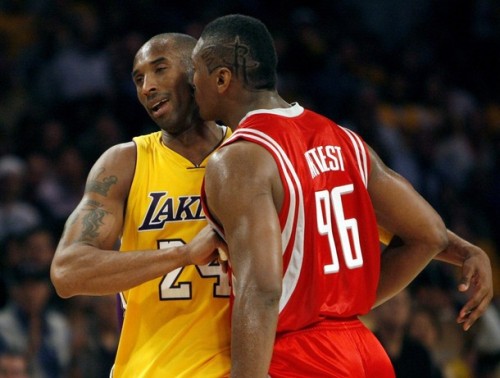
- November 19, 2004, the Malice at the Palace, probably the worst brawl in NBA history: Still with the Pacers, with less than a minute left in their game against the Detroit Pistons at the Palace of Auburn Hills, Artest got into a little confrontation with the other great defensive stalwart, Ben Wallace. During the argument, Artest laid down on the scorer's table. A spectator, John Green, then threw a cup of Diet Coke/beer/unidentifiable liquid at Artest while he was lying on the table. Artest responded by running into the stands and punching a man whom he mistakenly believed was responsible. Artest's teammate Stephen Jackson also ran into the stands shortly after and threw punches at fans, and eventually players from both teams entered the stands while many fans spilled out on to the court to escape the altercation. Another melee started when Artest was confronted on the court by two fans, both of whom Artest punched/knocked out. Jermaine O'Neal intervened by punching one of the fans in the jaw after a running start. The scene became chaotic and outnumbered arena security struggled to keep order. As the aftermath of this melee, Jackson, O'Neal, and Artest, and five others from both teams were suspended by the NBA. Artest's suspension was the longest, for the remainder of the season (73 regular season games and 13 playoff games). Artest lost approximately $7 million in salary due to the suspension.


- "Betraying" the Pacers in 2005, when he demanded a trade, and received it, to the Sacramento Kings for Peja Stojakovic.

- Succeeding with the struggling Kings team, and bringing them back to the playoffs.

- Releasing his first album 'My World' in October 2006, which was a mix of rap, R&B, and crazy.

- Spending 10 days in jail in 2007 after being arrested for domestic abuse, and subsequently, being suspended by the Kings.

- June 17, 2008 - AFter the Lakers had lost Game 6 of the NBA Finals (and the Championship) by an embarrasing 39 points to the Boston Celtics, he approached Kobe Bryant in the locker room after the game, while Kobe was taking a shower. "I want to come help you," Artest told Kobe. "If I can, I'm going to find a way to come to LA and give you the help you need to win a title."

- Being traded to the Houston Rockets in 2008, and helping them reach the second round of the playoffs for the first time in 11 years. Also, making life hell for Kobe Bryant, who was on his way to the 2009 Championship.

- Becoming a Laker in July 2009.

- Changing his jersey number from 15 (in honour of his father) to 23 (in honour of Michael Jordan) to 91 (in honour of Dennis Rodman) to 93 (because it apparently looks like qB- Queensbridge) to 96 (same reason) to 37 (because that's how long Michael Jackson's 'Thriller' was on the top of the pop charts).

- Going crazy in LA, from releasing random work-out videos to showing up at a talk show in his boxers.

- Still defending harder than a mutha. Still taking stupid three-pointers.

- May 27, 2010: Game 5, Conference Finals, Phoenix Suns. The buzzer-beater that made him famous, again, that made him a hero, banking a shot in at the final second to give Lakers the win and a 3-2 lead against the Suns.

- Shutting down 2008 Finals MVP Paul Pierce for most of the NBA Finals.

- Running what is now being called The Worst Offensive Position in Finals History in Game 2 - Artest did a Benny Hill impression, where his foolishness helped give the game away to the Celtics.

- Still defending harder than a mutha. Still taking stupid three-pointers.

And then he blinks. And then he's back. Game 7. This was his chance at redemption. At burying the horrors of that YMCA tournament in New York, of that Chicago Bulls locker room, of the brawl at Detroit, of all those suspensions, and fines, and criticisms, of Trevor Ariza's shadow, of Game 2.

Here was his chance to show the 'good' Artest - that which won defensive player of the year, that which made every team he was ever a part of better, that which hit the game winner against the Suns.

And at the biggest stage of his life, here he was. Artest has a game-leading 12 points in the first half, and he finishes the game with 20, second highest for the Lakers. He also holds Paul Pierce to a 5-15 night, and has clutch play after clutch play, including a dagger three, and becoming the hero of the Game, as Lakers win the title.

After the game, Artest gave perhaps the second-greatest post-game interview ever (my favourite is still Garnett's in 2008). He thanked his hood, his family, and his psychiatrist, who helped him "relax a lot." He even manned-up for betraying the Pacers, saying that he felt like a coward after bailing on his teammates.

And then he stops, and he has a flashback again, and adds one more memory to his life.

- Ron Artest, NBA Champion.

April 12, 2010

Several NBA teams amongst the highest-paid sports teams in the world


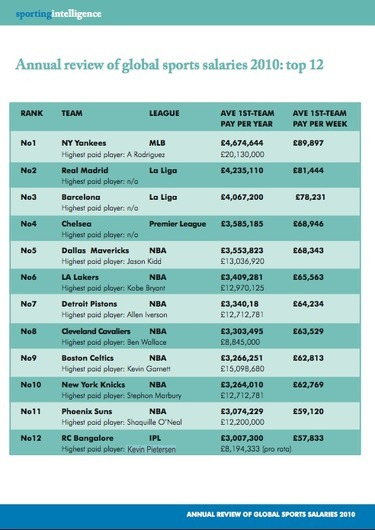
Seven of the top 12 highest-paid teams in sports around the world last year were from the National Basketball Association (NBA). The list is topped by baseball team New York Yankees of the MLB, worth $7,000,000, but they are the only baseball team represented in the top 12. Real Madrid (Spain), Barcelona (Spain), and Chelsea (England), all football teams, make up positions 2-4, and Dallas Mavericks of the NBA are at number five. 6-11 are also NBA teams, and a surprise inclusion at number 12 are the Bangalore Royal Challengers of the Indian Premier League (IPL)!
The list has been published by sportingintelligence, as part of their Annual Review of Global Sports Salaries (ARGSS). The list has been decided on the basis of the average salaries in the squad.

Here is the complete top 12 for 2010:
1. New York Yankees (MLB)
2. Real Madrid (La Liga)
3. Barcelona (La Liga)
4. Chelsea (EPL)
5. Dallas Mavericks (NBA)
6. Los Angeles Lakers (NBA)
7. Detroit Pistons (NBA)
8. Cleveland Cavaliers (NBA)
9. Boston Celtics (NBA)
10. New York Knicks (NBA)
11. Phoenix Suns (NBA)
12. Bangalore Royal Challengers (IPL)

You know what's funny? Check out the highest paid players in the NBA teams last year and you'll see that most of them are far from deserving of the honour. For the Mavericks its Jason Kidd, now in the twilight of his career. The Lakers and the Celtics get it right with Kobe and Garnett respectivelly. The Pistons paid the most money to Allen Iverson, who was a shadow of his former self and spent most of 2010 on the bench for the Grizzlies, and then signing and not playing for the 76ers.

How about the Suns at 12? They paid the most to Shaq, who is now out in Cleveland. And the Cavs themselves? You would think LeBron would be their highest paid, right? Nope - that honour goes to none other than Ben Wallace (now with the Pistons).
Undoubtedbly, the reward for the biggest waste of money goes to the Knicks, though, who are easily the worst team in this top 12 of all the leagues, and their highest paid player was Stephon Marbury, who has spent his 2010 streaming silly videos of himself and ballin in China.
And the Royal Challengers? Their highest paid player is none other than Kevin Pieterson, who if my knowledge of IPL is right barely gets to play for them.
So what's the moral of the story here? If you're good at basketball, you will be rich. Even if you're Stephon Marbury.
Indian parents - hand your child a basketball starting... NOW!