Showing posts with label SLAM Magazine. Show all posts

August 6, 2017

All Around The World


There are over a billion people in India—and none have ever played in the NBA. With a new elite Academy, the League hopes to turn this raw potential into basketball’s next big market.

This feature was first published in SLAM Magazine's September 2017 issue (SLAM # 211) and on SLAMOnline.com on July 17, 2017. Click here to read it on the official website.

Morning practice has ended for the 21 elite prospects at the NBA Academy India in Greater Noida, a city in the suburbs of the capital city New Delhi. The 13- to 17-year-old young men—chosen from a competitive evaluation stage that included hundreds of players from six cities around the country—now pair up for a few minutes to stretch, cooling down after a tiring session.

There are no more sounds of basketballs bouncing on the wood court, no rims clanging, no instructions from the coaches, and no squeaking from the soles of the royal blue Nike KD 9s that the 21 young players have laced up over their feet.

It’s a state of peace rarely found in the culture that created Yoga in its never-ending quest for tranquility. India is expected to overtake China as the world’s largest population in a few years, and every hectic moment in the country is a full-court press of pressure, from competing for the highest grades in the cutthroat national examination systems, jostling for space in Mumbai local trains, to queuing up in desperate masses outside ATMs when the currency was de-monetized. We Indians are in a constant state of squeezing in together and fighting to make our space.

Which is why the first class of recruits into the Academy—launched in May as the NBA’s biggest investment in India yet—enjoy the luxury of being free from the tougher distractions of life. They are in a world of their own, a secluded lagoon of basketball, where international coaches are training India’s best young prospects to make the next big jump and inspire a nation of young Indians to be devoted to the sport.

Despite a population of over one billion, not a single Indian has played in an NBA game. In 2015, the Mavs made 7-2 big man Satnam Singh the first Indian to be drafted into the NBA, but he has since only played for the Texas Legends, the organization’s G League affiliate. Last year, Palpreet Singh Brar was drafted by the G League’s Long Island Nets but never made the roster. India has a long yet largely unsuccessful basketball history, but there is potential in the grassroots to unearth a player capable of participating in NBA basketball.

Robin Banerjee, a 6-3 14-year-old, is one of those young players with hoop dreams. Banerjee’s father owns a small printing business in Patna, Bihar, a poor state that has rarely produced basketball talent in the country. Banerjee, however, had passion and aptitude for the sport early in his life. At 12, he left Patna to attend a specialized coaching center in Varanasi, another small town in a neighboring state. Last year, he heard about the ACG NBA Jump program that scouted the best prospects for the Academy, so he traveled about 430 miles southeast all alone on a train to take part in the event in Kolkata. He and two others were chosen from among over 600 aspiring ballers. A few months later, he qualified as one of the final 21 prospects. [As of presstime, the NBA Academy was planning to invite three more prospects for a total of 24, but they hadn’t been selected yet.—Ed.]

The Academy’s location at the Jaypee Greens Integrated Sports Center in Greater Noida is secluded from “real” India. Here, Banerjee and the other young prospects play, live in large dormitory-style rooms, eat their meals, and have access to exclusive club gym and swimming facilities. Twice a day, Banerjee takes part in training with coaches from Spain, Belgium, the United States and India.

“We practice all the time,” Banerjee says, “and when we’re done, there is nothing else to do but more basketball. There is a TV in our room where we watched the playoffs together.”

To spread the game in the grassroots, the NBA has been making inroads in India for several years. Their most concentrated efforts have come through the Reliance Foundation Jr. NBA program, a strategy that has been introducing basketball curriculum to schools since 2013 and has reached over six million kids and five thousand coaches.

“No development programs can work on their own—there has to be an entire ecosystem,” says Yannick Colaco, the Managing Director of NBA India. “We had to start at the base of the pyramid, the bottom. To get kids to have fun playing basketball.”

Once the game is more ingrained in the culture, the Academy hopes to find the diamonds in the rough. India’s tussle against a large, competitive population is also the country’s undeniable advantage.

The NBA’s Deputy Commissioner Mark Tatum was in India for the launch of the Academy. Tatum was previously part of Indian basketball history when he called out Singh’s name with the 52nd pick for the Mavericks at the 2015 NBA Draft. Now, he is hopeful that a successor can rise from the Academy.

“There will be a lot of divergent pathways,” Tatum told us in an interview from Mumbai on the day before the Academy’s launch. “Some kids will play at DI colleges in the US. Some will play in the G League. Some in other leagues around the world. We’re hopeful that in the next five to 10 years or so that we’ll see an NBA talent coming through.”

Potential NBA talent in India has been squandered too often. Skilled players have either been scouted too late or not provided the correct infrastructure to raise their games to be more competitive at the international level. The most poignant case is of Amritpal Singh, a powerful, 6-10 center. Amritpal is the son of a farmer, born in the tiny Punjabi farming village of Fattuwal. He didn’t know what a basketball was until he was 18 years old. By 22, he was the captain of the Indian national team, leading the group to surprising victories over China. The now-26-year-old has also played professionally in Japan and India.

Amritpal’s story can be seen as encouraging. But from another perspective, Amritpal’s case is a sobering reminder that a great number of young players weren’t getting the guidance and training at an early age to make the most of their potential.

With the Academy, there is now some hope the next generation of Amritpals can be scouted and taught the game earlier. Colaco says the Academy hopes to employ a holistic, 360-degree approach to player development with focuses on education, leadership, character development and life skills. The NBA will provide education for those selected at the public school in Jaypee Greens. The Academy has already hired a technical director to customize a future woman’s program.

There are similar NBA Academies in China (in Hangzhou, Jinan and Urumqi) and in Senegal (in Thies). India is a unique culture, however, and Tatum understands both the challenges and the opportunities that this program presents for the League’s ambitions.

“I think the opportunity is that in a short amount of time, there are kids here who have been identified through a national scouting network,” Tatum says. “What’s so positive is the level of talent we’re seeing from young kids in a market where basketball infrastructure hasn’t been great. It is a huge opportunity that we’re excited about.”

For now, the millions of young players who are beginning a relationship with the sport can have a realistic goal in mind, an aim to be among the chosen few at the NBA Academy India, to find breathing space for themselves from the cacophony of the country with the calm of basketball. For recruits at the Academy, like Banerjee, the promise is now of a brighter future beyond their wildest dreams, of earning a scholarship in a college abroad, of playing in a foreign professional league, and, of course, in the holy grail of hoops.

It’s simple, really, as the young Banerjee says: “I want to play in the NBA.”

October 21, 2016

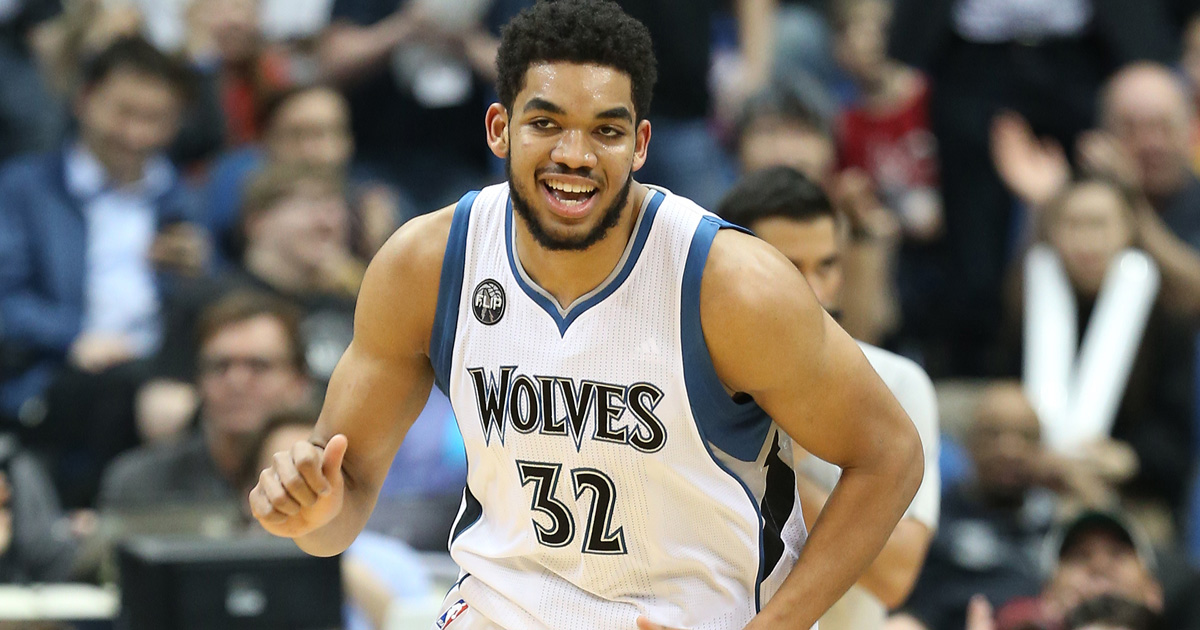
SLAM Top 50: Karl-Anthony Towns, No. 20


The reigning ROY is the prototype NBA big man.

This article first published as part of SLAM Magazine's #SLAMTop50 on SLAMOnline.com on October 10, 2016. Here is the original version of the piece.

Kinesiology, as per Wikipedia, is “a scientific study of human or non-human body movement. Kinesiology addresses physiological, biomechanical, and psychological mechanisms of movement.” It’s an important medical science, applicable in biomechanics and orthopedics. In the sports world, it can be applied to the rehab of athletes from injury, strength and conditioning, occupational therapy, and even sport psychology.

Kinesiology was also the subject that a certain college freshman majored in a couple of years ago at the University of Kentucky. That freshman was distracted by other things—chief among them was the fact that he was the best young basketball player in the nation. The “distraction” (my word, not his) was the reason he was at Kentucky. The “distraction” had made him one of the top-recruited players of his class and eventually made him the No. 1 overall draft pick in the loaded 2015 NBA Draft. That “distraction” became his profession.

But his interest in kinesiology never wavered. The freshman maintained a 4.0 GPA in his only year at Kentucky, continued taking online classes in kinesiology, and maintained that, after a casual couple of decades of dominance in the world’s most competitive basketball league, he is hoping to start a second career as a doctor.

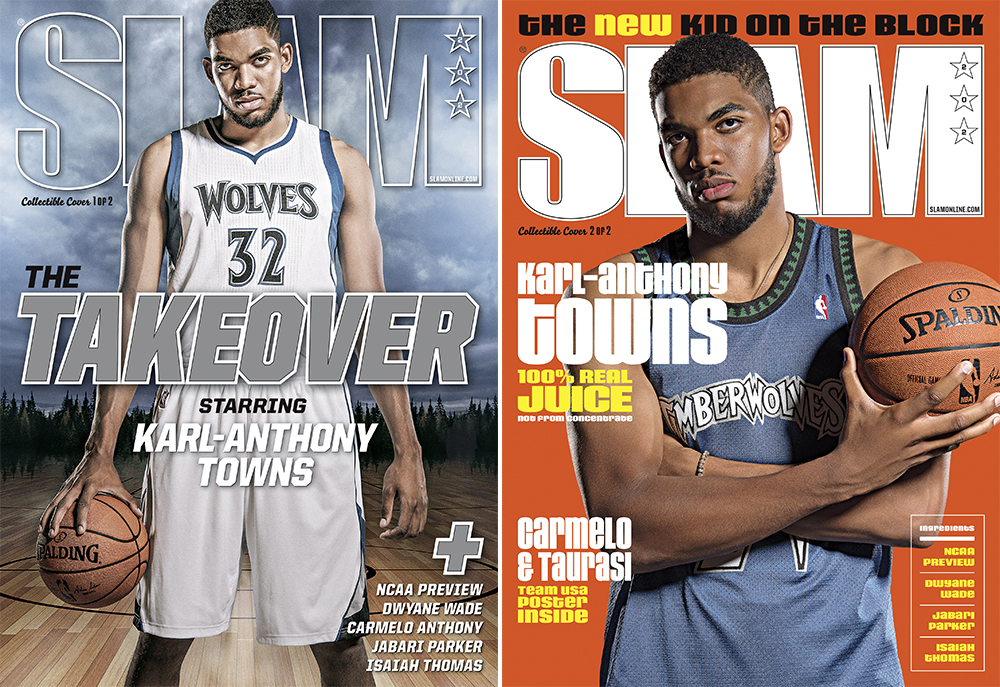
Meet Karl-Anthony Towns, aspiring doctor, specialist in human movement, the current face of not one but two special SLAM Magazine covers, and one of the best damn young players that the basketball world has seen in a long, long time.

If you follow SLAM, you know the story already. In his recent cover feature on Towns, Adam Figman told us about the lanky, awkward kid who went from being picked last in the playground to first in the draft. He told us about a 20-year-old (!!!) Dominican who presented an almost unreal combination of physical greatness and social congeniality. He quoted this 7-footed beast, the future of the NBA, leaving with the words: “I’ve always said that I want to leave the game on my own terms, finish as the best player that’s ever lived, and do it my own way—never a version two of someone else, but the first version of myself, and I strive every day and continue to work on my game so I can be the best player possible, so I can leave my legacy as that. I’m not gonna stop until I’ve accomplished that goal, until I have absolutely nothing to give to the game of basketball.”

The NBA changes every few years. Rules change, styles change, tactics change. Dominant big men make way for do-it-all swingman make way for all-three-point-shooting-everything. The constant imagining and reimaging of what ‘works’ in a winning system gives the league its competitive edge but also keeps talented players in a turnstile. Only a chosen few, those who adapt, can survive and thrive long-term. The rest get ushered out in a hurry.

Towns, undoubtedly a once-in-a-generation talent, will adapt, and he’ll dominant. I’m not talking later, I’m talking now. I’m talking following up on a historic rookie season where he played and started in all 82 games for the Timberwolves, averaging 18.3 points and 10.5 rebounds per game now. I’m talking a youngster with defensive intelligence way beyond his years now. I’m talking of the first big to win the NBA Skills Challenge now. I’m talking top 20 in the SLAM rankings at age 20 now.

Let’s stay with the “distraction” for now. The medical career can wait.

Kinesiology roots from the Greek word kinesis. Movement. The study of movement. While the rest of the league rests, or swirls around that turnstile. Towns is here to study that movement and then break through. Move on further, higher, faster. He’s here to stay. Here’s here to adapt. Here’s here to dominate.

October 14, 2016

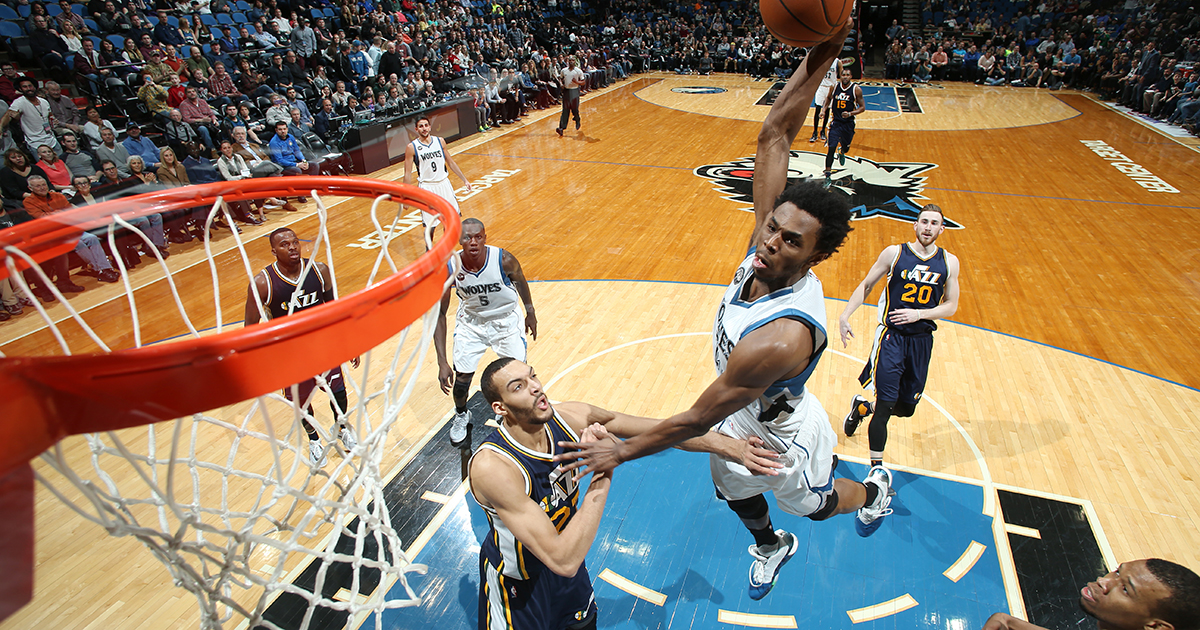
SLAM Top 50: Andrew Wiggins, No. 31


The fast-improving 21-year-old is beginning to realize the depths of his talents.

This article first published as part of SLAM Magazine's #SLAMTop50 on SLAMOnline.com on September 30, 2016. Here is the original version of the piece.


(We forgot about Andrew Wiggins)

The Minnesota Timberwolves drafted Karl-Anthony Towns number one in the draft last year. Towns went on to shatter his own high expectations and posted one of the finest rookie seasons in recent history. He was the unanimous rookie of the year, shot his way to early comparisons to Tim Duncan and Kevin Garnett, and even earned two solo SLAM covers.

The Timberwolves hired Tom Thibodeau as Head Coach and president of basketball operations in April, immediately setting off the promise of stability, defensive intensity, and long essays about Thibs’s “tireless work ethic”.

(We forgot about Andrew Wiggins)

The Timberwolves, usually an ignored, small market in the NBA, were the centrepiece of sports-talk in reminiscence after the retirement of Kevin Garnett, the greatest player in their franchise by a country mile. KG was the franchise leader in games played, minutes, points, rebounds, assists, blocks, steals, rookies barked at, opponents intimidated, Honey Nut Cheerios referenced, and, of course, the love of the Timberwolves’ faithful.

(We forgot about Andrew Wiggins)

The Timberwolves suffered tragedy this time last year when coach Flip Saunders passed away, and his death cast a shadow over the franchise he was closely connected to for the rest of the season.

Ricky Rubio got injured, came back, struggled to shoot, played well, played badly, and was in trade discussions every waking moment.

Zach LaVine won the Slam Dunk contest, and then battled Aaron Gordon in a historic battle to win it again.

Minnesota drafted Kris Dunn, who quickly earned the high honor of being named Rookie Most Likely to win the Rookie of the Year award by his peers. The rising Timberwolves already had a new potential idol.

(But we forgot about Andrew Wiggins)

Two years ago, Minnesota traded their second-greatest player, Kevin Love, to join LeBron James in return for an unproven rookie out of Kansas. Love had his ups and downs in Cleveland, didn’t fit in, got hurt, returned, then did fit in (sort of), defended Steph Curry in the final possession of Game 7, and won a title. Championships redeem everything, but Love’s uncertain place in the team hierarchy have hover over him the last two years, and may continue to hover around for as long as he remains in Cleveland. Minnesota, of course, remain happy with their returns.

(Yes, but, we forgot about Andrew Wiggins)

With all the changes, diversions, press releases, dunk contests, ankle surgeries, and the waves of optimism, it seems that somewhere, one of the most crucial members of that rising wave – Andrew Wiggins – seems to have been lost in the shuffle. Now entering his third season, the fast-improving 21-year-old is poised to have a season that you won’t forget.

Wiggins reacted to an early career snub by the Cavaliers by thriving in Minnesota and winning the rookie of the year award, playing all 82 games in his rookie season and averaging 16.9 points on 43.7 percent shooting to with 4.6 rebounds in the process. Unlike most rookies, Wiggins’ biggest strength turned out to be his motor: he played over 36 minutes per game for the young Timberwolves while doing heavy lifting on both ends of the floor. His offense earned him the highlights, he defence earned him the burn. The Timberwolves won 16 games, but even in their horrific record, they looked fun.

Then, even as Towns came to town and stole the show to his own ROY season, Wiggins, quietly, didn’t go away. In his second season, the Canadian upped his averages to 20.7 ppg while improving his shooting percentage to nearly 46 percent from the floor. The Timberwolves won 29 games, but even in their poor record, they looked tantalizing.

And here we stand now. Wiggins, before season number 3, armed with the perfect atmosphere for stability and success. He will get to play off an elite big man in Towns and thrive as the two try to emulate a modern remix of post-and-perimeter domination. He will be flanked by the ever-improving Zach LaVine by his side, and two point guards – Rubio and Dunn – who will both bring unique strengths to run the offense by his side. He will be coached by a defensive mastermind in Thibodeau, who will surely maximize his potential to greater individual and team success.

Wiggins doesn’t say much: his Twitter feed is mostly a mention of his national or sponsor obligations and his on-court demeanour could fool you into occasionally even forgetting he’s out there.

But, he has flashes of brilliance that destroy his silences with primal screams. Like the time he attempted a 720 dunk and broke the NBA internet. Like the time he owned the overtime period to hand the Warriors only their ninth loss of the regular season. Like how he feels like a future basketball Jedi, only now realizing the far reaches of his limitless powers.

(Don’t forget about Andrew Wiggins)

January 31, 2016

The Zen Masters


Despite social and political turmoil, the Tibetan refugee community in India remains bonded together by the game of basketball.

by Karan Madhok. Photos by Angad Sodhi

This feature was originally published in the March 2016 edition of SLAM Magazine (SLAM No. 195). You can also find it on SLAMOnline.com

After a morning of meditation and philosophical exercises, Thakpa Kunga and his classmates—all Buddhist monks-in-training—decided to temporarily skip spinning prayer wheels and start spinning basketballs.

They snuck out of their monastery in McLeod Ganj—a mountain town in India, more than 6,500 feet above sea level in the Himalayan Mountains—and rolled down to their neighborhood court, wearing traditional monk robes: a decorated golden or yellow chogu (undershirt) with a red shawl covering their bodies. The niftier monks among them found sneakers, while the rest descended in flip-flops. To save time, Kunga and his friends played unchanged in their robes. A few hours later, they snuck back into the monastery for more lessons in spirituality.

Nearly a decade later, I meet Kunga on another court. He’s continued on his path to full monkhood, and the 27-year-old is now enrolled in Tibetan Higher Studies at the Sarah College in Dharamshala, which is a larger mountain town a short walk down from McLeod Ganj.

But Kunga hasn’t abandoned his love of hoops. Every year, he played for Sarah in the Martyr’s Memorial Basketball Tournament, a championship for the community of Tibetan refugees in Dharamshala and beyond who escaped Tibet’s Chinese rule. “Basketball is like meditation on court. Sometimes, I play just to clear tension. When you play basketball, there are no problems.”

For years, I held the mountain hamlets of Dharamshala and McLeod Ganj in great regard, partly because of my addiction to the Himalayas, and partly because of the organic love for basketball among the area’s refugees. So when I found out about the Martyr’s Memorial Tournament, I traveled back up the mountains. I met a myriad of people, including monks who had devoted their lives to achieving nirvana, refugees with stories of pain and danger, and young men and women with ambitions like every other young Indian in the country’s growing economy.

And I found that the game of basketball—in its own small way—bonded them all together.

Tibet—Xizang in Chinese—is China’s second-largest province. It sits on the world’s highest plateau and has long served as a buffer between the planet’s two largest and occasionally hostile populations: China and India. In 1950, the Chinese People’s Liberation Army (PLA) “liberated” Tibet and soon, China’s government won complete sovereignty over the region.

But many Tibetans have opposed China’s claim and have been fighting for Tibet’s freedom from Big Brother in Beijing for decades. There was much violence and bloodshed in the late ’50s, and in contemporary times, the largest uprising for Tibet’s cause was in the lead-up to the Beijing Olympics in 2008, when hundreds were shot by the Chinese and thousands arrested. In recent years, over 140 Tibetan monks have performed self-immolations in opposition to Chinese rule.

Back in 1959, Tibetan Buddhism’s spiritual leader, the 14th Dalai Lama, Tenzin Gyatso, fled to exile in India, where he eventually settled in McLeod Ganj. Scores of refugees followed him.

Estimates have about 150,000 Tibetans living in exile around the world, with over 94,000 in India. As the birthplace of Buddhism (the Buddha received enlightenment and gave his sermons in North India) and current home of the Dalai Lama, India was an easy choice for refugees hoping for a new life. About 2,500 Tibetan refugees make the journey out of China annually. They cross glaciers, trek through mountain passes and walk in the blanket of night to avoid detection. In Dharamshala, the Central Tibetan Administration (CTA), a government for those in exile, has been set up.

Two schools of thought have developed among Tibetans for the political status of their homeland: the Dalai Lama-supported Middle Way that asks for autonomy for the Tibetan people as a part of China, and the Tibetan Independence Movement that demands complete freedom.

Despite protests and support of many world leaders, neither approach has worked. As far as China sees it, Tibet, unsettled and rich in resources, will always be a part of its country.

Directly below where the CTA is located in Dharamshala is the newly renovated Gangyi Court, which is playing host to the Martyr’s Tournament. On the day of the finals, the hillside is abuzz. Young hoopheads wearing NBA t-shirts mingle with monks in robes and enthusiastically cheering girls in traditional chupas. Tibetan flags and Buddhist prayer flags fly around the court.

Among the fans is Tsetan Tenzin, age 30: by day an assistant at a Tibetan herbal medicine clinic, by night a long-range threat for Example Team, which was ousted earlier in the tournament. Tenzin was born in Tibet but his parents hired a guide to help him escape to India when he was 7. He hasn’t seen them since.

Tenzin’s love grew when he was in school at a refugee orphanage in Mussoorie, in North India. He carried it with him when he moved to Dharamshala. “We play basketball so much in Dharamshala because, surrounded by mountains, there is no room for bigger games,” he says. “Tibetans love the NBA. My favorite player is Stephen Curry; I love to shoot from outside.”

The refugees’ love for the game is also an ode to their “motherland,” where basketball is one of the most popular sports, too. “In Tibet, people play a lot of basketball, too, especially in school,” Tenzin adds. “So it’s normal for refugees to come [to India] and continue playing.”

***

China, with more than 1.3 billion people, has the largest hoops fan base on Earth. The sport was always popular, but after Yao Ming was drafted No. 1 in 2002, it took center stage. China has a fast-growing league (CBA) and is one of Asia’s most powerful national teams. Their second-tier league, the National Basketball League (NBL), expanded to Tibet this year, where the region’s capital city of Lhasa will host rivals in what China Daily called “the world’s highest basketball court” at 3,658 meters above sea level.

China pushed swift development in infrastructure and economy in Tibet, but what they call development and modernization, Tibetans call environmental deterioration and cultural genocide. International human rights groups have exposed stories of violations and the unwelcome indoctrination of Chinese communist thought and philosophy among the Tibetan population, replacing centuries of lifestyle, language, spirituality and culture.

To raise awareness, the Dalai Lama has traveled the world speaking to leaders and humanitarian organizations. He won the Nobel Peace Prize in 1989.

Hours before the tourney’s finals, I met Wangden Krab, president of the Regional TYC office in McLeod Ganj, who organizes the event. “The purpose is to remember the Tibetan martyrs who have sacrificed for their country,” Krab says. “Most Tibetan youth are now born in India or come here very young. In this tournament, we want to remind them of their martyrs. We want to bring youngsters together and unite them.”

The TYC is the largest Tibetan non-governmental organization of Tibetan exiles, mostly young Tibetans with hopes of Tibetan independence. They have around 80 chapters and over 20,000 members around the world.

“We are still fighting for complete independence,” Krab says. “We report to world governments, the UN and other human rights organizations about the critical situation in Tibet, including losing freedom of speech and fighting for human rights. Many refugees are not ready to settle in India; they always dream of Tibet.”

Krab has dissent in his blood. His grandfather fought in the war against China in the late ’50s before being imprisoned for 30 years by the Chinese. His father was arrested for protesting Chinese deforestation in Tibet’s Dzorge area. Krab himself escaped to India in ’99, at age 16.

But today, his main agenda is basketball. “In Tibetan schools here, all types of players—tall, short, good, bad—stop and try their hand at basketball and are eager to learn,” he says. “It is a more ‘freestyle’ sport, with less structure and has rules that people can understand. There are no limits to basketball. Everyone can come to the ground and play.”

***

McLeod Ganj is a vibrant community where Tibetan refugees, NGO workers, tourists, monks and locals live in relative harmony. Tibetan culture is still preserved strongly here. Most refugees can speak and read the Tibetan language, know folk songs, speak of Tibetan “freedom fighters” and dream of Lhasa as their Promised Land.

Around town, there is also talk of the tournament—among the youth, monks, working men and women. The girls’ final is won by Men-Tse-Khang (Tibetan Medical and Astrological Institute), dressed in Miami Heat colors. The boys’ teams—both wearing practice jerseys that have slogans like “Free Tibet” or faces of the Dalai Lama—step out for their final. Before the game tips off, both teams greet each other with traditional Tibetan presents of white scarves.

The last two teams are “Dhasa,” comprised mainly of second-generation Tibetans born to refugee parents in India, and “Nomads,” who feature 20-somethings who escaped from China more recently. The action on court immediately speeds up. Each fall takes a little longer to recover from. Tough layups between crowds of defenders are the go-to approach. There are no dunks, but athletic lay-ups with the and-1 call prevail.

Eventually the Nomads break open the contest with a barrage of long-range shots. They win by 3 and the crowd rushes the court.Players are lifted on shoulders and drenched with water under a flurry of happy prayer flags.

Despite the differences between the Tibetans and the Chinese majority in politics, philosophy and the fight for freedom, basketball could close the gap. Nearly every refugee I spoke with had played basketball at some point. The Han Chinese love basketball, too; the sport is a common thread between two cultures that have such a wide cultural gap and often view each other in suspicion and distrust.

Days after I left Dharamshala and McLeod Ganj, I reflected on a sense of incompleteness among the refugees. They are exiled from China but not fully assimilated into mainstreem Indian society. Stuck in this purgatory, all they have is their community, their culture and their spirituality to accompany them. And basketball.

January 4, 2016

Hoopdarshan Episode 23: Basketball in Exile - How basketball bonds the Tibetan refugee community in India


In early October, Hoopdarshan co-host Karan Madhok traveled to McLeodganj and Dharamshala - hill-stations in the Indian Himalayas home to a vibrant community of Tibetan refugees - with photographer Angad Sodhi to cover a basketball tournament among the refugees. The epic trip turned into a story for the upcoming issue of SLAM Magazine (# 195) encapsulating together sports, politics, and travel. In Episode 23 of Hoopdarshan, host Kaushik Lakshman, Karan and Angad talk about the story behind the story, featuring how basketball bonds the refugee community together, the Tibetans' relationship with China and India, unforgettable characters from McLeodganj, and the quest for the perfect momo.

McLeodganj is home to the 14th Dalai Lama - in exile from Tibet to India since the late 50s - and his Temple. Dharamshala hosts the Tibetan Government-in-Exile. Both towns have thus become hosts to tens of thousands of Tibetan refugees over the past few decades and exist as idyllic worlds of peace, spirituality, and surprisingly, basketball. This episode should be heard as a preview or a companion piece to Karan and Angad's work on SLAM Magazine, the print edition of which will be available in US in early January and worldwide soon after. It will also be published on SLAMOnline.com soon.

Angad Sodhi is a professional photographer in Chandigarh, best known for his modern wedding photography around India. You can find some of his best work on his Instagram page or on Facebook.


Hoopdarshan aims to be the true voice of Indian basketball, and since we're such hopeless fans of the game, it will become the voice of everything basketball related we love, from the NBA to international hoops, too. On every episode of Hoopdarshan, we will be inviting a special guest to interview or chat to about a variety of topics. With expert insight from some of the brightest and most-involved people in the world of Indian basketball, we hope to bring this conversation to a many more interested fans, players, and followers of the game.

Make sure to follow Hoopdarshan on Soundcloud or search for 'Hoopdarshan' on the iTunes Store! Auto-sync Hoopdarshan to your preferred podcast app NOW!

Hoopdarshan can be found on...

    July 17, 2015

    Come Home With Me


    After a topsy-turvy NBA career, Stephon Marbury's unlikely journey brought him peace and success in China.

    by Karan Madhok

    This feature was originally published in the August 2015 edition of SLAM Magazine (SLAM No. 190). You can also find it on SLAMOnline.com.

    What is Home?

    Home was Coney Island, the Brooklyn neighborhood that birthed his game. Home was Georgia Tech, the college that developed his early stardom. Home was Minnesota, the city with the NBA team where he played his first few seasons in the NBA. For some stretches, home was New Jersey, Phoenix and Boston. Home really felt like home back in New York when the Knicks traded for him.

    Home, now, for Stephon Xavier Marbury, is Beijing, China. It’s a spacious apartment in a high-rise building in the heart of the city, surrounded by other high-rises and shopping complexes that have contributed to this historic city’s transformation into a concrete jungle. Home is a couple of metro stops away from Tiananmen Square, in the capital of the most populated nation in the world, of a civilization thousands of years old.

    It’s here—at home—where I find Marbury, a month after he turns 38, on a cold afternoon in late March. It’s been only a few days since he led the Beijing Ducks to their third Chinese Basketball Association (CBA) title in four years and grabbed the finals MVP award. I find him relaxed, alone at his apartment, draped in his 361° brand t-shirt and sweatpants, eating a Subway sandwich for lunch and listening to the Drake mixtape out of his smartphone.

    It’s here, at home, where he finally talks to SLAM again. Where we talk about his journey: his NBA career, his rise, his departure, his resurrection in China. It’s here, at his new home, where I ask about his old one. About his brothers, about his friends in the NBA, about Coney Island.

    I ask him if he ever gets homesick.

    “No.”

    “Never?” I ask, “When you think of what ‘home’ is?”

    “This is home,” he says, staring directly at me. “Beijing is home. I mean, America’s gonna always be home. But this is where I live at—this is home. This is where my life is at. Here in China.”

    There seem to be two separate lives to Stephon Marbury: “Starbury” in the US, “Ma Bu Li” in China. Starbury was the high school phenom from Brooklyn who broke New York City records and was a cult hero even before getting selected fourth overall by the Timberwolves in the heralded 1996 NBA Draft. He was the score-first point guard much ahead of his time who, despite enjoying strong individual highs, never quite found permanence in the League. Nearly every team he was a part of was happier to see him gone, and by his last NBA years, he was reduced to a mere caricature of pro basketball careers gone wrong. He was blasted by critics, maligned by legal cases against him, suffered personal loss and live-streamed a nervous breakdown.

    So, at age 32, he packed up and left. Left the League, left the country and left what he now calls the “negative energy” behind. He traveled nearly 7,000 miles, crossed the Pacific and resurrected his career in China. Former NBA players had taken their talents to China before, but no one who had previously done so had a higher profile than him. The Chinese named him Ma Bu Li, and after two years of teething troubles in Shanxi and Foshan, he joined the Beijing Ducks, making the team and the city his home in 2011.

    “At first, it was a trying time, because it was all brand new,” he says of his early years in China. “I was ready to do something different and be a part of something different. I wanted to evolve to a new area in my life and in basketball. It was a trying time because of the culture barrier and not being able to speak the language and not being able to communicate.

    “I understand the culture now,” he adds. “I love the food. I now know why people do what they do when they do it. Even though I can’t speak the language as well as I would like, I know a little bit more than when I first came here. It’s just growth.”

    The growth off the court correlated with success on the court, and despite his age, Marbury has remained The Man (there’s the annual CBA legend of “Playoff Marbury”) for the Ducks, leading them to back-to-back-to-back championships. I suggest that, if he stayed on his traditional route in the NBA, his role would’ve probably gotten smaller as he got older, and I ask if it’s been tougher to continue playing at a high level with age.

    “I wouldn’t necessarily say that if I was playing in the NBA, if I got older, that my role would’ve changed,” he answers with characteristic defiance. “How I played in the NBA and how I play now is the same. It’s no different. But I think playing here, you have to do more, because a lot more is required out of the foreigners [CBA teams are usually only allowed two foreign players each—Ed.]. So consistency is something that plays a major role here in being able to score, play defense, trying to get everybody involved to do all of the different things that are needed to play at a higher level.”

    Back in the NBA, being a point guard is perhaps the deepest and toughest gig in the League now, with damn near every team featuring an All-Star or All-Star-potential starting PG. I try to make him imagine that alternate universe, the universe where he’s still playing in the NBA, having never attempted the China experiment. What kind of role do you see yourself in if you were still in the NBA? I ask.

    “I see myself as a starting point guard,” he says. “I probably wouldn’t be as dominant as when I was younger, but I would definitely still have my same attributes on court. My style wouldn’t be any different.

    “[Allen] Iverson and myself, we kinda changed the dynamic of how the traditional point guards played,” he continues. “Now, when you see the athletic guards that are dunking and doing the things that they are doing, Iverson and myself, we came in doing things like that, which changed the perspective of how people viewed the point guard. We took a lot of flak because we came in and changed the game.”

    Are there any younger guys that you see a bit of yourself in?

    “I like Derrick Rose,” he answers. “I like Westbrook, too. But Derrick Rose is my favorite. I like the kid Curry, too. He’s having a really good year.”

    ***

    Maybe home exists not in a specific, physical place, but in the legend built by history. By words and photographs by scribes, illustrators and photographers. By the journals that time will preserve—in paper and online.

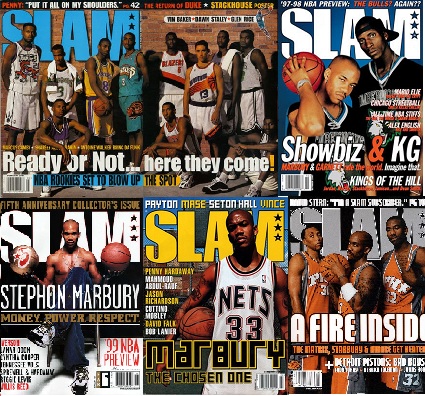
    Marbury began when SLAM did. He was the magazine’s first-ever high school diarist and appeared on a multitude of SLAM covers over the years. I pull out my phone to slide through photographs of those old covers. Each evokes a different reaction, a different moment in his career, telling a story through images a thousand times better than through words.

    We see the cover of SLAM 15, featuring the legendary 1996 Draft class, a class that gave the League Marbury and AI, as well as Kobe Bryant, Steve Nash, Ray Allen, Shareef Abdur-Rahim, Peja Stojakovic, Antoine Walker and more. I ask if he truly believes this class was the greatest ever.

    “By far.”

    Do you compare it to 2003? LeBron, Wade…

    “It’s not…” he interrupts me. “No class can mess with our class.”

    We scroll next to see the famous “KG and Showbiz” cover, featuring the exciting but ultimately ill-fated pairing of Kevin Garnett and Marbury in Minnesota at the end of Steph’s rookie year. He doesn’t react.

    I show him the cover of SLAM’s fifth anniversary special in January of 1999. He was on the cover again, posing in Coney Island, a few years later. He was traded to the Phoenix Suns in 2001 and appeared on the 75th issue cover with Shawn Marion and Amar’e Stoudemire.

    “Anytime you get on the cover of a magazine, especially SLAM Magazine that all of the kids like to go buy and read about, it’s cool. All the times was different times in my career,” he remembers. “It was all good times.”

    When the times were good, they were great. Starbury was named Third-Team All-NBA in 2000 and ’03, and played in the ’01 and ’03 All-Star Games. For the majority of his career, he was the only player since Oscar Robertson to average 20 points and 8 assists per game.

    But his greatest day in the NBA, he says, was his very first one. “When I got drafted, that was the best time. Everything else was just basketball and business. It was nothing more and nothing else. Making it to the NBA was my only thing. That was the only dream that I had as a kid.”

    Did you have any regrets?

    “No.”

    None at all?

    He shakes his head.

    Marbury’s NBA dream seemed to turn into a nightmare in his last few years in the League. After not returning to the Celtics in 2009, the world around him began to collapse. The low-point came during an infamous live-stream from his bedroom as he spoke about depression, ate Vaseline, lip-synched “Barbie Girl” and broke down crying.

    Earlier this year, Marbury finally opened up about his suicidal thoughts during that dark period to HBO’s Real Sports, and about eventually making it out to the light.

    “That interview was fascinating,” I told him, “because very few individuals could talk about the dark days so openly. Was that a tough process for you? To be so open about it?”

    “No,” he answers, “It’s something that happened. I don’t mind telling something that happened, that went on in my life. During those days, no one knew what was going on. Nobody knew I had lost my aunt, my coach, my father, all within a month. When we were burying people, you know, it wasn’t really anyone’s business. That was my life. That was something that I was going through in my trying times.”

    His voice begins to crack as he speaks, but he doesn’t stop.

    “Speaking about that was important for people to have a different understanding, because things have changed,” he continues, “because things have changed for the better. It’s a different story. It’s triumph. Some people think, ‘Oh, you play basketball, you make money, you live this life,’ that you’re exempt from the natural crisis of what goes on in human life, as far as being in an emotional state because of something that has happened. For me, sharing was easy. I said that because I wanted people to understand what was going on with
    me, what pushed me and what motivated me.”

    Maybe Home is where the love is?

    While delivering three championships to Beijing in the last four years, Marbury has also become a true cultural icon in the city. A statue of him stands outside the MasterCard Center where the Ducks play. Last winter, he was the subject and the star of the play I Am Marbury that was staged for a few days in Beijing. The China Post has released a collection of stamps and post cards in his honor. He was the only non-Chinese person named in the list of Beijing’s Top 10 Model Citizens of 2014. The Chinese, especially Beijingers, have accepted Marbury as their own. And he is fully accepting the nation, too, applying for a Chinese Green Card (permanent residency) this year.

    “I’ve said it once and I’ll say it again,” he says. “These are the best fans on the planet. I don’t say that loosely because I play in Beijing and I love Beijing. Whenever you have fans that bring that type of energy, it’s different and it’s rare. And it’s consistent throughout the whole game. The fan base—you can’t really put a price tag on that or compare it to anything.”

    Home is different for us all. For some, it’s a physical place; for some, it’s a feeling; for others, it’s their legacy. For Marbury, it seems that home is where he can continue to find bliss in his first true love: basketball.

    “Basketball is everywhere,” he smiles. “It’s not just the NBA. The game has changed. Basketball is global. I know I wasn’t the first American to come to China and I won’t be the last. I’m just the American who came here and did it my way. I came here. I’ve been real. I was open. I left myself completely vulnerable for people to understand me.

    “I can play as long as I want. Honestly, it depends on my body. When my body says ‘That’s it,’ then I’ll stop. So, I could say that I want to play another two-three years. It’s fun right now. It’s fun winning. So you’re driven to continue to work hard because the success of winning feeds you.”

    And you want to keep winning in Beijing?

    “Why not?”

    Do you see yourself in China long-term?

    “I’m not going,” he says. “This is my home. I’m going nowhere.”

    February 26, 2014

    We Miss Yao


    Three years after injuries ended Yao Ming’s playing career, the Chinese trailblazer is at peace and as invested in the game as ever.

    by Karan Madhok. Photos courtesy: SLAM and Starzsports.

    This feature was originally published in the April 2014 edition of SLAM Magazine (SLAM No. 176). You can also find it on SLAMOnline.com.

    The Chinese don’t say goodbye. Instead, the most commonly used phrase for an appropriate parting is zài jiàn—or zeh weh, in a Shanghai dialect—which literally translates to “meet again.” In China, no end is permanent. There is always another chance, another time.

    Yao Ming was only 30 years old when he officially ended his basketball-playing career. In the short time the gentle 7-6 giant bounced a basketball, he experienced unprecedented highs and disappointing lows; he became one of the most recognizable faces on the planet, and then quickly fizzled out.

    Amidst it all — being the No. 1 overall pick, the first draft pick from China, an All-Star, a 20/10 player, the face of the Houston Rockets and China — Yao maintains that the most memorable moment of his career occurred on April 11, 2011, during a game against the Dallas Mavericks that he didn’t even dress for.

    “That was my last game,” says Yao, who’d appeared in five games earlier that season. “I didn’t play because I was hurt already. Usually I just walk down, but that time I was thinking, I know this is my last time…I will miss this court! I didn’t tell the fans, or anybody that I was retiring. Only the Rockets management knew that this was my decision. They had to move on and know that I was out of the picture.”

    Move on. It’s easier said than done, but Yao took the initiative by moving on himself. At 33, Yao seems to be at peace with his decision, at peace with the glories that lifted him up and the injuries that grounded him. He has moved on to owning a basketball team in China, his hometown Shanghai Sharks, and to engaging in a variety of business ventures back in his homeland. But he remains most excited about his upcoming project, the NBA Yao School, which will launch in Beijing later this year, where he and his team will be coaching kids in an after-school program to learn life skills through basketball.

    Yao recently sat down with SLAM in Shanghai and reflected on his playing career and his post-playing life.

    SLAM: Why did you open the Yao School?

    Yao: I wanted to provide a service for kids after school. The education system [in China] has been focused only on academics. I feel that sports are equally important. Sports can provide a social experience before a child steps into the real world. The idea was for an after-school program where kids can relax their minds from school and have a chance to learn to become a team member. Concepts like teamwork, communication, cooperation or leadership can’t just be learned from paper; you have to experience them. And that’s what Yao School is here for. Basketball skills are the strategy to put that experience together.

    SLAM: What are your goals, in terms of basketball and culturally, for this program?

    Yao: This is character education. For years, kids in China have been isolated. Isolated at home, because of the one-child policy, and in school, where everyone is worried about [grades]. I want to take them out of that element and give them a chance to play as a group. A future career cannot be done in isolation; you have to work with somebody.

    SLAM: What is your fondest memory of your international career?

    Yao: Playing in the Beijing Olympics in 2008 was a special moment. And I still remember the first time I ever put my national team uniform on. It was the China junior team in ’97. That moment was so enjoyable; I spent a lot of time looking at myself in the mirror! I didn’t realize there was a long journey ahead for me.

    SLAM: You retired as one of the most popular players of all time, and definitely the most successful Asian player. When you look back at your career, do you feel that you achieved the goals you had when you started off?

    Yao: Honestly, I feel that the American players probably dream much bigger than this, but my situation was that I never dreamt to play in the NBA. I just hoped to play on the Chinese national team. The NBA seemed too far for me when I was a kid. Being drafted by the Rockets was already beyond my goals. But of course when you get there, you want to set a higher goal, you don’t want to stop, you want more. So, maybe I broke even. Maybe I should’ve gone a little bit further, but my injuries slowed me down. But you can’t change that fact. And you can’t live in regret.

    SLAM: Do you have any regrets? Is there anything else that you wish you had achieved?

    Yao: Not many…I think I did everything possibly I could. And if I went any harder, I would have probably broken my ankles a couple years earlier [laughs].

    SLAM: If you, Tracy McGrady and all of the Rockets had been healthy in your prime, how good do you think you guys could’ve been?

    Yao: First of all, there’s no such thing as “if”…I think we had our chance but we missed it. Whether we regret it or not, that is a fact, and we just need to learn from the experience and move on. Otherwise how can we go to teach kids: “Hey, you have to pull yourself together after this loss and move on,” you know?

    SLAM: Was there one particular year when you thought that you were good enough to go all the way and win a Championship?

    Yao: Yes, a couple of years. In ’06-’07, I felt really good about myself. I had rehabbed well from a fracture, had a good summer with the national team to get back to shape and I won Player of the Month the first month of the season. But then my knees broke right before Christmas. After that I never really had a complete season. My last full year [’08-’09] was good, too. Even though Dikembe [Mutombo] got hurt in the first round and I got hurt in the second round, it was a good year for me.

    SLAM: Was there any one moment that made you decide to retire?

    Yao: I was mentally stressed from the injuries and the recovery process. It’s hard to imagine waking up every morning, going to rehab for two to three hours, and then still going to practice after that…That’s really hard. You worry about getting hurt again. Once or twice it’s OK, but then to get hurt three or four times a couple of years in a row? You lose that confidence, and when you lose confidence, you cannot compete at that level. I thought I wasn’t at that level anymore. Of course, I was concerned about my future life…[Points at his feet and laughs] I didn’t want to end up in a wheelchair.

    SLAM: You’ve said you still follow the NBA closely, so you’ve noticed the League’s shift toward small ball. If you were still healthy and still at the top of the game, how do you think you’d fit in now?

    Yao: I’ve thought more than once about how I would compete in today’s basketball if I was still healthy and in my best shape. I think, if you can make enough free throws, or create enough free throws, you can still be effective. Otherwise, you probably need to run with the small ball. Someone like Shaquille O’Neal could create enough free throws for himself. He was very dominant and could change the pace of the game with that. But, the shooting skill today is so incredible. The three-pointer is so easy today. I think they should extend the line even another meter farther [laughs]. The defense is much more stressed by the range. And obviously, players with size like me would find it much more difficult to guard a shooter. So…[today’s NBA] definitely would not be easy for me.

    The game has changed. Basketball is a form of knowledge. Sometimes I compare basketball skill to war weapons. Think about war weapons through history. In the beginning, if people wanted to knock down some big towns they needed those big machines, like catapults, and they were huge. Consider that they are centers. And then came the fire guns. When the fire guns first came out how big were they? [Motions with his hands] They were huge. And then they became smaller and smaller, and now the pistol is only that size [shows the size of his palm]. That is the skill and shape of a player, you see. The first nuclear weapons, the first missiles were so big, but now, they can be very small. Consider a player’s skill and body like a weapon. The weapon has gone from huge to small, but their damage is the same or even greater now. The point guards are the smaller and more powerful weapon nowadays. And they are mobilized. More mobile. Easy to transport, easy to ship somewhere, easy to sneak into somewhere like cutting into the lane. That’s what I think.

    SLAM: You inspired so many people in China and beyond to take up basketball, to learn the game. When you are inducted in the Hall of Fame, how do you want your legacy to be remembered?

    Yao: I’m too young to be in the Hall of Fame. But, well, I want people to think of me as a basketball man, not just a basketball player. Of course I was a basketball player in my career, but after that, I still continue to work with basketball and to spread the sport. And I want many people to benefit not from me, but from that sport.

    July 17, 2012

    Ball-y-wood: Former NBA player and coach Kenny Natt is in the middle of a basketball revolution in India

    This feature was originally published in the August 2012 edition of SLAM Magazine (SLAM No. 160)

    by Karan Madhok - photo courtesy Angad B. Sodhi

    The sounds are the same. The same squeak of sneakers rubbing against the wooden floor. The same sweekk of a leather ball swishing through the net. The same cacophony created by a dozen different balls bouncing against the floor in irregular beats.

    But then the voices start and you realize that something is different. Basketball words are being used, but they are expressed in a jumbled mix of different languages: English, Hindi, Punjabi, Tamil, Malayalam and Marathi, too.

    This isn’t a pick-up run on the East Coast or a college game in mid-America or an NBA game on the West Coast. This is a court thousands of miles of land and ocean away from those basketball havens. This is India’s Senior Men’s National Basketball squad—a select group of the best basketball players chosen from a population of 1.2 billion people—hard at practice. In the midst of these players stands their coach, an American named Kenny Natt, who has a rich history in the NBA.

    Click here to read full feature on SLAMOnline.com