Showing posts with label Beijing Ducks. Show all posts

May 11, 2017

My Other Home


When his NBA career ended, Stephon Marbury ventured to China and impacted the country beyond his wildest dreams.

I originally wrote this article for SLAM Magazine's website on May 1, 2017. Read the original feature on SLAMOnline.com here.

On a cool October evening some five years ago, I was among the approximately ten thousand fans that flocked into the Wukesong Sports Center—now known as the LeSports Center—in Beijing for an exhibition game. I had moved from India to China just a few months before and this was my first chance to see my new “local” team, the Beijing Ducks, in preseason action. There was a special sense of electricity in the air: the visiting team was a troupe of retired and amateur American players, headlined by the almighty Allen Iverson and the ever-entertaining Jason Williams.

But even the presence of The Answer and White Chocolate himself wasn’t enough to steal the spotlight from the home team. The Ducks feature a rabid base of perhaps the Chinese Basketball Association’s most passionate fans and a few months before this game, these fans were rewarded with their first CBA title.

When the starting line-ups were announced, the biggest cheers were reserved for the new messiah of Chinese basketball. In my beginner’s Chinese, only three syllables stood out from the PA announcer: “Ma Bu Li”, the man who rose to heroic heights to deliver Beijing their elusive title, whose statue now stood by the parking lot outside the famous arena.

Stephon Marbury.

A pregame incident gave the first hint of true lore of Marbury in one of the world’s most populous cities. A few young fans were called midcourt to answer questions from the hype-man at the game, and a friend translated for me. One girl, aged around 10 or so, was asked who was her favorite Chinese player on the Ducks—each CBA team is allowed only two or three foreigners and the rest of the roster is packed with China’s finest. With little hesitation, the girl screamed out, “Ma Bu Li”.

Everyone laughed, then cheered, and there was no clarification or follow-up. Her answer immediately made complete sense. Born in Coney Island, Brooklyn, in another time, in another life, Stephon Marbury was once the quintessential great New York City player. At the height of his NBA career, he was a scoring superstar point guard years ahead of his time, and one of the most loved and complicated players of his generation. But now, he was here. He was in China.

And he was one of them.

I spent three more years in Beijing and during the course of this time, Marbury brought two more championships to the Ducks, made memorable playoff runs every year, and became a cultural icon in China. He was featured on Chinese national stamps, acted in a musical about his own life, became the first foreign athlete to receive a Chinese permanent residency (green card), named a ‘Model Citizen’ of Beijing, and a museum was built in his honor.

But after six years with Ducks, the 40-year-old is parting ways with the organization. Unlike some of his previous basketball breakups, the goodbye to Beijing has been congenial; Marbury was grateful for what the team and the city meant to him, and hopes to continue playing basketball elsewhere.

Beijing and Marbury forged a city-to-player relationship like no other. The playoff nights at the Wukesong in particular, were epic, where fans in those ubiquitous white and light-blue Marbury Ducks jerseys (I bought one, too!) roared for him pregame, chanted his name at every heroic moment, cried in joy alongside him when he shed tears over the championships.

“I’ve said it once and I’ll say it again: I think they – Beijing – are the best fans on the planet,” Marbury told me in an interview I conducted with him for SLAM at his apartment in Beijing two years ago. “The energy that they bring towards the players and the atmosphere in Wukesong is different and it’s rare. And it’s consistent throughout the whole game. They’re very knowledgeable, they understand the game, they know when someone’s shot isn’t going, and they know when someone needs to be encouraged. You can’t really put a price tag on that or compare it to anything.”

Former NBA players had taken their talents to China before, including the great lockout journey to the East that included JR Smith, Wilson Chandler, Patty Mills, and Kenyon Martin, and during my time in the country, former All Stars like Tracy McGrady and Gilbert Arenas. But none of them embraced the ‘Middle Kingdom’ like Starbury. He embraced the culture, food, language, and the people like none other, and they embraced him back. For him, China was not just a stepping stone, it was the destination. Later this year, he will even release a film called My Other Home about his journey East, from New York to Beijing.

This comfort in what he often called his ‘new home’ was evident when I met him. “Beijing is home,” he said. “I mean, America’s gonna always be home. But this is where I live at, this is home. This is where my life is at – here in China.”

“At first, it was a trying time because it was all brand new,” he said of his early years in China, when he played two losing seasons in for Shanxi and Foshan. “I was ready to do something different and be a part of something different. I wanted to evolve to a new area in my life and in basketball. It was a trying time because of the culture barrier and not being able to speak the language and not being able to communicate.”

“I understand the culture now. I love the food. I now know why people do what they do when they do it. Even though I can’t speak the language as well as I would like, I know a little bit more than when I first came here.

“It’s just growth.”

April 19, 2017

The unlikeliest duo - Aamir Khan and Stephon Marbury - promoted their movies in China together


I lived in Beijing for three years and, in my time, played a lot of pick-up basketball with the locals. There was a clear language gap with the guys I played with, since they spoke limited English (and no Hindi) and my Mandarin was almost nonexistent. In the universal language of basketball, however, we managed. I will never forget the one time when I was taking part in a 3x3 game, and a Chinese teammate discovered, in his broken English, that I am from India.

"India?" he asked. "Okay, so you be Raju. I will be Rancho, and he," he pointed at our third teammate, "is Farhan."

I was confused. "What do you mean?"

"You know, like the 3 Idiots! You are from India, right?"

I laughed out loud - his first reference to India was 3 Idiots, Aamir Khan's iconic film about the struggles of college life in India (and a perfect 3x3 basketball team team). I discovered that the film had been a cult-favourite in China, too.

Well, here's an even stranger story. Earlier this week, Aamir Khan was back in China to promote his new movie, and this time, his paths crossed with one of the most iconic basketball players of our generation: Stephon Marbury.

Aamir Khan is an Indian cinema legend, who has acted, directed, or produced some of the most memorable and successful Indian films, including several of my personal favourites. Stephon Marbury is a star American basketball player, whose career made him an icon in the NBA and a celebrity in China. The point guard is one of my favourite All Time players - his Knicks' jersey is the first I ever owned!

A few days ago, this unlikely duo shared the stage to meet with distributors for their respective sports films, and in the process, completely blow my mind.

Khan was in China this week to promote his film Dangal, which he produced and played a starring role in, based on the true story of the Phogat family's success in Indian wrestling. Dangal was released in India in December. Marbury, meanwhile, starred as himself in a Chinese biographical basketball documentary about his own life, My Other Home. It was the distributors of both these sports films that brought Khan and Marbury together in Beijing to promote their respective releases in China.

Marbury reserved some heavy praise for Khan on two posts on his Instagram page:

Chilling with #bollywood LEGEND #aamirkhan As we tease the movie screen distributors with his movie and my movie. Never in my life would I have thought up until now my path would lead towards acting and being paired with a living legend in another profession. I'm deeply humbled and completely thankful for all that God has done for my family and I in this life. #starburymovement #starbury #LoveisLove

BBALL by me and Wrestling by #aamirkhan #bollywood Legend Two sport movies coming soon. The anticipation is getting closer #myotherhome


Khan, whose films have broken box office records around the world, is also the most popular Bollywood star in China due to movies like 3 Idiots, Dhoom 3, and PK. To promote Dangal he attended events in three major Chinese cities: Beijing, Shanghai, and Chengdu.

Marbury, of course, is no stranger to transnational popularity. He was once considered the biggest basketball star out of New York, became an iconic NBA player for the Timberwolves, Nets, Suns, Knicks, and Celtics, before contentiously ending his NBA career. Marbury has since played in China for Shanxi, Foshan, and eventually, in Beijing, where he found career nirvana: he won three CBA titles with the Beijing Ducks, saw a statue of himself erected outside the MasterCard Center in Beijing, has stamps bearing his image in China, has starred in a musical play about himself, and been awarded a Chinese green card. His film My Other Home will be about his basketball journey in the US and China.

A few years ago, I interviewed Marbury in depth while in Beijing about finding home in China for SLAM Magazine.

Now, thanks to the magic of cinema, Bollywood and Basketball have again crossed paths in a surprising way. I'm wishing the best to both these legends in their ventures ahead. Now that Marbury has gotten some acting experience, perhaps Khan can find a place to cast him in his next blockbuster. Considering that they have the pulse of the audience in two of the world's most populous countries, I'm expecting this fictional future Star/Khan venture to break every record conceivable.

July 17, 2015

Come Home With Me


After a topsy-turvy NBA career, Stephon Marbury's unlikely journey brought him peace and success in China.

by Karan Madhok

This feature was originally published in the August 2015 edition of SLAM Magazine (SLAM No. 190). You can also find it on SLAMOnline.com.

What is Home?

Home was Coney Island, the Brooklyn neighborhood that birthed his game. Home was Georgia Tech, the college that developed his early stardom. Home was Minnesota, the city with the NBA team where he played his first few seasons in the NBA. For some stretches, home was New Jersey, Phoenix and Boston. Home really felt like home back in New York when the Knicks traded for him.

Home, now, for Stephon Xavier Marbury, is Beijing, China. It’s a spacious apartment in a high-rise building in the heart of the city, surrounded by other high-rises and shopping complexes that have contributed to this historic city’s transformation into a concrete jungle. Home is a couple of metro stops away from Tiananmen Square, in the capital of the most populated nation in the world, of a civilization thousands of years old.

It’s here—at home—where I find Marbury, a month after he turns 38, on a cold afternoon in late March. It’s been only a few days since he led the Beijing Ducks to their third Chinese Basketball Association (CBA) title in four years and grabbed the finals MVP award. I find him relaxed, alone at his apartment, draped in his 361° brand t-shirt and sweatpants, eating a Subway sandwich for lunch and listening to the Drake mixtape out of his smartphone.

It’s here, at home, where he finally talks to SLAM again. Where we talk about his journey: his NBA career, his rise, his departure, his resurrection in China. It’s here, at his new home, where I ask about his old one. About his brothers, about his friends in the NBA, about Coney Island.

I ask him if he ever gets homesick.

“No.”

“Never?” I ask, “When you think of what ‘home’ is?”

“This is home,” he says, staring directly at me. “Beijing is home. I mean, America’s gonna always be home. But this is where I live at—this is home. This is where my life is at. Here in China.”

There seem to be two separate lives to Stephon Marbury: “Starbury” in the US, “Ma Bu Li” in China. Starbury was the high school phenom from Brooklyn who broke New York City records and was a cult hero even before getting selected fourth overall by the Timberwolves in the heralded 1996 NBA Draft. He was the score-first point guard much ahead of his time who, despite enjoying strong individual highs, never quite found permanence in the League. Nearly every team he was a part of was happier to see him gone, and by his last NBA years, he was reduced to a mere caricature of pro basketball careers gone wrong. He was blasted by critics, maligned by legal cases against him, suffered personal loss and live-streamed a nervous breakdown.

So, at age 32, he packed up and left. Left the League, left the country and left what he now calls the “negative energy” behind. He traveled nearly 7,000 miles, crossed the Pacific and resurrected his career in China. Former NBA players had taken their talents to China before, but no one who had previously done so had a higher profile than him. The Chinese named him Ma Bu Li, and after two years of teething troubles in Shanxi and Foshan, he joined the Beijing Ducks, making the team and the city his home in 2011.

“At first, it was a trying time, because it was all brand new,” he says of his early years in China. “I was ready to do something different and be a part of something different. I wanted to evolve to a new area in my life and in basketball. It was a trying time because of the culture barrier and not being able to speak the language and not being able to communicate.

“I understand the culture now,” he adds. “I love the food. I now know why people do what they do when they do it. Even though I can’t speak the language as well as I would like, I know a little bit more than when I first came here. It’s just growth.”

The growth off the court correlated with success on the court, and despite his age, Marbury has remained The Man (there’s the annual CBA legend of “Playoff Marbury”) for the Ducks, leading them to back-to-back-to-back championships. I suggest that, if he stayed on his traditional route in the NBA, his role would’ve probably gotten smaller as he got older, and I ask if it’s been tougher to continue playing at a high level with age.

“I wouldn’t necessarily say that if I was playing in the NBA, if I got older, that my role would’ve changed,” he answers with characteristic defiance. “How I played in the NBA and how I play now is the same. It’s no different. But I think playing here, you have to do more, because a lot more is required out of the foreigners [CBA teams are usually only allowed two foreign players each—Ed.]. So consistency is something that plays a major role here in being able to score, play defense, trying to get everybody involved to do all of the different things that are needed to play at a higher level.”

Back in the NBA, being a point guard is perhaps the deepest and toughest gig in the League now, with damn near every team featuring an All-Star or All-Star-potential starting PG. I try to make him imagine that alternate universe, the universe where he’s still playing in the NBA, having never attempted the China experiment. What kind of role do you see yourself in if you were still in the NBA? I ask.

“I see myself as a starting point guard,” he says. “I probably wouldn’t be as dominant as when I was younger, but I would definitely still have my same attributes on court. My style wouldn’t be any different.

“[Allen] Iverson and myself, we kinda changed the dynamic of how the traditional point guards played,” he continues. “Now, when you see the athletic guards that are dunking and doing the things that they are doing, Iverson and myself, we came in doing things like that, which changed the perspective of how people viewed the point guard. We took a lot of flak because we came in and changed the game.”

Are there any younger guys that you see a bit of yourself in?

“I like Derrick Rose,” he answers. “I like Westbrook, too. But Derrick Rose is my favorite. I like the kid Curry, too. He’s having a really good year.”

***

Maybe home exists not in a specific, physical place, but in the legend built by history. By words and photographs by scribes, illustrators and photographers. By the journals that time will preserve—in paper and online.

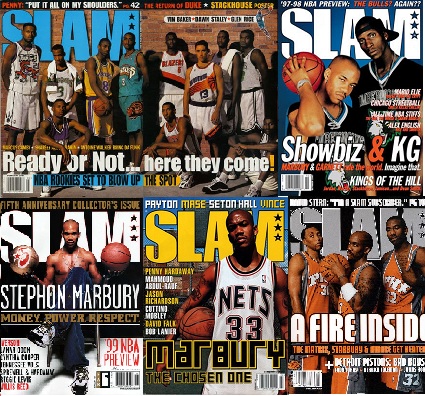
Marbury began when SLAM did. He was the magazine’s first-ever high school diarist and appeared on a multitude of SLAM covers over the years. I pull out my phone to slide through photographs of those old covers. Each evokes a different reaction, a different moment in his career, telling a story through images a thousand times better than through words.

We see the cover of SLAM 15, featuring the legendary 1996 Draft class, a class that gave the League Marbury and AI, as well as Kobe Bryant, Steve Nash, Ray Allen, Shareef Abdur-Rahim, Peja Stojakovic, Antoine Walker and more. I ask if he truly believes this class was the greatest ever.

“By far.”

Do you compare it to 2003? LeBron, Wade…

“It’s not…” he interrupts me. “No class can mess with our class.”

We scroll next to see the famous “KG and Showbiz” cover, featuring the exciting but ultimately ill-fated pairing of Kevin Garnett and Marbury in Minnesota at the end of Steph’s rookie year. He doesn’t react.

I show him the cover of SLAM’s fifth anniversary special in January of 1999. He was on the cover again, posing in Coney Island, a few years later. He was traded to the Phoenix Suns in 2001 and appeared on the 75th issue cover with Shawn Marion and Amar’e Stoudemire.

“Anytime you get on the cover of a magazine, especially SLAM Magazine that all of the kids like to go buy and read about, it’s cool. All the times was different times in my career,” he remembers. “It was all good times.”

When the times were good, they were great. Starbury was named Third-Team All-NBA in 2000 and ’03, and played in the ’01 and ’03 All-Star Games. For the majority of his career, he was the only player since Oscar Robertson to average 20 points and 8 assists per game.

But his greatest day in the NBA, he says, was his very first one. “When I got drafted, that was the best time. Everything else was just basketball and business. It was nothing more and nothing else. Making it to the NBA was my only thing. That was the only dream that I had as a kid.”

Did you have any regrets?

“No.”

None at all?

He shakes his head.

Marbury’s NBA dream seemed to turn into a nightmare in his last few years in the League. After not returning to the Celtics in 2009, the world around him began to collapse. The low-point came during an infamous live-stream from his bedroom as he spoke about depression, ate Vaseline, lip-synched “Barbie Girl” and broke down crying.

Earlier this year, Marbury finally opened up about his suicidal thoughts during that dark period to HBO’s Real Sports, and about eventually making it out to the light.

“That interview was fascinating,” I told him, “because very few individuals could talk about the dark days so openly. Was that a tough process for you? To be so open about it?”

“No,” he answers, “It’s something that happened. I don’t mind telling something that happened, that went on in my life. During those days, no one knew what was going on. Nobody knew I had lost my aunt, my coach, my father, all within a month. When we were burying people, you know, it wasn’t really anyone’s business. That was my life. That was something that I was going through in my trying times.”

His voice begins to crack as he speaks, but he doesn’t stop.

“Speaking about that was important for people to have a different understanding, because things have changed,” he continues, “because things have changed for the better. It’s a different story. It’s triumph. Some people think, ‘Oh, you play basketball, you make money, you live this life,’ that you’re exempt from the natural crisis of what goes on in human life, as far as being in an emotional state because of something that has happened. For me, sharing was easy. I said that because I wanted people to understand what was going on with
me, what pushed me and what motivated me.”

Maybe Home is where the love is?

While delivering three championships to Beijing in the last four years, Marbury has also become a true cultural icon in the city. A statue of him stands outside the MasterCard Center where the Ducks play. Last winter, he was the subject and the star of the play I Am Marbury that was staged for a few days in Beijing. The China Post has released a collection of stamps and post cards in his honor. He was the only non-Chinese person named in the list of Beijing’s Top 10 Model Citizens of 2014. The Chinese, especially Beijingers, have accepted Marbury as their own. And he is fully accepting the nation, too, applying for a Chinese Green Card (permanent residency) this year.

“I’ve said it once and I’ll say it again,” he says. “These are the best fans on the planet. I don’t say that loosely because I play in Beijing and I love Beijing. Whenever you have fans that bring that type of energy, it’s different and it’s rare. And it’s consistent throughout the whole game. The fan base—you can’t really put a price tag on that or compare it to anything.”

Home is different for us all. For some, it’s a physical place; for some, it’s a feeling; for others, it’s their legacy. For Marbury, it seems that home is where he can continue to find bliss in his first true love: basketball.

“Basketball is everywhere,” he smiles. “It’s not just the NBA. The game has changed. Basketball is global. I know I wasn’t the first American to come to China and I won’t be the last. I’m just the American who came here and did it my way. I came here. I’ve been real. I was open. I left myself completely vulnerable for people to understand me.

“I can play as long as I want. Honestly, it depends on my body. When my body says ‘That’s it,’ then I’ll stop. So, I could say that I want to play another two-three years. It’s fun right now. It’s fun winning. So you’re driven to continue to work hard because the success of winning feeds you.”

And you want to keep winning in Beijing?

“Why not?”

Do you see yourself in China long-term?

“I’m not going,” he says. “This is my home. I’m going nowhere.”

April 6, 2015

The Mighty Duck


This article was first published with the cover story of the 143rd edition (2015 - No. 4) of SLAM China magazine. Here is my original English version.

Stephon Marbury’s evolution has helped create a basketball dynasty in Beijing

It’s a rare moment when an icon and a community find perfect resonance with each other, a bond that eventually offers unconditional love from one to another. Watching a Beijing Ducks game in Beijing – especially during the playoffs at the MasterCard center – provides a glimpse of that type of resonance. On nights when Stephon Marbury is heroically carrying the Ducks to victory, pushing the team forward with big performances every night, the city parallels his passion and intensity off the court. Both of them feed into each other, until they make a monster that few in the CBA can conquer.

Last week, Marbury led Beijing to their second consecutive CBA title and their third in fourth years, deservedly winning the Finals MVP award. He’s now 38, and has played for nearly two decades professionally in Minnesota, New Jersey, Phoenix, New York, Shanxi, and Foshan. But it was in Beijing that the star point guard finally found fulfilment, and in return, the city made him a basketball deity.

“This is home,” he tells SLAM a few days after celebrating the title victory – his third – in Liaoning, “Beijing is home. America will always be home. But this is where my life is at, here in China.”

Marbury has shown Beijing and China love, and China has showed him love back. After over five years playing and living in the country, he has also overcome the early trials and tribulations to find peace, both on and off the court.

“It was a trying time because it was all brand new,” he says of his early years in China, when he went from being an NBA star to a point guard from Shanxi and Foshan, “I was ready to do something different and be a part of something different. I wanted to evolve to a new area in my life and in basketball. It was a trying time because of the culture barrier and not being able to speak the language and not being able to communicate. But for the most part it was cool, because I knew it was just part of the experience.”

“I understand the culture now,” he adds, “I love the food. I now know why people do what they do when they do it. Even though I can’t speak the language as well as I would like, I know a little bit more than when I first came here. It’s just growth.”

The growth off-the-court corresponded to success on-court, and with the Ducks, Marbury found a clique that finally brought him championship success. Part of the reason is team continuity, as the Ducks have had the same two foreigners (Marbury and Randolph Morris) and much of the same roster over the last four years.

When I ask him what the secret is to the team’s success, he says that it has always been about looking ahead. “[It’s about] our preparation from the beginning of the year. So now, our focus is on the next year. Everyone is aware of what we have to do for next year. We’re enjoying the championship but in the back of our mind we know that we have more work to do. We know where have to get better, where we have to improve. No one is relaxing right now. Everyone loves this feeling. We like winning. For the most part, everyone is conscious of living in the moment of now, but knowing in the future what we have to do to continue to stay stable as one of the top teams.”

And of course, having a city that resonates and encourages him and his teammates every moment of every game helps, too. “I’ve said it once and I’ll say it again,” Marbury stresses, “I think they – Beijing – are the best fans on the planet. The energy that they bring towards the players and the atmosphere in Wukesong is different and it’s rare. And it’s consistent throughout the whole game, not in spurts or just the fourth quarter, it’s all throughout the whole game. They’re very knowledgeable, they understand the game, they know when someone’s shot isn’t going, and they know when someone needs to be encouraged. All of that contributes to why they are the best fans. You can’t really put a price tag on that or compare it to anything. I know the energy that they gave me from the way that they go about cheering for us.”

NBA and foreign players have played in China before Marbury, and they’ll come to play in China after he retires, but there may never be anyone like him again, an individual who embraced the culture and a city and they embraced him back. And as he basks in the afterglow of another CBA title, Marbury sets his eye ahead for more success in China and with Beijing in the future.

“I wanna win more championships here,” he says, “It’s fun right now. It’s fun to be winning, and you’re driven to continue to work hard to keep winning”

October 13, 2013

Where European & Chinese hoops clash: Real Madrid beat Beijing Ducks in Beijing


It was a clash of two very different philosophies of basketball, and yet, once the referee sent the ball in the air for the tip off, the flow of the game itself took over to dominate all other cultural and philosophical differences. On Friday, October 11th, one of the Chinese Basketball Association's (CBA) most-popular franchises - the Beijing Ducks - hosted one of the most historically successful European basketball team's - Spain's Real Madrid - in a pre-season exhibition that turned out to be far more intriguing than anyone imagined. After a topsy-turvy encounter, Madrid used a timely fourth quarter run to speed past Beijing to a 92-86 victory.

The Euroleague's CEO Jordi Bertomeu was in attendance too, to overlook the game's proceedings.

The Ducks, who won the CBA title in 2012 and were in last year's semi-finals, hosted the game in Beijing's MasterCard Center. This game was the first time that Real Madrid - who were runner-up in the Euroleague last season - faced against a Chinese opponent in their long history. It was the last game of the pre-season for Real Madrid, who were coming off the Endesa Super Cup title against Barcelona.

A little over a month ago, the Chief Business Development Officer of the Euroleague Roser Queralto announced the game in Beijing with the proclamation that Chinese and European teams play quite a similar game, and an on-court interaction could strengthen the relations of both the leagues. While the playing styles rooting from Spanish and the Chinese tactics weren't exactly the same, the final result was an evenly-matched contest.

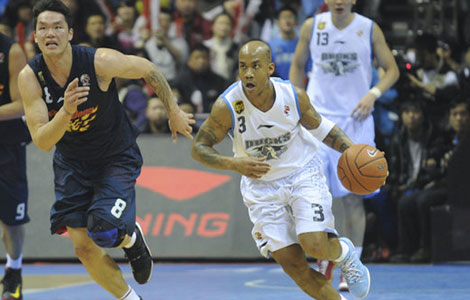
The Beijing Ducks of course feature former NBA All Star Stephon Marbury, who had been their hero and leader en route to their maiden CBA title in 2012. Marbury proved to be unstoppable for the Madrid defense, and slashed and shot his way to 25 points. The chief benefactor of Marbury's kick and drives or rebounding off his missed opportunities was his American teammate Randolph Morris, who kept the Ducks close with a game-high 28 point performance.

It was a back-and-forth contest throughout, and while Beijing mostly relied on their two American imports for offense, Madrid spread the ball around to keep their top contributors Jaycee Carroll, Sergio Rodriguez, and Tremmel Darden involved. The Ducks made a surprising third-quarter run to lead 63-57 before the final period began. The game continued to be close in the fourth quarter, and the score was tied 77 all with just five minutes left on the clock. Madrid finally broke out to a 13-3 run to put the game past Beijing, and settled on a 92-86 win.

Madrid will now begin their regular season back in Spain against Valladolid, while Beijing have to wait till the end of November for the start of the CBA season.

September 25, 2013

Chinese and European Basketball Leagues can learn a lot from each other – Euroleague CEO Roser Queralto


This article was first published in the 116th edition (2013 - No. 19) of SLAM China magazine. Here is the original English version of the story.

Real Madrid will become the latest Turkish Airlines Euroleague team to visit China when it faces the Beijing Ducks for an exhibition game on Friday, October 11 at MasterCard Center in Beijing. Among the planned activities for Madrid’s visit will be promotional events with Chinese fans, practices open to local players and coaches and, a charity programme at a local Beijing school of course, visiting some of country's famous sites.

The CEO of the European Champions Cup – Roser Queralto – was in Beijing to officially announce the pre-season game. SLAM caught up with Queralto for a brief interview on the relationship between European and Chinese basketball and the future of the Euroleague in China.

SLAM: How is the Euroleague continuing to build their relationship with China?

Queralto: I think that Chinese and European teams play quite a similar game, and that can strengthen the relations of the two leagues. The Euroleague can learn a lot from Chinese basketball and bring a lot of things to teach here. Now we have a Chinese player – Shang Ping – who is joining the Euroleague club Pananthinaikos too. We also had a Chinese junior team take part in an international junior tournament during the Euroleague Final Four last year.

SLAM: After Shang Ping, do you think more Chinese players can get a shot at playing basketball for a European team in the future?

Queralto: I think it’s both ways. We are looking for Chinese players to come and play in European, and we also have many players who have been playing in the Euroleague that will play here in China. This year, Bobby Brown – who was the leading scorer in Euroleague last season [with Montepaschi Siena] will be playing for the Dongguan Leopards in China. So it’s not only one way. We think that European and Chinese basketball are quiet similar in the playing styles, so we feel that we can exchange more players.

SLAM: A lot of the big Euroleague games are broadcast live in China. Are there plans from the Euroleague to broadcast more games in China?

Queralto: Exactly. This is the plan: we are looking forward to more games, to more television shows and in more territories. We are happy to say that the Euroleague Final Four has been broadcast live on CCTV 5 for many years, but we also have games on other channels like Let TV. So, looking ahead, not only the Final Four will be broadcast, but throughout the season, we will show games weekly.

SLAM: Chinese basketball fans of course have a great connection with their local teams – like the Ducks in Beijing – and a lot of fans over the years have also found a an identity with NBA teams. How do you hope to build the same type of connection for Chinese fans with Real Madrid or other big European clubs?

Queralto: We know that there is much to be done and we are approaching it step by step to do it the right way. We think that one of the ways that we can do that is by bringing Chinese fans to Euroleague games, whether it’s overseas, or whether we can bring more and more teams co China. This year, we will have Real Madrid, but in the future we may have two or three teams coming every year so that the fans get to know more about them. Another thing that we are doing is that we are creating several television pieces which can be broadcast during the games in which we explain a little bit about what the teams are, when they started to play, who are their main stars, etc. So we’re trying to explain to people what each of the Euroleague teams is all about.

August 27, 2013

Questions, and the Answer


Earlier this week, Allen Iverson indicated that he would officially announce his retirement, bringing an end to years of speculation of whether he’ll ever get an opportunity to wear an NBA jersey again. It was the end to a career that ignited the basketball-loving world for most of the past decade.

In the near future, Iverson will probably receive his accolades, mostly from the Philadelphia fans who became an extension to his family. He will have the jersey retired and will hear words of respect from his peers. But no matter the tribute at his retirement parties, it could never truly capture the adulation that Allen Iverson’s career once deserved.

Click here to read full feature

March 31, 2013

Guangdong sweep Shandong to win 8th Chinese Basketball Association Championship


The Chinese Basketball league is now 18 years old, just entering its state in adulthood. And in its 18th season, the league took another big jump into respectability, featuring a better-than-ever mix of new superstar players and well-coached teams. But by the time the dust settled and the CBA Finals came to an end, the glory belonged to one of the league’s traditional powerhouses again. The Guangdong Southern Tigers, in their 11th consecutive trip to the CBA Finals (!), won the title in a dominating 4-0 sweep over the Shandong Lions. This victory gave Guangdong their eighth CBA Championship, tying them with the Bayi Rockets for most championships won in China.

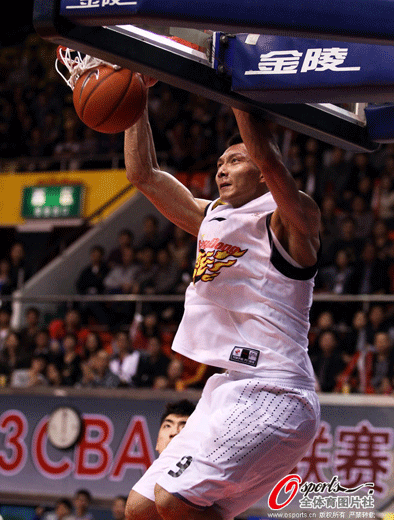
After a surprise loss to the Beijing Ducks in the Finals last year, Guangdong made sure that there will be no upsets this time around. Guangdong beat Shandong by an average of 13 points per game in the four-game sweep. Yi Jianlian of the Southern Tigers – who was named the domestic MVP of the league – also won the Finals MVP award, averaging 20 points and 11.3 rebounds per game in the Finals. In the clinching game at home in Guangdong, Yi had 24 and 13 to lead five players in double figures to win the game 94-74 and lift the trophy.

The result was never in doubt. Guangdong have been the most consistently dominant team in China for over a decade, and after a surprise loss to Beijing in the Finals last year, bounced back this season on a mission for redemption. Guangdong went 28-4 through the course of the season, finishing at top place in the league. Guangdong have the advantage of featuring the top Chinese players, many of whom comprise the backbone of China’s national team. Returning from an unsuccessful NBA stint, Yi Jianlian was back to becoming the poster-boy of the league and the best player for Guangdong. The team also featured Wang Shipeng and Zhu Fangyu. Unlike many other teams in China, Guangdong made better use of the foreigners in their squad, who weren’t asked to dominate but asked to become a part of the system. In the playoffs, Ike Diogu and Donald Sloan became an important part of their rotation, while Terrence Williams was cut at the end of the season and joined the Boston Celtics.

Guangdong continued their dominant run into the post-season, going undefeated throughout to win a championship, defeating Zhejiang and Xinjiang 3-0 and 3-0 in the first and second rounds respectively before the Finals sweep over Shandong.

It was the end of a fairytale season for Shandong. The Lions ended last season as one of the worst teams in the league, but the addition of Jordanian Zaid Abbas to the core of American players Jackson Vroman and Pooh Jeter helped this team finish in second place in the season and pull an surprising 3-0 victory over the defending champions Beijing in the semi-finals of the playoffs.

Guangdong’s victory once again highlights the disparity of talent and coaching in the league. Out of the 18 CBA seasons, two teams – Bayi and Guangdong – have won 16 of the titles. Bayi dominated the league in its early days, but ever since other teams began to pay big money to talented foreign players, Bayi – the Army team who doesn’t allow foreigners – slowed down. And ever since, the championship has mostly belonged to Guangdong. The only other teams in China to lift the titles have been the Shanghai Sharks with Yao Ming back in 2002, and the Beijing Ducks led by Stephon Marbury last year.

This season, which began with the hype of former NBA All Stars like Tracy McGrady and Gilbert Arenas joining the league, finally belonged to a Chinese player, Yi Jianlian. Yi, who got his start in Guangdong, tried his luck in the NBA, and then returned to Guangdong and to glory again. The scary thing about Guangdong’s dominance is that the team and the system seem to have gotten stronger as the season progressed, and there is no reason why they wouldn’t be at the top of the hill once again this time next year. Even a potential loss of Yi to the NBA (if he gets a chance to return) may not stand in their way.

February 25, 2013

Chinese Basketball Association: Regular Season Round-Up & a Preview of the Playoffs


This article was first published on February 19, 2012 on Court Side.

China’s Basketball Calendar roughly parallels their zodiac calendar. By the first week of February, the Year of the Dragon concluded in China, and the Chinese New Year also coincided closely with the end of the regular season of the Chinese Basketball Association (CBA). Now begins the Year of the Snake, and the CBA playoffs will begin about two weeks into the New Year. It’s a time for fresh beginnings and new starts. Once the haze of the festival celebratory fireworks clears, the picture ahead will get clearer.

The professional league in China has taken major strides forward each year since its inception just 18 years ago. This year, a slew of more stars including Tracy McGrady, Gilbert Arenas, and the returning Yi Jianlian joined the league that already featured big names like Stephon Marbury and several big name Chinese superstars. It made for an exciting few months of basketball. The questions now begin as we look ahead: Who has the best chance of moving forward to capture the CBA championship? Who will be the big surprises and the big disappointments? Which team can leave the Dragon behind and welcome the Snake with fireworks on court?

Eight of the 17 total teams in the league have qualified for the post-season, which is set to begin on February 27th. The eight qualified teams play the first round of the playoffs in a best-of-five challenge, before moving to best-of-seven in the semi-finals and Finals, which will conclude around the end of March.

The teams who have qualified for the playoffs are: Guangdong, Shandong, Beijing, Xinjiang, Liaoning, Guangsha, Dongguan, and Zhejiang.

Last year’s finalists, winners of seven CBA championships, and by far the strongest team this season, the Guangdong Southern Tigers are looking in top form to return to the Finals for the 11th straight year! Guangdong have become China’s marquee team, featuring many of the best players from China’s national squad and boasting of the league’s best record over the past decade. Guangdong finished the 32-game 2012-13 season with just four losses, decimating nearly every team that came in their way. Guangdong feature China’s best player – Yi Jianlian – who returned to the CBA this season after an unsuccessful NBA stint to boost his already powerful side. They are perfectionists, replacing their successful coach mid-season to add an even more successful coach, and replacing their foreign import Terrence Williams at the end of the season to add Donald Sloan – formerly of the Cleveland Cavaliers – to their roster.

Beijing Ducks – led by former NBA All Star Stephon Marbury – were the surprise winners of last year’s CBA title in their first-ever visit to the Finals. Despite a few minor hiccups, Beijing continued to be amongst the league’s elite this season behind the efforts of Marbury (who was amongst the league’s leaders in points and assists), Randolph Morris, Li Gen, and Zhe Ji. Like last year, Marbury has gotten his teammates involved more in the regular season before taking over in the playoffs. Will Guangdong – or any other opponent – find a way to stop him this time around? The Ducks face Zhejiang Guangsha Lions in the first round.

Finishing in the bottom four last season, CBA’s best ‘Asian import on hire’ Zaid Abbas (from Jordan) joined the Shandong Lions this season and helped completely change the fortunes for his new side, assisting other solid foreign imports Pooh Jeter and Jackson Vroman to help take this underdog side to second place in the league. But question marks remain if this team now has the mettle to carry on their hot streak into the playoffs. Their first round opponent are the Dongguan Leopards.

Those with an outside bet to challenge for the title could be the Xinjiang Flying Tigers of China’s cold far West, featuring veteran Mengkte Bateer and talented imports James Singleton and Von Vafer. Xinjiang will first have to deal with fifth place Liaoning Dinosaurs in the first round.

The first round could see an intriguing 1 vs. 8 matchup between Guangdong and the eighth-seeded Zhejiang Golden Bulls. While Zhejiang only barely managed to scrape into the postseason ahead of Shanxi and Bayi, they feature one of the league’s most entertaining scorers in Quincy Douby as well as forgotten former NBA big man Eddy Curry.

Outside the playoff picture, one of the revelations in the CBA this season was Shavlik Randolph of the Foshan Long Lions. Randolph was the CBA’s leading scorer (32.7 ppg) and finished the season third in rebounds (14.4 rpg). He missed the playoffs, but his performance could make him in high-demand in the CBA (or the NBA?) for the future.

Also missing the playoffs were two high-profile former NBA All Stars, both of whom who saw their teams finish in the bottom four: Tracy McGrady and Gilbert Arenas. McGrady had a decent individual season for the Qingdao Eagles, but his efforts weren’t enough otherwise to save his poor team from a last place finish in the league. Gilbert Arenas showed glimpses of form for the Shanghai Sharks, but he missed more than half the season to injury and his squad suffered in the constant flux, finishing at 14th place.

But the ones left behind are the past; they’re the ones slain by the Dragon and unable to compete with the Snake. Now we look ahead: Will Guangdong get back to the top of Chinese Basketball? Will the Ducks bring the title back to China’s capital? Or will the New Year bring a new champion?

October 31, 2012

CBA Webchat: T-Mac, A Retooled Guangdong Offence and Jianbings

A few days ago, I took part in a web-chat with two of the best English-language basketball writers in China - Andrew Crawford, the writer Shark Fin Hoops, and Jon Pastuzek, the man behind NiuBball. This was the first time that I have participated in a webchat with them, and as a relative newcomer to Chinese hoops, it served as an important introductory conversation. The chat was first published on Shark Fin Hoops.

The Chinese basketball season is about a month away from starting and in anticipation of this, cash has been flashed and some well-known NBA players will be plying their trade in China this season.

Andrew Crawford: Karan, as its your first time talking CBA hoops with us, why don’t you give people an idea of who you are and your writing background?

Karan Madhok: Well, I’m a basketball writer from India and have worked with the Basketball Federation of India, NBA.com/India, and SLAM Magazine. I keep a blog about basketball in India called ‘Hoopistani‘. I moved to China just over 3 months ago so I’m still new to the CBA and Chinese hoops.

AC: Great stuff. Do you think you’ll chose a team to follow this year or are you going to stay neutral the whole time!

KM: Oh, I’m definitely choosing the Beijing Ducks for 2 obvious reasons. 1) I live in Beijing and I’m already a fan of the city and 2) Call me crazy, but I’ve been on the Stephon Marbury bandwagon for over a decade now, following his career through its ups and downs, vaseline eating and championships. Oh and 3) The Ducks and have the coolest name in the CBA!

AC: That they do. Well, you’ve picked a fine time to arrive in the capital- I was hoping to get you on the Sharks bandwagon but alas. Since you brought up Stephon Marbury, lets neatly segway into another NBA player whose been around for a while- Tracey McGrady has signed with the Qingdao Eagles. Guys, do you think T-Mac can still do it or is this more about both sides making money off this?

KM: Well, this is definitely about the money first and foremost. Qingdao benefits, McGrady benefits, everyone’s happy. But for McGrady, I think there is still some (very) faint hope that this stint will give a him a chance in the NBA again once the CBA season ends. I don’t expect him to be a Marbury-type loyalist to basketball in China – at least not yet, anyways. Whether or not he gets a shot with the NBA again (and I’m not sure he will), McGrady will be using Qingdao for the stats and the money, and Qingdao will use McGrady for the money and the fans.

Still though, this is a logical next move for him. McGrady has definitely been very popular in China since the Yao days, and a star like him will no doubt bring some more excitement to the CBA.

Jon Pastuszek: Obviously, money plays a big factor when these big name NBA guys sign in China. But, whereas last year there were some players making well into the seven figures, T-Mac’s contract this season is reportedly quite reasonable by CBA standards. This is more of a long-term thing for him. McGrady, a la Stephon Marbury, will aim at building his brand inside the Chinese market. He’s already hugely popular among fans and the belief is that if he can stick around and build Qingdao into a winner, he’ll become an even bigger name out here.

About his play, there’s a few questions: Can his body hold up to 30+ minutes a night? Is he explosive enough to get to the basket consistently? How is he going to handle the pressure of having to score 25 to 30 points a night?

With his height and versatility, he will find ways to effect the game beyond scoring the ball, but in the CBA, imports are expected to put the ball in the hoop… and with seven Chinese players leaving the team this off-season, including Li Gen, he won’t have much help around him to alleviate that pressure.

AC: Absolutely- the Li Gen point is crucial in my books. I know last season, Qingdao were happy to let Lester Hudson call the shots but they always had a solid Plan B in Li. Cai Liang was also a decent player for them too and he’s gone as well so it really is all about the star player this season.

After the K-Mart/Patty Mills/ Wilson Chandler drama last season, how do you think T-Mac will handle his debut year in China. Qingdao is obviously a very nice city but it certainly isn’t Orlando or Houston!

JP: While not Orlando or Houston, or even Beijing or Shanghai, Qingdao is actually a very pleasant city by the coast and one I think McGrady could get used to. He’s been to China several times before and he says he is aware of all of the issues he’ll have to face, so I don’t think living here will be an earth-shattering adjustment for him. Unless his body chooses not to cooperate and his play suffers as a result, I think he will adapt just fine.

KM: I have never been to Qingdao, so it won’t be fair for me to comment on how McGrady can fit in. But I believe that if guys like JR Smith and Kenyon Martin can go to the hinterlands of China, then McGrady will be okay, too. In the end, if the money is good, he’ll be good. Plus, he’ll enjoy the type of popularity here that he has never experienced in his career. That will be worth it all.

AC: Just behind T-Mac in terms of the wow factor is probably Yi Jianlian coming back to China and playing for his home team, the Guangdong Tigers. The fact that the Tigers now have an already strong local roster that is now reinforced by getting a Chinese NBA caliber player as well as still having room to add two overseas imports has to make the favorites going into the start of the season?

KM: From what I’ve been able to gather in my short time here, it seems that Guangdong are primed to be the favourites again. The NBA imports may get all the hype but it will be the familiarity of Yi coming back to his old system that will really propel this team.

JP: I’ve almost always been a subscriber to the belief that the reigning champions come into the season as the favorites. And with a Beijing team that made a big addition themselves with Li Gen, I still think they’re the favorites.

But, Yi is obviously a massive signing for them. Not only is he an NBA-caliber seven footer, he’s one who has no playing time restrictions because he’ll be registered as a Chinese player. Yet, while he’ll be force this year, Guangdong didn’t play well in the time that he was with the team last year during the NBA lockout, and I think there will be an adjustment period as his team gets re-adjusted to playing alongside him. Having too much talent is one of those good problems, though, and I think Guangdong is certainly the odds-on-pick to get back to the Finals.

AC: The third and final ‘ big’ name we should talk about is Gilbert Arenas- again with Guangdong. That signing looks to be all but done and Agent Zero is on his way to Guangzhou. On paper, this is an excellent move- a scoring PG like this will be an asset on any team but he’s a little crazy to say the least!

KM: This is a high risk/high reward move of course: either Arenas just shoots them out of contention or he somehow manages to play with Yi and build a championship.

JP: Like T-Mac, the issue with Gil will be his body’s ability to deal with 30+ minutes a night. If he really is healthy. like some reports have suggested, and he has some of that explosiveness he had a few years ago, he’ll be a problem for opponents. I question if this is really what Guangdong needs right now, especially with Yi coming back. Historically, this is a team that thrives when they get “system foreigners,” like Smush Parker and Lester Hudson, ones who understand that the team doesn’t need their imports to dominate offensively. Last season, they had a similar import in Aaron Brooks, and while he played very well, he struggled to run good offense and get his teammates good looks in the Finals against Beijing. Critics of this argument will say that Arenas is bigger and stronger than Brooks and will be able to effect the game in more ways than just scoring, but I don’t believe its ever been within Arenas’ nature to be a distributor. There’s a lot of potential for Guangdong to be an explosive offense, but whether the pieces fit together is something that I’m not too sure on.

AC: Have there been any other moves that have caught your eye? I really like the Hudson move to Dongguan and the Elijah Milsapp signing by my Sharks is also a nice bit of business. Millsap’s got that unknown quality to him but everyone’s excited about him in the city and he’ll hopefully provide a ton of dynamism between the 2 and 3 spots.

JP: I’m with you on Hudson, he should be a great fit with the Leopards. But I’m surprised you didn’t mention D.J. White, who if healthy is going to have a huge season in Shanghai. I like what Xinjiang has done, burying the hatchet on James Singleton and whatever beefs were there from two years ago, and bringing Von Wafer to play alongside him. I think Wafer is going to shred the nets this season and Singleton, as always, will do all of the little things in between that has made him such a good player in this league over the last three years. And I’m totally buying the culture change in Foshan: New coach, three good imports and a complete Chinese roster overhaul. Maybe they’re not a playoff team, but they’ll be much improved.

AC: I think for me, White’s NBA resume implies he’ll be a strong signing so I’m more instinctively drawn to the ‘what could be’ of Milsapp rather than the ‘what we know’ about White. This could easily be a case of preseason optimism but he’s quick and can make shots from all over the court so I’m hoping he could be Shanghai’s own Marcus Williams but time will tell on that one. Viz Foshan- any sort of culture change within that organisation can only be for the better because they’ve been nothing but mediocre for several seasons.

Is there a team in the league who is desperately screaming out for a certain individual/kind of player to help them in the upcoming season?

JP: Jiangsu needs bigs like I need jianbings in the morning, which is why they signed one of the bigger centers on the market, Garret Siler, and I’m looking into buying a jianbing skillet to put in my house. OK maybe just walking three minutes outside my house will do, but you get the point. Siler will help, but he is not a 36 minute a night kind of guy and I don’t think their Chinese are good enough to play consistently well when he’s off the court. I like Siler if he’s in shape, but I think they still are lacking in that area. I think Pooh Jeter will be solid for Shandong, but with Sui Ran already there at point guard, I’m surprised they didn’t go with a ball-handling wing. Maybe they’re committed to developing Ding Yanyuhang this season.

AC: Jianbings for life! That said, I don’t think even those delicious turnips ones I get on the corner of Wuding Lu and my apartment over in SH are going to help out Jiangsu this season. They were truly, truly bad and even my love for Meng Da’s oddness and Nanjing as a city can obscure the reality that the Dragons bouncing back to anything respectable this season is going to be tough.

Alright gents- There’ll obviously be a preview before the the first round of games starts but with the CBA season now a month away from starting, how excited are you about Chinese basketball in 2012/13?

JP: think it’s going to be a great season. For once, there’s actually some parity in the league — not just at the top of the league, but also in the middle part of the standings. Overall, I think the quality of the league top to bottom is as good as its ever been. The CBA is getting better and better every year: The level of foreign players, Chinese players and coaching continue to be on the upward. And as we saw last year during the Finals, fan interest is at an all-time high. Excited to see how it all plays out this year.

KM: I’m really excited obviously since this will be my first time to witness the action first-hand in China. The CBA is becoming one of the most-hyped leagues in the world. Of course, there can be a lot of criticisms and drawbacks of the way certain things are done here, but coming from India, the CBA model is a good one to follow to see how a league should be built and developed. This season, Yi is back, McGrady and Arenas are on board, and I live in the city of the Ducks and Marbury. What’s not to love?

AC: Indeed. I’ll gladly second Jon’s point about the upcoming season. There is so much to get excited about. For me personally, its been a massively long offseason and the sooner I get my three nights of basketball the better. Now I’ve got a season under my belt from last year, there’s a whole range of teams I want to see the Sharks crush, players I want to see crossed up and fourth quarter shoot-outs I want us to sneak out off by a point. Can’t wait. Thanks for your time guys- we’ll have to do this again before the season starts in late November

October 9, 2012

Allen Iverson, Stephon Marbury, and the strange present of past legends

I was amongst the crowd of approximately ten thousand Chinese fans who showed up to watch a team featuring former NBA-ers - headlined by Allen Iverson - take on the home team Beijing Ducks in an exhibition. Beijing's professional basketball team was led by the forever mercurial Stephon Marbury who inspired the squad to their first ever Chinese Basketball Association (CBA) championship this March. Here are my in-person observations on where these two greats of the past are headed in the future.

Click here to read the full feature!

April 1, 2012

Marbury’s Fall; Ma Bu Li’s Redemption


Earlier this week, Stephon Marbury, a talented player mostly remembered as a ‘failure’ in the NBA finally reached redemption in his topsy-turvy basketball career by finally winning his first championship at the age of 35… in China. Marbury fell, but finally, Ma Bu Li achieved redemption.

Click here to read full article.

November 18, 2011

NBA's loss is CBA's gain


When the NBA and it's players failed to agree on a Collective Bargaining Agreement (CBA), and thus, put an end to the current lockout, there is another CBA that seems to have gained: the Chinese Basketball Association. And now that the NBA's player's union has disbanded, and the 2011/12 NBA season is seemingly slipping away, China will start looking like an even more attractive destination for NBA players.

Of course, going overseas isn't a newly-discovered option for former NBA players - bit players who couldn't find NBA jobs and those who were past their prime have occasionally taken the leap overseas and taken their talents to Europe, South America, and in rare occasions, to Asia.

But the change in economy has also directly influenced the change in preferred basketball-player destination. The NBA, which is the richest and the most competitive basketball league in the world, is obviously the dream destination for every basketball player in the world. But the NBA is no more (for now): and so, during this lockout, more and more players are thinking China. Europe is in serious recessions, while China has become the world's second largest economy. It also happens to be a country crazy about hoops - of course, the cultural barrier in the Far East as compared to Europe may be a tougher hurdle for the average NBA player - but the CBA has rising competitiveness and relative financial strength in its favour. No team outside the NBA can really match NBA salaries, but in today's economy, it seems that the CBA comes the closest.

The CBA was only founded 16 years ago - in 1995. The first American player to play in the league was James Hodges. There are 17 teams in the league.

The first American to play in the CBA was James Hodges, back in 1996. Since then, former NBA players slowly made their way back and forth, but the biggest breakthrough in NBA to CBA history was the arrival of former All Star and Timberwolves/Nets/Suns/Knicks/Celtics guard Stephon Marbury. One of the most exciting (and possibly crazy) players in the NBA, Marbury shocked the world when he joined China's Shanxi Brave Dragons in 2010. Since then, Marbury has played for the Foshan Dragons and has now signed for the Beijing Ducks. In the process, he has become one of the most popular players in China, all while also promoting his shoe company there. For a former perhaps-nutcase, Marbury has flipped his career around for the better with the China move.

Now, to promote their own talent, Chinese teams have quite stringent rules for allowing foreign players on their rosters and for the playing time that the foreign players get. All teams except the Bayi Rockets can have a maximum of two foreign players, although the bottom five teams in the league are allowed to sign an additional Asian player to their roster. When facing an opponent in any game, the foreign players are allowed to play a combined total of six quarters, except for when teams are facing the Bayi Rockets, in which case the foreigners can play up to five quarters.

Why the Bayi Rockets exceptions, you ask? Well, the Rockets are China's Army Team, and thus, they feature only Chinese players. The Bayi Rockets also happen to be the squad that beat up players from the Georgetown University team in a 'friendly' game a few months ago. They also happen to be the most successful team of the CBA, winning 8 of the 16 titles so far.

Until last season, a few former NBA players did manage to make their impact on the, although none of them were as well known as Marbury. These included former Kings player Quincy Douby (Xinjiang Flying Tigers), who was last year's China All Star MVP, former Knick/Hawk Randolph Morris (Beijing Ducks), former Spur/Clipper/Bobcat Marcus Williams (Shanxi Brave Dragons), former Clipper/Mav/Wizard James Singleton (Guangdong Southern Tigers), former Rocket/Wizard Mike Harris (Shanghai Sharks), former NBA journeyman Andre Emmett (Fujian Sturgeons). Another former NBA big name - Steve Francis - had a shot with the Beijing Ducks, but it never really worked out. Former Kings player Bonzi Wells had a pretty successful 1 season in China with the Shanxi Brave Dragons.

Still, nothing prepared China for what was going to happen across the pond this year. When the NBA went into lockout, most of the players took the wait-and-see approach before deciding on their futures overseas. But some of them were more proactive and decided early. Now, compared to basketball leagues in other countries, China has strict rules that are still keeping NBA-ers at bay: once a player signs with a Chinese side, he has to play the whole season. In other countries, players can break their contract and return to America if the lockout ends; not in China.

But many players have made the jump eastwards anyways, and from the looks of things, many more are now considering it. Already, a major portion of the former Denver Nuggets have traded the Rocky Mountains for the Great Wall: Wilson Chandler (Zheijiang Lions), Kenyon Martin (Xinjiang Flying Tigers), and JR Smith (Zheijiang Golden Bulls) signed for CBA teams a few months ago. They were joined by the Nets' Dan Gadzuric (Jiangsu Dragons), and the Hawks' Josh Powell (Liaoning Dinosaurs). Chinese stars Yi Jianlian of the Wizards also headed back to his homeland to play for the Southern Tigers, who are the league's defending champions.

And a few days ago, the Suns' Aaron Brooks became the latest to accept a contract with the Chinese team, signing with the Southern Tigers. Chinese teams have been showing interest in bringing over Shane Battier, too.

And of course, there was a major push a few months ago for Kobe Bryant - it didn't resolve to anything back, but since the NBA's status has gone from bad to worse, I'm sure that even the Mamba would be thinking about expanding his horizons. Kobe would definitely become the biggest basketball name in country, and perhaps the best NBA player to ever play in an overseas league. But Chinese fans shouldn't get too carried away about that, yet, as he has a lot more international options and offers to choose from.

The NBA, our favourite league, is unfortunately slipping. Who knows when, and if, there will be a settlement between the two sides, especially now that they're going to court. But the NBA's loss has become the CBA's gain. And while the world's best basketball league in the world's strongest economy squabbles and shuts down over money matters, the second-strongest economy in the East seems to be becoming a brighter option for the basketball starved players.