Showing posts with label JD Walsh. Show all posts

December 13, 2015

Hoopdarshan Episode 22: Coach JD Walsh observes the ascent of Indian Basketball


In 2007, after coaching around the world from the USA to China and Europe, JD Walsh descended to India. Walsh's "JDBasketball" movement spread quickly to all corners of the country, influencing thousands of Indian players and coaches. On Episode 22 of the Hoopdarshan podcast, Walsh joins hosts Kaushik Lakshman and Karan Madhok to talk about the past, present, and future of Indian Basketball, the state of his hometown New York Knicks, and the Pandavs starting 5 from The Mahabharat.

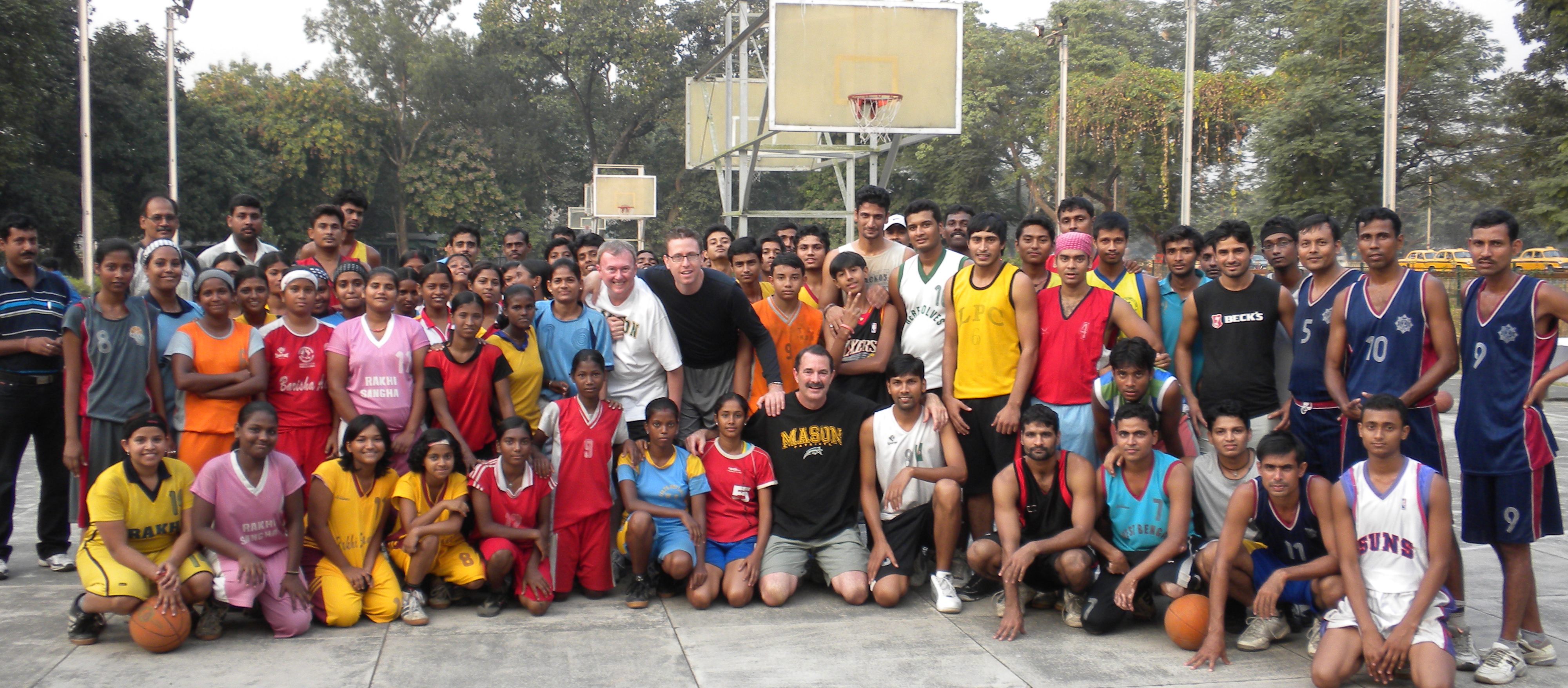
JD Walsh is an American basketball coach who graduated and played for the University of Maryland before coaching everywhere from High School and professional training in the USA to worldwide camps, clubs, and work with national teams in eight countries on three continents. He has received funding from the US Dept. of State as a 'sports diplomat', has worked with several NGOs, and has taken coaching clinics of Indian coaches to train them in the US at the George Mason University. He's now based between New York and DC. Over 15,000 participants have been involved in the JDBasketball school around the world. In India, Walsh has worked in all four corners of the country, conducting over 75 camps in cities such as Srinagar, Bangalore, Chennai, Kolkata, Midnapore, Mumbai, New Delhi, Pune, Patiala, and Trivandrum for over 5,000 Indian youth. He's currently based in New York.


Hoopdarshan aims to be the true voice of Indian basketball, and since we're such hopeless fans of the game, it will become the voice of everything basketball related we love, from the NBA to international hoops, too. On every episode of Hoopdarshan, we will be inviting a special guest to interview or chat to about a variety of topics. With expert insight from some of the brightest and most-involved people in the world of Indian basketball, we hope to bring this conversation to a many more interested fans, players, and followers of the game.

Make sure to follow Hoopdarshan on Soundcloud or search for 'Hoopdarshan' on the iTunes Store! Auto-sync Hoopdarshan to your preferred podcast app NOW!

Hoopdarshan can be found on...

    February 13, 2014

    Basketball de-registered as a sport in Jammu and Kashmir


    It's no secret that basketball has struggled to take off in India's northern-most state of Jammu and Kashmir (J&K), despite the efforts of many outside onlookers who have fallen in love with the region as much as they love the sport itself. But even a struggling sport is better than a non-existent sport. Basketball in J&K was on a life-line for several years; now, Rising Kashmir has reported that the Jammu and Kashmir State Sports Council (JKSSC) has taken it completely off life support. Essentially, this means that end of the J&K State Basketball Federation and the end of all funding for basketball in the state.

    This is truly disturbing news. Basketball was one of six sports recently de-registered by the JKSSC, including Kayaking and Canoeing, Swimming, Softball, Roller Skating and Body Building.

    "When the associations do not maintain the things which they ought to, obviously we are not left with other option than to derecognize them,” Abdul Qayoom Baba, Sports Officer, Kashmir told Rising Kashmir. "These Associations who have been derecognized are not maintaining the accounts, not holding elections, unofficially conducting the trials and so on and thus disturbing the constitution of the sports council, compel us to do so."

    Last week, the J&K Basketball Association even conducted selection trials for the state's team for the Basketball Federation of India (BFI) organized National Championship, set to be held in New Delhi from the end of February. But Qayoom Baba commented that the trials were conducted without the permission of the JKSSC and without screening, so the certificates given to the participants would be of no use.

    Despite the state federation's ineffectiveness, their struggles to conduct better district and state-level competitions, and therefore, the poor performances of J&K players at the national level, the state was able to participate in most Indian national tournaments, even as minnows. School teams and clubs from J&K would also make the effort of joining BFI or NBA organized recreational leagues in Punjab, New Delhi, etc. Over the last few years, foreign coaches like JD Walsh and Shahid Bhat have done a valiant job to bring national and international attention to the sport in the state.

    Unfortunately, now we won't be seeing the Jammu & Kashmir contingents in national championships, at least in the near future. And talented players from the position would have to look for other ways to find support for their basketball dreams beyond the state.

    Basketball in J&K is dead, but hoop-heads in the region and beyond will be hoping that it can be resurrected as soon as possible.

    February 17, 2012

    14 Indian basketball Coaches to visit US as part of Sports visitor exchange


    Basketball continues to bring the two largest democracies in the world together.

    While the USA and India may be on opposite spectrums of the scale in the basketball world, the game has proven to be a crucial medium for the two countries in recent years.

    As part of its newest step, the US Department of State’s Bureau of Educational and Cultural Affairs, along with the National Basketball Association (NBA), announced that 14 Indian basketball coaches have been chosen for a 10-day basketball Sports Visitor exchange. The delegation of Indian coaches will be in the US from February 17th – 27th, 2012, starting their programme in capital city Washington DC and even travelling to Orlando for the NBA All Star Game, set to be held on Sunday, February 26th.

    The US Department of State has announced that the Indian coaches will be meeting US Basketball Coaches during their time in Washington, working with young American athletes, participating in basketball clinics with Special Olympic athletes, and engaging in activities that focus on teambuilding and injury prevention.

    This is of course not the first time a programme like this has been organised for the Indian coaches: in mid-2010, American basketball coach JD Walsh, who has been heavily involved in teaching basketball in India, took 10 Indian coaches to the George Mason University (GMU). That initiative was sponsored by the International Sports Initiative grant, awarded through the SportsUnited Division of the US state department's Bureau of Educational and Cultural Affairs.

    In recent years, the NBA has also been involved with basketball diplomacy between the US and India: A year ago, NBA legend George Gervin and WNBA player Katie Smith visited India as part of a US Dept of State sports envoy. Last month, former NBA player Muggsy Bogues came to India to also be part of an NBA and US Dept of State collaboration programme as part of a trip made by the US Senate India Caucus to India.

    February 7, 2011

    SDAT Clinic in Chennai with JD Walsh


    A lot has changed in basketball in India over the last three years, from the new massive IMG-Reliance sponsorship deal to the NBA expanding its operations in the country. But throughout the highs and lows of the development of the game in India over this period, the one constant has been the persistent efforts of American basketball coach JD Walsh in bringing India to the world of basketball... And bringing the world of basketball closer to India!

    Over the past week, Walsh completed another crucial four-day clinic in Chennai at the SDAT Stadium from February 2-5. Walsh worked with about 75 youngsters in three different groups: U18 Girls, Boys from all over the state of Tamil Nadu, and a local boys' college team.

    "I have been coming to Chennai a couple of times every year for a long time now," said Walsh, "I think the city has a very organised sports culture, especially ingrained in basketball. They have done well in organising events for the whole state of Tamil Nadu. There is a sense of professionalism there, and I'm sure Tamil Nadu's efforts in improving its basketball will continue to show results on the national level."

    One of the highlights of the camp was the work that Walsh did with many Tamil Nadu coaches on concepts such as offensive and defensive strategies and helping developing players with their post game.

    Walsh contacted Don Casey, former New Jersey Nets, Los Angeles Clippers, and Temple (college) basketball coach from the USA over Skype. Casey spoke to the coaches about zone defense and answered their questions. Walsh said: "The Tamil Nadu coaches are very knowledgeable. They were excited about this opportunity and receptive to Casey."

    "These are small things necessary to make a difference for basketball in India," Walsh added, "I think we are finally beginning to turn a corner and change is coming to the game here."

    Nike Basketball sponsored Walsh's clinic with gear for the coaches.

    JD Walsh is the founder of the JDBasketball School, a global enterprise with a mission to each the fundamentals of basketball to youngsters around the world.

    October 21, 2010

    Diwali, the JDBASKETBALL way


    So Diwali is just about 15 days away, and like every year, you can expect the following things:

    1) Fireworks keeping you up until the wee hours of the morning.
    2) Fireworks giving your pet nightmares that go on at least until Holi.
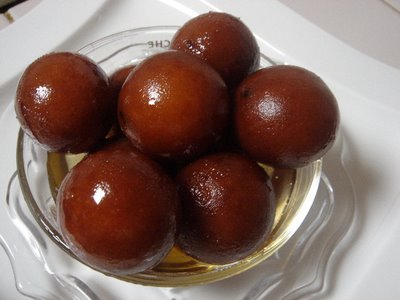
    3) A laddu/gulab-jamun/barfi/any other Indian sweet overdose.
    4) Decorated houses shining proudly all night.
    5) Basketball... Much basketball...

    That's right, because this Diwali, Delhi hoopers will be getting a special gift: American basketball coach JD Walsh will bring back the JDBASKETBALL clinic to the city to hold a Diwali Vacation Camp on November 6-7 at the American Embassy School (AES) in New Delhi.

    The camp will be open to kids in Elementary, Junior High School, High School, and University level, and training for the students will be separated by age and ability.

    Email info@jdbasketball.com for more information. Each session of the camp will be limited to 30 participants.

    Over the past three years, JDBASKETBALL has operated over 100 clinics in 12 cities to over 5,000 youth throughout India.

    I'm guessing there will be no fireworks allowed on court. Except for metaphorical ones.

    August 30, 2010

    The Indian Basketball Fan


    A cliché about India is that the country this vast size and population has "all types of everything." It is a country of a thousand religions, tribes, languages, languages, but most importantly, tens of thousands (or millions) distinctly different opinions.

    And the same holds true for basketball. India has a rapidly growing basketball community - Basketball is the second fastest growing sport in India (after football) with four million Indians playing the game, and of course countless others who are involved in the game as administrators or as fans. With such a large and rapidly growing population, it is hard to classify the types of fans, but here I would like to give it a real go! (Thank you JD Walsh, by the way, for that awesome pic!)

    There seems to be one thing in common about basketball fans in India (or NRI hoop fans) that I have either come across or those that have reached out to me: outside the circle of their own friends/school/teams, every fan thinks that they are a minority, and there is a beautiful thrill in coming across other desis that also adore the game.

    This is especially true for NBA nerds in India - for the longest time, my older brother and I staunchly believed that we would never find more of our kind, those that shared our crazed enthusiasm for the league, those that checked box scores every day and threw statistics at each other, those that spent hours discussing and debating our ultimate starting fives (Greatest ever, Most defensive, Most notorious, Best without-a-championship, Best second-fiddles, etc, etc, etc, I could go on all day...)

    But as I have delved deeper and deeper into my obsession, I have discovered that I'm far from alone. Basketball (and NBA) fans are a small but loud community in India, but one that is set to continue growing rapidly and continue making their voices heard.

    So without further ado, here is my breakdown of The Indian Basketball Fan. Where do you stand?

    1). Stalwarts of basketball in India: These are the ones who have represented our country in hoops, have played in tournaments and camps around the country, who have spent hours every day since their teenage years perfecting the game, listening to the barks of a ruthless (but affectionate) coach, and asking for the courts blessings every time they step on it. A large majority of these fans are so obsessed with the game that they are experts at the local knowledge of hoops but don't know much NBA or other world basketball information. To them, the real hoop legends are TJ Sahi, Sambhaji Kadam, Divya, Singh, Geethu Anna Jose, and Trideep Rai.

    2. Basketball is religion, and there's the NBA, too: These fans are much like the ones above, as in, they are mostly players of the game. But they also follow the international game and the NBA - they have been waking up at 5:30-6:30 in the mornings two or three times a week for a decade (or more), have been watching the NBA players, trying to emulate them, but still holding the grassroots stars in greater regard. When asked, many of these fans would probably reply that their favourite NBA players are Kobe Bryant or LeBron James, or Shaq, Iverson, and Michael Jordan for the older school.

    3. The NBA superstar fans: This category encompasses the legion of fans who play regular hoops at their school or their nearest playground and try to emulate their NBA player obsessions on court. These are the ones who may not have made the game their life and profession, but love it nonetheless, and are also huge fans of the NBA. Again, limited by what's shown on TV, these players love Garnett and the Celtics, Kobe and the Lakers, Dwight Howard and the Magic, or LeBron James and the Cavaliers... Okay... maybe not the Cavaliers any more! You're a fan number three if you supported the Cavs until last season but ever since his trade, you're a Miami Heat fan. You're a fan number three if you follow the player, not the team.

    4. The NBA "all-player" fans: Above are the fans who only like the marquee players that are hyped up all the time: (LeBron, Kobe, Dwight, Wade, Garnett, etc), but this category is for the ones who are crazed about the underrated stars of the league. If you're more interested in David Lee's double-doubles, Stephen Curry's shooting percentage, or Shane Battier's defensive intensity, you belong in this category.

    5. The NBA teams' fans: This category is usually filled with older NBA fans, or at least the more stubborn ones! These are the ones that will support a team rain or shine. Of course, it is difficult being loyal to an NBA city when we live thousands of miles away, but these fans try. A part of me belongs to this stubborn list too, as I've been a New York Knick fan for over a decade and seen only one year of relevance for my favourite squad! Despite the popularity of the Cleveland Cavaliers, it's hilariously obvious that the team didn't have any real fans - you just need a revisit to your nearest Adidas shop in India to see that all Cavalier merchandise has suddenly disappeared!

    6. Fans of the game, and nothing much else!: These are the ones usually go on to become the coaches or the referees! These are the fans that just love basketball - who is playing, who they are representing, where they are playing doesn't matter. They love the game, the Xs and and Os, they love designing plays and reading them, they love to study the arc on the perfect jump-shot and the shoulder-to-knee posture of the perfect defensive stance!

    As I write this, I have started to have a sneaking suspicion that many fans could relate to at least two or three of these categories. But wherever you find yourself as a fan, there will be one thing that will unite you all: passion. Despite the relative lack of exposure, popularity, and media hype to basketball, Indian fans have somehow remained loyal to the game.

    So if you're not a hoops fan yet, join one or six of the crazed categories above, because I guarantee you will come out rewarded. I did!

    June 24, 2010

    Indian Coaches to be trained at GMU


    With the recently announced IMG Reliance partnership with the BFI, India seems to be taking some positive strides in developing basketball facilities, infrastructure, and player development, but even the best players will be lost without the right direction. With this in mind, the BFI has also collaborated with jdBasketball and the George Mason University(GMU) to welcome 10 Indian coaches to Vermont, USA, for intense training courses, from July 2-12.

    American basketball coaches JD Walsh, Craig Esherick, and Bob Baker have visited Indian in November 2009 and April 2010 to hold coaching clinics and camps for players and coaches. Now, Walsh (who has been at the forefront of promoting basketball training in India for over three years now), Esherick (former head coach of Georgetown University), and Baker (Head of Sports Management at GMU) are set to go through on and off court training that will include discussions of coaching philosophy, nutrition, strategy as well as marketing and organization.

    The list of coaches, selected by the BFI, are some of the biggest names in Indian basketball, many of whom are past or present coaches of junior and senior national teams and have represented India as players in the past.

    The coaches invited are:

    Abdul Hamid Khan.
    Aparna Ghosh
    Bijender Hooda
    Prasanna Jayasankar
    Rajesh Patel
    Rajinder Singh
    Ram Kumar
    Shiba. Maggon
    Divya Singh
    Gour Raghavendra Singh
    Yuvika Sharma
    Vinod Vacahni

    June 21, 2010

    India to have a professional basketball league


    BREAKING NEWS!!! It's official - the Basketball Federation of India (BFI) has teamed up with the IMG Reliance venture to develop basketball in the country, and most importantly, develop a professional basketball league in India similar to the American NBA or the Chinese CBL.

    I have been giddy with joy ever since I read this news! Three months ago, Reliance Industries, led by India's wealthiest Mukesh Ambani partnered with US-based sports marketing company IMG Worldwide in a joint venture to build sports facilities in India. The sports model that they set out to create was meant to "be similar to the one followed in mature sports and entertainment markets such as the US". IMG Worldwide is a sports management company and talent agency, who have been involved with sports promotion in the US for several years.

    The agreement between BFI and IMG Reliance has been signed for 30 years.

    From SportzPower:

    The initiative is poised to significantly impact the competitive level of the sport and enhance the pool of talent in the country. The deal will see IMG Reliance assisting BFI on financial, promotional and technical aspects. As part of the agreement, the BFI has granted IMG Reliance commercial rights relating to basketball in India, including sponsorship, advertising, broadcasting, merchandising, film, video and data, intellectual property, franchising and new league rights. The highlight of the agreement is expected to be the development of a professional basketball league in India in which players from around the globe will compete alongside Indian players, similar to the CBL in China. A critical element of the new initiative will be the development of world class infrastructure in India to support the effort, including the construction of new arenas and training facilities.
    In line with its focus on developing the game at the grassroots level, IMG Reliance will advise the BFI regarding the organization and management of school and college leagues throughout the country. This will create a platform to develop and augment the talent pool of young men and women, enhance their opportunities to compete internationally, and successfully represent India on the world stage.
    Talking about the deal, BFI secretary general Harish Sharma said, “We cannot mention the finances of the deal but IMG reliance would be supporting all the programmes BFI would be conducting across the country.”

    “IMG Reliance would be commercially supporting our school/college leagues, championships etc. They will also be helping in gradation of the players where in the top players will get financial support to play the game. International expertise will be brought in to India to promote the game. As a long term plan, they also plan to promote a professional league in future,” he added.
    “This is a step to promote and popularise the game in India. IMG is a global company and will surely help us in making the sport the second most popular sport in a few years,” he added.
    "We are working towards kicking off the leagues at the onset of the sporting calendar in the country," Sharma further added.

    Commenting on the development, Andrew Wildblood, IMG Reliance said, "The game of basketball is one of the most popular spectator sports across the world. With the active support and participation from the Basketball Federation of India, we will work to take the sport to the next level. IMG Reliance will leverage IMG's unparalleled experience of developing sporting leagues and talent development to make basketball in India a commercially exciting sporting proposition with a large fan base.

    IMG Reliance also plans to establish sporting academies in India, modeled on the world renowned IMG Academies at Bradenton, Florida, to provide athlete and coach training in the country.


    The BFI's partnership with IMG Reliance will not be interfering with the grass-roots efforts of growing the game in the country, particularly that of Mahindra's partnership with the NBA for the Mahindra-NBA Challenge. I think it's great that we have two big companies competing in the basketball realm in the country: more competition = more money, and more money will be directly proportional to the rise of basketball in India.

    Basketball is already one of the fastest growing sports in India - and as the interest grows, we now have to make sure that our coaches and management provide the right guidance to the future generation of ballers to make sure that there talent responds to the financial growth in the game.

    The best way for things to improve is if several efforts continue to work parallel to each other, and I can see many things happening around the country now. The Mastan League in Mumbai made headlines for first introducing a short professional-type league in the city. The NBA has been increasing its interest in India over the past few years, promoting the game (and itself) via the Mahindra League, infrastructural growth, player development, commercial development, and others. American coaches like JD Walsh, Bob Baker, and Craig Esherick have been to the country to train coaches and players, and Walsh continues to train Indian coaches in achieving a high level of basketball knowledge.

    And now, with IMG Reliance taking a positive step into the frame, there is a light at the end of the tunnel for Indian basketball fans. Time to get the next generation of hoopsters ready, because before we know it, we're going to have full-time basketball professionals in India!

    April 28, 2010

    SABAL pre-season tournament held in Bangalore


    Continuing to work with youngsters at the grassroots level, Subhash Mahajan of the Sumpoorna grassroots basketball movement organized a pre-season tournament of the Sumpoorna Annual Basketball League (SABAL) at Vidyaranyapura in Bangalore from April 21-24. 53 children, all below the age of 15, participated in the five day summer event.

    Mahajan said that "The idea of this type of tournament for the children was to promote the game with more enjoyment and compassion and less pressure on the kids." For the first four days, the children participated in casual games and training, so that all of them had a chance to participate. A knockout tournament of the eight teams was held on the 25th.

    The Tumkur edition of the SABAL preseason tournament will be a bigger affair, set to take place from May 19-21 at the Tumkur village near Bangalore. Mahajan expects the participation of up to a 100 kids.
    "The full SABAL league begins in July, after the schools re-open," added Mahajan.

    The hard work of Sumpoorna to promote basketball in Bangalore, Tumkur, and nearby villages have shown fruitful result as the game has grown astronomically amongst the youth in that region. Mahajan is continually in search of moral support and visits from Indian professional players and basketball fans to pay a visit to his camps and watch the game taught and played at the grassroots level.

    Recently, three respected American basketball coaches JD Walsh, Craig Esherick, and Dr. Bob Baker paid a visit to a Sumpoorna camp in Bangalore to interact with the village children and talk hoops!

    April 25, 2010

    An International Assist: American coaches hold coaching clinics and camps in India


    India's untapped potential for a basketball revolution has long been realized around the world - a country of nearly 1.2 billion people must surely have at least a respectable starting 5 to step out on any court and face any opponent, right? Surely?
    But potential is one thing, its realisation another. India is still a country where most sports, excluding cricket, aren't taken too seriously. While other Asian countries like China, Iran, South Korea, and Kazakhstan have improved their level of basketball dramatically over the last decade, India still lay 52nd on the last Men/Women combined FIBA rankings.

    But there is the potential, and although it may be difficult to make a change overnight, there are several who are chipping away every day, hoping one day to carve out a space for basketball in this cricket crazy country. After spending several years holding training camps and coaching in India, American basketball coach JD Walsh recently teamed up with Dr. Bob Baker (Head of Sports Management at George Mason University) and Craig Esherick (former head coach of Georgetown University) to hold combined coaching clinics and youth basketball camps in South India. The initiative was sponsored by the International Sports Initiative grant, awarded through the SportsUnited Division of the US state department's Bureau of Educational and Cultural Affairs.
    Walsh, Baker, and Esherick spent around 10 days in India, holding basketball clinics and camps in Chennai and more intriguingly, getting a chance to work with a few members of the Indian Men's National team in the city of Bangalore. Only seven of the 21 total members of the Indian squad, nicknamed 'The Young Cagers', showed up for the training camps, but they were accompanied by dozens of interested basketball coaches from around India who came to pick up coaching skills from the American coaches. I was lucky to speak to all three of them before they boarded their flight (and beat volcanic ash) to get back to the US last week.
    "Some of the boys we worked with were pretty good," said Esherick, who helped in organisation practice drills for the players that attended, "But it will take a lot of hard work and organisation on the part of the basketball federation here to make a decent team."

    Esherick should know - currently the assistant professor of sports management at George Mason, one of the highlight's of Esherick's coaching career was playing the role of assistant coach and scout of the US Men's Basketball Team that won bronze in the 1988 Olympics in South Korea.
    The trio of American coaches also worked with Alexsander Bucan, the Serbian head coach of the Indian team. "We have tried to help Alexsander demonstrate basketball fundamentals to the players," Esherick added, "This is a young team with a good nucleas, and their hard work will pay dividends later on. They need to play together, train together, and stay together to form a good squad. They must travel together and get some more exposure. But all these things won't be possible without a stable structure and the right amount of financial assistance from the federation."
    The current national team is indeed a young squad, with most of their players under the age of 24. At the recently concluded South Asian Games in Bangladesh, India was captained by 18 year old Vishesh Bhriguvanshi. Vishesh is one of the brighest young Indian talents, first making his name when he won the MVP award at the Basketball Without Borders (BWB) Asia camp two years ago. He also won praise for his hard work at the camp in Bangalore.
    "He's a good shooter and has a strong inside game, too," says Esherick. Walsh adds, "Vishesh has good size and he works hard - but more importantly, he really wants to be a better player." Apart from Vishesh, Walsh had warm words for a few other Indian guards too, particularly praising their shooting ability.
    I take special, biased pride in Vishesh's successes - he is one of the many hoop talents rooted from my hometown in Varanasi. A city known more for its spirituality than its sports, Varanasi has surprinsingly been able to produce talent after talent for both the Indian men and women's teams. I interviewed Vishesh for the first time when he was just 17, fresh after his BWB MVP award - in two years he seems to have build on that potenial.
    Potential. And it seems like that word never seems to leave my mind when I think about Indian basketball. No, potential isn't good enough. Far from it.
    Bob Baker, who also spoke about his experience and welcome so far in India, agrees that the country can do a lot more in the world of hoops. "It is important for India as a big player in the global community to make a strong commitment to the sport of basketball," feels Baker, "There needs to be a strategic approach to the whole organisation of basketball here. The federation and other organisers need to work on how to keep the players together, what other things to teach them, how to get them to play more games..."
    "But I'm confident that these players will develop," he adds, "That is the best way for the sport to be visible to the audiences and popular in Indian culture."
    Baker was also encouraged during this camp by the enthusiasm of the attending coaches from around India. "The coaches really cared about developing their knowledge of the game," he said, "They absorbed our teaching, asked great questions, and we spent a lot of time discussing basketball teaching and strategy with the coaches. It was neccessary to talk to both the coaches and the players about the importance of fundamentals."
    Walsh added: "The coaches were really interested and asked a lot of questions. We worked with them on various offensive and defensive sets - motion offense, press, etc. It is disappointing that only seven players of the team showed up, because we would have obviously liked to see the entire team. I would love to come and work with the national team on a more regular level."

    Apart from their camps in Chennai and Bangalore, Walsh, Esherick, and Baker also got a chance to see another side of basketball in India when they visited Subhash Mahajan and his Sumpoorna camp at the village of Tumkur. Mahajan has been working for several years to support India's grassroots basketball movement. After deciding to synchronise their efforts, Walsh and the others visited Mahajan during their trip where they interacted with young hoop lovers.
    Many of the kids who play in the village camps are from underpriviliged backgrounds, sent from an NGO called Shishu Mandir in Bangalore. "The kids here are now gaining more awareness about basketball now that JD has been visiting and helping out," said Mahajan, "They were just awestruck just to see the tall Americans! Some of them asked the JD and the others if they could pass on LeBron James' e-mail ID!"
    Mahajan admits that cultural challenges in India make it difficult for people to take sports seriously, but he was glad that the children got to know that there is more to the game than just casual shootarounds on the court. "They have to learn about a serious world of basketball, that they have to persist regularly and practice hard to make a life out of it."

    The USA's assist to aiding basketball in India has continued in another form - NBA-India has recently launched the Mumbai edition of the Mahindra-NBA Challenge, which features a recreational basketball league and training camps for hoops enthusiasts in the city. Laker legend AC Green was in town along with former WNBA player Teresa Edwards to tip-off the tournament. Green has since been to Bangalore to help out in an Indian national training camp for under-18 girls. This iniative was taken in the form of a pact that the NBA has entered with the Basketball Federation of India (BFI) to provide world-class training to the Indian players and coaches.
    Green said at the event: "Indian women players have lot of potential and they are no less than anyone in the field. What they need is an opportunity to prove themselves."
    Potential. There seems to be hell of a lot of that going around our 1.2 billion isn't it?
    There is still a long way to go to fix the untailored and casual culture towards sports in India. Federations have to be organised, players have to be provided incentives, accountability has to be asked for, media hype to be created, and most of all, the game has to be loved. But basketball, if anything, is a hell of a lovable game. There are various efforts offering the game an assist here - let's just hope that we can finish the play.

    *First published on SLAMONline.com on April 22, 2010.

    April 14, 2010

    An NBA preseason game in India? Dream on...


    The NBA is a very rich league, a league much richer than other sporting leagues in North America, and a huge reason for this is that the NBA is a lot more famous internationally. There are three major reasons for this:
    1) Basketball is the one sport that both North Americans and the majority of the rest of the world understand and enjoy.
    2) There once lived a man named Michael Jordan who was the biggest thing since basketball itself.
    3) NBA commissioner David Stern is a shrewd man - and ever since he took the role of commissioner in 1984, the one thing that the NBA has done best is spread the game to other parts of the world while at the same time feature more and more international players in their own league.
    Let's focus on point number 3: there are countless examples of the NBA's efforts to promote itself to a far greater international audience than just those in North America. Outside the US and Canada, NBA games are regularly broadcasted live in at least 31 more countries around the world. The recent All-Star game was broadcasted in 215 countries in 41 languages! The NBA has set up a dedicated 'Global' page to showcase its efforts around the world, and it has global websites in Brazil, France, India, Taiwan, Canada, Germany, China, Japan, Spain, Italy, Hong Kong, and the UK. There were 83 international players from 36 different countries on NBA rosters to start the 2009-10 NBA season.
    And then its the NBA's outreach and grassroots events in other countries that continue to make them the ubiquitous name in basketball. The Basketball Without Borders (BWB) programme has served as "has served as a summer camp for young people designed to promote friendship, goodwill and education through sport." BWB have been to India, too, and as you may know, the NBA has teamed up with Mahindra to start a recreational league in three Indian cities this summer. Programmes such as BWB have also encouraged current and former NBA players to visit other countries, including India.
    So where do we go from here? In most countries, usually the NBA's next step has been the most interesting one - organizing preaseason games featuring NBA teams on foreign soil. The NBA has been holding games exhibition games in Europe for several years already, and recently announced that the Lakers, Knicks, and T'Wolves will be playing again in Europe this October.

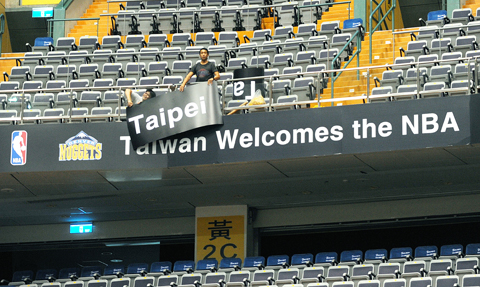
    Even Asia has had its share of NBA action: The NBA has played six games in Japan since the 1990s, and has held preseason games in China since 2004, after Chinese star Yao Ming joined the Houston Rockets in 2002: the first game obviously featured the Yao-powered rockets against the Sacramento Kings. In 2009, when the Nuggets met the Pacers in Taipei, it became the eight Asian city to host either an NBA regular season or preseason game, along with Tokyo, Yokohama, and Saitama in Japan; Beijing, Shanghai and Guangzhou in China; and Macau.
    You know where this train of thought of heading... an NBA game in India? FUGGEDABOUDIT! What is the one thing in common amongst all the other countries that we lack back home in India? We have the money if someone chooses to spend it (for proof, see IPL). Our extra large population ensures that even a small percentage of NBA fans make up for enough to provide enough audience for any game. And the IPL has proven that we have the technological, energy and security infrastructure to host large sporting events.

    No, what we really lack back here are good, ol-fashioned arenas! Not the kind of sharp-shooting, gun-toting Arenas that plays for the former Washington Bullets; no, I mean actual, international quality indoor basketball courts, made of good quality, polished hardwood (or similar surface), with fiberglass boards, and the capability to hold a large-capacity audience. Yes, there are some new courts around the country now which come close, but we're talking NBA-quality here, people! Yes, the NBA has brought in everyone from AC Green to Dikembe Mutombo opened several courts in India over the past few years, but we're far, far hehind.
    Hell, even the Indian national team has to practice on shoddy surfaces most of the time. One of the biggest complains is that the best players in India play most of their basketball on concrete courts with rubber balls, and so when they move on to play on a hardwood court with a leather basketball they are constantly struggling to adjust. Even the men's national team members that have been training with JD Walsh, Craig Esherick, and Dr. Bob Baker in Bangalore have had to work in embarassing facilities.
    I'm sorry, but there's no way that David Stern is going to allow his preciously talented millionaire NBA stars to break a sweat in any of our Indian courts.
    Who knows, maybe the Reliance-IMG alliance to develop sports facilities in India will change things in the future. The extremely distant future. Otherwise, no, no chance in hell.
    Go ahead, David Stern, NBA, Reliance... prove me wrong.


    March 31, 2010

    'Hoops for Health' hoping to make a difference beyond sport


    Sport is one of the best ways to unite people together. Whether it was the 2004 Indian cricket team's "Friendship Tour" of Pakistan following years of mistrust of the Kargil war, or the conflict-ridden Palestine hosting its first ever international football game in 2008, sport can provide a way to rehabilitate those in need, find common ground between conflicting cultures, and provide a healthy, competitive alternative to the harsher realities of life.

    One such effort has been by the 'Hoops for Health' basketball school that has been making a difference in the lives children under extremely hostile conditions in Kashmir, breaking language, cultural, and national barriers. There is no better way to rehabilitate some of these youngsters who have already been through atrocities in their young lives than through lessons and activities of sport. The project is a collaboration between basketball school jdBasketball and independent, non-profit organization Child Nurture and Relief (CHINAR).

    jdBasketball is the brainchild of American basketball coach and entrepreneur JD Walsh, who has spent several years in India coaching basketball as well as using the game as a vehicle for social change.

    CHINAR is an organization working for the psychosocial rehabilitation of orphaned and vulnerable children in conflict areas. They operate in the conflicted Kashmir area with a mission to "to provide a stable and nurturing environment for children in need, which encourages and equips them to reach their highest potential and effectively meet challenges in life."

    In 2007, CHINAR began working with the jdBasketball to conduct a 3 year basketball programme, 'Hoops for Health'. The event garnered national attention, bringing to light the problem and this new innovation solution for social change. Hoops for Health was awarded the Nike/Ashoka Foundation Changemaker Award for using basketball to affect social change in their community.

    This year, 'Hoops for Health' has been entered into nomination for the Beyond Sport awards. Beyond Sport is a global organisation that promotes, develops and funds the use of sport to create positive social change across the world - the awards programme provides support worth $1 million annually to projects across the world that use sport to address issues within their communities.

    For their work in Kashmir, 'Hoops for Health' has been entered for awards in two categories: the Sport for Health Award and the UNICEF Sport for Education Award. Please click on these links to comment your support on jdBasketball-Chinar.org's efforts.

    Other entries from India in the Beyond Sport categories this year are Rural Challengers- an audacious initiative and Project Green Hands

    The last date for the 2010 Beyond Sport Awards entries is April 16, 2010. A shortlist of the nominations will be revealed in May, and the winners of the awards will be unveiled at the Beyond Sport Summit from September 27-30 2010 in Chicago.

    Dikembe Mutombo, Former NBA Player and Founder, Dikembe Mutomobo Foundation: "Meeting all the inspirational people behind the sport and development projects shortlisted for the Beyond Sport Awards was a truly memorable experience. If we can get more people to follow the lead of these initiatives that we saw first-hand at the Summit then we can create real social impact across the world."

    I've closely followed JD Walsh's efforts in India and hope that his work with CHINAR and the children in Kashmir can be boosted with much-needed support if the programme is to win a Beyond Sport Award.

    Read about JD Walsh's Slumdog Basketball initiative in the Mumbai slums.


    March 11, 2010

    jdBasketball returns to India


    Basketball school jdBasketball, run by coach and entrepreneur JD Walsh, is returning to India next month. As part of a programme sponsored by the US Department of State, jdBasketball will host training camps in Chennai, Bangalore, and Mumbai.

    Additionally, jdBasketball will be partnered by the Centre of Sports Management of the George Mason University, where the basketball programme is overseen by assistant professor of sport management Craig Esherick (former assistant basketball coach and scout for the 1988 U.S. Men's Olympic basketball team).

    These are the tentative plans for the tour:

    Chennai: April 7-10, with the Sports Development Authority of Tamil Nadu.
    Bangalore: April 10-15, Men's National Team training.
    Mumbai: April 16-18, jdBasketball camp and clinic.


    Bookmark and Share

    March 9, 2010

    BFI's Harish Sharma: "India could have a professional basketball league in three years!"


    Sitting courtside at the NBA All Star Game at the Dallas Cowboys stadium in Arlington, Harish Sharma, the secretary general of the Basketball Federation of India (BFI), was more awestruck by the scenes off the court than the superstars on it. Off the court sat the biggest crowd to ever attend a basketball game – a mind-boggling, Guinness-Book-of-Records shattering 108,713 people.

    That is more than 1 lakh, 8 thousand in Indian terms.

    “I have never seen a crowd this big at a basketball game,” Sharma said, “It was amazing. I was happy and excited to see that basketball can draw such a huge number.”

    The All Star Weekend in Dallas was just one of the many basketball-related activities that Sharma took part in during his eight-day tour of the US last month. Sharma represented Indian basketball as he traveled from city to city, watching players, meeting NBA officials, and plotting a future for basketball in India.

    No, there is no chance that a crowd of over 1 lakh will show up for a basketball game in India anytime soon. Hell – that kind of crowd doesn’t even show up for NBA games – the All Star was only an exception. Nevertheless, Sharma was left moved and motivated – basketball has a future, in the USA, in India, and all around the world.


    One of his most ambitious projects is, with the co-operation of the NBA, to begin a two or three city school and college league in India later this year, which would eventually lead to a full-scale professional basketball league in around three years time.

    I finally caught up with Sharma yesterday for a brief interview. Basketball may still be a fringe sport in terms of national consciousness in India, but Sharma and the efforts of others in BFI ooze in confidence, promising a bright future for the game here.


    Hoopistani: I know you attended the recently concluded Ramu Memorial Basketball Tournament in Mumbai – what were your thoughts on the level of basketball there?

    Sharma: The level at Ramu was good, but a lot of other good teams and players were not able to participate. It was the offseason and the tournament was being held immediately after the National Basketball Championship. Still, I was satisfied by the improving talent of our basketball players.

    Hoopistani: Let’s talk about your visit to the US. How long were you there for? What was on your agenda?

    Sharma: I spent 8 days in the USA, from the 11th-18th of February. It was a busy trip, as I met several top-level officials of the NBA, including NBA commissioner David Stern. I attended the All Star Game in Dallas. I also got to meet [basketball coach and entrepreneur] JD Walsh, and discussed the George Mason University programme with the help of which we hope to send Indian coaches to get trained in America. I was in Tampa, Florida to observe other basketball systems, and even kept my eye on non-resident-Indians, the Bhullar brothers, play a game in Philadelphia.

    Hoopistani: Speaking of JD, what do you think of his efforts and work with basketball in India?

    Sharma: We totally support his work here. We open our arms to anyone who can come here and help Indian basketball.

    Hoopistani: Now, the NBA has been increasing interest in India over the last few years, with programmes such as Basketball Without Borders that was held a few years ago and the launch of the new NBA-India website at the end of last year. What is the future of the NBA with India?

    Sharma: The NBA have started a partnership with BFI, and we are looking to share a vision of basketball in India with them. We are seeking their help from them in developing basketball in the country in various ways. There will probably be a follow-up Basketball Without Borders programme very soon. One of our main agendas is to launch a pilot school and college city basketball league.

    Hoopistani: Can you please tell me more about this project? When will it be launched?

    Sharma: This school/college basketball league will be launched later this year in two or three cities in India. We are definitely looking for a school league in New Delhi and a college league in Chennai. We may increase the number of cities if the response to our request to the sponsors/marketing people requires it.
    Hopefully we can come up with some good basketball in these leagues. The NBA is helping us to run this and make sure that we follow it in the correct way.

    Hoopistani: What about professional leagues? Do you think we should have a basketball league in India that mirrors the NBA or the Indian Premier League (IPL) of Twenty-20 cricket?

    Sharma: Absolutely! A professional basketball league in India is definitely our goal. That is why the school/college league will play the part of a nursery to develop more future basketball players. My trip to the USA was one of our efforts to learn about how to develop such a league in India. Give it maybe three years, and such a league could become a reality.

    Hoopistani: One problem in India with basketball is getting enough sponsors to support the project. Do you think these proposed leagues would have the necessary support?

    Sharma: Yes, sponsorship is always a hindrance for such projects – but we have the NBA’s support, and are working hard to get sponsors to help launch this league.

    Hoopistani: How has basketball evolved in India over the last few decades, ever since you were a player? (Sharma was part of the Indian national team in the 70s, representing the country in tournaments such as the Youth Asian Championships and the Indo-German series).

    Sharma: A lot has changed. Basketball is a lot more popular in India now. There is more basketball on TV, more players, more tournaments, and more schools are involved.
    There will always be arguments between the old-school and new-school, and which is better, but there is no denying that the facilities are better now, the courts are better. There are more manufacturers producing basketball goods – I remember that as a player, we had to get our shorts get custom made by the tailors because we couldn’t find the right gear in the market!

    Hoopistani: What do you see for the future in Indian basketball?

    Sharma: India has progressed – we must dedicate a lot of effort into the game. India will very soon come into a big space in basketball. One of our main aims is to make sure our players are better rewarded. They deserve more for playing the game, and I’m sure that in the near future, there will be much better incentive and reward for Indian basketball players.
    But players have to also understand their responsibility. The federation and sponsors may do all they can, but in the end, it all comes down to the performance of the players. Only their performance can really shape the future of Indian basketball – and I’m confident that they can do it!


    Bookmark and Share

    December 3, 2009

    Breaking Old Habits: JD Walsh’s basketball movement in India

    Amongst our several unique nuances, we Indians have a particular slogan, which is repeated multiple times daily by tens of millions, like a mantra across the country’s wide, three million square kilometer area:

    “Chalta hai.”

    Translated literally from Hindi, it means ‘it goes.’ The Dictionary of Indian English emphasizes it further as ‘it will do,’ or ‘anything will do.’ It describes the fatalist philosophy of most of the country’s population, that everything happens because it is meant to happen, and since we can’t change it, we should learn to live with it. The typical Indian attitude, careless, passive – we admit it as one of our character blemishes, but at times, it’s something that most of us are sheepishly proud of. The sugar isn’t right in your tea? It’s OK, Chalta hai. There are no motorable roads into your village? Theek hai, Chalta hai. Did the minister refuse your requests because you didn’t bribe him? Chalta hai – we’re like this only…

    And so it comes as no surprise that the same attitude is followed in sports. For decades, sport in India has suffered, poisoned by our own lack of active commitment toward betterment. We all want improvement, but at the end of the day, most of us have remained unmoved by the lack of it. “We are like this only,” we say, and when things don’t work, it’s OK, because “It’s India – chalta hai!”

    But then there are a few who oppose this passive laziness, this lack of commitment that ails our culture. These individuals have thrived by capitalizing on that which others ignored. So then there is a reason why a country where around 30 percent of the people are below poverty line is the same which has produced some of the richest people in the world. A reason why, the country which doesn’t seem to have the funds for several basic sporting facilities is also the same which has one of the richest sporting leagues in the world (the Indian Premier League for cricket).

    Three years ago, American basketball coach John David “JD” Walsh drifted into this India. And soon, defying the standards of inefficiency, JD went through a series of events, camps, interviews and drills, and became one of the prime coaches and talent scouts across the country.


    He tells me that he’s heard it all. As he travels around India, he’s heard it spewed out the mouth of non-believing journalists, disgruntled coaches, and discouraged players.

    “[Basketball] is not being encouraged here.”

    “Wait, again. You’re a basketball coach, in India. What are you really doing here?”

    “We need a little bit more exposure… we need a lot of body game, and ours is not very physical.”

    “There’s a lot of politics.”

    “Do you play cricket?”

    “… It stinks.”

    JD Walsh, the New York born basketball coach and founder of the JDBASKETBALL School has been around the world, and for the past three years, he has held hundreds of camps all over India. He looks out his hotel lobby at the New Delhi skyline, a city which he now looks at as his own, and he repeats that he’s heard it all. He’s heard that there is no future in Indian basketball. He’s heard that there is no money in the game. That Indian basketball is 40 years behind China. That the system is too corrupt to improve things. That the players are just not strong enough, not athletic enough…

    “I know how things are,” Walsh says, “I know it’s challenging, but it’s a challenge that I’m looking forward to face.”

    I believe him, too, because at the end of the day, it’s about basketball – and for years, the game has been flowing through his veins.

    JD is one of the most well-known figures in global basketball schooling today. He was a scholarship basketball player for The University of Maryland, and later on for St. Vincent’s in Dublin (Ireland) before an injury halted his playing career. In 1998, he started the JDBASKETBALL School in Great Neck, NY, to teach basketball fundamentals to local kids in the New York metropolitan area. Fast-forward 11 years, and JDBASKETBALL has evolved into a global enterprise. Walsh, who considers himself a “global soul,” has held camps and toured countries around the world, including China, Dominican Republic, Italy, Qatar, Taiwan, Israel, and his most recent stop, India. The JDBASKETALL School has now reached over 15,000 children worldwide.

    From 1999-2005, JD had a stint as a varsity basketball coach in New York. He has coached and trained with several professional and collegiate all-stars, including Smush Parker, Troy Murphy, Mike Dunleavy Jr and Speedy Claxton. His guest speakers in the camps have included Claxton, Murphy, as well as Allan Houstan and Jerome “Junkyard Dog” Williams.

    From 2002-2006, JD trained and worked with several teams in the Chinese Basketball Association (CBA) as well as with the Chinese National Team. In 2002, he was the head coach of the U.S. Elite All-Stars when they went on tour in China against the China National Jr. Team.

    “There was a time, after China, five or six years ago, when I was tired with this life,” JD remembers, “I wanted something more than just basketball. But it all changed when I came to India – I fell in love with this country, and it completely reinvigorated me.”

    “They say that India isn’t interested in basketball — that this country is all about cricket. But I don’t see any reason why people from other parts of the world can’t have similar interests. China didn’t have the interest they have in basketball today a decade ago. India is still a long way away, but given the right set of circumstances and direction, the consumer interest is still possible.”


    Considering the similarities in their location, populations, size and rising economy, it is impossible not to constantly draw comparisons between China and India. As recently as 2002, when Yao Ming came into international consciousness, China was only waking up to the world of hoops. Things have, of course, changed drastically for them: China has become a notably strong basketball team internationally and its fans (or “consumers”) have embraced basketball and NBA in a big way.

    JD knows it could take decades for basketball in India to get to where it is in China today, but things are improving. There is undeniable talent in the country, and the potential for the promotion of the game to India’s large population has already been recognized by the NBA, which is looking to capitalize on the game’s fast growing popularity here. “I’ve seen talent all around the world, and I’m confident that I can find and foster talent here in India to take to the U.S.,” JD says, “The ability amongst the players is there – the only question is when?”

    In his years here, JD has conducted clinics for players and coaches in Mumbai, Chennai, Pune, Kolkata, Bangalore, Midnapore, New Delhi, Srinagar, and in the states of Punjab and Kerala, too. He’s worked with the state basketball associations in Tamil Nadu, Karnataka, West Bengal, Maharashtra, with educational institutions in various cities, and with several non-profit and non-government organizations. He fondly remembers one of his most extraordinary basketball experiences in India, when he worked with young Muslim women in Chennai who ended up playing veiled behind burkhas.


    JD’s efforts to blend basketball with social causes have been well-documented, from the ‘Hoops for Health’ program with an orphanage in Srinagar (Kashmir) to conducting events in Mumbai that will assist in building outdoor basketball courts in the city’s slums. But these are really only just the tip of the iceberg – from Israel, the US, to India, JD’s focus has always been in accommodating social/charity events with basketball.

    I met him in Delhi, during his most recent tour of India. He had already held camps in Chennai, during which he also sat by the sidelines to watch the Indian Women’s team battle it out in the FIBA Asia Women’s Championship held in the city (which, predictably, was won in a clean sweep by Asia’s superpower, China). He has also held training camps in New Delhi and Mumbai over the past few days.

    One of the most exciting recent developments has been the awarding of a Sports Initiative Grant to JD (with co-partner George Mason University [GMU]) from the U.S. Department of State, that will allow for a coaches training and cultural exchange programs between India and GMU.

    JD was considerably excited about this grant. “Around July next year, we’re planning to take 10 coaches from India and train them at GMU,” he says, “And in November as well as in March we will be working with Indian state basketball associations to train coaches in three to five Indian cities.” He adds that he has been able to rope in the expertise of Craig Esherick (assistant professor of sports management at GMU, former head coach of the Georgetown University men’s team, and head coach and scout for the 1998 US men’s Olympic team) for this project.

    JD’s active involvement and initiative to make a difference in remarkable, especially in trying to survive and thrive in a country that even its own countrymen struggle to fully understand. A few months ago, he blogged about what he believes are ways in which basketball in India can become competitive with the rest of the world. JD lists infrastructure, corporate and government financing, incentive, hi-level training for youth under-12, and a whole dose of patience for this to be possible.


    Unfortunately, like every Indian knows, idealistic ideas for the future rarely transform into reality, and even if they do, they are rarely done in time. If things are in bad condition, then they’re supposed to be that way; we’re like this only, no? The delay in preparation for next year’s Commonwealth Games in New Delhi is just one glaring example of his inefficiency.

    Take the recent case of India’s ‘queen of track and field’, PT Usha, who is one of the greatest athletes the country has ever produced, winning medals, awards, and admiration in a career that began three decades ago. On Monday, October 5, Usha reportedly broke down into tears, because sport authorities that welcomed her for an Open Athletics Meet shuffled her around for three hours in confusion and without accommodation, as she waited cluelessly under the pouring rain. She later told reporters that “I have won medals for the nation. And see how I am being treated. If this is the deal I get, you can well imagine what the struggling sportsmen go through.”

    Indeed, imagine that. India is a country of contradictions and frustrations, of the beautiful and the ugly in the same image, of restlessness and passivity. JD himself once wrote, “I’ve said out loud, I hate India, I love India, over 20 times a day on multiple occasions.” It is a country where ‘everything goes’ because, somehow, we believe that it’s supposed to.

    JD shows me the photographs from his camps, his experiences, and talks about his past, and the future. Towards the end of our conversation he turns reflective, taking a step back to view the bigger picture, of what he has been through, and what he is now becoming. “I don’t want to just come to India and take something away,” he says, “I want to grow and assimilate talent here, and in the process, hopefully grow as a person myself.”

    I go away feeling that basketball in India needs JD Walsh as much as JD Walsh needs India. He is far from the lone savior of the game here – for decades Indian coaches, players, and event managers have rebelled against the system and dedicated their lives in making a difference to the future of the game here. In a country where every reality, good or bad, is accepted with a chuckle and a fatalist “Chalta Hai,” it is heartening to see such specks of hope toward a positive change.

    *First published on SLAMONLINE.COM on October 9, 2009.


    Bookmark and Share