Showing posts with label Palestine. Show all posts

October 24, 2021

Hoopdarshan 109: Amritpal Singh returns to dominate for Team India

In a must-win qualifying game against Palestine, Amritpal Singh posted 32 points and 12 rebounds to secure a dramatic comeback victory for India. Now, the Punjabi big man joins Hoopdarshan to look ahead at the FIBA Asia Cup, share how he remained sharp during the Lockdown, and reminisce his time with the NBL in Australia. Hosted by Kaushik Lakshman and Karan Madhok

 Also in Episode 109, Kaushik and Karan discuss India's performance at the FIBA Asia Women's Cup, and recap the worst storylines of the NBA's offseason.
 

Hoopdarshan is the truest voice of Indian basketball, and since we're such hopeless fans of the game, it will become the voice of everything basketball related we love, from the NBA to international hoops, too. On every episode of Hoopdarshan, we will be inviting a special guest to interview or chat to about a variety of topics. With expert insight from some of the brightest and most-involved people in the world of Indian basketball, we hope to bring this conversation to a many more interested fans, players, and followers of the game.

Make sure to follow Hoopdarshan on Soundcloud or search for 'Hoopdarshan' on the iTunes Store! Auto-sync Hoopdarshan to your preferred podcast app NOW!

Hoopdarshan can be found on...

November 17, 2015

Amjyot's Ascent


Amjyot Singh’s rapid journey to become the superstar that Indian basketball desperately needed.

This feature was first published in my column for Ekalavyas on October 14, 2015. Click here to read the original article.


On one end of the court, Amjyot Singh defended the star perimeter player, and when his opponent switched on a pick, moved in to deny a scoring opportunity to a different player in the post. On the other end of the court, the 6-foot-8 forward stretched his slower defender out to the three-point line and bombed away. Through the course of the game, he continued to secure rebounds, assists, and steals as per his team’s need. Late in the game, with the result still hanging in the balance, he trailed on a fastbreak behind teammate Vinay Kaushik, cleaned up Kaushik’s missed lay-up off the glass, and slammed it home, securing the Indian lead and the tournament’s most crucial victory.

When the final buzzer rang, India had squeaked past the higher rated Palestine team 73-70 in the Second Round of the 2015 FIBA Asia Basketball Championship in Changsha (China). Amjyot’s teammates surrounded him in jubilation and supported him back to the locker room, just as he had supported them for the entire game. Amjyot finished with 32 points and 11 rebounds, playing 39 of the total 40 minutes in the game to earn India this surprise win and hand Palestine their first loss in the tournament.

Less than 24 hours later, while most Indians were still being awoken to the kook-ra-koo of the morning rooster or the hollers of the kabari-wallah, Amjyot was in China dominating opponents again, leading India with 26 and 12 to yet another close win over Hong Kong.

The stellar performances on all ends of the court – displaying both his motor and his versatility – would continue for Amjyot throughout the course of the 2015 FIBA ABC, which he finished as India’s leading scorer and the fourth-leading scorer in the tournament (20.9 ppg) and India’s leading rebounder (8.3 rpg) and helped the team finish at 8th place, their best results in 12 years. India lost to the mighty Chinese at the Quarter-Final stage, but Amjyot left Changsha as one of the top performers in Asia.

Hailing from Chandigarh, the 23-year-old Amjyot’s rise in prominence as the best player in Indian national colours has paradoxically been both expected and surprising. Amjyot used to be a cricket player in school, but a shoulder injury kept him out of the game for three months. He watched his father – a basketball player – on the court while injured and his interest for the game grew. Soon, he began to sneak out of his after-school cricket practices to play basketball instead. At 15, he ditched cricket for basketball forever.

He broke into the ranks of India’s youth (under-16) team in 2008, and then became the latest recruit to Ludhiana’s famed Basketball Academy – the same academy which has produced the likes of Yadwinder Singh, Amrit Pal Singh, TJ Sahi, Satnam Singh, Jagdeep Bains, Seema Singh and many more – under the legendary late coach Dr S. Subramanian.

The discovery helped his ascent, but it was not as early as a player of his potential deserved. In most countries with a better youth scouting system, a talent like Amjyot Singh would’ve been ‘discovered’ and moulded at the highest level available from his pre-teens onwards. Amjyot had to wait till was nearly of college age to receive elite-level coaching. His mastery of the game accelerated, but his late bloom also served as a reminder of how much better he could’ve become had he received serious instruction of the game earlier.

At 19, Amjyot was selected by the then-Head Coach Kenny Natt to India’s senior national team for the first time to play in the South Asia qualifiers and the 2011 FIBA Asia Basketball Championship. Amjyot showed great promise for India off the bench, and ever since – even as coaches and teammates changed – he became one of the lynchpins for the national team.

Of course, one can’t speak of Amjyot without speaking of two other Punjabi big men who made the national team debut in 2011 alongside him. Senior national team rookies Amjyot, Amrit Pal Singh, and Satnam Singh – all products of the Ludhiana Basketball Academy – beefed up Kenny Natt’s frontcourt together in an explosion of youth and size that Indian basketball had rarely been blessed with before. Since then, Amrit Pal has been Amjyot’s partner in the national team’s starting frontcourt for the last few years as the two big men dominated at the domestic level, improved at the international level, and headed together to play professionally for the same teams in Japan.


The story of Satnam Singh diverted sharply. Satnam – four years younger and five inches taller than Amjyot – spent much of his later teenage years in High School at the IMG Academy in Florida, USA, where he developed into a solid young player and eventually became the first Indian to be drafted into the NBA earlier this year. Satnam’s focus on High School hoops in the USA and NBA tryouts kept him out of Indian national team duty after 2013. In his absence, Amjyot and Amrit Pal grabbed the reigns in the middle and flourished in the India jersey.

But it wasn’t until 2014 that the legend of Amjyot – and the Indian Men’s team around him – took a sharp turn into higher, uncharted territory. At the FIBA Asia Cup in Wuhan, China, Amjyot and Amrit Pal – both Sikhs who don the customary turbans to cover their long hair – faced the discrimination of FIBA’s “No Headgear” policy in their first game against Japan, leading to a distracted start and a loss. A day later, hair tied by headbands, Amjyot and India – led by Head Coach Scott Flemming – took out their frustrations on hosts China, the finest team in the continent.

Amjyot scored a game-high 13 points to go with five rebounds and was masterful on both ends of the floor against the Chinese bigs to help India upset China – for the first time in history – with a 65-58 win. A highlight of the victory was the clutch alley-oop dunk finished by Amjyot to secure the lead for India in the game’s dying minutes. Amjyot would go on to lead India in points, rebounds, and steals at the tournament and make waves with the local and continental media for his skill and versatility. Even more astonishingly, Amjyot and India earned respect at the FIBA Asia Cup despite having any professional basketball experience.

His work at Wuhan, and later, his domestic and international play at the Asian Games, got Amjyot recruited – along with Amrit Pal – to become the first Indian players chosen for Japanese BJ Summer League in summer of 2015. The two Indian bigs dominated the competition, so much so that they were handed Japanese D-League contracts with the Tokyo Excellence soon after.

By the time he re-joined Team India in preparation for the 2015 FIBA Asia Championship in Changsha, Amjyot had clearly elevated himself into one of the leaders of a national team in flux, along with Amrit Pal and experienced captain Vishesh Bhriguvanshi. India had a new head coach (Sat Prakash Yadav) and were missing five top players who had played a key role in the wonders at Wuhan. Lacking gravely in depth, the big three of Amjyot, Amrit Pal, and Vishesh had to shoulder the heaviest weights in carrying the squad – Amjyot finished the tournament playing a team-high 37 minutes per game, third-most in the competition.

But instead of pressing him down, the heavier load only pulled the rising star higher up. Amjyot always played like a guard blessed with more size than he had expected. He had the game of a swingman and the height to better most Asian forwards.

In Changsha, however, his game elevated to another level; there was fluidity with which he moved, handled the ball, and attacked the basket, a confidence that seemed to have been triggered at the recent realization that few in the continent could now stop him or match-up with the offensive arsenal that he had developed. Amjyot played with a combination of inside and outside, height and speed, strength and agility; the only way to guard him was to be as physically gifted as him.

But it isn’t enough to be only physically gifted: the reason that Amjyot has become one of India’s most prominent male players in recent decades is that he has played with a humility and duty to put team over self. While other prodigious Indian talents – think TJ Sahi or S. Robinson – came up short of their potential, Amjyot seems to be charging rapidly towards his. While many players halted the progress of team development, Amjyot’s rise has come in sync with the rise of Team India. He constantly deflected all the praises we lavished upon him in our Hoopdarshan interview towards his teammates, and speaking to FIBA after his big performance against Palestine, he laughed off his own 32-point, 11-rebound effort by talking about his teammates instead: “They do all the hard work, and I get to score.”

India has had several individual talents in the last few decades, but there have been few whose talents have worked consistently to provide positive results for the nation. As of now, it may not be a stretch to say that he can be the best male basketball player for India since Jayasankar Menon, who was named to the Asian All Star team in the mid-90s and was nominated for an Arjuna Award.

If this was cricket, Amjyot Singh – the best performer for the Indian basketball team and one of the best players in his position in Asia – would've been a household name in India by now. Unfortunately, every other sport in the country takes a major backseat in the eyes of the Indian mainstream after cricket.

The last Indian basketball player to make news across the country was Satnam Singh, on the day he was drafted into the NBA. But Amjyot has done more for the Indian national team, and may be a better overall talent than Satnam right now. Satnam, of course, has an age and size advantage, which will see him start his professional career in the NBA D-League.

Meanwhile Amjyot (and Amrit Pal) will be heading back to Tokyo for the Japanese D-League, but the former’s performances at Changsha have alerted basketball scouts across the globe of his talents and (still untapped) potential. It would not surprise me if offers from other Asian leagues or Europe come calling. And one can never discount the possibility of that dream NBA or NBDL trial, either.

In a short span of time, Amjyot Singh’s ascent into the Asian basketball elite has been marvellous and heartening. It should give hope to other late bloomers of the game as well as encourage coaches (and parents) in India not to waste the early, formative years of potential talents. Meanwhile, the Indian basketball family and fans will hope that Amjyot continues to improve, continues to rise up the ranks of Asia’s best players, and with him, carries India higher up, too.

October 4, 2014

Recap: India at 2014 Asian Games basketball tournament; Hosts South Korea win double gold


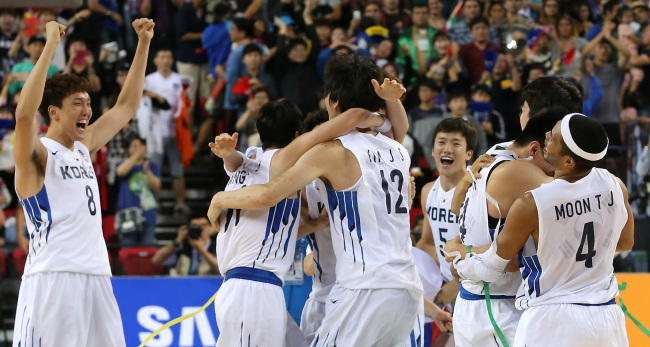
South Korea defended their home turf in style, as both their Men and Women's squads outperformed higher-ranked squads to secure the gold medal at the Basketball tournament of the 17th Asian Games in Incheon. Both the finals of the tournament were held at the Samsan World Gymnasium in Incheon on Friday, October 3rd, the penultimate day of events at the Asian Games. South Korea's Men won a thrilling contest against Iran, while their Women's squad edged to a victory over China.

Topsy-turvy performances by India saw some positive moments but also left a lot to be desired. India's Men finished 12th (out of 16) and Women finished 6th (out of 11).

The basketball tournament at the Games was held at the Samsan World Gymnasium and the Hwaseong Sports Complex from September 20 - October 3.

After trailing by two at halftime, Korea's Women took a third quarter lead over China in the final, before surviving in the final minutes to a 70-64 victory. Yeonha Beon scored a team-high 16 for South Korea, while on the Chinese end, Xiufeng Shi scored 16 too. As hosts, Korea had made sure to send their top 'A' squad to the Asian Games tournament, while their 'B' team played at the FIBA World Championship for Women. China, who also qualified for FIBA Worlds, did the reverse.

In the Men's final, South Korea again rallied on their home support to take an early lead against FIBA Asia champs Iran and hold on to secure the gold despite a strong comeback by the Iranians in the second half. Behind the efforts of their superstar Taejong Moon (19 points) and Jongkyu Kim (17), Korea raced to a nine point lead in the first quarter and held a 42-36 advantage at the halftime break. But Iran - boosted by a 30-point outing by captain Mohammadsamad Nik Khahbahrami - bounced back to take a lead in the third. Down by five in the game's last two minutes, Korea bounced back to take a lead with just 36 seconds left in the game, and a missed last shot by Iran's Khahbahrami secured the hosts a 79-77 win.

Earlier in the day, Japanese Women survived another back-and-forth close contest versus Chinese Taipei to secure the bronze medal with a 61-59 win. Japan's Men won the bronze too, but it didn't come easy against the surprise team of the tournament, Kazakhstan. Kosuke Kanamaru scored 21 points for Japan, who only put the Kazakhs away for good in the game's waning minutes for a 76-72 win. Kosuke Takeuchi added 17 points for the victors, while Kazakhstan's Dmitriy Gavrilov scored a game-high 22 points in the losing effort.

A couple of days earlier, Xiufeng Shi (20) and Dan Liu (18) helped China's Women bounce back from an early deficit to defeat Chinese Taipei 75-63 in the Semi-Final stage. Ping Jen Huang scored 19 for Chinese Taipei in the loss. In the second women's semi-final, hosts South Korea overcame a very slow start to beat Japan 58-53. Japan's Naho Miyoshi scored a game-high 18.

Japan and South Korea also faced off in the Men's semi-final, and after being locked at 34-each at halftime, the hosts once again found a second half boost to race to a 71-63 win. The Koreans overcame 18 points by Japan's Naoto Tsuji. Kazakhstan played valiantly against Iran in the other Men's semi-final, giving the Iranians trouble on all ends of the court until the game's dying seconds. But it was Khahbahrami who poured in a heroic 27 points to insure a final appearance for his nation. Kazakhstan's duo of Pavel Ilin and Anton Ponomarev scored 16 points each in the loss.

After some positive performances over the last few months, India's Men's team entered their last international competition of 2014 with some cautious optimism. India were placed in Group B of the Men's Qualifying Round in the tournament, along with Saudi Arabia, Kazakhstan, and Palestine, and their task was to finish in the top two to qualify for the Preliminary Round with Asia's stronger teams.

India started well against the minnows of their group, Palestine. The Young Cagers raced to a double digit lead in the first quarter and never looked back, hitting from all angles and playing hard on the defensive end, too. Amjyot Singh scored 25 to lead the Indian attack in the 89-49 win for India. One bright spark for Palestine was their captain Hend Sani GS Sakakani, who finished with 19 points for his side.

But India were given a brutal shock the very next day against Saudi Arabia, who were considered to be beatable opponents. The Saudis capitalized on careless offense by India to take an early lead and stretch it to 40-27 at halftime. India began to play their best basketball in the fourth quarter, but the comeback attempt was left too late and Saudi Arabia held on for a 73-67 win. Fahad Alsalik M Belal scored 17 to lead the Saudis. India's top performers were the big men duo of captain Amrit Pal Singh (19 points, 10 rebounds) and Amjyot Singh (19).

With their backs against a wall and needing a win - a convincing one at that - to qualify for the next round against the group's toughest team, India bounced back in style against Kazakhstan. In what became their best performance of the tournament, India's hot shooting gave them a 24-14 lead in the first quarter, and from then on, India held on to their double digit advantage all game. Point guard Joginder Singh hit seven three-pointers for a game-high 25 points, while veteran guard Vishesh Bhriguvanshi added 16. Anton Poromarev scored 16 for Kazakhstan. India finished the game with a 80-61 win; and the margin of victory helped them qualify for the Preliminary Round by finishing top in their group, relegating Kazakhstan to second.

India thus found themselves Preliminary Round Group E, along with Asian giants Iran and Philippines, both of whom had recently represented the continent at the FIBA World Cup in Spain. India started slow against the aggressive Filipinos, who were playing their first game at the competition. The Philippines took a 50-37 lead at halftime, and a slew of bad shooting and turnovers kept India at bay. The Indians did make a strong comeback in the fourth quarter, but it wasn't enough as they fell to a 85-76 loss. Amrit Pal Singh was the game's leading scorer with 16.

India played their fifth game in five days against Iran next, who were playing their first game at the tournament. The more athletic, experienced, and rested Iran side left no chance for an Indian upset. Despite a decent start where India were only down by six in the first quarter, Iran fed the ball to experienced big man Hamed Haddadi (16) for much of the damage in the first half and the explosive Khahbahrami (16) to dominate in the second. India were outplayed in all aspects of the game and their tiredness showed as they fell to a 76-41 loss. By finishing last in the group, they were eliminated from the tournament.

India Men finished the tournament with a 2-3 record at 12th place.

"In general this was a great experience," said Scott Flemming, Head Coach of the Indian Men's team, "Being in a setting with 45 countries and 13,000 athletes is enlightening. This was a chance, if taken advantage of, to broaden our scope globally. In regards to basketball there were things we could control and other aspects we could not control. In the areas we could control I feel as though our defense continues to be our strong point, maybe with the exception of the Philippines game. We have also improved in our shot selection and our accuracy from the field. Where we struggled at crucial times was in our defensive rebounding, free throw shooting and number of turnovers that led to points by our opponents. I will take responsibility for these short comings. They will need to be focused on even more in the future.

"We also had a few areas that we could not control," Flemming added, "Again, we played no preparation games leading up to this tournament. Many of these teams have played anywhere from 10 to 50 preparation games before coming to Korea. These are crucial to compete at these high level tournaments. We also played 2 of the top teams in Asia (Iran, Philippines) while playing 4 and 5 days in a row. They were both fresh in these games. It may not have hurt us so much if we had played in one of the other pools in the next round. But again, those things we cannot control. We ended up first in our qualifying pool. We played very well at times but we definitely need to take another step to reach those medal games. I am proud of what we have accomplished this year but there is definitely more work to be done."

India's Women, who had finished at a best-ever fifth place in last year's FIBA Asia Championship for Women, began their tournament by automatically starting in the quarter-final. The only problem? Their quarter-final opponents were reigning Asian champs Japan. The swift and talented Japanese dominated India from beginning to end, and even holding India to just five points in the opening quarter. No Indian player was able to crack double digits in scoring and Japan cruised to an easy 70-37 win, eliminating India from moving further up into the tournament.

Instead, the Indian eves fell to the 5-8th place bracket, where they first played Mongolia, losers of another quarter-final. Jeena PS got India started off on a roll and the experienced Prashanti Singh (17) took over late. India maintained a healthy distance from the Mongolians through the course of the game and held on for a 68-50 win. Mongolia's leading scorer was Ganzul Davaasuren, who finished the night with 25 points.

India's last game at the tournament was against Kazakhstan, and despite a competitive start, India were outclassed for the final three quarters of the game. Kazakhstan, who had a 15-12 lead after the first quarter, stretched their lead to 14 at halftime and then outscored India 19-4 in a big third-quarter surge. Kazakhstan finished the night with a 68-47 win and were secured of fifth place at the tournament.

India Women finished the tournament with a 1-2 record at sixth place.

"On paper, if you check that we were at 6th position, you might think we played a good tournament," said Francisco Garcia, Head Coach of India's Women's team, "And of course, 6th position is good since that we had the youngest team in competition. But the reality is that we did not find our pace in this championship. Mainly we faced teams with players who play around 60 games a season and came to Incheon with 10-15 practice games before the tournament began. We came here with zero practice games after three camps. And of course there is no team in the world who do that before a championship. I am really dissappointed about that."

"We have been asking since a long time ago to create pro leagues for men and women and no one listen to us," added Garcia, "That is the key for our players to grow and compete better internationally, apart from playing often with our team abroad. And I repeat, this is not a fact of the result, because it was a good one. It is necessary to become closer to the top teams. IMG Reliance and the Basketball Federation of India (BFI) must urgently plan pro leagues."

Final Standings

Men
  • Gold: South Korea
  • Silver: Iran
  • Bronze: Japan
Women
  • Gold: South Korea
  • Silver: China
  • Bronze: Japan

September 19, 2014

2014 Asian Games: The Complete Team India Basketball Preview


The journey - as it usually is with Indian sports - wasn't easy, and threatened to unravel into disaster as, less than 10 days before the beginning of the 2014 Asian Games in Incheon (Korea), the fate of India's basketball (and a few other sports) teams hung in the balance. Luckily for the Indian athletes and hoop lovers back home, the turmoil finally ended last week and India's Men's and Women's Senior basketball squads were confirmed to participate at the basketball tournament in Incheon, set to be held from September 20 - October 4.

The 17th Asian Games - or the XVII Asiad - will be held in Incheon from September 19 - October 4, 2014. A total of 439 events from 36 sports and disciplines set to feature in the Games. The basketball tournament at the Games will be held at the Samsan World Gymnasium and the Hwaseong Sports Complex.


India's Men's Basketball team at the 17th Asian Games
  • Joginder Singh
  • Narender Kumar Grewal
  • Akilan Pari
  • Prakash Mishra
  • Pratham Singh
  • Vishesh Bhriguvanshi
  • Amrit Pal Singh (Captain)
  • Prasanna Venkatesh Sivakumar
  • Palpreet Singh Brar
  • Amjyot Singh
  • Yadwinder Singh
  • Rikin Shantilal Pethani
  • Head Coach: Scott Flemming
  • Coach: Prasad Rama Linga
  • Physiotherapist: Naved Hameed
Head Coach Scott Flemming has opted for a completely unchanged roster for Team India from the squad that performed wonders at the 5th FIBA Asia Cup in Wuhan (China) in July this year. Flemming's decision is no surprise at all: this is the same Indian squad that defeated the mighty Chinese on their home soil at the FIBA Asia Cup for the first time in the nation's basketball history. Although India finished the tournament at only 7th place, they managed to scare much-favoured Asian squads like Iran and the Philippines (both of whom played at the FIBA World Cup) and proved that they were much better than their 61st FIBA World Ranking proclaimed. India will once again rely on their three most talented players - Vishesh Bhrighuvanshi, Amjyot Singh, and new captain Amrit Pal Singh - to strike fear in their opponents.

India will start the tournament in Group B of the Qualifying Round.

Asian Games Men's Basketball Groups
  • Qualifying Round Group A: Mongolia, Hong Kong, Kuwait, Maldives. 
  • Qualifying Round Group B: Saudi Arabia, Kazakhstan, Palestine, India
  • Preliminary Round Group C: China, Chinese Taipei, B2. 
  • Preliminary Round Group D: South Korea, Jordan, A2. 
  • Preliminary Round Group E: Iran, Philippines, B1. 
  • Preliminary Round Group F: Japan, Qatar, A1.
To qualify for the Preliminary Round of the tournament, India must finish in top 2 of the qualifying round stage. India should be able to do just that: Kazakhstan are slight favourites for Group B but India should be able to defeat Saudi Arabia and Palestine. If India can beat Kazakhstan too, they will top the group. Either way, if India qualifies for the Preliminary Round, they will thrown right into the fire. Finishing top will see them in a group with Asia's World Cup representatives Iran and Philippines and finishing second will place them with Asia's top seed China as well as FIBA Asia Cup runner-ups Chinese Taipei.

The top two teams from from Groups C, D, E, and F will move on to two more groups (G and H) of round-robin games as the Quarter-Final round, and the four best from these groups will finally be in the semi-final knockout stage.

India's Men's Qualifying Round Schedule - all timings IST
  • September 20 - 12:45 PM - India vs. Palestine.
  • September 21 - 12:45 PM - India vs. Saudi Arabia.
  • September 22 - 12:45 PM - Kazakhstan vs. India.
"It has been a long wait and one with uncertainty," Coach Flemming told me as Team India readied to head out to Korea for the Asian Games, "We are very glad that we have been given approval to participate in the Asian Games. At the same time we are again battling the odds with no preparatory games and a limited coaching staff. We will again need to be overcomers and overachievers. We draw confidence from our play in the Asia Cup earlier this summer. Our team will do our best to meet the challenge ahead of us."

My Prediction: At the 2010 Asian Games in Guangzhou (China), India's Men finished winless, losing all five of their games. This year, circumstances and groupings are different and India should be able to notch a couple of Qualifying Round victories. India will have to use the first two games against Palestine and Saudi Arabia as their 'preparatory' games before their biggest early challenge against Kazakhstan. The Kazakhs are known to be tall and athletic, but I feel that this Indian side has enough confidence and talent now to beat them and top Group B. Unfortunately, they will have to go against Iran and Philippines in the Preliminary Round then, and only another miracle (like our win over China two months ago) will be able to see India survive for the Quarter-Finals.


India's Women's Basketball team at the 17th Asian Games
  • Akanksha Singh
  • Kavita Akula
  • Kruthika Lakshman
  • Kavita Kumari
  • Poojamol KS
  • Raspreet Sidhu
  • Prashanti Singh
  • Smruthi Radhakrishnan (Captain)
  • Rajapriyadharshini
  • Jeena PS
  • Stephy Nixon
  • Head Coach: Francisco Garcia
  • Coach: Divya Singh
  • Physiotherapist: Rajesh Chavan
It's been a long time since we've seen a full-strength India Women's basketball team in action. It's been almost 10 months, actually. Garcia led India to a best-ever fifth-place finish at the 25th FIBA Asia Championship for Women in Bangkok (Thailand) last year, and India notched their first-ever Level 1 victory in the tournament, too. Since then, India's only major international exposure has been at the Lusofonia Games in January, where Garcia opted to play a younger, less experienced squad. Although several of the big guns are back in the roster for India, this team is missing some familiar faces like recent Arjuna Award winner Geethu Anna Jose and young rising star Shireen Limaye, who tore her ACL just days before the team was due to fly to Korea. Jose's Railways' teammate Anitha Paul Durai is also missing in action. India will be relying on the potential of youngsters Jeena PS and Kavita Kumari, the leadership of captain Smruthi Radhakrishnan, and the experienced Singh Sisters - Prashanti and Akanksha - in the campaign. Because they finished in Level 1 of last year's FIBA Asia Championship, India's Women have already been seeded to the competitions final round.

Asian Games Women's Basketball Seedings
  • Qualifying Round: Hong Kong, Kazakhstan, Mongolia, Nepal, Qatar.
  • Final Round: China, South Korea, Japan, Chinese Taipei, Thailand, India.
The top team from the Qualifying Round will play Korea in the Quarter-Final while the second-best team will play China. India's first game at the tournament will be a Quarter-Final clash against Japan on September 28th at 9:30 AM IST. If India win this game, they will play either Korea or the top team from the Qualifying Round in the Semi-Final. If India lose, they will be slotted in the 5th-8th place tournament.

"Our preparation for the Asian Games was not the best," Coach Garcia said, "We ran three camps but our exposure trip was cancelled even when we were ready with visas to head to China for practice games. So at the end of the day we go there [Incheon] without playing a single game. As far as I know, our opponents have been playing in international tournaments since the end of July. Also, we'll be going there without our two best scorers (Jose and Paul Durai) and rebounder (Jose) of the last FIBA Asia Championship. Days ago, Shireen Limaye, an important player in our system, tore her ACL so she won't be able to play either. But still, we expect to compete at 500 percent; we have been working very hard and although we have adversities, I believe in this group to give their best in the tournament."

My Prediction: India's Women were also winless at the 2010 Asian Games, going 0-3 in the tournament. By being seeded in the final round this year and starting in the Quarter-Final, India are ensured at least a top 8 finish. India's chances of winning that quarter-final against Japan are low since the Japanese are the reigning FIBA Women's champions. If they lose, they will have to face against other Quarter-Final losers in the 5th-8th tournament, where their biggest challenger will probably be Thailand. India proved last year that they were ready to cement their position as Asia's fifth-best women's team after the big four of China, Chinese Taipei, Korea and Japan, and I expect them to be good enough for fifth-place again this time around.

March 31, 2010

'Hoops for Health' hoping to make a difference beyond sport


Sport is one of the best ways to unite people together. Whether it was the 2004 Indian cricket team's "Friendship Tour" of Pakistan following years of mistrust of the Kargil war, or the conflict-ridden Palestine hosting its first ever international football game in 2008, sport can provide a way to rehabilitate those in need, find common ground between conflicting cultures, and provide a healthy, competitive alternative to the harsher realities of life.

One such effort has been by the 'Hoops for Health' basketball school that has been making a difference in the lives children under extremely hostile conditions in Kashmir, breaking language, cultural, and national barriers. There is no better way to rehabilitate some of these youngsters who have already been through atrocities in their young lives than through lessons and activities of sport. The project is a collaboration between basketball school jdBasketball and independent, non-profit organization Child Nurture and Relief (CHINAR).

jdBasketball is the brainchild of American basketball coach and entrepreneur JD Walsh, who has spent several years in India coaching basketball as well as using the game as a vehicle for social change.

CHINAR is an organization working for the psychosocial rehabilitation of orphaned and vulnerable children in conflict areas. They operate in the conflicted Kashmir area with a mission to "to provide a stable and nurturing environment for children in need, which encourages and equips them to reach their highest potential and effectively meet challenges in life."

In 2007, CHINAR began working with the jdBasketball to conduct a 3 year basketball programme, 'Hoops for Health'. The event garnered national attention, bringing to light the problem and this new innovation solution for social change. Hoops for Health was awarded the Nike/Ashoka Foundation Changemaker Award for using basketball to affect social change in their community.

This year, 'Hoops for Health' has been entered into nomination for the Beyond Sport awards. Beyond Sport is a global organisation that promotes, develops and funds the use of sport to create positive social change across the world - the awards programme provides support worth $1 million annually to projects across the world that use sport to address issues within their communities.

For their work in Kashmir, 'Hoops for Health' has been entered for awards in two categories: the Sport for Health Award and the UNICEF Sport for Education Award. Please click on these links to comment your support on jdBasketball-Chinar.org's efforts.

Other entries from India in the Beyond Sport categories this year are Rural Challengers- an audacious initiative and Project Green Hands

The last date for the 2010 Beyond Sport Awards entries is April 16, 2010. A shortlist of the nominations will be revealed in May, and the winners of the awards will be unveiled at the Beyond Sport Summit from September 27-30 2010 in Chicago.

Dikembe Mutombo, Former NBA Player and Founder, Dikembe Mutomobo Foundation: "Meeting all the inspirational people behind the sport and development projects shortlisted for the Beyond Sport Awards was a truly memorable experience. If we can get more people to follow the lead of these initiatives that we saw first-hand at the Summit then we can create real social impact across the world."

I've closely followed JD Walsh's efforts in India and hope that his work with CHINAR and the children in Kashmir can be boosted with much-needed support if the programme is to win a Beyond Sport Award.

Read about JD Walsh's Slumdog Basketball initiative in the Mumbai slums.