Aiming to create "a sports revolution in the country", sports and entertainment company SE TransStadia will be organizing a massive sports summit, the biggest of its kind in India, in Mumbai, from March 24-25. Amongst the several political and sport-related attendees from around the world will include members of the management board of the NBA's San Antonio Spurs.
Hey, I always knew the Spurs have an eye for great foreign players - Tony Parker, Manu Ginobili, and Tim Duncan isn't exactly American, either (Virgin Islands, actually). Looking for the next big thing by making contacts in India already?
Talking about the initiative, Udit Sheth, MD and CEO of TransStadia says “Sport has ceased to be a vocational activity and has emerged as a billion dollar industry. We aim at bringing together a potpourri of global and Indian sports celebrities and administrators, under one roof to come up with ideas to transform Indian sports.” He adds, "There is tremendous change in the way we look at sports in India. It is on par with any other industry. Innovative sports development events such as the IPL have clearly put sports in a pole position. Unfortunately, Indian sports is divided and fragmented and lacks collective thinking. We need to chart a new path and aim to do that by bringing in the best of talent in sports administration, government, people connected to sports infrastructure and the media on a single platform," says Sheth.
Aside from the Spurs management, other attendees will include Gujrat Chief Minister and World Class Choot Narendra Modi, Chief Minister of Maharashtra Ashok Chavan, President of the Indian Olympic Association (IOA) Suresh Kalmadi, Australian cricketer Matthew Hayden, and representatives from the English Premier League.
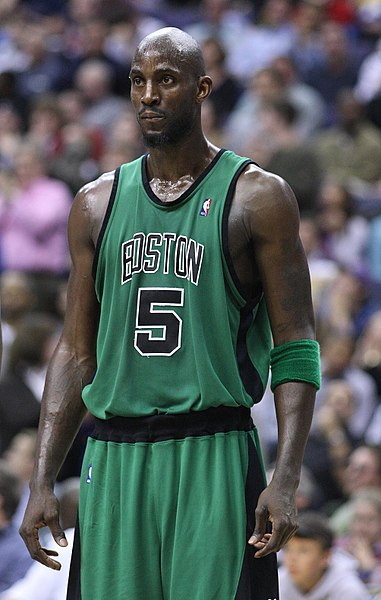
Switch on a Boston Celtic game now, and when you see Kevin Garnett struggling to pace up and down the basketball court, getting lost on the offensive end, and failing to match his outward intensity with efficient play, a new NBA fan may be fooled in believing that the thin 6’11” power forward could have ever been better than the 14 points and seven and a half rebounds per game he has averaged this season.
They couldn’t be more wrong.
Slowed by a right knee strain and nearly 34 years of his age, ‘KG’ has unfortunately become a mere shadow of the player that only two years ago was NBA’s Defensive Player of the Year, leading the Celtics to an NBA championship in the 2007-08 season. In 15 years in the league, he’s the same player that has averaged 19.9 points and 10.9 rebounds a game. He’s the same player that was the league’s Most Valuable Player (MVP) in the 2003-04 season, recording career highs in points (24.2), rebounds (13.9), blocks (2.2), getting 5 assists a game, and leading the league in rebounds. He’s the same player that has been named to every NBA all star game since his second season in the league.
Allow me to re-introduce to you one of the greatest basketball players of the past 15 years, and one of my personal favourites since I first started to watch the NBA: Kevin Garnett, or as he used to be called as a youngster straight out of high school, ‘Da Kid’.
KG is a Celtic now, but he has become to the Minnesota Timberwolves franchise what Michael Jordan is to the Chicago Bulls, what LeBron James is to the Cleveland Cavaliers, what Reggie Miller is to the Indiana Pacers, Gary Payton to the Seattle Supersonics, Dwyane Wade to the Miami Heat, Dominique Wilkins to the Atlanta Hawks, Allen Iverson to the Philadelphia 76ers, and Tim Duncan to the San Antonio Spurs. These players, at least in the contemporary age of basketball, are the faces of the franchise, the first face that pops up in your head when you think of these teams.
Garnett spent 12 long, hard, and exemplarily loyal years with the T-Wolves, taking a below average team to the playoffs for eight straight years from 1997-2004. And below average is right, for except for that successful 2003-04 season, the best players that Garnett played with for the rest of those eight years was Wally Szczerbiak. Wally friggin Szearayaerabziaakkk!!!
The 2003-04 season was wonder for KG, for the T-Wolves got the services of Latrell Sprewell and Sam Cassell, and besides winning the MVP with this great supporting crew, Garnett took the team to the Western Conference finals for the first time, only to lose out to the ‘Fantastic Four’ Lakers team (Payton, Kobe, Malone, Shaq).
Through these years, what Garnett’s incredible stats didn’t say became part of his credibility. He was one of the league’s most dominating defenders, and his presence in the paint was enough to change the entire attacking philosophy of the opposing team. He was also one of the most passionate players to ever hit a basketball court, wearing every single emotion on his sleeve, so much so that it was impossible to not love his style of play.
Garnett’s influence on the NBA has been massive, both on and off the court. Before star players like Kobe Bryant, Jermaine O’Neal, Tracy McGrady, Amar’’’e Stoudemire, LeBron James, and Dwight Howard did it, Garnett broke a 20 year mould and skipped college to go straight from High School to the pros. And he was a freak of nature – a player that is nearly the height of the centre but with the on the ball skills of a perimeter slasher. KG played between small forward and power forward for most of his career, completely changing the required skill-set of a big man in the league – thanks to Garnett, you could be big and handle the ball like a guard.
And there’s yet another reason why I have a special affinity towards Da Kid: In July 2006, as part of a now-struggling Timberwolves team and constantly bothered by trade rumours, KG came to India as part of a promotional tour for adidas. The tour stopped in several Indian cities, and you can read about it here on KG’s Asia tour blog.
What made this tour special was that, by sheer providence, I happened to be in New Delhi on the day that Garnett was invited to a high school in New Delhi to hand out trophies for a youth basketball tournament in the city. I didn’t miss the opportunity to sneak in and catch sight of him, as he towered over hundreds of admiring school kids and about two dozen personnel and security men.
As KG was ushered by his security out the school gym after the awards ceremony and towards his bus, I ran up near him to have this now legendary conversation!
Me: KG!! KG!! Hey KG, you should join the Knicks man! KG: [laughter]
Ya, that’s it. Then I took this photo
Almost exactly a year later, Garnett finally did get traded. Not to my hapless Knicks, but to the hapless Boston Celtics to suddenly reignite the fortunes of the legendary franchise. The Celtics were coming off another awful season, winning just 24 games and ending with the second worst record in the league. Even the Timberwolves won eight more games than them.
But this historic trade changed it all. After acquiring Ray Allen from the Sonics, Celtics then traded SIX players (SIX!) for Garnett. That is HALF THEIR ACTIVE ROSTER: Ryan Gomes, Gerald Green, Al Jefferson, Theo Ratliff, and Sebastian Telfair. Oh, and there was more, Celtics gave up a 2009 first round draft pick (top three protected) and a return of Minnesota's conditional first round draft pick, AND cash.
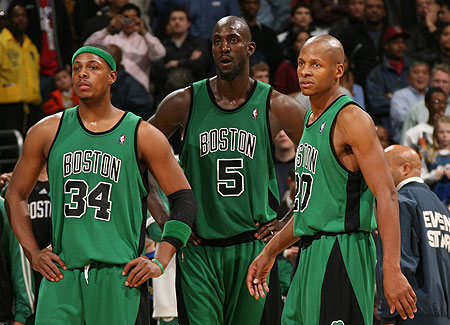
What happened the following season is stuff of folklore. KG joined Paul Pierce and Ray Allen in the Celtics to form a formidable ‘Big Three’, who went on to have the best record in the NBA with 66 wins, posting the best single-season turnaround in NBA history, improving by 42 wins from the previous season. Imagine that! The second-worst team gives up six players for one player, finds another sharp-shooter in Allen, and becomes the best team. It’s incredible.
Of course, this team went on to win the NBA finals against the Lakers, 4-2. After a 13 year hunt, KG’s dream of lifting the NBA trophy finally came true, and with it came what I believe is the most emotional moment in NBA basketball. Watch this video of Garnett’s post-game interview at the end of Game 6, right after the Celtics had blown out the Lakers to win the championship:
What is most amazing is how Garnett completely changed the basketball culture of Boston, getting the team and its fans used to winning again, becoming a top defensive team, and playing as an amazing well-oiled machine, so much so that the rest of the team played like him even when he wasn’t on the court. Garnett was the defensive player of the year that season. The league awarded the MVP to Kobe which seemed to me to be more like a lifetime achievement award, but it really should’ve gone to Garnett for being the single most valuable player in the whole league.
So it goes: it is now two years since that legendary season, and age seems to have finally caught up with KG (and the rest of the Celtics). Thanks mostly to Rajon Rondo and Ray Allen this season they are still one of the better teams in the Eastern Conference, but far from the untouchable world beaters that they looked merely two years ago. As of now, the Cavs seem to be the favourites to win the East, and teams like the Magic are looking formidable too. Out West, the Lakers, Nuggets, Mavericks, Jazz are all gunning for the title, and the Celtics have a lot of hard work to do to win another championship.
Da Kid is now an old man (well, in the pro-basketball sense, at least!) and is no more the game changer that he once used to be. He is still an elite talent, of course, but to lift his team to the top of the NBA summit again, KG has to rise to the occasion and prove that he still has what it takes to be amongst the world’s best. Rondo has been amazing this season, and Allen has found his brilliant shooting touch again. Pierce is great, but inconsistent. In the end, I believe it all rests on the Garnett’s broad shoulders.
But as KG himself proclaimed in that famous interview after winning his first championship: ANYTHING IS POSSIBLE!!!!
Good news... now, here's some relief for your typing fingers... Hoopistani is now available on hoopistani.com... saving you a whole NINE characters of that 'blogspot.' - nevertheless, anyone on hoopistani.blogspot.com will be pleasantly redirected to this new domain.
IMG-Reliance will also develop professional basketball and football leagues in India, nurture young talent at the academies, and train coaches in these sports as well.
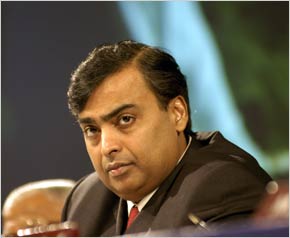
The new company, IMG Reliance, would set up sports facilities across the country to train athletes, thus developing the sports market. The model would be similar to the one followed in mature sports and entertainment markets such as the US. The companies plan to create and operate major sports and entertainment assets. Mukesh Ambani, chairman and managing director, Reliance Industries, said: "Development of sports and the sporting culture is a social imperative for India in the 21st century. World-class infrastructure, frugal engineering, technology and scientific coaching are an integral part of development of today's sporting talent globally."
Plans are underway to create an agency to offer 360-degree sports management to celebrities from the world of sports, Bollywood and fashion. IMG would transfer its existing business and assets in the country to the joint venture. These include the Aircel Chennai Open, the Association of Tennis Professionals World Tour event and Lakmé Fashion Week. However, the ongoing Indian Premier League would stay with IMG and the company's international business and executive team is to manage it. Ted Forstmann, chairman and CEO of IMG, said: "The performance of Indian athletes on the national and international stage will improve dramatically with the correct development strategies. As a consequence, the commercial performance of sport and entertainment in India will be enhanced."
To quote an article from the The Wall Street Journal, IMG owner Ted Forstmann said that "the venture's ambitions are to create something akin to England's Premier League, for which IMG produces and distributes television programming... People might laugh at that now, but let's see where we are in five years"
The real potential profits from the venture will come from the development of professional sports leagues. The IMG-Reliance venture will look to strike arrangements with India's soccer and basketball federations to help them build these leagues.
Wow. I don't mean neccessarily good wow or bad wow... Just.. Wow...
It's all really happening now isn't it? When the richest Indian company and one of the most succesful sports management companies from the USA get involved in helping to build facilities and a basketball league in India, you know it's more than just empty words.
I've always believed that India's sporting success has always come despite the government. Despite the public sector. So, while the BFI plans and contemplates and slowly trudges towards starting a pro basketball league in the country, here come Ambani and Forstmann with a lot more money and a lot more vampire fangs to suck into the growing Indian athletic juices. Their proposed basketball and football leagues will not be too different in terms of the commercial standpoint from Lalit Modi's IPL T-20 Cricket league. Purists may completely disregard what the IPL and T-20 have done to the game, but there is no denying that now being a professional cricketer is an exciting and possible option for a lot more Indians than before.
This could turn out well for basketball in India. Better facilities, better training, more money, more talent, better teams, more fans, more merchandise... More basketball.
On the other side, it could all go bonkers... If the soul of the game itself is disregarded. Money may be able to buy a lot of things, but it'll be interesting to see how they manage to buy fans for the game in India. It's not impossible, for basketball and football are very easily likable sports, and are already two of the fastest growing sports in the country. I just hope that, like T-20 threatened to butcher what purists called "real cricket", this league doesn't butcher the game of basketball itself.
This game goes down in basketball and NBA myth, spoken in reverence amongst hoops fans over the past 30 years. There has never been a single invidual performance in a basketball game like the one Earvin "Magic" Johnson produced on May 16, 1980. It was only Magic's rookie year, and he played his greatest game ever. The Lakers had league MVP Kareem Abdul-Jabbar, who had led them into the finals along with the help of Magic. In the finals, the Lakers faced off against the 76ers, led by 'Dr J.' Julius Erving and Darryl Dawkins.
Lakers took a 3-2 lead in the first five games of the NBA finals, but Kareem hurt his ankle in Game 5, and the series was returning to Philadelphia without him. It was at this point that the rookie Magic, a natural point guard, stepped up to start at Centre and play ALL FIVE POSITIONS in the game, finishing with 42 points, 15 rebounds, 7 assists, and 3 steals. The Lakers won the game 123-107 and became the 1979-80 NBA champions. Magic won the finals MVP, and proceeded to win four more NBA championships.
He's the first (and only) rookie to have won Finals MVP - Magic at 6'9" was a freak of nature, capable of doing things few others could. I was inspired to look up this video and write this article when I read the SLAM article "Which MJ was the Greatest?" by Vincent Thomas. Now, Thomas wasn't able to convince me that Magic was better than Michael, but he does put up a compelling argument. Magic to me was the second best basketball player of all time, and on that May night nearly 30 years ago, he put up a show that no one else could ever match.
I rate this game greater than Wilt's 100, Kobe's 81, Jordan's 63 against the Celtics, or any other performance ever. Not only was this the championship clinching game, Magic was also only a rookie, and did I say that he played FIVE positions?
What do you think this was the greatest individual performance ever?
Sport is supposed to be different. Sport is supposed to be a platform where a combination of talent, practice, and luck mesh together to create an alternative reality. In a vast and culturally dense country like India, the population is divided amongst millions of subgroups by state, language, caste, color, profession, and politics.
But sports, and in our case, basketball, is supposed to be different — when basketball players step on to the court, something in their nature changes. They are no longer the desk clerk, the IT technician, the law-student, the father of two, the Hindu, the Muslim, the Marxist, or the liberal. They become basketball players. All the other staples of community division go out the window — the rich man doesn’t always win, the darker one isn’t discriminated against, the educated holds no advantage over the illiterate.
Well, all that is supposed to happen, anyways.
There are not many who take the sport seriously in India, but for the small population who do, basketball is their lifeline, their way out of dreaded pigeonholing in everyday society, where a boy in the service class will take a government job just like his father and a girl — any girl — will be married off sooner than she can learn to pronounce “Independence”. This is obviously not the trend in the modern, urban, upper-class Indian society; but the majority of middle and lower class ball players prefer to live in the alternative reality where their jump shot is more valuable to the world than the caste they were born into.
For these serious ball players, the basketball court is held in reverence, respected like a temple, where all other realities become blurred away leaving room for something that puts them on a common playing field, something that is fair.
But what is the point of reverence when it is nothing but a farce? When games are played not to win but to pave way for the ‘natural order’ of sport in the country; when results are determined not by the team with the more talent but the team with the stronger voice?
Here is the latest example: Last month, the All India Inter University Basketball tournament, featuring the best college-level talent in the country, concluded in my hometown of Varanasi. Hosted by the Banaras Hindu University (BHU), this tournament featured the best four teams from each of the four zones in the country. 16 teams took part in this exciting competition, which featured two local teams in the final — the hosts BHU versus the Mahatma Gandhi Kashi Vidyapeeth (MGKV). BHU beat MGKV 63-56 to lift the trophy in front of their home fans, and thus became the best university basketball team in the country.
But the result is far from the complete truth. Players from visiting Delhi and Rajasthan universities alleged that they had to forfeit or lose their games over threats at gunpoint!
To everyone’s shock (or perhaps not), the entire starting five of the MGKV squad didn’t play a single minute in the tournament’s final against the BHU. These included 23-year-old Vikram ‘Dicky’ Parmar, the best player in the tournament, and one of the most talented young players in the country. The excuses for this ranged from “mild injuries” to “protecting the players from future injuries”.
Really? Why would you protect your players in the FINAL of the most important basketball tournament of their time in university?
The truth is this: It had been agreed from before that the MGKV coach would only play his reserves against BHU in the final, so that BHU could win their hometown tournament and BHU’s longtime revered coach KN Rai would be given a victorious retirement party.
The game itself exposed this charade further — after trailing for most of the three quarters, MGKV reserves actually made an amazing comeback in the fourth and took a one-point lead against BHU in the final two minutes. At this point, the MGKV coach had a word with his second squad, and subsequently, MGKV players practically gave up, loosening up their defense and standing around as the BHU scored freely to pick up a victory.
The most shocking fact about this farce isn’t that the above mentioned incidents took place; it is that everyone involved with the tournament and the teams taking part in the finals silently let it happen. The crowd, although uncomfortable with the happenings on court, simply sat back and watched. The media made a soft whimper about it on the following days, but the organizing associations turned a blind eye. Even the coaches and players of MGKV could only respond with a sigh, agreeing “these things just happen.”
They just happen. When I spoke to former UP player and Varanasi-based basketball coach Jitendar Kumar about this incident, his only response was that these things are “natural” in such tournaments — everyone from the referees, gun-toting bullies, and even opposing coaches and players get involved in making sure the home squads take the trophy. The teams agree to the result: That is what is supposed to happen because it always does.
Let me also add Varanasi has had a reputation of being uniquely illustrious in churning out national-level basketball talents. Unfortunately, this ancient city, also known for attracting pilgrims and tourists from around the world, happens to be in one of India’s major crime belts across Eastern Uttar Pradesh.
In the days following this story, I received a range of reactions from the fans. Subhash Mahajan, who is a basketball coach in rural parts of India, shared that he wasn’t surprised with the result, adding the sport is tainted on every district, state, or institution level in the country.
Players from the other teams who took part in the competition also complained of how the atrocities could take place under the nose of some of the event’s organizers. I can’t think of an apt NBA equivalent — how about Gilbert Arenas threatening the Lakers at gunpoint to lose the NBA Finals, right under David Stern’s eye. The gunpoint thing may not be completely unimaginable in Arenas’ case, although the thought of the Wizards in the Finals may be a bit too farfetched.
A reader of my blog, Vivek Taterway, once shared this tragic story: “My brother, who had mistakenly scored a goal at a University Football Tournament many summers ago at their rival’s home ground, barely escaped with his life. He actually ran off before the game ended! Today that event is recalled at family gatherings with loads of laughter but the irony cannot be missed.”
If the biggest university-level championship is treated under such conditions, we are doing nothing but corrupting the very core of what will shape our national sport teams in the future. What is the point of being true to basketball when those who run it won’t be true to you? If Indian authorities are really serious about promoting basketball as a major sport in India, it should first clean out such practices in all levels — a task much easier said than done, and for as long as our authorities remain corrupt, there is no chance of any serious attempt at this.
Basketball (and sport) is supposed to be an escape from the harsh realities from life’s other trends and professions, but we have unfortunately become used to accepting a corrupt system as the only reality. We need a united effort in the fans, players, and federation to fight against this. Let’s not convince our players to corrupt the one thing in life they love most: basketball.
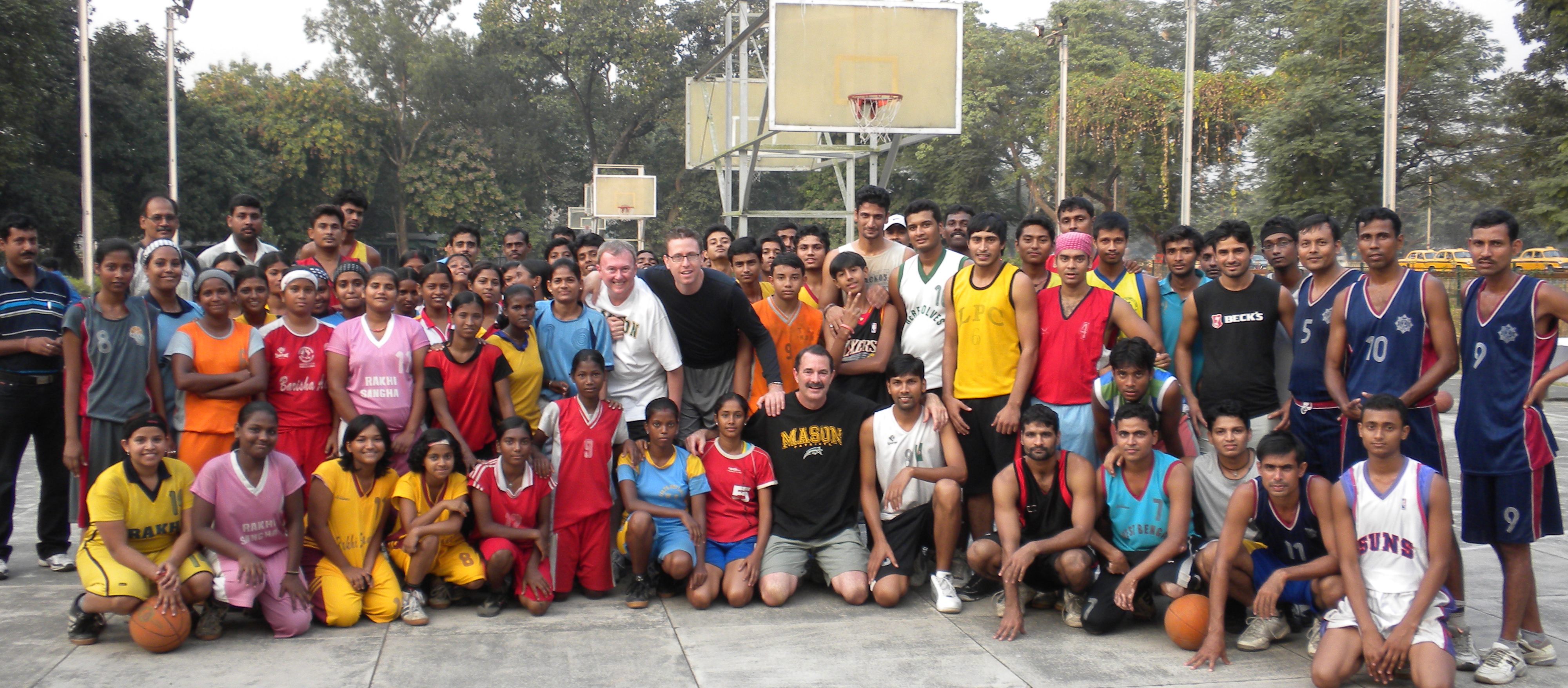
Additionally, jdBasketball will be partnered by the Centre of Sports Management of the George Mason University, where the basketball programme is overseen by assistant professor of sport management Craig Esherick (former assistant basketball coach and scout for the 1988 U.S. Men's Olympic basketball team).
These are the tentative plans for the tour:
Chennai: April 7-10, with the Sports Development Authority of Tamil Nadu. Bangalore: April 10-15, Men's National Team training. Mumbai: April 16-18, jdBasketball camp and clinic.
 Hey, I always knew the Spurs have an eye for great foreign players - Tony Parker, Manu Ginobili, and Tim Duncan isn't exactly American, either (Virgin Islands, actually). Looking for the next big thing by making contacts in India already?