Showing posts with label National Championship. Show all posts

October 3, 2014

Click 'n roll: Finding photographic bliss in Desi Basketball


If you were an attendee in any of the major national basketball championships across India, it's likely that you may have run across Cathy Scholl. And from Chennai and Mumbai to Ludhiana and Delhi, if you hadn't seen her in person, you would have surely found her online. You would've seen her wonderful photographs capturing an entire mosaic of emotions in Indian hoops in a single, static image. You would've been introduced to her work via social media. You would've seen banners of Indian players in actions at major stadiums in the country, and even if you didn't recognize the photographer, you would've surely known the photograph.


Since visiting and photographing the 2011 Indian national basketball championship in Chennai, Scholl has visited various hoops events across the country and introduced some much-needed professionalism and quality into the photography of the sport. Her work was also recently featured in TIME Magazine's photo-essay on the rise of Indian basketball. In India, Scholl's photographs have been used as banners at the Guru Nanak Stadium in Ludhiana to showcase the success of the Punjab home team. On social media, she continues to promote more of her work through her 'Desi Hoops' page, filling in a much-needed void of consistent photography work in the game.

Born in Wisconsin, USA, it was a strange and extraordinary journey that eventually landed the former talent manager to India. Scholl's passions for dance and music introduced her to Indian arts and culture, and it was her interest in Indian spirituality that served her first visit to the country. Inspired by HWL Poonja, Scholl visited India for the first time to Lucknow. And then, the visits never stopped, as for the next two decades she continued to take trips to India, usually staying at Ramana Maharshi's ashram in Tiruvannamalai. "Although I was sitting with eyes closed in mountain caves and meditation halls my childhood interest in photography was rekindled by the gorgeous colors of the women devotees' saris," she said.


India - with its myriad of colours, cultures, topographies, religions, and the diversity of people - is a photographer's paradise. But it took a different kind of inspiration for Scholl to zone in to the Indian basketball world. Back in California, she learnt about the story of the SEEDS Academy in Senegal, an institution to help the best young basketball players in the country. Scholl wanted to explore similar basketball programmes in India, and her research opened her doors to the JDBasketball Academy and a world of desi hoops through this Hoopistani blog. During a visit to an ashram in Tiruvannamalai, she decided to also head out to Chennai nearby to experience the Senior Nationals three years ago.

"When I walked into the stadium in Chennai I was instantly hooked," said Scholl, "I saw the passion of the players and the potential for growth of the sport. I love stories about globalization and cultural identity and this has both...an American sport mixed with the culture of India."

Ever since that first 'hook', Scholl hasn't let go, and basketball in India has taken her to several places and opened her eyes to many interesting experiences. Scholl particularly recalls her experiences of meeting and photographing the legendary coach S. Subramanian of the Ludhiana Basketball Academy not long before his death.


"I was happy to have met legendary coach Dr. S. Subramanian several times," she said, "In Ludhiana, I suggested we take a photo of him with all of his students, past and present. We were never able to get everyone together in one place but I was very happy to have photographed him with Satnam Singh Bharama and some of his (at the time current) students in Ludhiana."

Also in Ludhiana, Scholl recalled her surprise when she saw one of her Punjab championship photographs proudly displayed at the Guru Nanak Stadium in the city. "When I walked into the Stadium I was shocked to see my photograph from Chennai of the victorious Punjab team hanging as a giant banner next to photos of former champions. I immediately felt right at home with my picture hanging on the wall. It also confirmed that there was a need for my work and that I was helping to record Indian basketball history."

In her time, Scholl has been able to cultivate several close bonds with the basketball community in India, and says that her dream is to eventually use her background as a talent agent to get India's top players the representation they deserve, something that is sorely lacking in the nation right now. For the last few years, she has met several sports agents in India, and although none were representing basketball players, there were many who showed interest. Once the Indian professional basketball league begins, she believes that the opportunities for representation of Indian players will present themselves, and Scholl hopes to be involved in the process, too.


Indian basketball has grown steadily since Scholl first decided to explore it. Since then, there has been more professionalism in Indian national events, better results for the national teams, the launch of revamped school and college leagues, and the hopes of a future pro league. With a camera in her hand and with the hopes to catch the revolution one frame at a time, Scholl remains optimistic for the future.

"For the future, I feel a combination of excitement and frustration, just like everyone else," she said, "But I think that ultimately it will all happen... There will be a Professional league, an Indian NBA player, the level of play will rise, and many Indian players will be attending high school and college in America similar to my African friends. It's just a question of when. I hope it all happens sooner rather than later, especially so that the current players can receive some of the financial benefits that are sure to come."

"I hope to be there for all the exciting changes on the horizon," Scholl added, "I want to photograph the first game of the Pro League. I want to photograph the first Indian NBA player. I hope to see and photograph it all!"

All images above provided for this article are from Cathy Scholl's collection of Desi Hoops photography around India, used with her permission. You can check out more of her work on her website http://cathyscholl.com/ or her Facebook page Desi Hoops-Indian Basketball photography by Cathy Scholl.


July 18, 2014

Don't Call it a Comeback: Pratham Singh returned from injury to become one of India's heroes at Wuhan


No pressure. It was only the chance of leading India to their biggest win in history. It was only their first opportunity to ever defeat China, historically Asia's most successful team. It was only a chance to overturn years and even decades of Team India falling short of their potential, over and over again. So, yes, no pressure.

In the fourth quarter of what became a surprisingly closely-contested match-up, China made every attempt to avoid an astronomical upset. And for every question that China posed, India's 23-year-old Pratham Singh had an answer. Pratham hit three of the biggest shots of his career - clutch three-pointers - in the fourth quarter to give India the lead for good, and helped secure the win which will forever be remembered as the 'Wonder of Wuhan', of the first time India silenced the mighty Chinese on the basketball court.

And throughout this heroic, clutch performance, he remained calm. No over-reaction, no nervous breakdown, no shot taken too quickly or taken too slow. No pressure.

A few days later, when I asked Pratham Singh about his calm under the storm of that entertaining contest in Wuhan, China, at the 5th FIBA Asia Cup, he responded with humility, instead crediting the whole team for his individual performance.

"It's all about team defense," he said, "When the team is playing good defensively, and you're playing well defensively, too, then you automatically get confident and you feed off that good defense on the offensive end. The offense comes easy then. But if your defense lacks, then it gets in your head on the offensive end, too. Our team plays great defense, just as we did against China in those possessions."

Pratham talked about being lost in the moment of the game, when it's just him and the bucket, and him his job off the ball. His job was to stop China and his job was to hit those open shots. He did just that, and three after three after three, he was successful.

For Pratham Singh, each big moment now plays as the perfect balm to heal the missed opportunities of his past. One by one, each three he hit in the fourth quarter against China soothed the pains that he went through as a younger player, the pains that derailed his career and threatened to end a promising career before it could even take off.

Born in Amritsar, Punjab, but trained as a rising young talent at the Bhilai Steel Plant in Chhattisgarh, Pratham's performances caught the eye of the Indian Overseas Bank (IOB) in Chennai when he was just a teenager, They brought in the 6-3 sharp-shooter in to strengthen their wing position for the future. It was around the same time - in 2009 - that he moved up from India's junior squads to get a first senior team call-up. But Pratham's career paused before it could truly begin to ascent; a knee injury put him out of action for two years. For two years, basketball in IOB and internationally for India passed him by, and Pratham waited on the sidelines as it seemed to leave him behind.

An injury like this could've proven to be the end of an elite career for many players, but Pratham, gracious as ever, credited his IOB teammates for not letting him get down on himself.

"The team I got - IOB - were really good and supportive," he said, "So even when I wasn't playing, I wasn't disconnected from basketball. The senior players like S. Robinson and others who played for Team India really supported me and kept encouraging me. They told me that all players suffer through injuries, but it's only the ones who come back strong that become really great. Slowly I started coming back to practice and made a comeback."

The comeback, so far, has been electrifying. Once Pratham got his strength and explosiveness back, he became a can't-miss player - literally and figuratively speaking - for club, state, and country. He took a bigger role at IOB as the likes of Robinson made way for a younger generation, he helped Tamil Nadu - the state whom he represents now - reach the top by winning this year's Senior National Championship, and, most importantly, he found himself back in Team India colours - this time for good.

While the injury stole two years of basketball away from Pratham, he looked back at it now as a great learning experience, and his comeback for Team India has been all the better for it. "I was inexperienced as a Junior," he said, "But playing with and spending time with players like Robinson in IOB, I learnt a lot more about the game, I became stronger, and all of that helped me when I returned."

Since last year, Pratham has become an indispensable part of India's rotation. He made his national comeback by playing for India's 3x3 side at the FIBA Asia 3x3 Championship in Qatar. He was picked by Scott Flemming for the FIBA Asia Championship team, the Lusofonia Games, the SABA Qualifiers, and now, here at the FIBA Asia Cup. He is a regular starter for India, and for his clutch antics, a regular finisher in close games, too.

Pratham's rise has come parallel to the team's surprising rise as well. "In the last FIBA Asia Championship, we were losing to these same teams very badly in all our games," he said, "For this tournament, we didn't get an exposure trip before we started, and if we had, we would've done better against Japan in the first game. Of course, then the best thing happened and we beat China - after that our confidence level went up. Before we used to look at Iran, and think within ourselves that they're a really good team. We used to fear them. Now, we think of them, like, 'Okay, it's Iran, but we can play them well.' Teams like Iran and Philippines used to big us big. We've turned things around now."

"Our confidence level after this tournament has gone really high," he repeated, "And the coaches feel that this team can do well. Our players have improved, specially defensively. At the last Asia Championship, we played scared. Now, we know that if we practice hard in the future, we can do better."

The confidence in Pratham individually seems to be at an all-time high too, despite the fact that India followed their wins against China and Indonesia with three losses at the hands of Iran, Philippines, and Jordan. Despite the losses, the team left a strong impression and turned some heads. India's next big challenge after Wuhan will be an invitational basketball tournament in Dubai, and after that, they will likely head to Incheon, Korea, for the Asian Games in mid-September.

"My dream is that India plays well at the FIBA Asia Championship," he said, "This time we nearly did it, but missed. It was a great chance to make semi-finals but we lost by just 4 points. Next time, we'll try in Dubai tournament to reach semis or finals. And then continue good work in Asian Games as well."

These are bold ambitions from a player who represents a team that has rarely cracked the top four of Asia's best. But India's new crop of players - among whom Pratham Singh is their clutch, cool three-point threat - now have the conviction to look any opponent in the eye and believe that they could be taken down. After beating China, Pratham Singh and India have the conviction to make history again.

So yes, no pressure.

May 9, 2014

ONGC basketball team shifts base from Dehradun to Chennai, strengthen Tamil Nadu squad


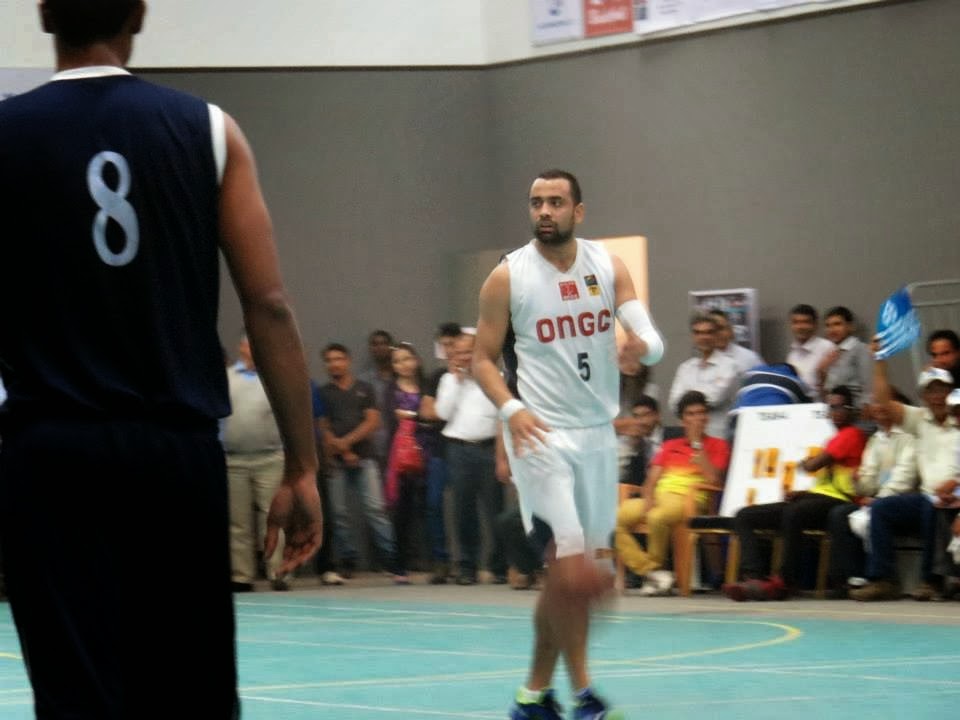
When two of the finest teams in the country face each other, fans expect fireworks. But when the two teams merge into one, it calls for doomsday for every other opponent in the nation. This is exactly what may happen in the foreseeable future for Indian basketball. Tamil Nadu were already the hottest team in Indian hoops after they won the Men's gold medal at the National Championship in Delhi back in March. Now, one of the most talented clubs in India - ONGC - has announced that it will be shifting base from Dehradun to Chennai, which means that Tamil Nadu will be boosted with all the ONGC players who had been representing the state of Uttarakhand until now.

Photo Courtesy: Ekalavyas.com
The Oil and Natural Gas Corporation - or ONGC - employ some of India's top players including present and former internationals such as Vishesh Bhriguvanshi, Amrit Pal Singh, Yadwinder Singh, Trideep Rai, Murali Krishna and many more. ONGC have won most of the Men's titles in most All India invitational tournaments in recent years and their stars helped guide Uttarakhand to the 2013 National Championship gold, too. Earlier this year, Uttarakhand finished fourth in the Senior Nationals, while Tamil Nadu took home the gold.

The Asian Age recently reported that ONGC - the 2014 Federation Cup champions - will be shifting both their strong basketball and volleyball teams to Chennai, bolstering the national champion Tamil Nadu sides in both squads. According to the report, the players have been ordered to report at the Chennai office on June 13.

Although no players have appeared on record, the report - written by C. Santhosh Kumar - quoted a key member of the ONGC basketball squad who said, "The [ONGC] management always wanted better exposure [for] its team and I reckon it's the reason behind shifting base to Chennai, where basketball and volleyball are more vibrant than Dehradun. Even though talks started a year ago, receiving the order on Tuesday evening was a big surprise."

Tamil Nadu's basketball fraternity will be glad to be spoiled for choice now in choosing their Men's state teams, and it should make for some healthy competition. Currently, the Indian Overseas Bank (IOB) is the only public sector company in Chennai that regularly recruits players. IOB have done fairly well on the national stage, though, and many of their players were in TN's national winning side. Stars like Rikin Pethani, Pratham Singh, SP Venkatesh, and more will be contending for their spots for Tamil Nadu after their recent successes.

"I understand that the ONGC board has approved the change of base," said L. Suren, Treasurer of the Tamil Nadu Basketball Association (TNBA), "If they come to Chennai, it will create more job opportunities for Tamil Nadu players and help develop the sport here."

But how soon could ONGC players start suiting up for Tamil Nadu? Rules state that a player must reside in a state for at least six months before being eligible to represent it. Suren added that, "in this case, apart from the residential status, the Basketball Federation of India (BFI) can decide straightaway because the entire team will be moving from one place to another."

But not everyone is happy about this move. In a report published on The Hindu today, some of ONGC's basketball players have expressed disappointment over the move from Dehradun to Chennai.

Via The Hindu

Speaking to The Hindu on Thursday, V.K. Mahendru, Head, Corporate Sports (New Delhi) said: “As far as volleyball is concerned we are hopeful that it will be in Chennai, but when it comes to basketball, we are yet to make a call. The final decision will be taken within 10-15 days. Whatever we do, we will do it in the best interest of the team.”
A senior basketball player said most of the players were not happy with the move.
He argued that, with Chennai being home to good teams such as IOB, ICF, Customs and Indian Bank, not many ONGC players will get the chance to represent Tamil Nadu.
“We have two cement courts in our residential colony (in Dehradun). Where will we now practice in Chennai? And the weather too is hot,” he said.
Another player said: “They’ve decided. We have no choice. We have got the orders to join duty in Chennai on June 13 after playing in an all-India tournament in Hyderabad.”
He said the Tamil Nadu team selection will now be tougher with so many good hoopsters.
“While Tamil Nadu basketball team will be very strong, other teams will not be so.”

You can only have 12 players in a team, and the presence of ONGC players fighting for their spot against other IOB/Tamil Nadu players should make for some fascinating competition in the state. Star players will be snubbed, but overall, it could make for one hell of a roster top to bottom for TN. They will become the Indian hoops version of a 'super-team'; and the pressure will be on rivals from Punjab, Services, or Indian Railways to step up a gear. The losers of his move will unfortunately be Uttarakhand, who will be left with little without the ONGC talent and could experience a major drop in national rankings next year.

March 13, 2012

India’s strongest basketball teams in Kochi for Federation Cup starting tomorrow


India’s best basketball clubs/units (in the Men’s section) and state teams (from the Women’s division) are set to compete in the 26th Federation Cup National Basketball Championship for Men & Women, starting on Wednesday March 14th at the Rajiv Gandhi Indoor Stadium in Kochi (Kerala). The tournament will conclude with the Finals on March 18th.

Click here for full story

December 5, 2011

Ajay Pratap Singh: The Future is here, now


On this basketball court, even when he is surrounded by other players of his age and his talent level, Chhattisgarh's 17-year-old phenom Ajay Pratap Singh - or 'APS' as his friends call him - manages to stand out. Even those in the audience unfamiliar with his young, yet experienced career, can tell that he is primed for big things. More than anyone else, Ajay moves like a basketball player.

The court was the indoor facility at the Sri Ram College of Commerce (SRCC) in New Delhi. The event was the BFI's Junior Basketball Expo, a showcase of the best under-18 basketball players in the country. In the audience were over a 100 Delhi high-schoolers and aspiring basketball players watching every move of Ajay and his fellow compatriots. The ringmaster is Kenny Natt, a former NBA Head Coach and now the Head Coach of India's Senior Men's team, who has organised this showcase to scout for the next generation of Indian stars who will take the mantle in the national team.

Each of the 26 players on the court and on the bench of the U18 All Star Game have made a name for themselves as junior basketball stars. Still, the crowd, and especially those who know of Ajay's capabilities, keep waiting for him to stand out, to do things that separate him from the rest, that make him special. But for the majority of the All Star Game, Ajay keeps us waiting.

But let's rewind this story back to the very beginning. How does the son of a Billai Steel Plant employee in Chhattisgarh, who hadn't picked up a basketball until he was 11-years-old, become one of India's most prodigious young talents six years later?

I'll let Ajay explain it himself: "It all started with a summer camp," he says, "I was 11-years-old and a friend of my father was a basketball coach, who encouraged me to try out basketball at the camp. Normally, players who are new to the game are encouraged only because of their height, but back then, I was no taller than the average kid of my age. At first, basketball was just 'time pass' for me at the camp, but when I returned, I realised that I had actually become very interested in the game, and so I continued playing."

Ajay says that is first coach was RS Gour in Billai, who was always backing the youngster to keep playing and keep improving his skills. Luckily for the youngster, his love for the game developed parallel to the golden period in Chhattisgarh's basketball history - a period that is continuing full-fledged even today - where good management and better coaching helped mould numerous stars to make a mark in the national and international level from the state. Ajay had no shortage of role models.

"I looked up to a lot of senior players from my area," said Ajay, "I saw what they did on court, I saw what they achieved, and I wanted tot he same. There was a senior at that time, Pratam Singh, who had been a star for Chhattisgarh and had even represented India. I wanted to follow in his footsteps."

A few years later, and it seems that Ajay has done well in following the course set by his idols, and then some more. For he didn't just follow the footsteps, he glided over some of them: at the SRCC court during the Junior Expo, Ajay gives a few glimpses of his amazing athleticism, all during practice time before the All Star Game. While other players touched the ball off the glass for neat basket during the lay-up lines, Ajay is one of the few who is intent to punish the rim with an electrifying dunk at each opportunity. I have seen this all before: he is one of the few junior players in India with both the audacity and the actual talent to ignite the crowds with regular in-game dunks. The crowd at SRCC move closer to the edges of their seats when the All Star Game begins, expecting fireworks from this athletic youngster. But Ajay keeps them all at bay...

Back to our story, though, and we find a 13-year-old about to make his first breakthrough at a national-level competition. Ajay played in his first Sub-Junior National Basketball Championship in his hometown of Billai back in 2007. His team had to settle for a third-place finish, but Ajay remembers this as the first time in his career when he began to develop real confidence in his abilities.

"I was a little scared at first at such a big occasion," he says, "But I was given ample chance to play, even though I was younger than most in the squad."

"Back then, I played more of the guard position, because I was a little shorter," Ajay adds, "This helped me improved my ball-handling, and now that I've grown taller, I can be a mismatch at the guard position because of my height."

Like many before him to have made the breakthrough in Indian Basketball, the accolades, success, and higher levels of competition began to follow thick and fast. Ajay kept playing, kept performing, until the day he first wore an 'India' jersey: his big break came with India's Youth (U16) team that was sent to the U16 FIBA Asia Championship in Malaysia in 2009.

"It felt very good to be playing for your country," he remembers, "Despite our final finish (13th place), we played very well. It was the first time that a Youth Asia championship for being held, so it was a new experience for us all."

In October 2011, Ajay would head out for the U16 FIBA Asia Championship again - this one in Nha Trang City in Vietnam - and it would be his most recent performance for India that would help further distinguish him from the rest.

The All Star Game begins at the Junior Expo. Ajay has been placed in a far better team of the U18s: he is part of 'Team Red', which include other rising players like Loveneet Singh, G Sivabalan, and Aravind A. Known for his prolific scoring ability, Ajay instead takes a back-seat to his talented teammates, choosing instead to focus on his other strong-point: play-making. With Ajay and Loveneet running the motor of this squad and Aravind finishing any and everything around the basket, Team Red take a 13 point lead over 'Team White' with less than four minutes left in the game. For Ajay, it seeded to be a routine, if relaxed, victory on the cards.

He has played the play-maker role brilliantly before, of course, but what makes him special is his ability to switch seamlessly became shot creator and shot finisher. In the most recent Junior National Championship in New Delhi, Ajay was perhaps the top individual player in the Men's section. He laid out his full arsenal for Chhattisgarh, which includes an above-average three-point range, blinding quickness with the dribble, an ability (and the will) to regularly attack the basket, a long wingspan to disrupt the other team's offense on the defensive end, and crystal clear floor vision to always keep an eye on other teammates.

Ajay carried this momentum with him to the 2nd U16 FIBA Asia Championship in Vietnam. In a talented team with other gifted players such as Satnam Singh Bhamara, Loveneet Singh, Rakesh Sangwan, and Karthickeyen Saminathan, Ajay was the crucial cog in the middle, running the team as its most experienced and consistent player. India surprised a few traditional heavyweights with Ajay contributing with scoring and assists. He had 17 points in a win over Malaysia and 25 big ones in India's surprise victory over Chinese Taipei. India didn't do too well in the Second Round of the tournament, but Ajay had another 20 point game against hosts Vietnam in a classification match. India finished the tournament at 10th place.

Ajay ended the tournament as India's second leading scorer (13.1 ppg) behind Satnam Singh, but he also made a name for himself in the assists department, averaging the highest numbers of assists per game (4.0 apg) of all players in the tournament!

"I'm very proud of what we accomplished in Vietnam," Ajay said after the tournament, "We were a very well-coached team, and were well prepared this time. The federation gave us good support to work hard and practice for months for this championship in Delhi before we headed out there."

"We made a few mistakes in the Second Round against Korea and Iraq, two close losses that prevented us from qualifying for the Quarter-Finals," Ajay added, "We really could have won those games: our team was very united, and it felt good to play together in such a strong system."

Ajay named his big performance in the group stage against Chinese Taipei as the high-point for him individually as well as team-wise (India won the game by 21 points), but he took heart even in India's losses against Korea and Iraq. "We worked hard on our team defense for those games. Our coaches were always defensive minded. For whatever I achieved on the offensive end, I feel I did more on defense, since I had more experience than the other players there."

Back in SRCC, and it seems that Ajay's defensive intensity from the FIBA championship could be sorely needed. 'Team Red' start to get careless in the game's last few minutes, and 'Team White' begin to script an epic comeback. Careless turnovers by the Reds and determined play by the Whites suddenly turns this into a six point, then a four point, and then a two point game. Team White go on a dramatic 17-2 run, and with only seven seconds left in the game now, find themselves ahead, 54-52. The game's momentum has been abruptly shifted, and Team Red have only one last chance for an answer.

My eyes were on Team Red, and on the young boy from Chhattisgarh. I had the unfair advantage of knowing enough about him that I was convinced that he would deliver. A few weeks ago, Chhattisgarh Basketball's secretary and legendary coach Rajesh Patel had marveled about the youngsters abilities, especially in crunch situations.

Here was Patel's scouting report: "Ajay plays well in big games. He's left-handed, but can finish with the right, tall, and has a very accomplished all-round game. He has good ball control, good three-point range, and good driving and rebounding ability. Ajay is a prolific scorer, but more than that, he is confident and mature for his age."

And Ajay himself had shown little doubt about his abilities, in the present or the future. He may have been in an All Star Game in Delhi, but a part of his mind may have already been plotting ahead to Chennai, where next month, the Senior National Basketball Championship is set to be held. It will be Ajay's third Senior tournament, and he will be amongst a talented group of Chhattigarh players like Ankit Panigrahi and Kiran Pal Singh as they attempt to improve on last year's seventh place finish.

And maybe a part of his mind is looking even beyond, at India's Senior National team, which will is coached by the experienced and influential Kenny Natt. "I dream of playing for India at the Senior level," Ajay says, "I was called for the Senior camp earlier this year before the FIBA Asia Senior Championship in China but I wasn't selected then. But I have a chance to make it in the future team, though, I know Coach Natt needs a shooting guard. I'll be working hard to prepare myself for this role."

Coach Natt is of course in attendance at the SRCC All Star Game, and has seen Team Red just give up their double digit lead in a matter of minutes. With seven seconds left in the game and his team trailing by two points, the ball is inbounded to Ajay Pratap Singh.

Seven seconds can be a long time in basketball, and an even longer time when, in a matter of seconds, hundreds of different elements of the same story come together. In the seven seconds, Ajay used his quick dribble and strength, honed from his childhood days, to attack the opposing team's basket. In those seven seconds, he uses his years of experience at the international and national level to catch his defender off guard. In those seconds, the player who had been passive all game suddenly moves like an aggressive scorer towards the basket. He dribbles with his left, but elevates with the ball in his right hand. He's fouled on his way up to the rim, and in the same movement he finishes the tough lay-up. Game tied at 54. One second to go. The foul gets Ajay to the free-throw line for one last shot.

Patel's prediction proves right. With a relaxed head on his shoulders, Ajay calmly sinks the free-throw. 55-54. The last second wasn't enough for Team White to get a good shot off. Game over. Team Red win.

The crowd erupts and the teammates from the bench rush the court to celebrate with Ajay. It's a brief, relatively minor successful moment in a young career of many other successes. But Ajay Pratap Singh is not defined by what he has done already: he will be defined by what he will do in the future. And he isn't looking too far ahead to stake his claim and show that he belongs amongst the best players in the country: for Ajay Pratap Singh, is future is already here, now.