Showing posts with label FIBA Asia Championship. Show all posts

April 26, 2019

Abbas Moontasir: Hoopistani Indian Basketball Hall of Fame


Even today, decades after he took his official final shot from the game, the legend of Abbas Moontasir rings loud around his neighbourhood in Nagpada, around Mumbai, and across the nation. The feisty guard who picked up the game in some of Mumbai's roughest bastis went on to become a legend for the game, captaining the Indian national team, starring at the international stage in the 1960s-70s, and winning the coveted Arjuna Award. He is the newest addition to the Hoopistani Indian Basketball Hall of Fame.

Born in Mumbai in 1942, Moontasir picked up basketball from American missionaries in the Nagpada area, in what is now known as the iconic Late Bachookhan Municipal Playground. He played for Bombay University, Maharashtra state, and then reached his peak with Western Railways. His international debut also came in his hometown against an Australian side in 1960. Moontasir captained Team India in two FIBA Asia Championships, in 1969 and 1975, and was also the member of the Indian team that participated in the 1970 Asian Games in Bangkok. He took part in the 10th Anniversary confederation Tournament in Manila and was chosen for the Asian All-Star team in 1970.

The same year, Moontasir was given the rare distinction of the Arjuna Award in basketball. He went on to play for the country and for Railways (despite a few years lost in between to suspension) until 1986, when he retired at age 44.

Off the court, Moontasir authored a book called 'Principles of Basketball' and, like every well-known Mumbaikar, flirted with Bollywood in two films: Khoon Ki Takkar (1981) and Aashiana (1986). Now 77, he continues to be a guiding force in Nagpada and for basketball in Mumbai.

Click here for more of the Indian Basketball Hall of Fame.

July 9, 2016

Olympic Dreams


Indian Basketball’s Olympic Dream: A step-by-step guide.

This article was first published in my column for Ekalavyas.com on June 29, 2016. Click here to read the original feature.


The photographs of the past – black-and-white, sepia, unfocused, and unclear – tell stories of a million words. Brown-skinned players in tight basketball vests, some wearing turbans, spread across a basketball court, playing with the words भारत (Bharat) in the Devanagari script adorned across their backs. They were making history. For the first and only time ever, an Indian Basketball team had played at the Summer Olympics.

In the 1980 Summer Olympics in Moscow (Russia), India’s Basketball team lost every game they played by a huge margin, finished 0-7, and at last place out of the twelve participating teams. And yet, the achievements of Ajmer Singh, Paramjit Singh, Radhey Shyam, and more left an indelible mark on the game. India had played at the biggest stage in international basketball. The future of the sport for the young country seemed to be in good hands.

Alas, that future has been mostly downhill since then. In the 36 years since Moscow, Indian Basketball hasn’t even sniffed the success they enjoyed in the 70s and 80s. India has generally struggled at the FIBA Asia Basketball Championship (ABC) stage, and without continental success, failed to qualify for the FIBA World Cup or make the exclusive club of Olympic teams. Despite brief respites such as the victory over China in the 2014 FIBA Asia Cup, both Men and Women’s squads have a long way to go before they can truly contend against the highest level.

But with 2016 Rio Olympics nearing and the Indian contingent in other sports gearing up to bring back some medals to the country, I couldn’t help but get caught up in the Olympic fever, too. Here’s a step-by-step breakdown of how India made it to the Olympics in 1980, how our Men’s and Women’s squads can improve to contend for a future Olympic spot (2024), and the qualification process to make the dream come true.

So, how exactly did we get there in 1980?

The 1980 Olympics will probably be remembered as one of the most controversially staged events in post-World War history, and I recalled Indian Basketball’s 1980 presence at the Moscow Olympics in comprehensive detail for SportsKeeda four years ago.

It took a topsy-turvy chain of events – both political and athletic – that eventually landed India among the final twelve Men’s basketball teams in Moscow. In 1979, the Soviet Union began their military invasion of Afghanistan. In retaliation, the United States decided to boycott the 1980 Summer Olympics in the Soviet capital of Moscow and withdraw their athletes. Soon, more nations aligned with the USA’s stance withdrew from the Olympics as well.

There was one spot for Asian teams at the tournament, and China – winners of the 1979 FIBA ABC – had withdrawn after the USA. And then, the second, third, and fourth placed countries from the 1979 ABC – Japan, South Korea, and Philippines – withdrew from the Olympics, too. This left the Asian Olympic spot free for the lucky fifth place finishers. Which was… India!

India found themselves among Soviet Union, Yugoslavia, Italy, Poland, Australia, Spain, Brazil, Cuba, Czechoslovakia, Sweden, and Senegal at the Olympics Men’s Basketball Tournament. Team India comprised of captain Paramjit Singh, 6’5” superstar Ajmer Singh, talented forward Shyam Radhey, Amarnath Nagarajan, Baldev Singh, Hanuman Rathore, Diniar Parvez Irani, Tarlok Singh Sandhu, Paramdip Singh, Dilip Gurumurthy, Jorawar Singh, and Harbhajan Singh. India lost every game, which was definitely a disappointment, but nevertheless, the twelve men who represented the country in Moscow were immortalised forever.

After another fifth place finish at the 1981 FIBA ABC, India never reached the top five in Asia again. The Women’s team only made it to the top five of the Women’s ABC in 2013. Neither have ever been close enough to qualify for the twelve-team Olympic contingent.

How can we contend again?

The next few paragraphs are mostly speculative, utopian fiction. A lot easier said than done.

To qualify for the Olympics, India’s Men’s and Women’s teams need to first be good enough to challenge the best in Asia. For the 2016 Olympics, only one Asian team of each gender – the ABC winner – was guaranteed a spot; the rest of the top four (Men) and top three (Women) booked their place in FIBAOQT and had to qualify from there. India will need to contend with the likes of China, Iran, Japan, Philippines, South Korea, etc.

The first step towards this drastic improvement will be to fix the issues plaguing Indian basketball at its leadership level. Due to the chaos caused by warring factions and subsequent inaction by the Ministry of Sports, the Basketball Federation of India (BFI) is de-recognised, crippling the development of the sport to its full potential. Only once the BFI can come to a peaceful resolution will it encourage confidence among investors like IMG-Reliance to provide funding into Indian basketball, funding that will help grow the game at the grassroots, attract expert coaches, improve infrastructure, and encourage young players to invest their careers in basketball.


India needs great coaches like Scott Flemming and Francisco Garcia, our former Men’s and Women’s national coaches, and we need these coaches long-term to set-up a system and inspire a generation of young coaches to train other coaches and players around the country.

We need a professional basketball league, one that provides our players with round-the-year basketball opportunity, keeps them in shape, and creates a more professional and disciplined environment. It will incentivise more Indian players to take basketball seriously as a career.

While some grassroots academies are already functioning well around the country, more effort should be put into discovering and honing talent from a younger age in big cities, small towns, and even villages, to make basketball more accessible. Schools in India already have the potential. Once the coaching and scouting improves, more talents will develop in Punjab, Uttar Pradesh, Tamil Nadu, Kerala, Karnataka, Haryana, Assam, West Bengal, etc. This will deepen India’s talent pool and inevitably benefit the national teams.

One of the biggest complaints of past Indian coaches and current/past players is that India rarely gets enough exposure or practice games before big international tournaments. Our federation needs to invest in ensuring that our national team players play in more international matches against a variety of opponents. The new FIBA calendar will ensure a longer qualification period with more games after 2017, but India needs to be better prepared and organized to take part in other international contests, too. Big game experience against great teams will make our own players better.

Finally, all of this coaching, grassroots preparation, and improved infrastructure should result in some top-heavy star power for the national team. Players like Satnam Singh, Amrit Pal Singh, Amjyot Singh, and Palpreet Singh are already taking their skills internationally. With our bigs on a steady road to improvement, the men’s squad will need to develop better perimeter talents like Vishesh Bhriguvanshi and floor generals on the point guard position.

The women’s squad lost its greatest-ever talent Geethu Anna Jose to a self-imposed exile from the game, but there are some young up and comers like Jeena PS, Poojamol, and Poonam Chaturvedi to carry the mantle forward. While the men need help in the perimeter position, the women could definitely do with some size and physicality to hold strong against some of Asia’s best bigs.

Now that we’re in contention, how do we qualify for the Olympics?

Even in our entirely hypothetical scenario, let’s be semi-realistic, and imagine that India can achieve all of the above in about five years (Summer 2021). Cool. Now we have a team that can contend against the best in the continent. So, what do we have to do to qualify for the Summer 2024 Olympics?

We’ll have to qualify for the 2023 FIBA World Cup first. The FIBA Calendar, as I mentioned previously, is going to change from 2017. Teams from Oceania (Australia, New Zealand) will now play in the Asian qualifiers pool. Currently, India’s FIBA Asia ranking is 10th for Men and 5th for Women. Adding Oceania teams will push both down a couple of spots. This will still keep us in the higher level Group A of the World Cup qualifiers (top sixteen). These qualifiers will be held from November 2021 to February 2023 over the course of several international windows in home and away games. India will have to finish in the top seven to qualify for the World Cup, which means challenging Australia, China, Iran, New Zealand, Philippines, Jordan, and Korea.

If India is successful, we will play among the 32 teams at the 2023 FIBA World Cup. Seven of these teams will then qualify for the 2024 Olympics, and for India to be among them, our only hope is to finish among the top three Asian squads. Finishing as the best Asian team is an automatic Olympic qualification. Finishing second or third will direct India to the eight-team FIBAOQT in 2024; four of these eight teams will qualify for the 2024 Olympics.

Remember, India is already in the top twelve of the Asia/Oceania combination. We have five to six years to improve to get into the top seven and make the World Cup. There, we have to finish in the top three of only the Asian teams (excluding Oceania) to have a shot at the Olympics.

The final twelve-team Olympic field in 2024 will be: top seven teams from World Cup (two from Americas, two from Europe, one each from Africa, Asia, and Oceania), one host, and four teams from the FIBAOQT.

Got all that? In our dream scenario, India is among those twelve. And the real “acche din” have begun.

We’ve made it! Now what?

Making the Olympics is a herculean task, because there are a hundred teams around the world who will look at the qualifying structure and believe that they can perform miracles and make it, too. India’s Men currently rank 53rd in the World and the Women rank 40th. To break into the top twelve for the Olympic stage will require intense amount of preparation and a lot of good fortune. We cannot count on a 1980-type political situation to gift us a spot again: this time, we’ll have to earn it.

The task isn’t impossible, it’s just highly improbable. But what if we make it? What if it’s India facing up against the best in the world, including Spain, Lithuania, Argentina, France, and of course, the mighty United States, featuring whoever NBA stars are running the league at that point (Karl Towns will probably be the centrepiece)?

India will have a shot at glory. Every half-decent performance will reverberate exponentially back home. Proud fans will cheer on the ‘Young Cagers’. Our best players will become sporting icons.

It’s mostly a dream, but India has the world’s largest youth population. Professional interest into the sport could open the floodgates for another golden age of basketball in the near future. Hopefully, there will come a day when desi accents infiltrate into the international hoops world and we can bust out those amazing भारत jerseys again!


August 15, 2015

Milestones in Indian Basketball (2015 Update!)


It's India's 69th Independence Day today, it's the day where we celebrate the anniversary of when that the fruits of the labours of our founding fathers - Gandhi, Nehru, Bose, Bhagat Singh, Azad, and so many more - came to realization. It's the day that India began its tryst with destiny.

Since 'Hoopistani' is the self-proclaimed holy-scripture of Indian Basketball, it is a must that this blog should celebrate Indian Independence Day in a special manner, too. Earlier this week, the Hoopdarshan podcast - hosted by myself and Kaushik Lakshman - released a special Independence Day episode, where we gave listeners a lesson in Indian basketball history, capturing its greatest moments and highest achievers. We also spoke to India's former Women's NT captain Prashanti Singh. The podcast was a retelling of an article I wrote on this blog over five years ago, listing the greatest milestones and individual award winners in Indian basketball.

Since then, history has come closer to fans of Indian hoops, with steady development in the sport racking up new milestones at an accelerating level. With the most current state of the game in mind, here is the 2015 update. Of course, with 85 years of hoops history in the country, not every major moment can be captured. These are the highest of the highlights; feel free to suggest any other major milestones that should be considered in the comments section below.

Arjuna Award winners
  • 1961: Sarabjit Singh
  • 1967: Khushi Ram
  • 1968: Gurdial Singh
  • 1969: Hav. Hari Dutt
  • 1970: Gulam Abbas Moontasir
  • 1971: Man Mohan Singh
  • 1973: SK Kataria
  • 1974: AK Punj
  • 1975: Hanuman Singh
  • 1977-78: T. Vijayaragavan
  • 1979-80: Om Prakash
  • 1982: Ajmer Singh
  • 1991: Radhey Shyam
  • 1991: Suman Sharma
  • 1999: Sajjan Singh Cheema
  • 2001: Parminder Singh
  • 2003: Satya (Sports)
  • 2014: Geethu Anna Jose
Dhyan Chand Award winners
  • 2002: Aparna Ghosh
  • 2003: Ram Kumar

Indian basketball has come a long way from the time the first ball was bounced somewhere in the middle of Punjab to the same state producing India's first NBA draftee, 85 years later. Through the years, we have seen 17 players and two coaches receive Arjuna and Dhyan Chand honours respectively, played basketball in the Summer Olympics, hosted several major international basketball competitions, and shocked heavyweights China in a legendary victory. Despite its growth, the sport still feels like it is in its infancy in India; considering India's massive population and growing economic status of the middle class, we have sold much short of our true potential.

Hopefully, the future will be much brighter than the past. The Indian basketball family will be looking forward to a major professional basketball league, more young players following Satnam's footsteps into the NBA, and further international success by our national teams. For the present, however, let's celebrate our favourite sport in our favourite country and go out to shoot some hoops!

August 13, 2015

Indian basketball legend - the late Khushi Ram - immortalized with statue in Haryana village


During his prime, Khushi Ram always found a way atop the basketball score card, dominating Asian tournaments and rising above competitors from across the world as one of the finest Indian basketball players of his generation. As years passed, hindsight titled the man affectionately referred to as 'The Magician of Basketball' as one of the greatest Indians to ever play the game. And now, two years after his death (at 77), Ram's legacy has been immortalized forever.

Earlier this week, a statue of Khushi Ram was unveiled in his home village of Jhamri, in the Jhajjar district of Haryana. The marble statue was a first-of-its-kind to be given to honour a basketball player in India. A former captain of India's national Men's team, Kumar was handed with the Arjuna Award in 1967. His son Ram Kumar (also an Arjuna Awardee for basketball), former basketball legend Ajmer Singh, and many members of the Indian Basketball Players Association (IBPA) were among the many present to unveil this statue in Jhamri.

The 6-foot4 Ram was one of the leaders of an era when Indian basketball was on the rise. He was an integral part of India's national team from 1964-72, and captained India in 1965 at their first ever appearance at the Asian Basketball Confederation Championship (now known as the FIBA Asia Championship) in Kuala Lumpur, Malaysia. India finished 7th at the tournament. He was the highest scorer at the championship (the only Indian at the Senior Men's level to be the tournament's highest scorer). In the next two Asian Championships in Seoul (Korea) and Bangkok (Thailand), he was the tournament's second and third highest scorer respectively.

Born in Jhamri on August 7, 1936. His interest for basketball began at age 14 when he joined the Delhi-based Army unit Rajputana Rifles as a Boy Recruit in 1950. He made his debut as a youth player at the National Basketball Championship in 1952 representing the Armed Forces team. From a young age, he was known for his shooting ability - which helped him become an unstoppable scorer for the course of his career - and for his high IQ and sense of the game.

Ram's fame was at its height in 1970, when he dominated at the 10th Anniversary Celebrations Championship in Manila and scoring 43 points (highest by an Indian in an international) against the hosts Philippines.

After retirement and even until his final years, Ram was coaching basketball to students at the Modern School in Kota.

The Indian Express' Shivani Naik wrote in further detail about the statue unveiling and Ram's past glories.

His son Ram Kumar, an Arjuna Award-winner just like him and a coach of equal repute with the Railways, believes that it was important to set down the legacy in stone. “I personally went to Jaipur and this was made by sculptors who specialize in marble work and took two months to complete,” he says. “India’s attention is on basketball and everyone’s looking ahead to developments in NBA. But we also need to honour our past, because Indian basketball has a rich history, and Khushi Ram was a legend,” he said.
A dozen boys trained by the doyen in his final years, also played an exhibition game, as his work continues in the little-known village. Jhamri promises to be a rare basketball nursery even as the rest of Haryana is swept by myriad other sports — hockey, volleyball, boxing and even cricket. “The villagers came out in huge numbers because they knew what this man did for Indian basketball. I can’t expect the whole country to know him but it was heartening that the whole village turned up at the unveiling by another towering legend Ajmer Singh (who was India’s highest scorer in the 1980 Olympics),” Ramkumar said.
The legend of Khushi Ram is incomplete without the tale of the Philippines coach. The tiny island country were the dominant nations of Asian basketball in the 60s. A Philippines coach had once declared after an invitational tournament where Khushi Ram finished as the MVP of Asia, the highest scorer in Asia and best centre of the meet: “Give us Khushi Ram, and we’ll conquer the world.” Asia’s most formidable side in 1970s had just been humbled by a spirited India, riding on Khushi Ram’s exploits at Manila, and the rival coach made more than the polite enquiry into whether it was possible to poach India’s tall-man for good, before the team returned home.

“I know basketball players get lost in sands of time and are forgotten. But the statue will keep the spirit of this game and what it means to several village ball players alive. Future Satnams (Dallas Mavericks pick Satnam Singh) are bound to come from villages,” Ram Kumar added.

As far as I know through Uncle Google, Jhamri, with a population of a little over 2,000 people, is barely indistinguishable from one hot, farming Haryana village to another. Khushi Ram may have been the village's most accomplished son, and now, Jhamri can become the part of a unique Indian basketball pilgrimage. Pilgrims of other religions travel hundreds or thousands or miles to pay respect to their saints or their Gods around the world; for those whose true faith is basketball in India, this little village with the statue of one of our greatest talents, may become a minor 'tirth stahl' of its own.

April 18, 2015

Hoopdarshan Episode 3 - Vishesh Bhriguvanshi and the lifestyle of Indian basketball stars


On Episode 3 of Hoopdarshan - the first-ever Indian basketball podcast - hosts Kaushik Lakshman and Karan Madhok catch up with Vishesh Bhriguvanshi, one of the most talented and experienced players of India's national team and a dominant force for India at the domestic stage. Bhriguvanshi reveals the worldview of being a top basketball player in India, discussing why he chose basketball as a profession, his greatest national and international experiences, and his love for good ol' dal-chawal.

Bhriguvanshi (26), from Varanasi, is one of the most accomplished players in Indian basketball today. He has been a key component for India's national Sr. Men's team for nine years,holding the role of captain for the majority of his time. He has played in three FIBA Asia Championships, two Asian Games, and was one of India's top players in the squad that defeated China at the FIBA Asia Cup in Wuhan last year. Bhriguvanshi has also won gold and silver awards at several FIBA Asia 3x3 events for India. Domestically, he has won five of the last seven Senior National Championships with Railways and with ONGC, his current employers.


Hoopdarshan aims to be the true voice of Indian basketball, and since we're such hopeless fans of the game, it will become the voice of everything basketball related we love, from the NBA to international hoops, too. On every episode of Hoopdarshan, we will be inviting a special guest to interview or chat to about a variety of topics. With expert insight from some of the brightest and most-involved people in the world of Indian basketball, we hope to bring this conversation to a many more interested fans, players, and followers of the game.

Make sure to follow Hoopdarshan on Soundcloud or search for 'Hoopdarshan' on the iTunes Store! Auto-sync Hoopdarshan to your preferred podcast app NOW!

Hoopdarshan can be found on...

March 22, 2015

Hoopdarshan Episode 1: Introducing Hoopdarshan with Scott Flemming


Welcome to Hoopdarshan, the first ever podcast on Indian Basketball! On the first episode of Hoopdarshan, hosts Kaushik Lakshman and Karan Madhok introduce you to the podcast and interview our inaugural special guest, Scott Flemming, the Head Coach of India's Senior Men's National team. Flemming speaks about leading India to their first-ever victory over Asian powerhouses China last year, previews the national squad ahead of this year's FIBA Asia Championship, discusses some of the team's best players, and brings us up-to-date with his grassroots efforts around the country.


Hoopdarshan aims to be the true voice of Indian basketball, and since we're such hopeless fans of the game, it will become the voice of everything basketball related we love, from the NBA to international hoops, too. On every episode of Hoopdarshan, we will be inviting a special guest to interview or chat to about a variety of topics. With expert insight from some of the brightest and most-involved people in the world of Indian basketball, we hope to bring this conversation to a many more interested fans, players, and followers of the game.

Follow Hoopdarshan on the following mediums and keep your eyes and ears ready for future updates and podcasts!

- iTunes Podcast store: Hoopdarshan
- Hoopdarshan on Soundcloud
- On Twitter: @Hoopdarshan
- Facebook.com/Hoopdarshan

UPDATE: Hoopdarshan is now on iTunes podcast as well! Please use this link to subscribe to us,  or search for us on the iTunes Podcast Store. Auto-sync Hoopdarshan to your preferred podcast app NOW! 

July 16, 2014

Indian refs also calling the shots at FIBA Asia Cup


India's national men's team are earning both wins and respect on the court at the 5th FIBA Asia Cup in Wuhan, China, but they are not the only representatives from the nation making the 'tiranga' proud: India have also sent two of its most experienced referees - Snehal Bendkel and Ceciline Michael Vino - to call the shots on the court from a different angle. The tournament has added yet another feather in the cap for both these exceptional officials.

Bendke, born in the city of Kohlapur in Maharashtra, is truly one of our lesser-known national treasures. She has a ever-growing list of "firsts" next to her resume: she was among the first Indian women to become a FIBA referees, she was the first Indian woman to be nominated to officiate at the Olympics games, and she was among the two first women of any nationality to officiate at a Men's FIBA Asia Championship last year. She has refereed in the Women's World Championship and in Women's FIBA Asia tournaments for all age groups: U16, U18, and Seniors. And now, she is back to impose her ruling on the Asian Men's scene as one of the referees at the Men's FIBA Asia Cup.

"No, the men don't bully me!" she said, "But they're not afraid of me either, they know me now. In Manila - at the FIBA ABC last year - they were surprised to find a woman officiating them for the first time. They used to come and ask and make sure if I really was an official. Now, they're used to it!"

"The level of basketball so far at the Asia Cup has been really high," she said, "These are the top 10 teams in the tournament, and they are all playing at a high level."

After accomplishing nearly everything on a referees radar, Bendke still has a few more accomplishments to check off her list: "I want to referee in the World Championship for Men, and referee Finals for the World Championships!" she said.

The last time we checked in with Ceciline Michael Vino, he had just officiated the biggest game of his career, the Final of the Women's FIBA Asia Championship in 2011. The former All India University Championship player, bailing from Nagercoil in Kanyakumari district of Tamil Nadu, has only added to his growing list of referring accomplishments since. In total, he has officiated at two Men's FIBA Asia tournaments and three Women's tournaments in the past.

Being a FIBA referee doesn't only involve staying sharp on court; there is immense responsibility among all FIBA officials to study FIBA's rule changes and live up to the high expectations to keep evolving as the game itself evolves. But Vino said that, with the change in rules, practice makes perfect. "We practice a lot whenever the rules change," he said, "FIBA always announce such changes six months prior, so it's very easy for us to cope with them by the time they are implemented."

"My best experiences so far have really been at the Women's ABC Finals in Tokyo, and the semi-finals of the next tournament in the same category in Bangkok last year," he added.

Indian fans will truly be hoping that their team's Cinderella run continues and they can shock the continent by reaching the Finals in Wuhan. But if they fail on any step of the way, we will be rooting for one (or both?) of our refs to represent us in the biggest game of the tournament.

December 31, 2013

Indian Basketball Legend & Arjuna award winner Khushi Ram passes away


The man who was once called The Magician of Basketball in India, the legendary Khushi Ram, passed away at age 77 on December 29, 2013. Ram will go down in history as one of the India's greatest ever basketball players and - at his time - one of the top talents in all of Asia. A former captain of India's national Men's team, Kumar was handed with the Arjuna Award in 1967.

While we live in a time when basketball players in India rarely get the respect and admiration that the sport deserves, Ram was one of the leaders of an era when Indian basketball was on the rise. Ram was an integral part of India's national team from 1964-72, and captained India in 1965 at their first ever appearance at the Asian Basketball Confederation Championship (now known as the FIBA Asia Championship) in Kuala Lumpur, Malaysia. India finished 7th at the tournament. He was the highest scorer at the championship (the only Indian at the Senior Men's level to be the tournament's highest scorer). In the next two Asian Championships in Seoul (Korea) and Bangkok (Thailand), he was the tournament's second and third highest scorer respectively.

Ram was also the father of another Indian basketball legend, the Dhyan Chand Award Winner Ram Kumar, and of the late Asok Kumar.

Ram was born in Jhamri village in Rohtak district in Haryana on August 7, 1936. His interest for basketball began at age 14 when he joined the Delhi-based Army unit Rajputana Rifles as a Boy Recruit in 1950. He made his debut as a youth player at the National Basketball Championship in 1952 representing the Armed Forces team. From a young age, he was known for his shooting ability - which helped him become an unstoppable scorer for the course of his career - and for his high IQ and sense of the game.

From 1958-68, Ram was associated with the Army. The Armed Force team won India's National Basketball title 10 consecutive years, with Ram leading the helm several times as the tournament's best player. In 1969, he moved to Kota (Rajasthan) to join Shri Ram Rayons. He represented the state of Rajasthan for the next five years in National Basketball Championships.

Ram's fame was at its height in 1970, when he dominated at the 10th Anniversary Celebrations Championship in Manila and scoring 43 points (highest by an Indian in an international) against the hosts Philippines.

After announcing his retirement he took over as the coach of Shri Ram Rayons Basketball team in 1976 and also coached Rajasthan's Basketball team for many years. Under his helm, Shri Ram Rayons became one of the best teams in India and won many All India tournaments.

Even until his final years, Ram was coaching basketball to students at the Modern School in Kota.

We wave goodbye to a pioneer of Indian Basketball, one of the greats to have paved the way for the path that all of today's players now follow. Ram received a lot of tributes for his achievements in his lifetime, but the most lasting tribute to his memory would be a concentrated effort by the basketball fraternity in the country to help India reach it's old glories again, and perhaps even shoot for a higher level than ever before.

June 1, 2013

India set to play in FIBA Asia Championship SABA Qualifiers in New Delhi


Asia's most prestigious basketball event - the FIBA Asia Basketball Championship - is scheduled to be held this August in the Philippines. Under new coach Scott Flemming, India's 'Young Cagers' will be anxious to improve on their most recent performance at the Championship. But before they can be chosen amongst the 16 squads to compete in Manila, they first have to defeat their South Asia neighbours in a qualifying competition back home. The South Asian Basketball Association (SABA) Zone Qualifiers for the 2013 FIBA Asia Basketball Championship for Men are set to be held at the Thyagraj Stadium in New Delhi from June 2-4.

India, who are the most dominant squad in the SABA Zone, will have to compete against Afghanistan and Nepal in the qualifiers this year.

This will be the first major international challenge for India's squad under Coach Flemming, who was named Head Coach of the Men's team in September 2012 after spending the past two years as an assistant coach with the Texas Legends of the NBDL.

Here is India's 12-man roster for the SABA Qualifiers:

Joginder Singh - PG - 5-11 (Delhi)
Sambhaji Kadam - PG - 5-10 (Pune)
Vishesh Bhriguvanshi - G - 6-2 (Uttarakhand)
Narender Kumar Grewal - SF - 6-3 (Delhi)
Vinay Kaushik - G - 6-2 (Delhi)
Basil Phillip - G - 6-1 (Kerala)
Loveneet Singh - PG - 5-11 (Ludhiana)
Ranbir Singh - G - 6-3 - (Punjab)
Yadwinder Singh - F - 6-6 (Uttarakhand)
Amjyot Singh Gill - F - 6-9 (Tamil Nadu)
Rikin Pethani - F/C - 6-9 (Tamil Nadu)
Amrit Pal Singh - C - 6-11 (Uttarakhand)

The usual big names are there with the squad. Bhriguvanshi and Yadwinder Singh, teammates in ONGC, have been one of India's biggest stars over the past few years. Amjyot Singh and Amrit Pal Singh are two rising stars, both young bigs who can be the cornerstone of India's future. Loveneet Singh is another young star coming fresh out of a silver-medal performance at the U18 FIBA Asia 3x3 Championship. Sambhaji Kadam is the team's oldest player and the veteran point guard will be the team's leader in the locker-room. India's young phenom Satnamn Singh Bhamara, the 7 footed 17-year-old Center, will skip the qualifiers because of his schedule at the IMG Academy in Florida.

Here is the schedule of games at the SABA Qualifiers.

Participating Countries

1. Afghanistan
2. India
3. Nepal

Fixtures

June 2 - 4:00 PM - India vs. Nepal
June 3 - 6:00 PM - Nepal vs. Afghanistan
June 4 - 6:00 PM - Afghanistan vs. India

Coach Flemming feels cautiously optimistic about India's chances over the two games. Speaking on the team's preparations, he said, "I believe we have really improved as a team during our two training camps this year. We haven't arrived yet but our players our buying into our system. We have particularly focused on the defensive end. We have had great practices but we haven't been game tested except for a few scrimmages."

"Although we won't take anyone lightly it looks as though Afghanistan will be our biggest challenge in the SABA Qualifier. They beat our Indian team in recent years and return most of the same players. We have set some longer term goals and I am confident we will continue to improve in the days ahead."

If India win the tournament, they will win SABA's only berth in the final lineup of teams at the 2013 FIBA Asia Championship, which will be held from August 1-11, 2013. India finished 14th at the 2011 FIBA Asia Championship in Wuhan (China).

May 23, 2013

Dr. S. Subramanian – one of India’s greatest-ever basketball coaches – passes away


When we say that we "live for something", or that we "dedicate our life" towards something, what do we even mean? Do we mean that we aspire day and night to keep that something safe and make that something better? Does it mean we spend a year, 10 years, 20 years, or a whole lifetime guarding and obsessing over that thing? Does we mean that the something for us really is everything?

A lot of us claim that basketball is our something, the one thing that we obsess with day or night, our everything. But only a few truly give the game the dedication that it deserves.

Dr. Sankaran Subramanian - who spent 43 long years as a basketball coach in India, honing and shaping some of our country's best players and helping the game take great strides over the past four decades - is one of the few. Subramanian truly dedicated his life to basketball. Subramanian passed away at 75 years of age in Patiala (Punjab) on the early hours of May 22nd, 2013, but even in absence, his presence will continue to be felt in the legacy that he leaves behind.

Subrananian will go down in history as one of the greatest-ever basketball coaches in India. From 1968 onwards, he had been thoroughly involved in coaching and developing players in Punjab and for the Indian national team. Subramanian was the coach of the Punjab state team, the director and chief of the Ludhiana Basketball Academy (LBA) in Punjab and also the director of the National Institute of Sports in Patiala. He was the man behind half of India's Men's Basketball squad that represented the country in the last FIBA Asia Championship in Wuhan (China) in 2011. He was the man who first honed the skills of Satnam Singh Bhamara, India's 17-year-old 7-footed phenom who is garnering hype to become the future face of Indian basketball. Over the past years, he trained hordes of athletes (at the Senior as well as Junior level) who went on to represent India in FIBA Asia Championships, in Commonwealth Games, Asian Games, and even the Olympics.

Subramanian played basketball for his school and college teams and later joined Indian Air Force in the year 1958. He played in Air Force and Inter-Services Championships and also participated in the National Basketball Championships for three consecutive years from 1964-1967. He took to coaching after that in 1968, working with the Air Force team and with Services and leading them to wins in several national level tournaments. He also briefly coached the Mysore Girls team in the early 70s. He joined NIS in Patiala in 1973 from where he worked to hone several junior and senior players and host national coaching camps at NIS.

Subramanian had been the head coach of the Punjab State teams from 2000-2013, and led them to an era of great dominance in this period, collecting 14 Gold, 13 Silver and 9 Bronze Medals in Sub-Junior, Youth, Junior and Senior National Championships. Under his tutelage, Punjab's Senior Men's team won the National Championship in 2012 and finished as runners-up this year.

He was also a FIBA certified International Referee in basketball and had officiated in many international Tournaments/Championship in India and abroad.

The number of talented stars who had blossomed under his tutelage during this period is too vast to be mentioned here, but some of them include Arjuna Award winner Manmohan Singh, Paramjit Singh, who represented Indian in the 1980 Olympic Basketball team, and Tarlok Singh Sandhu. In India's most recent Men's squad, a record number of six players were developed under Subramanian in his Ludhiana Academy: TJ Sahi, Yadwinder Singh, Jagdeep Singh Bains, Amjyot Singh, Amrit Pal Singh, and of course, Satnam Singh Bhamara. He also trained women's international Kiranjit Kaur, who won gold for India in the 2012 Asian Beach Games.

Anyone who ever delved into the world of Indian hoops came out with a special appreciation for Subramanian's passion for the game and his dedication over four long decades to young players. He was known to be a very disciplined coach but one who also found ways to change this tactics and take risks to get the best out of his players. His ability to find and develop new talent in India is virtually unmatched.

Many have spoken of their appreciation of Subramanian since the news of his demise. India's current basketball head coach Scott Flemming wrote: "So glad I was able to spend time with him this past January in Ludhiana. I was so impressed not only with his coaching background but his passion for helping young athletes." NBA India's Senior Director of Basketball Operations Troy Justice wrote: "He was a father to many of us who knew him. He earned our love and respect through his hard work and passion. He was always there to teach, coach, lead, serve, or whatever it took to to enrich someone else's life. I will always carry the great memories we shared together. There is a special bond when you are together on a basketball court that can never be broken."

The true effect of a coach's brilliance can't be gleaned from the coach himself, but from the players he coaches. For every great player, you know that there is one even greater coach making them who they are. In that spirit, even in Subramanian's absence, we will remain blessed with his greatness going into the future. In players like Sahi, Yadwinder, and Jagdeep, who continue to be the foundation of India's basketball. In young bucks like Satnam, Amjyot, and Amrit Pal, who will carry Subramanian's spirit with them into the bold new future. And in those countless other young players that he has worked with, from superstar internationals to amateurs who found love in basketball.

Basketball in India doesn't bring in much fame, and it surely doesn't bring in that much money. Those who stick with it do it because of the true, uncorrupted love for the game. Subramaniam loved basketball till the very end; and in demise he coaches us all one more time, teaching us how to truly dedicate our lives to that something we love, to the very end.


February 7, 2013

India’s Big Basketball Hope Satnam Singh Bhamara: One Step Closer


This feature was first published on Court Side News on February 2, 2013.

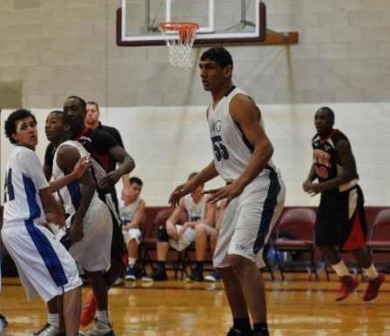
You may have heard of Satnam Singh Bhamara already. You may have already heard about the 7-foot (215 cm) teenager from a remote North Indian village. You may have heard about the giant 10-year-old boy who couldn’t even spell ‘Basketball’ that was found on his father’s farm in Punjab. You may have heard how this boy was taught Basketball and within four years, become the brightest young player in his country. You may have read about how this young man was recruited amongst a chosen few Indian youngsters to get a scholarship from the renowned IMG Basketball Academy in Bradenton, USA. How this boy continued to improve and began to dominate Junior and Youth championships in against strong Asian competition.

And if you’ve been paying attention, you would have definitely realized how this 17-year-old has developed into the biggest hope for Basketball fans from India’s 1.2 billion population, a fan-base that has yet to see one of their own make it to the big league.

If you’ve been following Bhamara’s story, then here’s the next chapter. Here’s where the 11th grader stands now, and where he’s looking ahead. Now, hear it directly from him.

“I’ve been working hard for the past year,” said Bhamara – speaking in rustic Punjabi – over a phone interview from Florida, “I think that I have made many improvements in my game. I had trouble keeping pace with the American game in the beginning, but now, I can run up and down the court quite comfortably. This has helped me be more aggressive in-game situations. My coaches and I have also been working to help my post-game: hook shots, jumps shots from close the basket, and finishing strong around the basket.”

Bhamara represents IMG’s Senior School team and says that the squad is halfway through their season. But he is no ordinary High-School student; in his vacations, he travels back to India for more Basketball, to represent state and nation in various important tournaments.

In December, Bhamara was back in India to represent home state Punjab in India’s biggest domestic Basketball competition – the Senior National Championship – in Ludhiana. Led by Bhamara, who was his team’s leading scorer in most games, Punjab finished runners-up in the tournament, only to lose the Finals to the side from Uttarakhand. The 17-year-old showed no trouble playing against – and dominating – veteran Indian players at the peak of their powers.

“I think I played really well at the Senior Nationals,” says Bhamara, “I was able to make my stamp on each game on both ends of the floor. I knew it was an important tournament, and despite some niggling injuries to my wrist and my elbow, I played hard and gave it my all. The best game was probably against Delhi where I scored 31 points.”

Bhamara was strong on the other end of the floor too: more than one respected big man in India struggled to score on Punjab whenever Bhamara manned the paint. From barely getting action in Senior tournaments a year ago, he graduated to becoming the focal point on his star-studded team.

But the next step for the youngster will be to dominate for India – at the Senior level – like he has been for his state. Bhamara’s biggest international breakthrough performance came two years ago when he was Asia’s leading at the U16 FIBA Asia Championship in Vietnam. This year, he will be setting his sights on returning to play for the Senior squad which – led by newly appointed American Head Coach Scott Flemming – will be playing in the 27th FIBA Asia Championship in Philippines.

“I still have to make a lot of improvements in my game,” Bhamara says, “I have to get fitter so I can be even faster up and down the court. I have to work on my footwork and my post moves. I want to double my effort in everything that I’ve learnt so far.”
During his short trip back to India, Bhamara was also able to pay a brief visit to his village Ballo Ke in Punjab, where he is hoping to be a role model for more youngsters to pick up basketball. He held a meeting with many in the village and has even sought the help of high ranking administrators in Punjab to build a full-length court in the village.

Like any intriguing High School talent in the US, Bhamara is already hearing offers from colleges hoping to recruit him. So far, he says that he has heard from D1 schools like Oregon State and Stanford. “But I’m still only in my Junior year,” he says, “I have a lot more time before I even think about college. I have to focus on my studies in school right now – I still struggle with the English language, and I have to get better to improve my overall academic performance.”

With each passing year, Bhamara is moving one step closer to becoming a top Asian talent. He is moving one step closer to his dream of being the first Indian to play NCAA D1 hoops, and of course, to fulfilling the dream of every young basketball player to play in the NBA. There is still a long way to go before Bhamara – still a raw talent – can be determined to be good enough for the world’s top leagues. But most importantly to the youngster, he is one step closer to becoming the kind of player that India’s basketball future can be built around.

“I have to improve as much as I possibly can,” he says, “So I can keep coming back and playing for India!”

January 31, 2013

Hoops Route: A journey across Asian Basketball


This feature was first published on Court Side News on January 26, 2013.

To understand Asian Basketball presents the daunting task to try and understand what binds Asia in itself. Separated by seas, mountains, Great Walls, culture, religion, and many, many languages, it is a continent like no other. And yet, despite its magnitude and its separations, the dozens of nations of the world’s largest continent remain tied together in the same cluster of brilliance and chaos. For thousands of years, the continent remained connected with trade routes like the Silk Road. Now, it is the rising economies, the populations, and its diversity that give the continent its unique identity.

And it’s sport, too. While Football and Cricket are two of the most popular sports in Asia, the popularity of basketball has been rising at an exponential rate. China, Japan, the Philippines, India, Indonesia, and several hoops-strong Middle Eastern nations are contributing to the growing population of basketball players across the world. Although they are not at the level of teams from the Americas or Europe, Asian nations have been steadily rising with their national teams and their professional leagues. And as these nations rise economically, there is bound to be a time – sooner rather than later – that the populated continent begins to make bigger splashes in world basketball.

Here is a brief overview of Asian hoops.

We start where the Silk Road starts (or ends, if you work in the other direction!) – China! The most populous nation in the world is also the continent’s strongest basketball representative. While the country’s own estimates of ‘300 million basketball players’ (the entire population of the United States) might be a tad too exaggerated, it is still one of the most hoops crazy nations on the planet.

China has dominated Asian champions for years and only seems to be getting better. They have made more appearances in the Olympics Basketball tournament (8) than any other Asian nation. In recent years, they only seem to be getting better. China has produced a handful of NBA players (more than any other Asian nation) in the past, led by Asia’s biggest ever superstar, Yao Ming. Players like Wang Zhi Zhi, Yi Jianlian, Mengte Bateer, and Sun Yue have flirted with the NBA in the past, too.

China also features one of the most powerful basketball leagues in Asia, the CBA. At 18, it’s still a relatively young league compared to the rest of the world, but it has grown in strength considerably since its inception and is now becoming a viable option for many of the world’s best talents outside the NBA. While the league still suffers from growing pains – like some lackadaisical quality, an uneven bridge of talent between foreign and local players, and refereeing scandals – it has improved every year and has a brighter horizon.

Challenging China’s dominance in Asia are a trio of Middle-Eastern nations who boast of athletically gifted players who regularly spring a surprise over the Chinese sides. Iran, Lebanon, and Jordan are the three strongest sides from the West Asian Basketball Association (WABA) region. Iran, who are two time champions of the FIBA Asia Championship, are a regular threat and even played in the 2008 Beijing Olympics. They feature Hamed Haddidi, a Center who has dominated Asian competition and is currently a fringe player on the Memphis Grizzlies. With Yi’s return to China, Haddidi is the only Asian still in the NBA. Outside of Haddidi, some of the best known players from this region include Samad Nikkah Bahrami (Iran), Fadi El Khatib (Lebanon), and Sam Daghlas (Jordan). Top clubs from the WABA nation take part in the annual WABA League, one of the most hotly contested club competitions in Asia.

Unfortunately, Women’s Basketball doesn’t get the same interest and attention in several WABA countries, and their teams lag behind other powerhouses in Asia.

On the Eastern end of China’s massive borders are three neighbours who are regular contenders, especially in the Women’s divisions: Korea, Japan, and Chinese Taipei. They have their faint NBA credentials: Japan’s Yuta Tabuse and Korea’s Ha Seung-Jin have both made NBA appearances in the past. All the countries have well-organised – if not necessarily competent – domestic leagues. Chinese Taipei hosts the popular William Jones Cup tournaments for Men and Women annually.

The Philippines have one of the most interesting legacies in Asian hoops. The basketball-crazed nation has been infected with the hoops bug for over a century thanks to their historical American influence. They have won 8 titles in the FIBA Asia Championship (second only to China) and have made several memorable Olympic appearances. Their best days might be behind them, but the national team has seen a recent resurgence. Their chances for future glory have been further boosted as they will play host to the 2013 FIBA Asia Championship. The Philippines also boast of a popular league – the PBA – and have perhaps the most culturally-inbred love of hoops out of all nations in Asia.

We’ll finish our brief Asian hoops-de-joie with India. If China is Asian hoops promise fulfilled, India is the continent’s sleeping giant. Together, the two nations comprise of a third of the world’s population. For most of China, the sport of choice is basketball, but in India and its South Asian neighbours, it is Cricket that dominates proceedings. Despite the large numbers and improving economic status, India is still not a consistent sporting nation outside of Cricket, and basketball, amongst other sports, suffers from this. There is no league in India and the best players have to make do with semi-pro status. The national teams are still far away from challenging Asia’s best, and no individual yet has made a name on the global scale. India’s biggest success story is of Women’s star Geethu Anna Jose, who has dominated Asian competitions and came close to a WNBA contract.

Despite its current state, India represents the hoops potential for all of Asia. Long has the continent been a sleeping giant in basketball, hounded by disregard to the sport, mismanagement, and archaic training regimes compared to their North American or European counterparts. Just as the status of these nations has risen in recent decades in other fields, so will improvements eventually come in sports, and particularly for our interest, in basketball.

And hopefully, the continent’s powerhouses can turn potential into reality and consistently produce world class basketball talent.

January 8, 2013

India up 1 spot to 46th in 2012 Combined FIBA World Rankings

At the end of the 2012 Calendar year, India’s combined FIBA ranking (Men, Women, Boys, Girls) has improved one spot to 46th place. The big difference-making competitions for India in 2012 were the U18 FIBA Asia Championships for Boys and Girls, held in Mongolia and Malaysia respectively.

Click here for full feature on all of India's rankings.

February 15, 2011

Yadwinder Singh: Indian Basketball's Energy Bar


As the opposing team's best player dribbles towards his basket, Yadwinder Singh claps his hands together, almost violently, psyching himself up on defense. With an agile and quick 6 foot 6 inch frame, he is capable of guarding almost anyone, from speedy point guards to powerful, back to the basket post players. Yadwinder stays in front of the attacking player, blocking his vision at the basket. As the player drives in, he is forced to change his shot, which clanks off the side of the rim.

Yadwinder grunts loudly as he grabs the rebounds - it's his and his alone. He passes the ball to one of the guards on hid team and races ahead, beating everyone else on court to get to the opposition's basket. Before anyone else can react, he is in perfect position to receive the ball under the basket and lay it up. A few milliseconds later, he's back at the defensive end, turning passes into turnovers, and defense into offense, as he shows his range by nailing a smooth outside jumper.

There are few players in Indian basketball like Yadwinder Singh, or ‘Yadu', as we know him. A monster at both ends of the floor, Yadu seems to be on a constant energy rush, as if Red Bull has given him the wings to fly and keep flying. Defense to offense to defense and back and over and over again… There seems to be no full stops to his energy, just commas. Even when the game pauses for a free throw, Yadu will be talking, joking, shouting, instructing. Even when he is substituted out of the game, he doesn't stop, keeping his body warm and ready to go back in, jogging, doing push-ups… Constant movement.

I have seen enough NBA basketball to know of one (and only one) NBA comparison that comes to mind as I see Yadu, a Power Forward/Center, run the floor like a guard, defend and score like a big man, and motivate his teammates with an unbelievable rush of electricity and tenacity: Kevin Garnett.

His own motivations on the basketball court match Garnett's too: "I feel like basketball is a game all about the defensive effort," Yadu says, "For all the effort one puts in offense, you have to do double of that on the defensive end."

Yadu's defensive instincts, coupled with his fast-paced style of play, perfectly complement how his teams play. Whether he is representing Punjab, Railways, or India, Yadu believes that the secret to basketball success lies in his pace. "Basketball is one of the fastest games in the world," he says, "And if you aren't going to keep running, then why play it? If my team plays a perfect fast-paced game, we can be unstoppable."

Easily one of the most exciting players to watch in India, Yadu has become an important piece to the Senior National side, as was a starter for the country at the 2010 Asian Games in Guangzhou (China). Compared to many other early starters, Yadu had a late introduction to basketball, a fact that perhaps makes his quick ascension up the game's ranks that much more remarkable.

Yadu, the son of a farmer, hails from a small Punjabi village called Rasulpur Khurd. He was athletically-aligned from a very young age, but there was another sport that he focused on: Discus.

"I used to be a very serious discus thrower in school," he said, "And I took part in several major athletic competitions on Punjab from my school." He was also part of his school's hockey team.

In 2002, not until he was 16 years old, and at that point, stood at 6 foot 3 inches, did he take admission in a school in Amritsar where his coach encouraged him to try basketball. From that point on, Yadu's career took a dramatic upwards swing: he went from the Amritsar team to the Ludhiana Academy and then to the Punjab U17 team, all within a matter of one and a half years. By late 2003, he had his first senior national experience in Cuttack, had played U20 international for India in Kuwait, and participated in the Champions Cup in Malaysia.

The basketball world in India can be thankful that he abandoned his Discus throwing days behind to start throwing the basketball, but it's evident from some of his full-court bullet heaves that the throwing arm still has a lot of juice left in it. "When I look back now, even when I was younger, I used to watch a lot of basketball on TV," he said, "My Dad encouraged me to stay with athletics and discus, but once I crossed over to basketball, it completely consumed me and I didn't have the time to practice any other sport anymore."

Yadu added: "I started to enjoy basketball game a lot. It was a team sport where there was so much interaction with other people. And everything kept coming naturally to me - I kept on getting what I wanted. It was a great feeling to first play for Punjab, and then it became even more amazing to wear an ‘India' jersey for the first time!"

Yadu credits his early coaches for making him work extremely hard, whether it was his Amritsar coach Fateh Chand or Ludhiana's famed basketball trainer, Dr. Subramanyam. "I wanted to learn everything about basketball," and adding a smile, he added, "I stopped paying attention to everything else - including my studies!"

Constantly upbeat, energetic, and light-hearted, Yadu becomes the heart of the any team he joins. His Railways and India teammate Arjun Singh says, "He has incredible energy - and the best thing about his game is that he doesn't back down to anyone, no matter who the opponent is."

Yadu and the rest of the Indian squad faced the toughest of opponents at the Asian Games in November, and although they returned with an unflattering 1-5 record, Yadu took home a lot of positives: in the coaching and in India's potential in Asia. "We had a really good coach in Bill Harris for this tournament," he says, "With a coach like that, if we keep working hard, we can become top four in Asia."

"The future is good," Yadu says, "My dream is to take India to a medal one of the big championships - the Asian Games or the Asian Basketball Championships." The 26th edition of the FIBA Asia Basketball Championship, or the ‘ABC', are set to be held in Wuhan (China) in September this year.

Yadu's optimism off the court, on the future of the game, is as contagious as his optimism on it, where he focuses hard on each defensive assignment, each offensive rebound, and each jump-shot. And if this contagious optimism continues to grow in the hearts of Indian basketball player, we may very well see the day when the Young Cagers make a name for themselves in Asian basketball's biggest stages.

February 2, 2011

FIBA Asia releases 2011 Events Calendar


Press Release: The complete FIBA Asia calendar of events for 2011 has been announced.

The calendar will tip off with the 22nd FIBA Asia Champions Cup, FIBA Asia’s premier event for club teams, to be hosted by Philippines at Manila from May 28 – June 5, 2011.

Philippines will host a FIBA Asia event after a gap of six years. The last FIBA Asia event hosted by Philippines was incidentally also the Champions Cup – the 16th edition of the event – in 2005.

Wuhan in China and Omura-Nagasaki in Japan have already been chosen to host the two marquee events of the calendar – the 26th FIBA Asia Championship (Sept 15-25, 2011) and the 24th FIBA Asia Championship for Women (Aug 21-28, 2011).

Ho Chi Minh City, the capital of South East Asian nation Vietnam will host the 2nd FIBA Asia U16 Championship at a date to be decided. The event will mark the first time Vietnam will host a FIBA Asia event.

Urumqi in China has been chosen as the host for the 2nd FIBA Asia U16 Championship for Women, at a date to be decided. Among other important events, Urumqi had hosted the 2006 FIBA Asia U18 Championship.

The two FIBA Asia U16 events are qualifying events for the corresponding FIBA World U17 events to be held in 2012.

Lauding the host of each events, FIBA Asia president Sheikh Saud Ali Al-Thani said: “Hosting an event is charming, but the challenges that come up can be understood only by the hosts. I congratulate each of the host and the National Federations for coming forward to host the events.”

“From FIBA Asia side I assure all support. I hereby call upon all the prospective participants for each event to provide all the necessary support so that each event runs smoothly,” Sheikh Saud added.

“I also welcome Vietnam who are joining our list of hosts,” Sheikh Saud said.

“Last year we had Yemen joining the list of hosts. This year it is Vietnam,” said FIBA Asia Secretary General Dato’ Yeoh Choo Hock.

“The quality of FIBA Asia events has seen a tremendous improvement in the last couple of years. I am confident we can not only continue but also improve our standards this year,” Dato Yeoh added.

“Organizing an event in new cities is always exciting. It provides a wonderful opportunity to widen the support base for our sport,” said FIBA Asia Deputy Secretary General Hagop Khajirian, also the Chairman of the FIBA Asia Committee for Marketing and Media.

“The fact that new cities are coming forward to host events is very encouraging. It means our sport is gaining in support from more people. I congratulate and look forward to working with all the host cities and National Federations,” Khajirian added.

The complete FIBA Asia 2011 calendar:

May 28 - June 5: 22nd FIBA Asia Champions Cup (Manila, Phillipines).
Aug 21 - 28: 24th FIBA Asia Championship for Women (Omura-Nagasaki, Japan).
Sep 15 - 25: 26th FIBA Asia Championship (Wuhan, China).
Dates TBC: 2nd FIBA Asia Championship (Ho Chi Minh City, Vietnam).
Dates TBC: 2nd FIBA Asia U16 Championship for Women (Urumqi, China).