July 22, 2015

Big Dreams: The day that Indian Basketball, the NBA, and Satnam Singh Bhamara changed forever


This article was first published in my column for Ekalavyas on July 12, 2015. Click here to read the original post.

Satnam Singh at the 65th Senior National Basketball
Basketball Championship 2014, in Bhilwara. Photo
Courtesy: Ekalavyas - Vishnu Ravi Shankar

The Present.

Dressed in a dapper, dark blue single-breasted suit, Satnam Singh Bhamara sat anxiously on the crowded floor of the Barclay’s Center in Brooklyn, New York. A single Thursday evening in late June had the potential to change the 19-year-old’s life forever, and forever make history for Indian Basketball and the NBA.

But nothing was certain. The previous few weeks had turned Satnam from an unknown 7-footer out of High School into a possible late Second-Round pick. His name had made its way on to the draft boards, but being a potential late Second-Round pick is too close to being undrafted, too close to a dream deferred. The NBA Draft has only 60 picks, which means only 60 dreams are guaranteed to come true on that night. And as the picks went on, and the teams who had worked out Satnam with chose other players, that number edged closer and closer to 60.

And then, after pick number 52 was announced, nothing was the same again.


*

The Past.

Dressed in a plain, striped white shirt and blue jeans, Satnam Singh Bhamara sat anxiously at the former office of the Basketball Federation of India (BFI) near Paharganj in New Delhi. A single basketball workout a few weeks ago had changed the 14-year-old’s life forever, and set into motion a new era for Indian Basketball.

But still, there was uncertainty. That day in the BFI office – in the summer of 2010 – was the first time I got to meet and get to know Satnam. Just a month before that meeting, Satnam was one among 50 boys and girls – all under 14 from every corner of India – who were invited to New Delhi by the BFI for trials hosted for IMG Reliance for a potential IMG Academy scholarship programme. The youngsters were chosen based on their performances at the recent Sub-Junior National Basketball championship.

Satnam was the centrepiece – literally and figuratively – of those trials. While the rest of the players were 13 or younger, a special exception was made for the 14-year-old 7-footer who was played for Punjab’s Youth (U16) team already and had recently led them to a national championship in Trichy, Tamil Nadu. A year earlier, at just 13, he had already played for India at the FIBA Asia U16 Championship in Malaysia.

IMG-Reliance had recently signed a sponsorship deal with the BFI to sponsor the federation events and provide this rare scholarship programme. After the tryouts, IMG’s coach Dan Barto chose four boys and four girls for the scholarship at his basketball academy back in Florida, USA. Unsurprisingly, Satnam was the biggest name among the eight.

So there he was at the BFI office in New Delhi, a few months before his semester of school was due to begin in Bradenton with the IMG Academy. He sat nervously in the office – barely being able to stretch his large legs on a bench in the tiny space – and waited for his paperwork to get cleared. He spoke only in thick Punjabi and needed by help to fill out his English visa form for the United States.

He had been handed a scholarship at one of the top youth sport academies in the world, but back then, he didn’t really know what it meant. In my earlier conversations, he talked with uncertainty about the future. Uncertainty about how he, a boy who grew up in a farming village with less than 700 people and trained at the squalor of the Ludhiana Basketball Academy in Punjab, a boy who was barely familiar with urban India, would now be exposed to a First World nation, exposed to some of the world’s best training facilities, and a culture at a polar opposite to his own. He didn’t know that the way he was educated and coached would change forever.

He had heard whispers – said wistfully rather than confidently – that he had the potential of becoming the first NBA player out of India. He told me that his dream was indeed to play in the NBA one day. His potential had been co-signed early by Troy Justice, the NBA’s Director of Basketball Operations in India back then. Here he was, a boy who played for Punjab’s youth teams and was being forced to pay his dues as a backup over less-talented seniors in the national team being told that he could do what no Indian had done in 60 or 70 years of history of both the NBA and Indian Basketball.

He was anxious about his visa process, sure, as every Indian applying for US visa ever is. But he was calmly confident about his chances with the NBA ‘one day’. No one knew when, of if, that ‘one day’ would ever come. Maybe the confidence was a virtue of his ignorance, of him not yet being aware of the low odds of making the world’s best basketball league, of the combination of hard work, opportunity, and luck that goes into making that dream a reality.

He got that visa, and along with seven other Indian basketball-playing kids, headed off to Florida. And nothing was the same again.

*

Aside from providing basketball fans with the greatest basketball players, teams, and moments in history, the NBA has also been at the forefront of social change and bringing the world closer through the sport. They featured the league’s first black player (Earl Lloyd) in 1950, drafted the first European players (Fernando Martin and Georgi Glouchkov) in 1985, brought in first Chinese player (Wang Zhi Zhi) in 1999, their first openly gay player (Jason Collins) in 2014, and of course, the first Indian-descent player (Sim Bhullar) earlier this year.

The seven-footed center Wang Zhi Zhi – the first Chinese player in the NBA – was drafted 36th by the Dallas Mavericks in 1999. 16 years later, it was these same Mavericks who were on the clock at the 2015 NBA draft with their second round pick – number 52 – and an Indian seven-footer waiting in the wings to become a part of history.

China always had a long history with basketball and success with the sport in Asia, but the game only became the nation’s favourite as the Chinese Basketball Association (CBA) was launched in the mid-90s and Wang’s drafting was followed by Yao Ming going number one to the Houston Rockets in 2002. Yao’s short but successful career thrust the spotlight on China’s billion-plus as they became the largest basketball market on Earth.

The NBA have been wishing for India – another billion-strong nation – to mirror that success, too. Of course, our nation has different complications. Over here, most other sports including basketball exist under cricket’s ever-dominating shadow. The NBA put in their efforts over the last half decade to have a bigger grassroots presence in India, bring NBA superstars closer to fans in the country, and accelerate the availability and broadcast of NBA content to Indians. The NBA had come to India, all that was left was for an Indian to go to the NBA.

*

Satnam Singh Bhamara – at 14 – came to America a complete stranger to the country’s culture, language, and educational system. He struggled in class and missed his family back in Punjab. But it helped to have the other prospects from India – his friends Sanjeev Kumar, Dinesh Mishra, and Ashiv Jain – with face the early cultural experiences together.

It also helped to have basketball. Satnam improved his game with the coaches at IMG, specifically Coach Barto who had scouted him in India and eventually, Coach Kenny Natt – the former coach of the Sacramento Kings – who had also been the former coach of India’s national squad and had given Satnam his first senior international appearance for India. In 2012, Natt joined the IMG Academy staff as well, and his familiarity with the big Punjabi kid added another positive dimension to the training process.

On court at the academy, Satnam spent the next five years with focus on improving his strength and conditioning as a priority, and eventually making his mark for IMG’s senior team. Back home in India, he continued to return for some domestic championships, playing well for Punjab whenever he got a chance. After Natt gave him the senior debut at the FIBA Asia Championship in 2011, he played for India’s senior national team for a couple of more Asian tournaments. At the FIBA Asia Under-16 tournaments in Vietnam, he made waves by emerging as one of the top youth talents in the continent.

Off court, he improved his English and eventually, began to see a realistic roadmap for his future. As he reached college eligibility, several mid and high level NCAA colleges showed him interest, but his English wasn’t good enough to get him the grades required. So he took a bold risk and declared for the NBA draft. Over the next few weeks, he impressed scouts in pre-draft workouts around the league, and, with confidence in his abilities, he waited for Draft Day. 

*

Karl Anthony-Towns went first to Minnesota, D’Angelo Russell went second to the Lakers. Several hours later, NBA Commissioner announced the last pick of the First Round – Kevin Looney – going 30th to the champion Golden State Warriors.

A few minutes later, deputy commissioner Mark Tatum took over to welcome in the picks for the Second Round. Turkey’s Cedi Osman was at 31. Josh Richardson went 40th. And as more time passed and the night got older, the numbers inched closer to the end. The Orlando Magic picked Tyler Harvey at 51. With less than 10 more picks to be drafted, it was going to be now or never for Satnam.

Then, Tatum walked out to the stage again. “With the 52nd pick of the 2015 NBA Draft, the Dallas Mavericks select… Satnam Singh…” a section of the crowd erupted, “… From Chawke, India. He last played for IMG Academy.”

Hugs. A draft hat. A handshake with the deputy commissioner. A life transformed.

On draft night, Satnam went from being an unknown international prospect to a player drafted into the NBA within a matter of minutes. But those few minutes were only the crowning glory of the culmination of years of hard work, fortunate opportunities, support from friends, family, and coaches, and many anxious waits.

Those few minutes signified a dream realized, the end of a journey that few in Indian basketball ever saw possible. 

*

Or, they signify the beginning of another journey.

Getting drafted into the NBA and playing in the NBA are two vastly and widely different achievements. Once he signs his first NBA contract, Satnam will be hoping to be named in the Mavericks’ Summer League and earn some minutes in Las Vegas. It is highly likely that he’ll start the regular season in Frisco instead of Dallas, playing for the Mavericks’ affiliate D-League team Texas Legends. Here, he’ll have the opportunity to learn the pace of the professional game, become more confident against better opponents, and further develop physically and technically as a player.

Blessed with his gargantuan 7-foot-2 frame, Satnam has age and size on his side. In the long-term, the best-case scenario for him – if the Mavericks are able to get the most of his potential – would be to eventually secure a steady backup NBA job for several years. Those invested in Indian basketball will be desperately wishing for Satnam to make the leap into earning NBA playing time. Even his smallest steps will leave giant footprints. For a country so anxious for basketball role models, any success for Satnam – no matter how miniscule – will be a positive and influential step forward. 


However his journey proceeds, Satnam has already achieved the impossible. The boy from a non-descript Punjabi village has come further than the distance between Ballo Ke and Dallas and jumped higher than his own gargantuan height. On Draft Night, he may have been a relatively unknown giant in a sharp suit; but once he was drafted, his name rung viral across fans in India, and eventually, fans around the world, too.

*

The future?

Dressed in a Royal Blue Mavericks jersey with the name ‘Satnam’ in silver on the back, Satnam Singh Bhamara waits on the bench for his number to be called. With a couple of minutes left in the first quarter, Coach Rick Carlisle looks to the end of the bench and nods at him. Satnam jumps up on his feet, checks in at the scorer’s table, and exchanges dabs with the exiting player on court.

He steps on an NBA court and nothing is ever the same again.

July 21, 2015

Revenge of the small market


Most of the big name unrestricted and restricted free agents over the last month chose to pass the glitz and glamour of the big city to choose the team that was the right fit for them and their ambitions. Some of the biggest moves were the ones that weren’t made, deals that were made by All Star calibre players to stay in cities without the ‘big market’ tag. In the new, smaller world, where the entire universe of information is just a few tweets away, the geographical location of NBA stars rarely matter anymore. All that matters is talent and success.

Check out my full article on SportsKeeda.


July 19, 2015

Stumble, stutter, and baby steps forward: What we learned from Satnam Singh's Summer League experience


Back home in India, there was breathless anticipation and the heaviest weight of expectation on the number 52 pick of the 2015 NBA Draft, Satnam Singh Bhamara. This was not entirely unexpected, of course, because Satnam just so happened to be the first Indian citizen to be drafted into the NBA, after the Dallas Mavericks picked him late in the second round. But in contrast to the hype back home, NBA scouts, coaches, and most of the learned basketball media were had little or no expectations of the 7-foot-2 when he was named in the Mavericks' squad for the Summer League in Las Vegas. Most insiders believed that Satnam was too raw and inexperienced for this level of the game, and expected little more than him to trip over his own feet at the Summer League.

Unfortunately, the first few seconds of his NBA-lite action in Vegas was a rude awakening that left the critics smirking with self-satisfaction. When he checked in against the New Orleans Pelicans, his first shot was blocked by 6-9 Jarvis Varnado. Minutes later, he actually did trip on his own feet on the defensive end. He may have been the biggest guy on the court, but the 19-year-old looked, well, 19-years-old, confused, and perhaps a little intimidated by the moment.

But the great thing about good basketball players is that the game can provide them almost instant redemption. Satnam got back on his feet and got back to the play, brushing past the early nerves. He ended up playing 11 minutes in his debut, taking three shots, scoring four points and grabbing three rebounds in the limited time.

By the time the Summer League ended for the Mavericks - they were knocked out at the tournament's Quarter Final stage by the Atlanta Hawks on Saturday - Satnam had played bit minutes in five of Dallas' six games and showed hints of his potential, including games against the Pelicans, Trail Blazers, Lakers, D-League Select, and Hawks. He played an average of seven minutes per game at the Summer League, scoring 2.6 points and grabbing 2.4 rebounds per game. While the likes of Dwight Powell and Justin Anderson shone brightly for the Mavericks in Vegas, Satnam's bit play went mostly unnoticed and didn't contribute much to the team's fortunes.

And yet, even in his small way, Satnam did enough to leave an encouraging impression on the minds of the same scouts and coaches who may have had been skeptics earlier. He showed intelligence when cutting to the post, finishing strong around the basket, communicating with his teammates on defense, and generally, making the most of his small moments. There were stumbles and there were stutters, but Satnam took baby steps forward each game, and showed flashes of promise on both ends of the floor.

"I thought Satnam played pretty well," said Mavericks owner Mark Cuban to Mavs Moneyball at the end of the team's Summer League campaign, "He raised a lot of eyes. I think people didn't expect him to move as well and be as skilled as he is. I think he comported himself very well."

More from the Mavs Moneyball piece by Doyle Rader:

Mavericks Summer League head coach Kaleb Canales isn't hesitant to point out what he is doing well in Las Vegas.
"His communication on defense has been great," Canales said, "He's been aggressive. He's not shy which is a positive I think. He's not afraid to attack on offense. And on defense he's been talking pick and roll coverages but also hitting the boards."

"It's NBA 101," Canales said of where Singh is. "From terminology to system and in terms of concepts and principles, he's learning step by step in this process. It's a long journey for him ahead."
Luckily, everyone with the organization is on the same page about Singh. He isn't ready for the NBA. The Mavericks didn't draft him with the expectation that he would have an impact right away. He's a project player.
Next season he will play for the Texas Legends, the Mavericks' D-League affiliate, so he can continue to develop. Steven Kyler of Basketball Insiders tells Mavs Moneyball that the Legends will bring in former Maverick DeSagana Diop to mentor and work with Singh.

As for Singh, he already feels that he is up to the challenge.
"I think it's good to work with these guys," he said about his teammates and coaches. "When I was here [in the first game] and we were really close with some D-League [players] I said, ‘Of course I can play with these guys. My body is ready for these guys ... I'm here. I'm ready.'"

Earlier in the same article, Mark Cuban explicitly stated what the rest of us have been thinking: "I don't see him playing in the NBA this year," he said, "We'll give him time to develop."

This is fine, and this is to be expected. Satnam isn't one of the top rookies that came out shining at the Summer Leagues, like Emmanuel Mudiay, Mario Hezonja, or Kristaps Porzignis. He won't be expected to contribute to his team straight away like them, and even if he improves to an NBA level, he won't be expected to be a game-changer.

Still, his appearances at the Summer League proved that Satnam is more than just a publicity stunt. Satnam is a genuine NBA project and was a low-risk pick for Dallas at 52nd in the draft. If he can continue progressing and improving, he may earn an important role for the Texas Legends in the D-League, and hopefully, we'll see him back at the Summer League in Vegas a year from now with a bigger and better role. And after that, if the career trajectory continues positively, perhaps the NBA debut wouldn't be too far away.

July 18, 2015

UBA Professional basketball league tips off in Hyderabad with home side starting on winning ways


The most eye-catching thing about the 2015 UBA Basketball League - the first iteration of a two-week national professional basketball league in India - are the team names. Nothing makes basketball fans giddier than seeing their home teams - or other teams in their country - represented like professional franchises, with nicknames, logos, attractive jerseys, banners on the rafters, and more. As the first day of this novel league tipped off at the Gachibowli Indoor Stadium in Hyderabad on Friday, July 17, it was this fanfare and the celebrity attendance that started the show. But ultimately, the show was stolen by the main event: the exciting basketball players in attendance providing high-quality hoops action for the fans on court.

Photo courtesy: Ekalavyas
On the first day of this league, which features eight teams from around the country, hosts Hyderabad Sky and the Pune Peshwas got off to winning ways.

The Universal Basketball Alliance - UBA India - have launched this league to be held in Hyderabad from July 17 to July 30, set to be held on a league-cum-knockout basis. The eight participating franchises are: Pune Peshwas, Delhi Capitals, Haryana Gold, Punjab Steelers, Chennai Slam, Mumbai Challengers, Bengaluru Beast, and Hyderabad Sky.

“This is the first time in India’s basketball history that a pro league is being organised,” said UBA India Director Deepesh Solanki. “Our main focus is infrastructure. Athletes should feel like pros.” Hindi Film actor Anjana Sukhani was the celebrity guest on the opening day and she wished both all participating teams the very best. “I’m so happy that someone has taken the initiative to bring out the talent that this country has.” she said.

In the league's opening game, Pune survived a strong effort from the Bengaluru Beast and their star point-guard, TJ Sahi. Sahi - a former national team star - is the most recognizable name in this league and scored a game-high 32 points in his debut for the Beast. But it was Pune's forward duo of P Vijay and Arjun Mehta who scored 23 points each to stay competitive against the stacked Bengaluru squad and stretch the lead out to double digits in the third quarter. A last gasp effort from Bengaluru wasn't enough and Pune earned a surprising victory, 88-81. Bengaluru's Chetan Suresh scored 16 in the loss.

Hosts Hyderabad won in a thrilling opening encounter against the Chennai Slam. At one point, Hyderabad looked comfortable and fully in control of proceedings, leading 36-22 at halftime and giving the home fans a lot to cheer about. But Chennai grabbed momentum in the second half and made a furious comeback. Unfortunately, they fell short, and when time expired, Hyderabad survived to win 65-61. Nihal Yadav (19) and Sujith Reddy (16) were Hyderabad's high scorers in the win.

Scoreboard
  • Pune Peshwas (P Vijay 23, Arjun Mehta 23) bt Bengaluru Beast (TJ Sahi 32, Chetan Suresh 16) 88-81 [19-18, 23-17, 29-25, 17-21].
  • Hyderabad Sky (Nihal Yadav 19, Sujith Reddy 16, Liju Abraham 15) bt Chennai Slam (Agu 14, Vicky 14) 65-61 [18-9, 18-13, 19-22, 10-17].
Find the full schedule of the league on UBA India's website.

July 17, 2015

Come Home With Me


After a topsy-turvy NBA career, Stephon Marbury's unlikely journey brought him peace and success in China.

by Karan Madhok

This feature was originally published in the August 2015 edition of SLAM Magazine (SLAM No. 190). You can also find it on SLAMOnline.com.

What is Home?

Home was Coney Island, the Brooklyn neighborhood that birthed his game. Home was Georgia Tech, the college that developed his early stardom. Home was Minnesota, the city with the NBA team where he played his first few seasons in the NBA. For some stretches, home was New Jersey, Phoenix and Boston. Home really felt like home back in New York when the Knicks traded for him.

Home, now, for Stephon Xavier Marbury, is Beijing, China. It’s a spacious apartment in a high-rise building in the heart of the city, surrounded by other high-rises and shopping complexes that have contributed to this historic city’s transformation into a concrete jungle. Home is a couple of metro stops away from Tiananmen Square, in the capital of the most populated nation in the world, of a civilization thousands of years old.

It’s here—at home—where I find Marbury, a month after he turns 38, on a cold afternoon in late March. It’s been only a few days since he led the Beijing Ducks to their third Chinese Basketball Association (CBA) title in four years and grabbed the finals MVP award. I find him relaxed, alone at his apartment, draped in his 361° brand t-shirt and sweatpants, eating a Subway sandwich for lunch and listening to the Drake mixtape out of his smartphone.

It’s here, at home, where he finally talks to SLAM again. Where we talk about his journey: his NBA career, his rise, his departure, his resurrection in China. It’s here, at his new home, where I ask about his old one. About his brothers, about his friends in the NBA, about Coney Island.

I ask him if he ever gets homesick.

“No.”

“Never?” I ask, “When you think of what ‘home’ is?”

“This is home,” he says, staring directly at me. “Beijing is home. I mean, America’s gonna always be home. But this is where I live at—this is home. This is where my life is at. Here in China.”

There seem to be two separate lives to Stephon Marbury: “Starbury” in the US, “Ma Bu Li” in China. Starbury was the high school phenom from Brooklyn who broke New York City records and was a cult hero even before getting selected fourth overall by the Timberwolves in the heralded 1996 NBA Draft. He was the score-first point guard much ahead of his time who, despite enjoying strong individual highs, never quite found permanence in the League. Nearly every team he was a part of was happier to see him gone, and by his last NBA years, he was reduced to a mere caricature of pro basketball careers gone wrong. He was blasted by critics, maligned by legal cases against him, suffered personal loss and live-streamed a nervous breakdown.

So, at age 32, he packed up and left. Left the League, left the country and left what he now calls the “negative energy” behind. He traveled nearly 7,000 miles, crossed the Pacific and resurrected his career in China. Former NBA players had taken their talents to China before, but no one who had previously done so had a higher profile than him. The Chinese named him Ma Bu Li, and after two years of teething troubles in Shanxi and Foshan, he joined the Beijing Ducks, making the team and the city his home in 2011.

“At first, it was a trying time, because it was all brand new,” he says of his early years in China. “I was ready to do something different and be a part of something different. I wanted to evolve to a new area in my life and in basketball. It was a trying time because of the culture barrier and not being able to speak the language and not being able to communicate.

“I understand the culture now,” he adds. “I love the food. I now know why people do what they do when they do it. Even though I can’t speak the language as well as I would like, I know a little bit more than when I first came here. It’s just growth.”

The growth off the court correlated with success on the court, and despite his age, Marbury has remained The Man (there’s the annual CBA legend of “Playoff Marbury”) for the Ducks, leading them to back-to-back-to-back championships. I suggest that, if he stayed on his traditional route in the NBA, his role would’ve probably gotten smaller as he got older, and I ask if it’s been tougher to continue playing at a high level with age.

“I wouldn’t necessarily say that if I was playing in the NBA, if I got older, that my role would’ve changed,” he answers with characteristic defiance. “How I played in the NBA and how I play now is the same. It’s no different. But I think playing here, you have to do more, because a lot more is required out of the foreigners [CBA teams are usually only allowed two foreign players each—Ed.]. So consistency is something that plays a major role here in being able to score, play defense, trying to get everybody involved to do all of the different things that are needed to play at a higher level.”

Back in the NBA, being a point guard is perhaps the deepest and toughest gig in the League now, with damn near every team featuring an All-Star or All-Star-potential starting PG. I try to make him imagine that alternate universe, the universe where he’s still playing in the NBA, having never attempted the China experiment. What kind of role do you see yourself in if you were still in the NBA? I ask.

“I see myself as a starting point guard,” he says. “I probably wouldn’t be as dominant as when I was younger, but I would definitely still have my same attributes on court. My style wouldn’t be any different.

“[Allen] Iverson and myself, we kinda changed the dynamic of how the traditional point guards played,” he continues. “Now, when you see the athletic guards that are dunking and doing the things that they are doing, Iverson and myself, we came in doing things like that, which changed the perspective of how people viewed the point guard. We took a lot of flak because we came in and changed the game.”

Are there any younger guys that you see a bit of yourself in?

“I like Derrick Rose,” he answers. “I like Westbrook, too. But Derrick Rose is my favorite. I like the kid Curry, too. He’s having a really good year.”

***

Maybe home exists not in a specific, physical place, but in the legend built by history. By words and photographs by scribes, illustrators and photographers. By the journals that time will preserve—in paper and online.

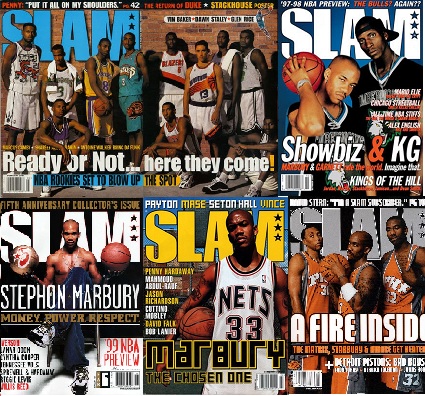
Marbury began when SLAM did. He was the magazine’s first-ever high school diarist and appeared on a multitude of SLAM covers over the years. I pull out my phone to slide through photographs of those old covers. Each evokes a different reaction, a different moment in his career, telling a story through images a thousand times better than through words.

We see the cover of SLAM 15, featuring the legendary 1996 Draft class, a class that gave the League Marbury and AI, as well as Kobe Bryant, Steve Nash, Ray Allen, Shareef Abdur-Rahim, Peja Stojakovic, Antoine Walker and more. I ask if he truly believes this class was the greatest ever.

“By far.”

Do you compare it to 2003? LeBron, Wade…

“It’s not…” he interrupts me. “No class can mess with our class.”

We scroll next to see the famous “KG and Showbiz” cover, featuring the exciting but ultimately ill-fated pairing of Kevin Garnett and Marbury in Minnesota at the end of Steph’s rookie year. He doesn’t react.

I show him the cover of SLAM’s fifth anniversary special in January of 1999. He was on the cover again, posing in Coney Island, a few years later. He was traded to the Phoenix Suns in 2001 and appeared on the 75th issue cover with Shawn Marion and Amar’e Stoudemire.

“Anytime you get on the cover of a magazine, especially SLAM Magazine that all of the kids like to go buy and read about, it’s cool. All the times was different times in my career,” he remembers. “It was all good times.”

When the times were good, they were great. Starbury was named Third-Team All-NBA in 2000 and ’03, and played in the ’01 and ’03 All-Star Games. For the majority of his career, he was the only player since Oscar Robertson to average 20 points and 8 assists per game.

But his greatest day in the NBA, he says, was his very first one. “When I got drafted, that was the best time. Everything else was just basketball and business. It was nothing more and nothing else. Making it to the NBA was my only thing. That was the only dream that I had as a kid.”

Did you have any regrets?

“No.”

None at all?

He shakes his head.

Marbury’s NBA dream seemed to turn into a nightmare in his last few years in the League. After not returning to the Celtics in 2009, the world around him began to collapse. The low-point came during an infamous live-stream from his bedroom as he spoke about depression, ate Vaseline, lip-synched “Barbie Girl” and broke down crying.

Earlier this year, Marbury finally opened up about his suicidal thoughts during that dark period to HBO’s Real Sports, and about eventually making it out to the light.

“That interview was fascinating,” I told him, “because very few individuals could talk about the dark days so openly. Was that a tough process for you? To be so open about it?”

“No,” he answers, “It’s something that happened. I don’t mind telling something that happened, that went on in my life. During those days, no one knew what was going on. Nobody knew I had lost my aunt, my coach, my father, all within a month. When we were burying people, you know, it wasn’t really anyone’s business. That was my life. That was something that I was going through in my trying times.”

His voice begins to crack as he speaks, but he doesn’t stop.

“Speaking about that was important for people to have a different understanding, because things have changed,” he continues, “because things have changed for the better. It’s a different story. It’s triumph. Some people think, ‘Oh, you play basketball, you make money, you live this life,’ that you’re exempt from the natural crisis of what goes on in human life, as far as being in an emotional state because of something that has happened. For me, sharing was easy. I said that because I wanted people to understand what was going on with
me, what pushed me and what motivated me.”

Maybe Home is where the love is?

While delivering three championships to Beijing in the last four years, Marbury has also become a true cultural icon in the city. A statue of him stands outside the MasterCard Center where the Ducks play. Last winter, he was the subject and the star of the play I Am Marbury that was staged for a few days in Beijing. The China Post has released a collection of stamps and post cards in his honor. He was the only non-Chinese person named in the list of Beijing’s Top 10 Model Citizens of 2014. The Chinese, especially Beijingers, have accepted Marbury as their own. And he is fully accepting the nation, too, applying for a Chinese Green Card (permanent residency) this year.

“I’ve said it once and I’ll say it again,” he says. “These are the best fans on the planet. I don’t say that loosely because I play in Beijing and I love Beijing. Whenever you have fans that bring that type of energy, it’s different and it’s rare. And it’s consistent throughout the whole game. The fan base—you can’t really put a price tag on that or compare it to anything.”

Home is different for us all. For some, it’s a physical place; for some, it’s a feeling; for others, it’s their legacy. For Marbury, it seems that home is where he can continue to find bliss in his first true love: basketball.

“Basketball is everywhere,” he smiles. “It’s not just the NBA. The game has changed. Basketball is global. I know I wasn’t the first American to come to China and I won’t be the last. I’m just the American who came here and did it my way. I came here. I’ve been real. I was open. I left myself completely vulnerable for people to understand me.

“I can play as long as I want. Honestly, it depends on my body. When my body says ‘That’s it,’ then I’ll stop. So, I could say that I want to play another two-three years. It’s fun right now. It’s fun winning. So you’re driven to continue to work hard because the success of winning feeds you.”

And you want to keep winning in Beijing?

“Why not?”

Do you see yourself in China long-term?

“I’m not going,” he says. “This is my home. I’m going nowhere.”

July 16, 2015

UBA launches two-week professional basketball league in India


If you're a basketball fan in India thirsting for some high-level, high-octane hoops action, I suggest you head down to Hyderabad for the next two weeks, and not just for the biryani.

The Universal Basketball Alliance - UBA India - are launching a two-week professional league from Friday, July 17, to be held at the Gachibowli Stadium in Hyderabad until July 30th. The 2015 UBA Basketball League will pit off eight teams from all over India in this two week event, which will conclude with the Semi-Finals and Finals on July 29-30th. Apart from some talented young players and India's veteran point guard TJ Sahi in the mix, several celebrities have also been invited to participate in the league's promotion to help create awareness and drive fans to come and support the game.

The eight participating franchises are: Pune Peshwas, Delhi Capitals, Haryana Gold, Punjab Steelers, Chennai Slam, Mumbai Challengers, Bengaluru Beast, and Hyderabad Sky. The opening game - between Bengaluru and Pune - tips off at 2 PM on Friday.

The UBA has acquired the broadcast, merchandise and sponsorship rights to the existing, and self-governing Indian University Basketball Programme. They are currently securing television broadcasting arrangements, securing corporate sponsorships for tournament play, and creating merchandising opportunities. UBA will focus its attention on the AIU and popularizing its All India Inter Zonal Tournament as an entertainment product for Indian viewers to enjoy for generations to come, just as Collegiate Basketball is in the United States. They organized the UBA All India Inter University Basketball Tournament for Men in Chennai from January 12-19.

You can find more information about the UBA here and a full schedule of games in Hyderabad here.

"We have done our home work and have been connected and invited all the schools, colleges and universities across the eight cities to follow the event," said Tausif Shaikh, the Managing Director of UBA, "It will be validated both when the actual spectators come to see these matches and when the games comes on one of the top sports network."

Punjabi star Sahi will be playing for Bengaluru. Another player to watch out for in the tournament will be Yogesh Jadhav, a 7-foot-1 big who will be suiting up for Pune.

The league is not going to feature any of the most-recognizable or top talents in India, the players who more likely to be seen in the Senior National championships or donning the India jersey in international games. This is still a league in its early stage, and most of the players who have been given an opportunity here have likely graduated up from the University league held earlier. Still, it should be a fun event and showcase that India has a lot more basketball to offer than the 'official' events governed by the Basketball Federation of India (BFI).

So, where do India's best basketball players play? Sure, the top talent spends a few months every year in national camps, preparing for international tournaments and championships. But for the rest of the year, they and all the other hundreds and thousands of players of all age levels have to settle for national championships (representing their state or work-unit) or sporadic, short invitational tournaments (playing for the government units whom they are employed by). Unlike many other countries, there is still no full-time professional basketball league in India, a league that could contract these players and provide them a steady source of income and basketball every year.

The solution - which would be the first Indian pro league - has been quoted as being 'one or two years away' for five or six years now. The organizers who would behind such a league - the BFI and IMG Reliance - have still not reached full preparation to turn this league from theory into existence.

The UBA has invited minor local and national celebrities like Ali Quli Mirza, Evelyn Sharma, Vidyut Jamwal, Anjana Sukhani, Mugda Godse, and Vidya Malawade to attend the league on various dates and interact with the fans.

Hopefully, the UBA India league provides an alternative and some healthy competition to the race for organized basketball events in India. If this league can be successful, it will turn even more eyeballs towards the sport.

July 15, 2015

New Basketball Federation of India, new website


It's been a rough few months for the Basketball Federation of India (BFI). A broken federation, departing coaches, the shutdown of all basketball activities. One of the side-effects of this drama was also the shutdown of the BFI website, the good ol' indiabasketball.org that I once used to write for and maintain.

But every basketball that bounces down must bounce back up, and you #CantStopIndiaBasketball for long. Now under new management - led by President K Govindraj and Secretary-General Chander Mukhi Sharma - the BFI is showing some signs of coherence, order, and life again. Yesterday, they launched a brand new website http://www.basketballfederationindia.org/ which gives a beautiful, modern, and sleek new look to the governing and controlling body of basketball in India.

The new portal is the clear announcement of intention from 'Team Govindraj' that the BFI now belongs to them, and not the committee led by Poonam Mahajan and Roopam Sharma, who were last in charge of (and paid/unpaid the bills of) the defunct indiabasketball.org site.

The new website has several interesting features, like a range of quotes from Indian (Geethu Anna Jose, Vishesh Bhriguvanshi) and foreign (John Wooden) minds, latest basketball news, results, upcoming events, and photos of important coaches and players in India. A major section is also devoted to Satnam Singh, the first Indian to be drafted into the NBA.

There are some early kinks of course ("WHERE THE FASTEST GROWING SPORT AND THE FASTEST GROWING DEMOCRACY, MEET" is interesting punctuation placement and India is already the world's largest democracy), and the website is still under construction, so a lot of pages are still blank. But I'm hoping that it can eventually become the source of India basketball news and information that the players and fans in the country deserve.

P.S.: It won't surprise me if 'Team Mahajan' bring indiabasketball.org back to life and claim that it's the real official BFI website. Welcome to the world of #IndiaBasketball.