Showing posts with label Space Jam. Show all posts

October 15, 2019

Bigger Than Basketball: The Significance of the NBA India Games


An edited version of this feature was first published for SLAMOnline on October 3, 2019. Read the original version here.


It truly hit me when I saw the promo on a national TV channel. A digitally altered Mumbai. Supersized balloon floats of Myles Turner and Harrison Barnes hovered over city’s iconic skyline. Young people gathered on the streets to watch. Kids jostled for space between the kaali-peeli—black-and-yellow—local taxis for a view. A massive Kings flag unfurled over the excited crowds, and a Pacers banner flew overhead. A cricket player stopped in his tracks to watch, in awe.

I watched in awe, too.

A day later, at a family function, my Maama—mother’s brother—asked me, for the first time, about work.

“So, the NBA is coming here in a big way, aren’t they?”

I smiled. In India, the ‘NBA’ and ‘basketball’ are buzzwords for the youth. People of my uncle’s generation would never “get it”, we thought. The game was too niche, the league was too far away from everyday Indian concerns for any of them to bother. There were a thousand other distractions in mainstream Indian culture.

But even he had heard about it. The Sacramento Kings and Indiana Pacers were coming to Mumbai for first ever NBA India Games in early October. A mere blimp on the NBA’s calendar, a preseason exhibition between two non-contenders But for India, a giant leap in its basketball history. The jump-ball start to a new era.

*

As an Indian child in the 90s, I knew of the NBA’s existence only in the peripheries. I’d heard of Michael and Magic. I knew that the “Chicago Bulls” meant something good. I’d seen Space Jam half dozen times.

But back then, I didn’t quite understand the value of the world’s greatest basketball league. No, back then, my Lord Almighty of Sports wasn’t Michael Jordan, but an unathletic 5’5” Indian cricket player with the voice of someone who had been skipped over by puberty: Sachin Tendulkar. Like every good Indian boy, Cricket was my Bible and Tendulkar was my God. The NBA was too far away, across oceans, across continents, a sport that spoke in a different accent from the post-colonial cricket commentators, a game that moved in a faster pace than I have ever been accustomed to.

Around Middle School, however, that began to change. Space Jam helped, of course. So did the friends who brought home NBA trading cards and copies of SLAM Magazine from abroad. My school in the Indian Himalayas was obsessed with basketball, and, in every moment of our free time, that’s all we did: stand around a rim shooting baskets, talking shit. I overheard names like Jordan and Malone, and Ewing and Shaq and Kobe. I began to see more basketball games on TV in India: broadcast live only a few times a week, and at the ungodly early morning hour, awake only with the chokidaars and the roosters.

In 1999, the new hobby became an addiction. I followed the playoffs closely, especially because of this underdog eighth seeded team in the East—the New York Knicks—that overcame all odds and beat all favourites to make it to the NBA Finals. Sure, they got whooped by the Spurs and the Twin Towers of Duncan and Robinson once they got there, but I was already in love. Houston, Sprewell, Camby, and SLAM’s first-ever cover-boy LJ had become my favourite team.

Later, out on the courts, my friends and I would re-enact these Finals, with each side assigning themselves the Spurs or the Knicks. I chose New York, of course, and worked day and night on my baseline turnaround fadeways, hoping to emulate Allan Houston’s devastating midrange shots.

Fast-forward the next two decades, and my NBA fandom went in the opposite direction of the Knicks’ credibility. From over thirteen thousand kilometres away, I watched the Spurs become an annual threat, the Lakers become a dynasty, the Suns change the pace and size of the game, LeBron change everything, Kobe make 81, Iverson step over Lue, the Heatles, the Warriors, and more Knicks embarrassments than the word-count of this entire piece. At least we had Linsanity.

For most of this time, the NBA and its biggest stars felt like as alien to me as the Monstars. They were from a different world, a different time-zone, stars in the sky so dominant and charismatic that they felt almost unreal, as if they were fictional characters living in a world I could never access. They might as well have been the Avengers. Some definitely had superpowers.

Over the years, the NBA superheroes began to feel a little more mortal. I visited the USA, attended my first game (Knicks at the Garden, of course), and later, interacted with and interviewed many stars professionally. But despite the cynicism that comes with age over most of the world’s magic, the NBA remained something pure and special. Something shudh, as we would say in Hindi. Something that, back home to us in India, was still a beautiful galaxy far, far away.

Once the NBA opened its first office in India, in Mumbai, in 2011, the pace of the game’s growth here took a mid-2000s-Suns-esque boost. NBA and WNBA players of the past and present visited multiple times a year, peaking with Kevin Durant dropping in 2017 for hyped-up visit, freshly minted with his first title and Finals MVP.

Meanwhile, the stream had flown the other way, too, and some of India infiltrated the NBA. Most prominently, Vivek Ranadive became the first Indian-born person to become a majority owner of the NBA when he bought the Sacramento Kings. Immediately, Ranadive began to share his vision of one day taking the Kings back to his birth-city—Mumbai—for an exhibition game.

For those of us watching and covering the sport from back here, this idea barely seemed feasible. India didn’t have the infrastructure or the market ready for an NBA game—even a mere preseason matchup. Ranadive’s vision, I had thought, was stuff of science-fiction.

*

And then, the stars came within reach.

Early in the 2018-19 season, the NBA officially made the surreal announcement: The first-ever NBA India Games would be held in Mumbai on October 4-5, 2019 in Mumbai between the Kings and the Pacers. One team, owned by an Indian-American. The other, interested in reaching out to the Indian market—and, of course, it doesn’t hurt the Pacers to have ‘India’ in their name.

The news was a pataakha for us Indian NBA fan, blowing our minds like fireworks. The long-foretold day was near.

The NBA had, of course, been holding preseason (and some regular season) games around the world for years, all over Europe, South and Central America, Asia, and the special Africa Games. In Asia alone, the league had become a preseason staple in the rabid China market, as well as in Japan, Philippines, and more.

The league’s landing in India had seemed both inevitable and impossible—before it became a reality.

Mumbai—formerly Bombay—is the perfect choice to host the event. It is the country’s financial capital, of course. But it is also seeped in local hoops history, featuring some of the country’s most iconic courts, tournaments, and legends of the game. It’s India’s largest city, densely traffic-jammed with the country’s diverse population, and the home of Bollywood, readymade for all the drama and action that the NBA promises to present.

*

Basketball existed before the NBA, and India was a colonised country and collection of states hundreds of years prior to that. But coincidence married these two histories together. The Basketball Association of America (BAA) was founded as the BAA in June 1946, and its first season was held from November 1946 to April 1947. In August 1947, India won its independence from British rule.

Two years later, the BAA and National Basketball League (NBL) merged to form what is known as today’s NBA. During the course of the first ‘proper’ NBA season in early 1950, India’s constitution went into effect, officially forming the Republic. This was also the year that India’s own governing body—the Basketball Federation of India (BFI) was born, and independent India’s first basketball team, captained by the late Ranbir Chopra, participated in the 1951 Asian Games.

But ever since, India’s has merely remained a reserve on world’s basketball’s roster, barely able to register a blimp in hoops history. While the NBA eventually became the most popular and powerful basketball league in the world, India had to settle for fragments and scratches of success. We finished fourth in the FIBA Asia Championship once, in the 70s. In 1980, our men’s team took part in the Moscow Olympics, only because the USA and a number of its allies pulled out of participating in Russia. A few of our players got to play in low-tier pro leagues around the world. In 2014, we defeated China on their home soil at the FIBA Asia Cup.

Yet, India remained a potential pot of gold for the NBA, with its rising youth population and the prevalence of basketball around the country, albeit as a much smaller sport compared to the awning shadow of cricket and others. The NBA continued to increase its India presence, and we had our big moment of cheer when Satnam Singh became the first Indian to be drafted—by the Dallas Mavericks—in the 2015. The 7-footer never played in the NBA itself, but we felt that it was the beginning of something big.

Soon, the NBA launched an elite NBA India Academy to hone more talented prospects, and eventually, take the next big leap after Satnam.

The announcement of the NBA India Games brought the two varying histories into confluence. A couple of days after I saw that TV commercial and spoke to my uncle, NBA-India relations took another unexpected, surreal step. At a reception event for India’s Prime Minster Narendra Modi in Houston, US President Donald Trump jokingly suggested in front of the thousands gathered that he could show up to Mumbai for the historic preseason games. A couple of questionable world leaders had used the NBA’s moment to inflate US-India relations—and suddenly, everyone from my local samosa-wallah to my other uncles and aunties understood that this ‘NBA’ thing—whatever it was—was a pretty big deal.

*

And then, there’s the matter of the Games themselves. Remember, that after all this shor-sharaba and hoopla, this is a mere preseason contest. In true sporting terms, it counts for nothing. In the absence of the injured Victor Oladipo, there will be no All Stars on the floor. In a country where casual fans only know names like LeBron, Curry, Durant, and—like everyone else—are learning to pronounce Antetokounmpo—there is little global name-recognition that the Pacers or the Kings can offer.

Nevertheless, both these teams are going to be stacked with exciting, young players, and even the easy-preseason flow will offer a brand of basketball far higher than ever witnessed in India. Fresh out of the FIBA World Cup experience, Bogdan Bogdanovic, Nemanja Bjelica, Myles Turner, Harrison Barnes, Domantas Sabonis, and Isaiah Pineiro will all likely feature at the games. Barnes is already familiar, having spent a week in India earlier in the summer to promote the upcoming contests. Bogdanovic, in particular, was one of the breakout stars of the FIBA WC, and will hopefully continue his momentum in Mumbai.

Additionally, several other enticing players from both teams like De’Aaron Fox, Buddy Hield, Marvin Bagley III, Harry Giles, Malcolm Brogdon, TJ Warren, and more will potentially suit up in the two matchups. The Kings’ young core in particular is being slated for a major leap, and the games in Mumbai could be their first chance of stating their intent for the upcoming season.

Expectations will be high for these games from the in-arena crowd at the NSCI Dome in Mumbai, as well as all those around the country who will watch the games on live TV; but we’ll have to remember that most preseason games are duds, rarely producing moments of magic or note, and rarely showcasing a team’s true form or shape before the start of the regular season.

But even these ‘meaningless’ exhibitions will mean a lot to the players who participate: they’ll get to be a part of history, and stake their flag in unchartered NBA grounds. Those Indians unaware of the NBA—my uncle-types—will hear about Fox and Turner long before James and Curry. Who knows, maybe impressionable young minds—like my friends and I—will re-enact Pacers and Kings like the way we did with the Spurs and Knicks twenty years ago.

Some of the most intriguing action will take place on the sidelines and off-court. Being in the heart of the Bollywood film industry, the game is sure to be star-studded with some of the biggest Indian celebrities. Indian athletes, including national basketball players, coaches, and more will be in attendance, too. Every bigwig industrialist or sponsor present will co-opt this moment for their own. And true fans are coming from all over the country to have this unlikely dream come true.

The players and teams are going to participate in off-court charity and fan interaction events around the city. The league’s commissioner, a handful of NBA legends, and international media will gather. And Mumbai’s returning native son—Kings owner Ranadive—will get to shine in the spotlight of helping make this possible.

*

It's pretty surreal for me, personally, to see how far things have come since my childhood. NBA fandom in India had felt like a secret society, a code with which only those ‘in the know’ communicated. Living in smaller cities in India isolated me even further. Behind the hazy of the night sky, the stars were barely visible.

But the haze has cleared away now, and the entire galaxy is shining brightly above us. Although basketball remains a smaller sport in relative terms, the NBA’s popularity is already something that a younger-me could’ve never anticipated.

Of course, the league still has a long way to go to catch up with other sporting brands, like Cricket’s IPL or even foreign football/soccer leagues like the EPL or La Liga. The media in India often talks about waiting for our own ‘Yao Ming Moment’, for the day that an Indian player makes an impact in the NBA, and thus, propels the market back home. India, of course, still doesn’t have its own full-time pro basketball league and our national team still isn’t making any waves in the global game.

And yet, with the upcoming NBA India Games, we’ve taken a historic step forward. If it’s just a preseason game, if it doesn’t really matter, then it’s just about to become the most meaningful meaningless game ever.

February 20, 2014

The Underdog: Muggsy Bogues returned to India and preached big dreams


At just 5-foot-3, he was - and still is - the shortest player ever to play in the NBA. And despite the overwhelming odds of being the smallest man in primarily a big guy's game, Muggsy Bogues lasted in the world's most competitive basketball league for 14 years, most of them as a stable starting point guard. From his rough childhood to his unlikely NBA success, Bogues is the ultimate underdog story. Over a decade after his retirement from the game, Bogues continues to be an inspiration for others of the power of self-belief. Earlier This month, he made his second trip to India to preach the gospel of hoops.

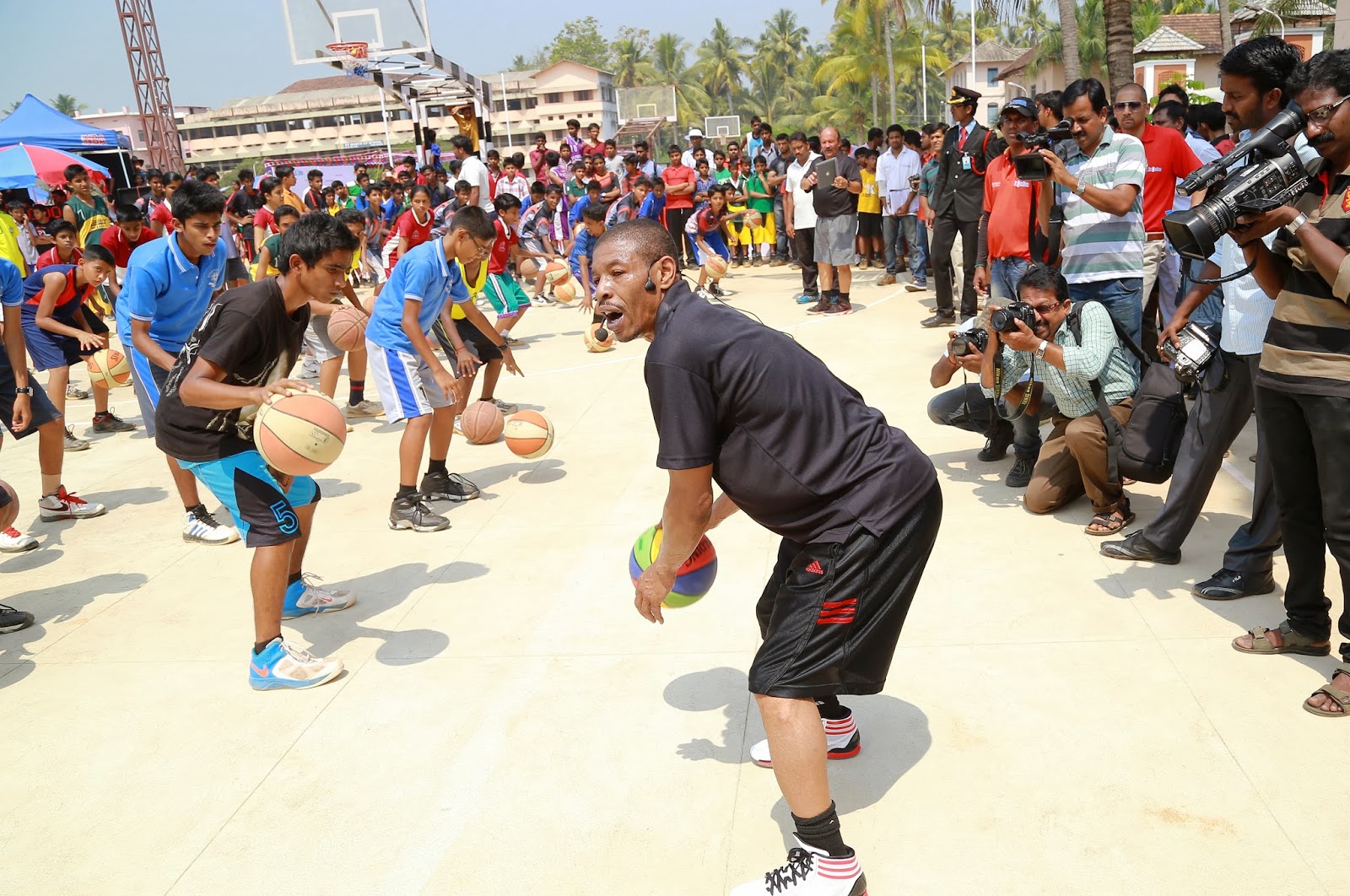
Bogues was invited officially to assist with the first season of the Reliance Foundation Jr. NBA programme, and he visited Mumbai and Kochi in the first week of February to train the hundreds of players and coaches involved in the events.

"I'm here to teach kids the game of basketball in schools and hopefully get them interested in the game at a young age," he told the Times of India, "The most important message I look to share is how important it is for youth to be active and healthy."

The Reliance Foundation and NBA announced a multiyear partnership to launch a comprehensive school-based youth basketball strategy for India: the Reliance Foundation Jr. NBA programme, which aims to teach basketball to more than 100,000 youth and train 300 coaches and physical education instructors to implement a turnkey NBA curriculum in India. Over the course of the long-term partnership, the goal is to reach one million youth and train 2,000 coaches and physical education instructors across the country.

Bogues visit included attending the finals of Kerala's first Reliance Foundation Jr. City Championship in Kochi, where he trained the kids and gave out awards. He thrilled the kids with an exhibition of various basketball skills, including ball-handling, shooting and defending techniques.

Of course, Bogues' calling card for his career and after has always been his height, or lack thereof. So when asked how he managed to enjoy a long career with the height disadvantage, he flipped the script. "In fact, I thought of it as an advantage," he told The Hindu, "No one knows, how big your potential is, how big your heart is. When you start dreaming, you start winning."

To Mid-Day, he added that the qualities of teamwork and sportsmanship are more important than being tall in basketball. He used his own example to motivate kids in India who might be too short, too unskilled, too poor, or too far away from basketball opportunities in other countries. "There can definitely be an Indian player in the NBA some time soon," he added in the Mid-Day interview, "I mean never say never. I'm living testimony of it. Even though India is not known for tall athletes, don't get discouraged with that. Great things come in small packages."

In his NBA career, Bogues played with years with the Washington Bullets, Charlotte Hornets (he's still their franchise All Time leader in minutes played, assists, and steals), Golden State Warriors, and Toronto Raptors. He averaged around 11 points and 10 assists in his prime years. He briefly coached WNBA's Charlotte Sting and currently coaches the United Faith Christian Academy. And he had a monumental role in Space Jam. For all intents and purposes, Bogues went out and proved that size and circumstance shouldn't hold back one from achieving their dreams.

And to young Indians who interacted with him, Bogues' visit once more proved that no matter how small, underprivileged, or how far you may be from your goals, nothing can stop you from dreaming big.

September 22, 2011

Start dribbling kids; India needs a point guard


When I was younger, one of my favourite movies was the Michael Jordan/Bugs Bunny starrer Space Jam (Unshameful disclosure: it still is one of my favourites, actually). What I loved almost as much as the movie though was the soundtrack. Chris Rock and Barry White captured it best when speaking about the emotions of a young wannabe basketball star in 'Basketball Jones'.

Then one day, my mama bought me a basketball
And I loved that basketball
I took that basketball with me everywhere I went
That basketball was like a basketball to me
I even put that basketball underneath my pillow
Maybe that's why I can't sleep at night


Aah. How I wish to see the day when hundreds and thousands of young kids in India will grow up with the 'Jones'. When they fall in love with a basketball as much as they love the cricket bat. When they keep dribbling, day and night, so that the by the time they grow up the basketball becomes an extension to their own body.

No position on the basketball court has more of a 'basketball-an-extension-to-the-body' feel than the point guard. The PG spends (or should spent) more time than any other player on the court with the basketball in their hands, and in my opinion, clearly is the most important guy on the court.

Point guards are in fashion, aren't they; well at least, in the NBA world they are. Derrick Rose won the MVP award and made it possible for a point guard, for the smallest man on the court, to be a volume scorer and be in a fantastic winning team. Iverson of course did it first, but he was never strictly a PG; the likes of Eric Snow were deputised to bring the ball up for him and them let him go ballistic.

Where am I going with this? Well, a few months ago, the NBA brought over Brandon Jennings to India, another 6 foot tall (or short, by NBA standards) point guard who preached the good word that we didn't need to be tall to be an effective basketball player. It's an easy message to be bought by the Indian hoops loving public, because seven-footers (or six-foot-nines, or six-foot-sixes) are a difficult commodity to find. It was the same in China, of course, a country made popular in basketball by Yao Ming, but in reality, most of their aspiring stars, like ours are much shorter and dream of moulding their game in the Iverson/Rose/Nash/Paul etc blueprint.

So, selling point guards in India should be easy, right? If anything, we should be teeming with point guards behind every nook and cranny, basti, and gullie, right?

Wrong.

India is in desperate need of a point guard, or two. Our national team's performances at the FIBA Asia Championship (ABC) in China over the past week proved this point even further. India played four games, lost them all (even the ones we should've won). Our only 'win' was a Qatar forfeit, and we returned with a 14th place finish. It was a disappointing performance, and one that I will get into in more detail when the tournament finishes.

India hired former NBA coach Kenny Natt to be our head coach. Natt, a brilliant and experienced leader, has had some experience with good point guards in the past: he was the assistant coach to Jerry Sloan with the Utah Jazz, where a certain John Stockton (you know, one of the best PGs ever, who holds the NBA record for most career assists and steals blah blah blah) was at the helm. Natt chose to take a different challenge by coming to India, and even before the FIBA ABC began, he made clear that, despite his happiness with the team at hand, there was a little 'situation' in the point guard position.

This is what he said in an interview with The Mint at the beginning of August:

We’re pretty good with our small forwards, and the two guard, and four and five are in pretty good shape too, but our point guard situation is in limbo. Obviously Sambhaji (Kadam) has taken the lead in that respect. He’s a veteran and he’s shown leadership on the floor, but with his age who knows how long his body is going to hold up.


Sambhaji Kadam is the 'Jason Kidd' of Indian players: a smary, savvy veteran, known for years to be one of India's best ball handlers and creators. He wasn't without fault in his prime of course, but few are.

Unfortunately, Natt's worries about Kadam proved to be right, as an injury prevented the veteran from joining the team in China.

What happened next? India were left with able ball-handlers, who weren't strictly point guards, but were forced to play out of position without our one true leader. Vishesh Bhriguvanshi, a natural SG/SF, is a great all-round talent, but had a troubling championship because he forced to handle the ball too much and couldn't get into his natural flow of the game. Hareesh Koroth is one of the team's best shooters and perimeter defenders, but his handle and creation has always been kind of iffy. Prakash Mishra is a good guard, but not up to the elite level. And then there's Talwinder Singh 'TJ' Sahi, India's best answer to 'The Answer', who has modeled his game a little too much around Iverson: Sahi is a brilliant scorer but wasn't the kind of floor general/passer that fulfilled Natt's needs.

India did have, in my opinion, someone I felt who was close to the 'ideal' PG to fill in Sambhaji's exalted shoes: Arjun 'Golu' Singh. Arjun Singh is one of the best floor generals I have seen, and who has shown the ability to switch between perfect provider and perfect scorer with ease. But Golu has had a troubled year since his huge performance at the Federation Cup back in February: he suffered an injury that kept him out of the early days at the National camp in Delhi; then, when he was healthy enough to participate, he was found guilty of a minor illegal substance misuse issue; and then he got hurt again. He's still only 21 and may still make that comeback, but we wonder if he will ever live up to the potential that India needs of him.

There are other options of course. Experienced players who are just not good enough to make the cut. Young players with potential to be decent but not great. We need better than that.

After three losses at the FIBA ABC, and three games without a proper PG, this is what Natt said in an interview with FIBA.com:

Natt... I have been around long enough to know it's very hard to compete without a point guard, they're an extension of the coach out on the floor. Our guys have played hard without a point guard, they've shown they can come out and compete.
FIBA: Is it hard to develop point guards without little kids growing up in India with a ball in their hands, playing the game every day?
NATT: That's the way it happens. Even now I see basketballs being bounced in India, and that's when you know you are getting there. When you can drive down the street and you see the ball under the arm, or someone's dribbling the ball or they're playing basketball in the park, that's when you know they're getting the message of basketball. The Indian people love it, it's just a matter of us continuing to expose them to it.


What the great coach is talking about right there is what Chris Rock and Barry White talked about on the Space Jam soundtrack. The Basketball Jones. We need a child to love basketball so much that he never lets go of it. We need neighbourhoods of children competing on who's got the quickest crossover. We need players who become so familiar with the basketball that, in the game situations, they can focus on leading, passing, and creating the play, and letting the basketball do the handling for itself, like an extension of their own body.

So listen: you, 11-year-old in Mumbai or Ahmedabad or Chennai or Kapurthala, with dreams of becoming an NBA star: pick up that basketball and just start dribbling. Dribbling it when you're sitting down. Dribble it when you're standing up. Dribble it when you're studying and dribble it when you're watching TV. Dribble two basketballs, practice the crossover, get faster, dribble while you run, dribble, stop, and quickly start dribbling again.

As I've learnt from personal experience, few things in basketball are as difficult to master as great handle on the ball, but the younger you start, the more you master it. When you master it, you can look up and see the court, run back and forth, easily spotting the open man, deciding the right time to pass, or whether to pass at all. You will do what the Jason Kidds, Steve Nashs, Chris Pauls, John Stocktons, and Magic Johnsons of the world do best. And you will do this without needing to look down at the basketball, which will be doing the dribbling itself; it will become another part of your body, a weirdly-shaped limb that you can control to a certain extent.

India needs you kids: go out and get that Basketball Jones.

July 1, 2011

Locked Out


A year ago today was one of my most optimistic days as an NBA fan. July 1, 2010, when LeBron James, Dwyane Wade, Chris Bosh, Amar'e Stoudemire, Joe Johnson, Carlos Boozer, and a whole host of others became free agents. My favourite team, the New York Knicks, had the money to afford two of these guys, and although we were able to snag 'only' Amar'e to New York in the end, there was that exciting potential of this many talented guys shuffling things around a little.

That summer, which I previewed in my article on July 1, 2010: the 'Summer of 2010', turned out to be more explosive than expected, and taking the cue from July, every month of the NBA Calender there onwards, July 2010 - June 2011, became more and more exciting. LeBron James, Chris Bosh, and Dwyane Wade teamed up to make the most hyped/hated/talked-about 'SuperTeam' in Miami. The Knicks got Amar'e, and in a mid-season trade, got Carmelo Anthony, instantly bringing back excitement to New York. Boozer joined the Bulls, and became an important piece in their significant improvement last season to end up with the best regular season record in the NBA.

From then onwards, it was as if the NBA's wildest marketing fantasies came true, one after the other. All of the league's biggest markets - Los Angeles, New York, Miami, Chicago, and Boston became relevant. The NBA featured the perfect mix of old school stars (Garnett, Ray Allen, Kobe, Jason Kidd, Steve Nash), in-their-prime stars carrying the hype of the league (LeBron, Wade, Nowitzki, Kobe, Carmelo Anthony, Chris Paul, Dwight Howard), and great young stars looking primed to make sure that the NBA remains in good hands in the future (Durant, Rose, Griffin). Yes, I know I put Kobe in two lists up there, simply because he's old school and still a marquee name.

You know what else went right? Pretty much everything short of a dream Lakers-Heat Final. The All Star Game got great ratings, a home-team superstar performance by Kobe Bryant, and a grand show by Blake Griffin which included an over-the-car dunk. The playoffs were one of the most exciting ever, getting the fans to believe that the NBA is not as predictable as cynics say it is. And the Mavs winning out in the end was a karmic finish (for those who like things coming full circle and all that) for Nowitzki, a feel good win for team-oriented, "nice guy" play against the three-headed Rakshas over at Miami. Teamplay beat individual brilliance, and it seemed nearly the entire world (except for Heat fans) were happy about this.

Oh, and did I mention that the Finals ratings were amongst the highest in the decade? Did I mention that, despite a poor draft class, this year's draft got the highest TV rating ever? Despite a bad economy in the US, crowds still rushed to watch the NBA games.

I can keep going on: internationally, the league kept the fans on its toes and connected better than ever before. The NBA became the biggest sports league since the English Premier League. The NBA marketed itself brilliantly worldwide, and got all the positive responses.

Simply put: until yesterday, the league was officially in one of the best positions it has ever been, primed to have another legendary, hugely anticipated season.

That is just one way to look at it.

Because the undercurrents to this all was a serious, rising threat of an NBA lockout. No matter how much hype you saw around you, there was always a sobering article somewhere, reminding us that the CBA negotiations were not going well, that the two sides were far apart, that a lockout was near inevitable. I didn't believe it of course - I'm a damned optimist, and when I read anything that depresses me even a little bit, I can't pay attention to it. The words skim over my head and I quickly distract myself with something else.

Unfortunately, I can't distract myself any longer, nor can I ignore this reality. July 1, 2011, exactly a year after that summer of optimism, begins the summer of depression. The NBA announced that it will commence a lockout of its players, effective at 12:01 AM ET on July 1, 2011 until a new collective bargaining agreement is reached with the National Basketball Players Association (NBPA).

What does this mean for us?

It means, possibly, maybe, no Summer League in July. Possibly No Pre-Season in October. Possibly no NBA Regular Season in November. And if things look really bad (they do), then say goodbye to any basketball until later next year.

HOLYZARKCHOOCOSUCRSLARTIBARTFASTMOHTHEFACKHIT!@!$#@#($#(Q$*Q#(

The word 'Lockout' brings out 2 memories to my mind. The first is from my favourite basketball related movie of all time, Space Jam, where the NBA had to lock-out the 1995 season because the aliens from Moron Mountain stole the talents of Patrick Ewing, Charles Barkley, Larry Johnson, Muggsy Bogues and Shawn Bradley to beat Michael Jordan and the Loony Toons, aka the 'Toon Squad'.

The second memory is slightly more real, when the NBA locked-out FOR REAL after Michael Jordan retired (if you didn't know, MJ runs everything basketball. Now you know) in 1998. The 1998-99 season started a little late, and only two-thirds of the regular season was played. The playoffs included a dream run by the Knicks to become the first eighth-seeded team to make the Finals, which were eventually won by the Duncan/Robinson Spurs, and sparked the beginning of one of the most consistent teams in NBA basketball.

That 1998-99 season was the first real season that I closely followed NBA basketball. That was the season where I could call myself a real fan, not just a casual over-hearer of news. And of course, because of the Knicks' amazing run that year, that the the season that made me a fan of NYK.

For Knicks fans like me, it's been downhill ever since, all until, ironically, today, when the Knicks are relevant again, and we face yet another lockout. CRAP.

So as a fan, NBA basketball has come full circle, starting with the last lockout and peaking with this one, before it all comes crumbling down again. I blame everyone involved. I blame David Stern (NBA Commissioner) for not softening his approach to the players. I blame Billy Hunter (NBPA Executive Director) for not softening his approach to the owners. I blame the players for not accepting lesser money. I blame the owners (who say that 22 out of 30 NBA teams are losing money) for being greedy.

The reality is of course several times more complicated than my super-simplified version in the paragraph above. I actually feel that I'm disrespecting the complexity of the negotiations by that simplified above paragraph. But no matter how deep you go into the issues, it all comes back to the basic, painful truth: there might not be any NBA games in the recent future. Not David Stern, or Billy Hunter, or the Lakers' Derek Fisher (President, NBPA), or the owners, all the other millionaire men in shiny black suits, or and millionaire athletes in fresh NBA jerseys... The lockout will hurt someone else much, much more.

The fans.

For the fans, the formula is simple. You can't see your favourite teams and your favourite players perform at the highest level. Until things get figured out, there will be no more excitement of trades this offseason, no one checking to see if rookies are developing, no teams getting upgraded, no faces of NBA players on any NBA websites (this one hit me HARD - check out NBA.com).

And worst of all, there will be no NBA basketball.

Sniff.

January 12, 2010

NBA.com comes to India: But is India ready?

Here is an article of mine that was recently published on SLAMOnline.com. It is an extended of my earlier post NBA.com/India(!!)

While researching for any recent news concerning the NBA’s growing interest in India, I discovered a short video on YouTube, where a bumbling journalist for NDTV (one of India’s best-known news channels) finds Shaq in Phoenix, and asks him a thing or two about NBA in India. Shaq stoically answered superficial questions about promoting the game in India, adding sometime along the lines of India and the NBA needing each other… “We need to come out there and have a couple of games…”


Soon after, the interviewer dropped a gem of a question, which started off with, “Now, you know in India, you’re known as much for Space Jam as you are for your slam dunks…”. And a few seconds later, adds, “Now again, you have a lot of rap fans, a lot of fans in India. Do you want to do a little rap for your fans?" Shaq’s ‘rap’ went something like this: “I just wanna say I love you / See you / Peace.”

I laughed for a few long minutes after this, took a deep breath, and then laughed some more. This is the knowledge of NBA in India, through one of the countries ‘best-informed’ media houses: Shaq was in Space Jam (apparently, nobody else but me tuned in during that July afternoon back in 2006 when HBO-India showed Kazaam. But what the hell, even I tuned out when Shaq started to rap in that Aladdin costume.

I may be picking cynically over one or two simple mistakes by that journalist, but the general mainstream awareness in the Indian media about the NBA isn’t too far from this. Except for the fringe population of basketball nerds, most NBA fans in India don’t know the Chris Bosh from the Chris Paul, the Baron from the Ricky, and wonder why the NBA sent a 65 million year old Triceratops named Mutombo to inaugurate basketball courts here.

Despite the ignorance and disinterest of the Indian audiences, it would be fair to say that, so far, the NBA’s efforts in India haven’t been commendable, especially in the last two years. It all really got into gear in July 2008, when Dominique Wilkins, Sam Perkins, Kyle Korver, Ronny Turiaf, Linton Johnson and Pat Garrity toured India as part of a Basketball Without Borders program to promote basketball and oversee an Asian youth camp that was held in New Delhi. Wait, did I say Dominique Wilkins? Dominique Fr*ggin Wilkins came to India, and yes, Dominic Fr*ggin Wilkins left after nothing but a minor whimper of fanfare. I guess we were too busy watching Shaq dunk over Bugs Bunny, huh?


There was an even bigger star that visited the Indian shores in recent years… Back in the summer of 2006, an adidas sponsored event landed none other than Kevin Garnett here, as part of KG’s promotional visit to India and China. His whirlwind tour touched several parts of the country, and I was lucky to crash his visit to a school in New Delhi and ask KG (then unsettled at the Timberwolves) to join the Knicks. He laughed.

In April this year things started to heat up – the NBA started to webcast live playoff games in India by offering free previews and specialized subscription packages. Around the same time, world famous virgin and three-time NBA champion AC Green was sent to India by the NBA to feature in court dedications in Mumbai. When interviewed, Green called for a professional league in India.

Things looking up? The NBA began looking to open an office in India, and a blink of an eye later, December 2009 falls upon us, and here comes Deke! Mount Mutombo, in all his prehistoric glory, was next, inaugurating basketball courts in Mumbai and Chennai a couple of weeks ago.


But the biggest news followed just a few days later: The NBA formally launched its India website: NBA.com/India, and all of a sudden, I was watching the NBA Commish greeting Indian basketball fans, expressing joy, hope, delight, etc…

The website is a humble, low-maintenance version of the NBA’s official website: its designed to target new or emerging basketball fans, with features such as video highlights, basic NBA rules, and Basketball 101 about things that most fans may find obvious: How to shoot the perfect free throw? What the hell is a ‘Sixth Man’? Court Dimensions? Etc, etc… The website even has some material in Hindi, although there have been complaints about inaccuracies with their usage of the Devanagiri script.

Another feature will be the Point-Counterpoint Blog, kept by two of my favorite NBA PGs, Steve Nash and Baron ‘I’ll forever make Andrei Kirilenko’s descendants shiver’ Davis. I know, information overload, isn’t it?

What really interests me is the feature of Thursday Live Game Webcasts, which began with the Wizards playing the Kings (my friend’s supposedly ‘excellent’ broadband connection couldn’t pick it up though, so instead I followed Live Box Scores on Yahoo! Sports. Sad, yes, I know.) If this venture is eventually successful, real NBA fans here will be able to watch an additional live game every week, adding to the measly two we get Friday and Saturday mornings.


The potential is great… But will the Indian media and fans embrace it? Why should they embrace a game where non-Indian cities take on other non-Indian cities with non-Indian players, anyways?

Well, because, firstly, China did it. And secondly, there’s the English Premier League…

I like to compare the “coming of the NBA” to the outrageously over-the-top coming of the English Premier League (EPL — football to the uninitiated, soccer to the American) to India: not only do ESPN/STAR Sports show five or six EPL games a week, they also have several talk shows, magazine shows, and highlight shows talking about the EPL matches in great depth. These shows are regularly directed at the Asian/Indian audience which makes them even more fun to watch for the football fan here.

The EPL was always on its way here — teams like Manchester United, Liverpool, Arsenal and Chelsea easily have large audiences in India, and players like the (now departed) Cristiano Ronaldo, Steven Gerrard, Wayne Rooney, Frank Lampard, Cesc Fabregas, etc., etc., etc., give our audiences icons to look up to. The excitement has spilled out including fan-followings of the star-studded Real Madrid and Barcelona teams in the Spanish Primera Liga.

But it’s not like the NBA has a lack of potential icons — as a matter of fact, it is literally TEEMING with it. You could play like LeBron or Kobe, like Wade or Dwight or Chris Paul, or Kevin Garnett or Duncan. There are flashy dunks, no-look passes, game winners, and old-school entertainers/favorites like Iverson or Shaq (I cringe and feel archaic as I say that: Shaq and AI are OLD SCHOOL?)

But the final goal, at least the way I see it, shouldn’t be just commercialization of the NBA, but popularization of basketball as a whole in the country. I recently contacted JD Walsh, the founder of the JDBasketball movement who has spent the last three years in India as a coach, talent scout, and a promoter of basketball in India. “I do hope that the NBA [site] will provide a new introspective to cultivate NBA fans in India,” JD said, “I do think the internet in India will need to grow some before its really significant — which it will. A good litmus of the trajectory of increasing basketball popularity in India will be not only be seen on NBA blogs but on the sites of others writing about the grassroots play of India–and more kids playing the game.”

The website will have to become a stalwart to accelerate the slow integration of basketball in Indian culture. The Basketball Federation of India (BFI) had this to say (source: Techwhack): “There is a great appetite for basketball across India and the sites will offer Indian fans the opportunity to learn more about the NBA and basketball in India. Basketball is one of the fastest-growing sports in India.”

That it is, and in typical NBA.com style, we can expect a lot of fluffy, everything-about-the-NBA-is-awesome reporting from the India site, but hey, it’s a start. The NBA has appointed two featured India bloggers: Experienced DNA sports journalist Ayaz Memon and Hindustan Times correspondent Sahil Sharma. Here’s to hoping that their efforts help the awareness of the game blossom here.

*First published on SLAMOnline.com on January 7, 2010.


Bookmark and Share