Showing posts with label 2014 Asian Games. Show all posts

April 27, 2015

Contracts of India's Foreign basketball coaches Francisco Garcia and Tommy Heffelfinger not extended


While the Basketball Federation of India (BFI) attempts to juggle controversies and power struggles threatening to tear apart the nation's governing and controlling body of basketball from within, budgeting issues and internal changes of philosophy have struck another blow to the game: two foreign coaches - Women's National Team Head Coach Francisco Garcia and Strength and Conditioning Coach Tommy Heffelfinger - did not receive extensions to their contracts with the BFI and will end their tenure with India Basketball by the end of May.

The decisions to not extend the contracts of Garcia and Heffelfinger were taken by the contingent of the BFI currently being led by Poonam Mahajan and Roopam Sharma. The federation is currently facing a fracture in its top structure: two opposing executive committees have chosen two different presidents/secretaries from two different meetings to form the leadership group. Sources inside the BFI have said that the Mahajan/Sharma contingent made the decision to discontinue the coaches' contracts because they are short on money (since the bank accounts are controlled by the competing Govindraj team) and felt uncomfortable about disagreements that the staff members had with the leadership and direction of the Mahajan/Sharma team.

Garcia, a Spaniard, was hired by the BFI two years ago to helm India's Senior Women's team. Garcia enjoyed a relatively successful two year stretch, famously helping India finish at a best-ever fifth-place at the 2013 FIBA Asia Championship and helping a younger side to a bronze medal at the 2014 Lusofonia Games. Later in 2014, Garcia also coached the team to a 6th place finish at the Asian Games in Incheon. He has been active in taking his knowledge to the grassroots level, coaching players and other coaches at various events around the country over the last few years.

"The best thing was that we created a system of play," Garcia told me as he looked back to his achievements with Team India over the past two years, "When I first came here, the players were used to another kind of system. Now, players understand the game lot better. To reach that point is the best achievement for a coach. As a team obviously to win our first-ever game in FIBA ABC's Pool A and finishing 5th (best in Indian basketball history), ranking India 5th in Asia (best in history) have been huge. We got bronze medal at Lusofonia games with an under-22 team and we competed very well at AsĂ­an Games without three key players from the ABC."

Garcia added that his best memory in India, no doubt, was working with the players. "They were always open to new things and always tried their best, even in the bad days," he said.

There seems to be no clear plan of who will carry on the reigns of the Women's national team system after Garcia leaves. Starting at the end of August this year, the FIBA Asia Championship for Women - the most important international tournament for Indian basketball - will tip off in Wuhan (China). India will lose their Head Coach only a few months before this crucial tournament and thus, lose the continuity that he had built within.

As usual, there is a good chance that the Women's team will not receive the international exposure and experience needed to prepare for this tournament. "Main thing lacking is the competition of the players throughout the year," Garcia said, "There is no professional league and little international exposure."

"Additionally, our players have to strengthen their inside game to show up to the next level."

Garcia has received offers from another national teal in Asia and a team in Iceland. "I don't know, life is unpredictable," he said, "All can change in seconds."

Seeing another change at the top ultimately hurts the national team players the most, who have lacked continuity in leadership. Ever since the IMG Reliance deal with the BFI, the National Women's team has had three different foreign coaches in less than five years: Tamika Raymond, Pete Gaudet, and Francisco Garcia. With Garcia's contract expiring, will there be a fourth one in stow soon? Garcia's two years have brought some improvements in the team's performances, but more importantly, created a structure that was pointing towards steady improvement for the future, too. With a change in coaching, there will be a change in system, and thus, another hiccup in the development of basketball.

Strength and Conditioning Coach Tommy Heffelfinger, who arrived from the USA to build Indian basketball's S&C programme last year, had a two year contract with an option at the end of his first year. The BFI was to conduct a formal review of his work and determine if they would like to keep him for second year. The BFI claim they did the formal review, but an inside source told me that nobody from their leadership (CEO or Deputy CEO) spoke to Heffelfinger for three months prior to his termination or answered any emails he sent for same time. His first year ends 31 May, 2015.

Heffelfinger has shown commitment to making Indian basketball players stronger, fitter, and better versed in the appropriate diet and training regimes required for excelling in international basketball. Strength and conditioning has long been a problem for India compared to top Asian teams. Getting rid of Heffelfinger will further set India back in this regard.

India's Men's team Head Coach Scott Flemming - who joined me a few weeks ago for a conversation on the inaugural episode of the Hoopdarshan podcast - is continuing with his position for the foreseeable future.

January 1, 2015

2014: The Year in Indian Basketball


Flip the calendars and adjust your dates. It's now 2015, and so much has changed in Indian Basketball in the past 12 months. Peaking with India's memorable victory against China mid-way through 2014 as well as other positive international performances, you could say that it was the year that basketball in the country truly began to grow up. Domestically, Indian basketball players were involved in bigger and better BFI, NBA, and Reliance Foundation events, events that reached to farther corners of the nation than ever before.

Let's look back at some of the biggest news stories from 2014 in Indian Basketball.

- In January over in Ahmedabad, ONGC repeated as Federation Cup champions with a big win over rivals IOB in the final, while Chhattisgarh's Women's side closed out the tournament in thrilling fashion with a one-point win over Maharashtra. Chhattisgarh's Radhakrishnan and ONGC's Vishesh Bhriguvanshi were named tournament MVPs.

- Just a few days later, Kolkata's outfit Eastern Railway capitalized their unexpected run with a final victory over Assumption College (Changanacherry) to win the 5th JCI All India Invitational Basketball Tournament, held in Athirampuzha in Kottayam district, Kerala. In the Men's Final that followed, Bangalore's outfit Vijaya Bank blew out Customs (Chennai) for a resounding victory.

- ONGC were back atop the podium the next week, defeating IOB once again in Mumbai to win the 9th Savio Cup in Mumbai. Although they started as favourites to hold on to their title, Southern Railway had to battle till the very end and use every bit of their talent and experience to outlast the spirited hosts Maharashtra in the Women's final.

- Goa played host to the 2014 Lusofonia Games, and Indian Basketball Men's team gave the home fans a real reason to celebrate. Under Head Coach Scott Flemming, India defeated Angola in thrilling fashion to win gold at the Games' basketball tournament. They were undefeated through the course of the tournament. India's Women's team - comprising mostly of under-21 players - finished with a bronze medal. Mozambique won Women's gold.

- Former NBA point guard Muggsy Bogues returned to India for his second trip in the first week of February. Bogues took part to assist the first season of the Reliance Foundation Jr. NBA programme in the country: he visited Mumbai and Kochi to train the hundreds of players and coaches involved in the events.

- February also offered some sobering news as basketball was de-registered as a sport in Jammu and Kashmir by the Jammu and Kashmir State Sports Council (JKSSC), ending all funding for the sport in the state.

- The 64th National Basketball Championship for Men and Women was delayed in 2014 and finally tipped off near the end of February in New Delhi. The delay wasn't the only anomaly: Chhattisgarh's Women ended a 10-year dominating run by Indian Railways at the Senior Nationals by defeating the pre-tournament favourites in the finals to snatch the winner's trophy. Meanwhile in the Men's section, Tamil Nadu's played some brilliant basketball through the course of the tournament and defeated Punjab to secure gold. Tamil Nadu's Rikin Pethani and Chhattisgarh's Kavita Kumari were given the Harish Sharma Most Valuable Player trophies at the end of the tournament, an award named in honour of the BFI's former CEO who passed away two years ago. Former NBA Head Coach Del Harris was a special guest at the nationals and held a 'Train the Trainers' clinic for attending and local coaches and players.

- In mid-April, ONGC (Men) and Southern Railway (Women) defended their titles at 2014 Advani Memorial Basketball Tournament in Jaipur (Rajasthan). Southern Railway's Kokila Subramani (Women) and ONGC's Amrit Pal Singh (Men) were named MVPs.

- After six months of action in eight cities, the finals of the 1st BFI-IMG Reliance National School/College League were held over five days in early May in New Delhi. Teams from Ludhiana and Chennai made their home cities proud with championship medals.

- In mid-May, India's Men's National Team took care of business at the 3rd South Asian Basketball Championship in Kathmandu (Nepal) dismantling four South Asian winners in efficient victories and qualifying for the 5th FIBA Asia Cup in Wuhan (China).

Photo courtesy: Ekalavyas
- The 64th Junior National Basketball Championship for Under-18 Boys and Girls - held at Kochi (Kerala) from May 26th to June 2nd - came down to a double rematch in both the divisions from last year's Finals. Chhattisgarh defended the girls' title with a second consecutive Final victory over hosts Kerala. Punjab's Boys redeemed themselves after last year's loss in Cuttack to snatch the title over Delhi with a win in the Boys' finale. Punjab's Arshpreet Singh (Boys) and Chhattisgarh's Sharanjeet Kaur (Girls) were named MVPs.

- NBA point guard Isaiah Thomas - who was with the Sacramento Kings until the summer and is now with the Phoenix Suns - visited India in June 2014. Thomas spent time in Mumbai and Chennai, where he visited schools, community organizations, and conducted youth clinics. He also joined the NBA's official broadcaster in India Sony SIX to provide analysis of the NBA Finals.

- Three Indian players - Vishal Gupta (Andhra Pradesh), Ashish Briggs (Madhya Pradesh), and Mahipal Singh (Rajasthan) - were invited to NBA/FIBA's Basketball Without Borders camp in Taipei from June 13-16. There were among 50 of the top young players from Asia and Oceania at the camp.

- By defeating Bangladesh and Sri Lanka on consecutive nights in July at the Koramangala Indoor Stadium in Bengaluru, India's U18 men's squad won gold at the South Asian Basketball Association (SABA) Qualifiers for the 23rd U18 FIBA Asia Championship. They qualified to represent South Asia at the U18 FIBA Asia tournament in Doha (Qatar).

- The highlight of 2014 - and really, one of the All Time highlights in Indian basketball history - was India's campaign at the 5th FIBA Asia Cup in Wuhan. In their second game of the tournament India defeated hosts and Asia's top squad China on their home soil, 65-58, in the 'Wonder of Wuhan'. India gave a scare to the continent's other top teams, and despite the Quarter-Final exit and just a seventh place finish, Flemming's team displayed performances on court that are sure to earn them respect in major Asian tournaments in the future. Iran eventually recaptured gold the gold by defeating Chinese Taipei in the final. The tournament was also notable for the flare-up of the nasty FIBA Headgear controversy, hurting India's Sikh star players Amjyot Singh and Amrit Pal Singh.

- Back home, former Portuguese basketball coach, general manager, television analyst, and ambassador Carlos Barroca was chosen to replace Troy Justice as the Senior Director of Basketball Operations for NBA India.

- India's junior boys' squad disappointed at the 23rd FIBA Asia U18 Championship in Doha (Qatar), finishing 13th (last), losing two of their three Preliminary Round games and failing to qualify for the next stage of the tournament. China played fantastic basketball through the course of the 10-day tournament and made this their 11th gold overall in the tournament. The FIBA Headgear controversy returned, as India's Anmol Singh was forced to remove his turban in the first game against Qatar.

- In mid-August, NBA India launched the biggest ever iteration of the NBA Jam, the hugely popular college basketball and youth festival, spreading out to 16 cities and involving a greater number of young Indian basketball fanatics than ever before.

- On August 29, Indian basketball superstar Geethu Anna Jose added another feather to her cap by being officially conferred the Arjuna Award - prestigious national award handed to sports-persons in India by the Government of India - by President Pranab Mukherjee at the Rashtrapati Bhavan in New Delhi. Jose became the 17th basketball player in India to receive this award, but only the first since 2001. She was also only the second women basketball player to win the Arjuna Award since Suman Sharma in 1991.

- With the expectation to engage over 750,000 youth basketball players and train PE teachers at more than 1,000 partner schools across India, the Reliance Foundation Jr. NBA programme returned with a bang for it's second year in early September, expanding from three Indian cities to eight. The programme focus was on inspiring youth to adopt a healthy, active lifestyle by integrating basketball into each participating school’s physical education curriculum.

- There was massive expansion elsewhere, too. By the end of September, the Basketball Federation of India (BFI) and IMG Reliance announced the new seasons of the Indian School Basketball League (ISBL) and the Indian College Basketball League (ICBL), to be held in 22 and 21 Indian cities respectively. Over 1100 institutions and 13,000 combined school or college students - both men and women - were set to participate in the ISBL and ICBL in 24 total cities.

- India's Senior Men's and Women's National teams played at the basketball tournaments at the 17th Asian Games in Incheon (South Korea). Topsy-turvy performances by India saw some positive moments but also left a lot to be desired. India's Men finished 12th (out of 16) and Women finished 6th (out of 11). South Korea defended their home turf in style, as both their Men and Women's squads outperformed higher-ranked squads to secure the gold medal.

- In mid-October, at the 31st Youth (U16) National Basketball Championship for Boys and Girls in Chandigarh, Tamil Nadu defeated Kerala in both the boys' and girls' finals to win double gold medals. TN's star performers through the course of the tournament - Eshwar PB (Boys) and Ishwarya J (Girls) - were named MVPs.

- With a victory over rivals Japan in the final, the Chinese eves completed a three-peat of titles at the FIBA Asia U18 Championship for Women in Amman (Jordan) on Friday, October 17th. This was China's 14th overall title in the 22nd edition of the tournament as they continued to be the driving force in junior Asian women's basketball. India, who played in the tougher Level I of the tournament, lost all their preliminary group games but won the crucial Level I qualifier against Malaysia to remain in the higher fray of the competition for 2016.

- From October 15-19, the city of Bengaluru hosted the inaugural Mulki Sunder Ram Shetty All India Basketball tournament, a men's championship that featured six of India's top club level or state teams. After five days of high-notch basketball, the tournament was settled with a comfortable final win by Indian Overseas Bank - IOB - against their Chennai city rivals ONGC.

- Three-time former NBA champion Bruce Bowen visited India to take part in NBA Jam and Reliance Foundation Jr. NBA events at Kolkata, Gurgaon, Chandigarh, and Ludhiana in early November.

- India's senior men and women took part in the 2014 Asian Beach Games 3x3 Basketball tournament in Phuket (Thailand). After an undefeated run, India's Men were finally defeated in the final by Qatar and had to settle for the silver medal. India's Women - reigning champs from 2012 - could not repeat their success after choosing to send a far less experienced team to Phuket. India lost all three of their games to finish at seventh place.

- Madhya Pradesh (Boys) and Kerala (Girls) lifted the winner's trophies at 41st Sub-Jr National Basketball Championship for Boys and Girls in Nashik (Maharashtra), with both teams defeating Chhattisgarh in the final. The MVP awards were handed to Kerala's Sreekala R (Girls) and MP's Mani Thakur (MP).

- NBA Commissioner Adam Silver closed his first year as the head-honcho of the league with his first-ever visit to India, and he brought along Kings' Indian-born owner Vivek Ranadive and former Kings/Lakers player Vlade Divac. Silver, Ranadive, and Divac spent their time in Mumbai, visiting a school as part of the Reliance Foundation Jr. NBA programme and interacting with the Indian press.

- 2014 NBA Jam National Finals conclude in Pune on December 7. Punjab Warriors (Boys) and Pune Ballers (Girls) were crowned the national champions.

- Towards the end of December, New Delhi hosted the national finals of the Indian School Basketball League (ISBL) and Indian College Basketball League (ICBL), featuring the winning 40 school and college teams in the men's and women's divisions from 10 cities. After seven days of exciting hoops action, the representatives of two cities - Chennai (Tamil Nadu) and Ludhiana (Punjab) - separated themselves from the rest of the pack to win their respective 2014 titles.

- On the eve of the launch of the 65th Senior National Championship in Bhilwara (Rajasthan), the BFI named December 28th as the official 'Indian Basketball Day', in honour of the late former BFI CEO Harish Sharma on his birthday. On this day, the best players in the country took part in Men and Women's All Star games and a Slam Dunk contest. Cultural performances, prize distribution, and a remembrance ceremony for Sharma was also held.

It was indeed a year to remember, and India can take heed in successes at the Lusofonia Games, the FIBA Asia Cup, and the Asian Beach Games internationally. Back home, the involvement of new cities in grassroots programmes will play a big role in the future development of basketball talent. The interest shown from FIBA and the NBA, as well as the continuing growth of the BFI, promise bigger things ahead for 2015.

October 14, 2014

The Fit & the Furious


India’s Strength & Conditioning Coach Tommy Heffelfinger discusses the importance of keeping Indian basketball players healthy.

This article was first published in my column for Ekalavyas.com on September 8, 2014. Click here to read the original post.

Tommy Heffelfinger gets the Indian Women's squad psyched up for a
strength and conditioning workout. Photo: Rajesh Chavan
As the final seconds ticked away in India’s Asian Games contest in Incheon (Korea) against the Philippines and an Indian loss was all but ensured, Indian swingman Pratham Singh suffered a nasty fall, hurting both his head and his back. As Pratham writhed in pain on court, a hush fell in the arena, and his teammates momentarily ignored the result to focus on their hurting teammate. Pratham was stretchered off court, and for the next few hours, the Indian basketball team, coaches, as well as fans held their breath and hoped for some good news from the medical team.

Over four and half thousand kilometers away from Incheon, India’s Strength & Conditioning Coach Tommy Heffelfinger followed the game in New Delhi with bated breath, too. Since his appointment by the Basketball Federation of India (BFI) three months ago, Heffelfinger has worked closely with Pratham Singh and several others of India’s top players – both at the Senior and under-18 level in both genders – to ensure that serious injuries are reduced as much as possible.

“When injuries go down, the performances go up,” he stated, something that may sound obvious but is always easier said than done. For an individual like Pratham – a top-six rotation player for India’s Senior Men’s national basketball team – his fitness is directly related to his team’s performance.

Later that day, some good news trickled out of the Indian camp in Incheon back to Delhi: Pratham went through some tests on his back and leg, revealing no serious injuries. He was rested for the next day against Iran, but for the big picture, Heffelfinger let out a sigh of relief.

Hailing from Ann Arbor in Michigan, USA, sports took Heffelfinger across the pond to England for a decade, where he worked with national players from the British Basketball Team, football players of the English Premier League club West Ham United, and rugby players, too. Choosing to be nearer to his wife – who is from Nepal – Heffelfinger jumped at the opportunity of joining the BFI’s Strength & Conditioning team, taking over a position left vacant since the previous Coach – Zak Penwell – finished his tenure. Familiar with India and South Asia in the past, Heffelfinger skipped over the culture shock that most foreign coaches suffer in their initial stages of their visit.

“I felt like I was pretty much ready for anything when I got here,” he said when I met him in New Delhi in mid-September.

What his previous visits wouldn’t have prepared him for would’ve been the basketball. As his predecessor Penwell discovered during his two years in India, the exercise, diet, and fitness regimes of Indian basketball players were uniquely specific and, in some ways, separate from the athletes they would’ve trained before.

“In India, first of all the dietary restrictions are a big deal,” Heffelfinger said, “And this is something to which we are constantly adjusting on camp. Beyond that, when it comes to dealing with player workouts, I’ve learnt how difficult it is for our national team players to stick to their regimes outside of practice – all of these players have other day jobs outside of basketball. It is difficult for them to find dedicated time to follow up with their fitness schedules outside of camp.”

“The positive,” he added, “Is that kids in India tend to have better base mobility and movement. They still do not have better control of their body weight, and we have to work on making sure that they reach certain standards before they start working with heavier weights.”

Heffelfinger’s responsibilities encompass the entire plethora of Indian national teams, including the Seniors, the U18s, the U16s, and the U14s for both boys and girls. Over the past three months, he has only had a chance to work with the Seniors and the U18s, the latter of whom he took part in a camp most recently and will be heading out again to the SAI Center in Aurangabad to help the U18 girls’ prepare for the upcoming FIBA Asia U18 Championship for Women in Jordan in a few weeks.

When his responsibilities eventually trickle down to the U16s and U14s, Heffelfinger will be handed the keys to coaching kids at the most transformative of ages.

Tommy Heffelfinger takes the team through stretching exercises. Photo:
Rajesh Chavan.

“When kids get to a certain age, it is considered their peak-height velocity, after which we can begin more focus on strength training,” said Heffelfinger, “That is a maturation point, usually around 15-16 for most kids, where we can introduce heavy weights more. Before that age, most of the training is usually technique based.”

But once the young players begin to focus on lifting weights and sculpting their bodies for optimum basketball shape, Heffelfinger warns that there is a strict need to be aware of the right parts of the body to work on.

“It’s true, a lot of people don’t know which part of the body they must work on, and the same is true for basketball,” he said, “For example, in basketball, you need to have strong quads, and work on the hamstrings. Focusing on the lifting weights for the right parts of the body will improve performance and reduce risk of injury.”

“Players need to start addressing the balance of their bodies. Posterior imbalance can be the cause of a lot of injuries.”

Heffelfinger’s work over the past three months has already begun to show some early signs of improvement among the elite Indian athletes. He worked with the Senior Men’s team at camp in Greater Noida prior to the FIBA Asia Cup in Wuhan (China) a few months ago, a tournament now immortalized in Indian hoops history for showcasing some of India’s best-ever performances, including a memorable victory over Asian giants China. While the team’s Head Coach Scott Flemming deserved much of the credit for tactically preparing India – particularly on the defensive end – to punch above their weight, the work of Indian physiotherapists and strength trainers such as Heffelfinger in the background shouldn’t be ignored either; it was no doubt that the new Team India looked fitter than ever before and can now respond to many more of Coach Flemming’s gruelling demands.

In training camps, Heffelfinger has also noted improvement on more specific aspects of fitness. For example, he mentioned that the junior girls have improved their short-distance (20 meters) sprint times drastically over the past few months. “The improvement was off the roof,” he said, “I couldn’t even have hoped for them to improve their times so soon. They are all adding strength to their lower body.”

While the early returns have been positive, there are still several challenges that Heffelfinger hopes that India can overcome in the near future. The first priority, he said, is to find a place to lay out all the strength and conditioning related equipment and set up what he hopes will eventually become the ‘BFI Player Development Center’.

“We have all the equipment with us already,” he said, “But we still haven’t been able to use most of it, since we’re still waiting to find a place to set it up.”

Another concern for Heffelfinger has been the diet, and he has noted that the senior teams often return overweight or out of shape form breaks in national camps. With many players also being vegetarian, Heffelfinger has had to get creative with his dietary advice.

“First and foremost, they need to just stay away from oily food,” he said, “Currently, they also seem to have a very limited intake of food, which is shocking.”

Heffelfinger’s long-term goals for India start by prioritizing athlete health. He wishes to reduce basketball injuries by two-thirds and over-training injuries by one-half, too. He also has hopes to collect medical data of Indian players to create reports of players’ injury history. At this point, there is no such existing medical database in Indian basketball.

Further on, he plans to spend time with other strength coaches in India and train them to help create a pyramid system where each coach can then pass on health and fitness tips to many more around the country.

“I feel that there has been a distinct improvement in the national teams over the past few months,” said Heffelfinger, “It was extremely rewarding to see when the improvement leads to improved results.”

Some injuries – like Pratham Singh’s fall at Incheon – are unavoidable. Some are caused by unforeseen circumstances, an over-aggressive opponent, or simply bad luck. There is no perfect science to staying fit and no athlete – no matter how well trained – is going to be indestructible. But concentrated efforts from Heffelfinger and India’s health, fitness, and physiotherapy teams can seriously turn the odds around to avoiding injury.


And, as Heffelfinger states, the obvious fact is also the most important one. Healthier teams are more successful teams. For Indian basketball in the midst of a rapid push forward, any competitive edge for further success should be embraced. 


October 4, 2014

Recap: India at 2014 Asian Games basketball tournament; Hosts South Korea win double gold


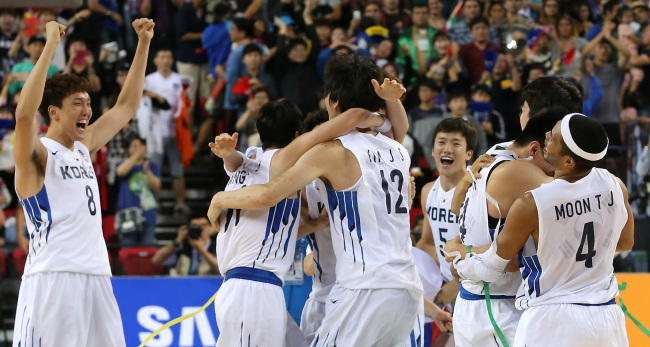
South Korea defended their home turf in style, as both their Men and Women's squads outperformed higher-ranked squads to secure the gold medal at the Basketball tournament of the 17th Asian Games in Incheon. Both the finals of the tournament were held at the Samsan World Gymnasium in Incheon on Friday, October 3rd, the penultimate day of events at the Asian Games. South Korea's Men won a thrilling contest against Iran, while their Women's squad edged to a victory over China.

Topsy-turvy performances by India saw some positive moments but also left a lot to be desired. India's Men finished 12th (out of 16) and Women finished 6th (out of 11).

The basketball tournament at the Games was held at the Samsan World Gymnasium and the Hwaseong Sports Complex from September 20 - October 3.

After trailing by two at halftime, Korea's Women took a third quarter lead over China in the final, before surviving in the final minutes to a 70-64 victory. Yeonha Beon scored a team-high 16 for South Korea, while on the Chinese end, Xiufeng Shi scored 16 too. As hosts, Korea had made sure to send their top 'A' squad to the Asian Games tournament, while their 'B' team played at the FIBA World Championship for Women. China, who also qualified for FIBA Worlds, did the reverse.

In the Men's final, South Korea again rallied on their home support to take an early lead against FIBA Asia champs Iran and hold on to secure the gold despite a strong comeback by the Iranians in the second half. Behind the efforts of their superstar Taejong Moon (19 points) and Jongkyu Kim (17), Korea raced to a nine point lead in the first quarter and held a 42-36 advantage at the halftime break. But Iran - boosted by a 30-point outing by captain Mohammadsamad Nik Khahbahrami - bounced back to take a lead in the third. Down by five in the game's last two minutes, Korea bounced back to take a lead with just 36 seconds left in the game, and a missed last shot by Iran's Khahbahrami secured the hosts a 79-77 win.

Earlier in the day, Japanese Women survived another back-and-forth close contest versus Chinese Taipei to secure the bronze medal with a 61-59 win. Japan's Men won the bronze too, but it didn't come easy against the surprise team of the tournament, Kazakhstan. Kosuke Kanamaru scored 21 points for Japan, who only put the Kazakhs away for good in the game's waning minutes for a 76-72 win. Kosuke Takeuchi added 17 points for the victors, while Kazakhstan's Dmitriy Gavrilov scored a game-high 22 points in the losing effort.

A couple of days earlier, Xiufeng Shi (20) and Dan Liu (18) helped China's Women bounce back from an early deficit to defeat Chinese Taipei 75-63 in the Semi-Final stage. Ping Jen Huang scored 19 for Chinese Taipei in the loss. In the second women's semi-final, hosts South Korea overcame a very slow start to beat Japan 58-53. Japan's Naho Miyoshi scored a game-high 18.

Japan and South Korea also faced off in the Men's semi-final, and after being locked at 34-each at halftime, the hosts once again found a second half boost to race to a 71-63 win. The Koreans overcame 18 points by Japan's Naoto Tsuji. Kazakhstan played valiantly against Iran in the other Men's semi-final, giving the Iranians trouble on all ends of the court until the game's dying seconds. But it was Khahbahrami who poured in a heroic 27 points to insure a final appearance for his nation. Kazakhstan's duo of Pavel Ilin and Anton Ponomarev scored 16 points each in the loss.

After some positive performances over the last few months, India's Men's team entered their last international competition of 2014 with some cautious optimism. India were placed in Group B of the Men's Qualifying Round in the tournament, along with Saudi Arabia, Kazakhstan, and Palestine, and their task was to finish in the top two to qualify for the Preliminary Round with Asia's stronger teams.

India started well against the minnows of their group, Palestine. The Young Cagers raced to a double digit lead in the first quarter and never looked back, hitting from all angles and playing hard on the defensive end, too. Amjyot Singh scored 25 to lead the Indian attack in the 89-49 win for India. One bright spark for Palestine was their captain Hend Sani GS Sakakani, who finished with 19 points for his side.

But India were given a brutal shock the very next day against Saudi Arabia, who were considered to be beatable opponents. The Saudis capitalized on careless offense by India to take an early lead and stretch it to 40-27 at halftime. India began to play their best basketball in the fourth quarter, but the comeback attempt was left too late and Saudi Arabia held on for a 73-67 win. Fahad Alsalik M Belal scored 17 to lead the Saudis. India's top performers were the big men duo of captain Amrit Pal Singh (19 points, 10 rebounds) and Amjyot Singh (19).

With their backs against a wall and needing a win - a convincing one at that - to qualify for the next round against the group's toughest team, India bounced back in style against Kazakhstan. In what became their best performance of the tournament, India's hot shooting gave them a 24-14 lead in the first quarter, and from then on, India held on to their double digit advantage all game. Point guard Joginder Singh hit seven three-pointers for a game-high 25 points, while veteran guard Vishesh Bhriguvanshi added 16. Anton Poromarev scored 16 for Kazakhstan. India finished the game with a 80-61 win; and the margin of victory helped them qualify for the Preliminary Round by finishing top in their group, relegating Kazakhstan to second.

India thus found themselves Preliminary Round Group E, along with Asian giants Iran and Philippines, both of whom had recently represented the continent at the FIBA World Cup in Spain. India started slow against the aggressive Filipinos, who were playing their first game at the competition. The Philippines took a 50-37 lead at halftime, and a slew of bad shooting and turnovers kept India at bay. The Indians did make a strong comeback in the fourth quarter, but it wasn't enough as they fell to a 85-76 loss. Amrit Pal Singh was the game's leading scorer with 16.

India played their fifth game in five days against Iran next, who were playing their first game at the tournament. The more athletic, experienced, and rested Iran side left no chance for an Indian upset. Despite a decent start where India were only down by six in the first quarter, Iran fed the ball to experienced big man Hamed Haddadi (16) for much of the damage in the first half and the explosive Khahbahrami (16) to dominate in the second. India were outplayed in all aspects of the game and their tiredness showed as they fell to a 76-41 loss. By finishing last in the group, they were eliminated from the tournament.

India Men finished the tournament with a 2-3 record at 12th place.

"In general this was a great experience," said Scott Flemming, Head Coach of the Indian Men's team, "Being in a setting with 45 countries and 13,000 athletes is enlightening. This was a chance, if taken advantage of, to broaden our scope globally. In regards to basketball there were things we could control and other aspects we could not control. In the areas we could control I feel as though our defense continues to be our strong point, maybe with the exception of the Philippines game. We have also improved in our shot selection and our accuracy from the field. Where we struggled at crucial times was in our defensive rebounding, free throw shooting and number of turnovers that led to points by our opponents. I will take responsibility for these short comings. They will need to be focused on even more in the future.

"We also had a few areas that we could not control," Flemming added, "Again, we played no preparation games leading up to this tournament. Many of these teams have played anywhere from 10 to 50 preparation games before coming to Korea. These are crucial to compete at these high level tournaments. We also played 2 of the top teams in Asia (Iran, Philippines) while playing 4 and 5 days in a row. They were both fresh in these games. It may not have hurt us so much if we had played in one of the other pools in the next round. But again, those things we cannot control. We ended up first in our qualifying pool. We played very well at times but we definitely need to take another step to reach those medal games. I am proud of what we have accomplished this year but there is definitely more work to be done."

India's Women, who had finished at a best-ever fifth place in last year's FIBA Asia Championship for Women, began their tournament by automatically starting in the quarter-final. The only problem? Their quarter-final opponents were reigning Asian champs Japan. The swift and talented Japanese dominated India from beginning to end, and even holding India to just five points in the opening quarter. No Indian player was able to crack double digits in scoring and Japan cruised to an easy 70-37 win, eliminating India from moving further up into the tournament.

Instead, the Indian eves fell to the 5-8th place bracket, where they first played Mongolia, losers of another quarter-final. Jeena PS got India started off on a roll and the experienced Prashanti Singh (17) took over late. India maintained a healthy distance from the Mongolians through the course of the game and held on for a 68-50 win. Mongolia's leading scorer was Ganzul Davaasuren, who finished the night with 25 points.

India's last game at the tournament was against Kazakhstan, and despite a competitive start, India were outclassed for the final three quarters of the game. Kazakhstan, who had a 15-12 lead after the first quarter, stretched their lead to 14 at halftime and then outscored India 19-4 in a big third-quarter surge. Kazakhstan finished the night with a 68-47 win and were secured of fifth place at the tournament.

India Women finished the tournament with a 1-2 record at sixth place.

"On paper, if you check that we were at 6th position, you might think we played a good tournament," said Francisco Garcia, Head Coach of India's Women's team, "And of course, 6th position is good since that we had the youngest team in competition. But the reality is that we did not find our pace in this championship. Mainly we faced teams with players who play around 60 games a season and came to Incheon with 10-15 practice games before the tournament began. We came here with zero practice games after three camps. And of course there is no team in the world who do that before a championship. I am really dissappointed about that."

"We have been asking since a long time ago to create pro leagues for men and women and no one listen to us," added Garcia, "That is the key for our players to grow and compete better internationally, apart from playing often with our team abroad. And I repeat, this is not a fact of the result, because it was a good one. It is necessary to become closer to the top teams. IMG Reliance and the Basketball Federation of India (BFI) must urgently plan pro leagues."

Final Standings

Men
  • Gold: South Korea
  • Silver: Iran
  • Bronze: Japan
Women
  • Gold: South Korea
  • Silver: China
  • Bronze: Japan

September 28, 2014

Indian basketball leagues, financial challenges, and the NBA dream: A comprehensive Q&A with BFI CEO Roopam Sharma


After drudging slowly along and failing to beat the shot clock, basketball in India in on a fast-break and now taking rapid strides forward. A few years ago, the Basketball Federation of India (BFI) agreed to a 30-year partnership with IMG-Reliance, a partnership that eventually spawned the birth of school and college inner-city leagues around the country. This year, the leagues have received an unprecedented boost, re-branded officially as the Indian School Basketball League (ISBL) and the Indian College Basketball League (ICBL) in 24 Tier-1 and Tier-2 cities in India. While the leagues serve as a grassroots programme, India continues to make steady improvement at the top - the Men and Women's national teams - both of whom have enjoyed historically successful moments over the past year.

But where do we go from here? A constant battle remains for the BFI and others invested in helping basketball - or any 'alternative' sport - in India against disadvantageous treatment by India's Sports Ministry and the nation's mainstream media. Social, academic, and family pressures discourage young talents from reaching their potential. Stagnancy at the government units and states lead our top talents to plateau after a certain point. Basketball infrastructure in India is still years behind accepted world-class standards. Fans are largely unaware or uninterested in the local game. And the lack of a professional league limits the growth of the game while forcing India's top players to remain semi-pros with other day jobs.

The launch of the re-branded ICBL and ISBL won't change things overnight, but it's a positive and ambitious step forward to connect with over 1100 institutions and 13,000 young players across India. A step like this will not only help to create a feeder system for the higher national/international level, but also create more basketball fans and lovers in the country than ever before.

About two and a half years ago, Roopam Sharma took over the CEO of the BFI, and has been building on the groundwork set by her Late husband and former CEO Harish Sharma. On the eve of the launch of the ISBL and ICBL, I got a chance to interview Sharma at the BFI's headquarters in New Delhi about the leagues and eventually, the challenges of basketball in India, and the future of the game.

Hoopistani: Apart from the expanded size of the re-branded leagues, how will the ISBL and ICBL be different from the IMG-Reliance School/College leagues that have been held in India over the past few years?

Sharma: This is the fourth session the School/College leagues. We have increased the number of host cities every year step by step, and this year, our aim is to expand horizons in the grassroots areas as much as possible. We are taking a more professinal approach than ever before.

Basketball is the third-most followed game in India now. IMG Reliance are looking to prepare and collate date and information about our players and teams to give the league a more comprehensive and professional look this year. We are aiming at higher visibility through the media so people can learn more about basketball. It's important eventually to attract more and more school boys and girls to play basketball, from more cities.

We are holding 3,568 total basketball matches around India for the entire league. We invite as many buyers and corporates to support us to join hands and promote the game. Eventually, we hope that this league will help us scout more talent both at grassroots and college level to create a better final structure for basketball.

I'm confident that all the help and support from IMG Reliance will help us in the BFI make good headway this year. We hope to expand this format to be even bigger and better in the coming years.

For the national champions of the different sections in both leagues, we have decided to support them by offering complete refurbishment of their basketball courts.

We have requested the Ministry of Youth Affairs and Sports to officially recognize the ICBL and ISBL. If young players take part in the league in school, this recognition will help them with their college admissions. In India, where there is a lot of family pressure to focus on academics, it will be a big step forward if basketball can help with academic placement.

Hoopistani: What will be the other eventual incentives or rewards for the winning teams?

Sharma: We have trophies and cash awards for all the winners, but more than that, I'm looking forward to the long-term growth of the game to each of the participating institutions, which will be a product of continuous four or five months of play. This is a big gain for players, coaches, and referees. I think this will eventually help the grassroots growth of the game.

Hoopistani Is the eventual plan to use these leagues to create a backbone for India's first professional basketball league?

Sharma: Well, I think that the manifestation of any sport aims to see a professional league in its final stage. Most sports in India - like us - are now looking to eventually launch a pro league.

Hoopistani When will the professional basketball league be launched?

Sharma: There is no confirmed dates on the timeline of the launch, but it is definitely on the plate for the future. BFI and IMG Reliance want to prepared so that, when the league is launched, it's launched in the best-possible way.

Hoopistani On the launch of football's Indian Super League (ISL) - also done in partnership with IMG Reliance - IMG's chairman Mike Dolan mentioned that the ISL could be used as a model to launch India's first basketball league over the next year. Are you looking at the ISL as a blueprint for the Indian basketball league?

Sharma: I haven't seen the blueprint for the ISL, but we can consider it. If it flatters our expectations, then we can emulate it. The most important thing for our league is that it should be relevant for the Indian environment.

Hoopistani Basketball in India does have a competitive advantage over football as it can be a more urban game because of it's small space advantage...

Sharma: Basketball is an urban game, but it also isn't. In India, a lot of the top talent is coming the villages, and our best players are not really city kids. But yes, space limitations in the cities make the game more adaptable for an urban set-up. We hope to have infrastructure in our participating cities at par with national and international standards.

Hoopistani Apart from the ICBL and ISBL, what other projects is BFI working on to raise the level of basketball in India?

Sharma: There are various parameters by which we are evaluating our performance right now.

We have improved the consistency and standards of our coaching staff at the top level, with three international coaches. [Scott Flemming - Men's National Team, Francisco Garcia - Women's National Team, Tommy Heffelfinger - Strength and Conditioning Coach].

We have improved our coaching camp conditions, shifting from SAI centers to the best courts at Jaypee Greens in Greater Noida to improve the competitive level of our top national teams.

We have done well in providing better physical conditions and improved diets for our players.

When I took over the BFI over two years ago, the Men's team was ranked 14th in Asia, and now we have jumped up to number seven. We beat China and even our losses to other strong teams were by a narrow margin. At the Lusofonia Games, the Men's team won a gold and Women won silver. The Women's team is now fifth in Asia behind China, Chinese Taipei, Japan, and Korea. We are trying to bridge that gap and the girls have undertaken aggressive training to improve their level of play. We were also happy to see Geethu Anna Jose receive an Arjuna Award this year. Outside of basketball, our players continue to get excellent career opportunities.

We have shown great degree of improvement in 3x3 basketball too: our Senior team won gold at the FIBA Asia 3x3 championship and the junior boys and girls won U18 FIBA Asia 3x3 championship silver medals.

There is now good potential for the senior teams and additionally, a great lineup of future players waiting at both the senior and under-18 levels. Our goal for the national teams is to feature a mix of experienced and young players.

BFI and IMG Reliance have been tracking significant improvement of several state teams at the national championships. We are also giving exposure to the game by taking the game to more cities as possible through the nationals. It's important to bring basketball closer to fans in more cities, and not just the metros in India. We have now ensured that all our cities hosting national championships have indoor courts to reduce injuries.

The nationals are now not just a championship, but a basketball festival.

BFI has been lucky in getting FIBA international instructors like Nelson Isley to come to India the last two years and train our young coaches in at least 12 Indian cities. These young coaches have been passing with great distinction. India's referees are now much sought-after for international tournaments like the Basketball World Cup and even the Olympics.

All our under-14, under-16, under-18, and senior levels, in both boys and girls, are improving. But I feel that exposure trips for our teams is essential as a final challenge before international tournaments. If we want to win, we need more and more games under our belts. I was disappointed with the Sports Authority of India (SAI) when they didn't approve our recent exposure trips. That is a regret for me, the players, and the coaches. SAI has budget for the national team which wasn't used for its purpose.

Hoopistani: You mentioned that you are looking to engage fans in more cities in India. Has this been a challenge to get fans to come watch basketball at the nationals or the school/college leagues?

Sharma: The good schools in India will usually have 2000-odd kids, and during school hours, it's ensured that many of these kids will come to see the basketball games. The same in colleges, too. For the ICBL/ISBL national finals in New Delhi, we will have several top teams who are city winners. We are looking to take professional help from event managers here to invite people to come and witness the competition.

For the nationals, I think that it is media which has the potential to make or break a lot of our activities. We are hoping that the media will support our sports endeavour. We want to communicate more with our fans to popularize the sport. We have sponsors at the nationals and we hope that they will help us attract a local fan following. There is a need for more visibility of the game in all the cities.

I want to make our games more entertaining, we are planning to have radio partners soon and hopefully tie up with TV-Media partners in the future.

We want to reach out to the maximum number of Indian basketball fans directly through our website, social media, and tools such as WhatsApp etc.

Hoopistani: What would you say are some challenges that BFI faces in their endeavours to grow the game?

Sharma: The biggest challenges are financial and the commercial viability of the sport. Infrastructure costs are huge. Readily-made infrastructure that meets our conditions isn't easily available or costs a lot of money. I think that the Government of India should give sports federations like us more help. I can requests the corporate partners but without indoor courts, which the government can help with, I'll always be limited.

Secondly, the Ministry of Youth Affairs and Sports need to support us and not only think of potential medal winners [The Ministry nearly cancelled Indian basketball participation at the Asian Games because of this]. A budget should be created by SAI not just for the individual performers but also for teams who have larger size. India needs to evaluate its budget for team sports.

SAI needs to promote the sport and not wait till the last minute to give us approval. The government needs a strong policy regarding this. Also, they want us to use our own funding for exposure trips. I told them in a letter that the national federation didn't have such deep pockets. Fortunately, they replied positively and have said that they will grant our requests for future exposure trips. The people in the government should be aware of the sports federations' restrictions and problems, and find ways in which they can help us. They shouldn't be a controller, they should be a facilitator.

If we want to view India as a medal prospect at any level of basketball, we need to seriously train our players better. It's crucial to set up academies for training of future stars.

Hoopistani: And looking ahead at the future, what does the BFI hope to achieve for basketball in the next few years?

Sharma: We'll be taking small steps to align ourselves with the ultimate objective of developing the game in India. We have to increase and improve when we participate in international tournaments and create basketball icons in India which the young fans be inspired by. If we can create our own Yao Ming, it will act as a catalyst to the game of basketball in India.

Hoopistani: Do we have a potential India 'Yao Ming' in the pipeline?

Sharma: We currently have players who are tall, athletic, and young, but without continuous support, they cannot compete at the NBA level, except for Satnam Singh Bhamara, who is currently training at the IMG Academy in the USA and getting the needed basketball exposure. We need to work hard at improving the skill level of other players by getting specialized trainers.

The NBA has shown intent in India, and this gives me a flicker of hope that they must have done their homework. Out of 125 million young Indians, maybe one or two can fit the bill!

September 19, 2014

2014 Asian Games: The Complete Team India Basketball Preview


The journey - as it usually is with Indian sports - wasn't easy, and threatened to unravel into disaster as, less than 10 days before the beginning of the 2014 Asian Games in Incheon (Korea), the fate of India's basketball (and a few other sports) teams hung in the balance. Luckily for the Indian athletes and hoop lovers back home, the turmoil finally ended last week and India's Men's and Women's Senior basketball squads were confirmed to participate at the basketball tournament in Incheon, set to be held from September 20 - October 4.

The 17th Asian Games - or the XVII Asiad - will be held in Incheon from September 19 - October 4, 2014. A total of 439 events from 36 sports and disciplines set to feature in the Games. The basketball tournament at the Games will be held at the Samsan World Gymnasium and the Hwaseong Sports Complex.


India's Men's Basketball team at the 17th Asian Games
  • Joginder Singh
  • Narender Kumar Grewal
  • Akilan Pari
  • Prakash Mishra
  • Pratham Singh
  • Vishesh Bhriguvanshi
  • Amrit Pal Singh (Captain)
  • Prasanna Venkatesh Sivakumar
  • Palpreet Singh Brar
  • Amjyot Singh
  • Yadwinder Singh
  • Rikin Shantilal Pethani
  • Head Coach: Scott Flemming
  • Coach: Prasad Rama Linga
  • Physiotherapist: Naved Hameed
Head Coach Scott Flemming has opted for a completely unchanged roster for Team India from the squad that performed wonders at the 5th FIBA Asia Cup in Wuhan (China) in July this year. Flemming's decision is no surprise at all: this is the same Indian squad that defeated the mighty Chinese on their home soil at the FIBA Asia Cup for the first time in the nation's basketball history. Although India finished the tournament at only 7th place, they managed to scare much-favoured Asian squads like Iran and the Philippines (both of whom played at the FIBA World Cup) and proved that they were much better than their 61st FIBA World Ranking proclaimed. India will once again rely on their three most talented players - Vishesh Bhrighuvanshi, Amjyot Singh, and new captain Amrit Pal Singh - to strike fear in their opponents.

India will start the tournament in Group B of the Qualifying Round.

Asian Games Men's Basketball Groups
  • Qualifying Round Group A: Mongolia, Hong Kong, Kuwait, Maldives. 
  • Qualifying Round Group B: Saudi Arabia, Kazakhstan, Palestine, India
  • Preliminary Round Group C: China, Chinese Taipei, B2. 
  • Preliminary Round Group D: South Korea, Jordan, A2. 
  • Preliminary Round Group E: Iran, Philippines, B1. 
  • Preliminary Round Group F: Japan, Qatar, A1.
To qualify for the Preliminary Round of the tournament, India must finish in top 2 of the qualifying round stage. India should be able to do just that: Kazakhstan are slight favourites for Group B but India should be able to defeat Saudi Arabia and Palestine. If India can beat Kazakhstan too, they will top the group. Either way, if India qualifies for the Preliminary Round, they will thrown right into the fire. Finishing top will see them in a group with Asia's World Cup representatives Iran and Philippines and finishing second will place them with Asia's top seed China as well as FIBA Asia Cup runner-ups Chinese Taipei.

The top two teams from from Groups C, D, E, and F will move on to two more groups (G and H) of round-robin games as the Quarter-Final round, and the four best from these groups will finally be in the semi-final knockout stage.

India's Men's Qualifying Round Schedule - all timings IST
  • September 20 - 12:45 PM - India vs. Palestine.
  • September 21 - 12:45 PM - India vs. Saudi Arabia.
  • September 22 - 12:45 PM - Kazakhstan vs. India.
"It has been a long wait and one with uncertainty," Coach Flemming told me as Team India readied to head out to Korea for the Asian Games, "We are very glad that we have been given approval to participate in the Asian Games. At the same time we are again battling the odds with no preparatory games and a limited coaching staff. We will again need to be overcomers and overachievers. We draw confidence from our play in the Asia Cup earlier this summer. Our team will do our best to meet the challenge ahead of us."

My Prediction: At the 2010 Asian Games in Guangzhou (China), India's Men finished winless, losing all five of their games. This year, circumstances and groupings are different and India should be able to notch a couple of Qualifying Round victories. India will have to use the first two games against Palestine and Saudi Arabia as their 'preparatory' games before their biggest early challenge against Kazakhstan. The Kazakhs are known to be tall and athletic, but I feel that this Indian side has enough confidence and talent now to beat them and top Group B. Unfortunately, they will have to go against Iran and Philippines in the Preliminary Round then, and only another miracle (like our win over China two months ago) will be able to see India survive for the Quarter-Finals.


India's Women's Basketball team at the 17th Asian Games
  • Akanksha Singh
  • Kavita Akula
  • Kruthika Lakshman
  • Kavita Kumari
  • Poojamol KS
  • Raspreet Sidhu
  • Prashanti Singh
  • Smruthi Radhakrishnan (Captain)
  • Rajapriyadharshini
  • Jeena PS
  • Stephy Nixon
  • Head Coach: Francisco Garcia
  • Coach: Divya Singh
  • Physiotherapist: Rajesh Chavan
It's been a long time since we've seen a full-strength India Women's basketball team in action. It's been almost 10 months, actually. Garcia led India to a best-ever fifth-place finish at the 25th FIBA Asia Championship for Women in Bangkok (Thailand) last year, and India notched their first-ever Level 1 victory in the tournament, too. Since then, India's only major international exposure has been at the Lusofonia Games in January, where Garcia opted to play a younger, less experienced squad. Although several of the big guns are back in the roster for India, this team is missing some familiar faces like recent Arjuna Award winner Geethu Anna Jose and young rising star Shireen Limaye, who tore her ACL just days before the team was due to fly to Korea. Jose's Railways' teammate Anitha Paul Durai is also missing in action. India will be relying on the potential of youngsters Jeena PS and Kavita Kumari, the leadership of captain Smruthi Radhakrishnan, and the experienced Singh Sisters - Prashanti and Akanksha - in the campaign. Because they finished in Level 1 of last year's FIBA Asia Championship, India's Women have already been seeded to the competitions final round.

Asian Games Women's Basketball Seedings
  • Qualifying Round: Hong Kong, Kazakhstan, Mongolia, Nepal, Qatar.
  • Final Round: China, South Korea, Japan, Chinese Taipei, Thailand, India.
The top team from the Qualifying Round will play Korea in the Quarter-Final while the second-best team will play China. India's first game at the tournament will be a Quarter-Final clash against Japan on September 28th at 9:30 AM IST. If India win this game, they will play either Korea or the top team from the Qualifying Round in the Semi-Final. If India lose, they will be slotted in the 5th-8th place tournament.

"Our preparation for the Asian Games was not the best," Coach Garcia said, "We ran three camps but our exposure trip was cancelled even when we were ready with visas to head to China for practice games. So at the end of the day we go there [Incheon] without playing a single game. As far as I know, our opponents have been playing in international tournaments since the end of July. Also, we'll be going there without our two best scorers (Jose and Paul Durai) and rebounder (Jose) of the last FIBA Asia Championship. Days ago, Shireen Limaye, an important player in our system, tore her ACL so she won't be able to play either. But still, we expect to compete at 500 percent; we have been working very hard and although we have adversities, I believe in this group to give their best in the tournament."

My Prediction: India's Women were also winless at the 2010 Asian Games, going 0-3 in the tournament. By being seeded in the final round this year and starting in the Quarter-Final, India are ensured at least a top 8 finish. India's chances of winning that quarter-final against Japan are low since the Japanese are the reigning FIBA Women's champions. If they lose, they will have to face against other Quarter-Final losers in the 5th-8th tournament, where their biggest challenger will probably be Thailand. India proved last year that they were ready to cement their position as Asia's fifth-best women's team after the big four of China, Chinese Taipei, Korea and Japan, and I expect them to be good enough for fifth-place again this time around.