December 2, 2013

Kerala's 58th Senior State Basketball Championship to tip off in Thrissur


The 58th Kerala State Senior Basketball Championship is set to be held at the Sree Kerala Varma College in Thrissur from December 3-8, 2013. The best performers of the championship will comprise of the state team to represent Kerala at India's Senior National Basketball Championship, slated for February 2014. Teams from 14 districts from the state will battle for the honors in the Men's section and 12 teams will take part in the Women's division.

The tournament will be organized by the Kerala Basketball Association under the auspices of the Thrissur District Basketball Association. The Municipal Stadium in Thrissur will also host some of the games of the tournament.

Ernakulum (Men) and Palakkad (Women) will be looking to defend their titles from their victories last year.

Participating Teams

Men
  • Group A: Ernakulum, Kollam, Palakkad, Kozhikode.
  • Group B: Thiruvanathapuram, Pathanamthitta, Alapuzha, Kottayam.
  • Group C: Thrissur, Kasargod, Wayanad.
  • Group D: Kannur, Malapuram, Idukki.
Women
  • Group A: Palakkad, Kollam, Kasargod.
  • Group B: Thiruvanathapuram, Ernakulum, Wayanad.
  • Group C: Kannur, Kozhikode, Malapuram.
  • Group D: Thrissur, Kottayam, Alapuzha.

December 1, 2013

China win 3rd FIBA Asia U16 Championship for Women; India finish 5th again


China's young stars were at the top of their game as they stole the show in Colombo (Sri Lanka), defeating Japan in the Final to capture gold at the 3rd FIBA Asia U16 Championship for Women on November 30, 2013. It was China's second gold at the competition, and their 62-50 triumph held Japan from repeating after their 2011 triumph.

For the second straight iteration of the tournament, India finished fifth with a 2-4 record and continued to solidify their stake as Asia's best women side after the dominant top four of China, Japan, Korea, and Chinese Taipei.

China used a balanced and defensive strategy to overwhelm Japan in the Final, bouncing back from a 17-9 deficit at the end of the first quarter to take a halftime lead, and then stretch out their advantage to a 62-50 victory.

Earlier on Saturday, Korea cruised past Chinese Taipei to a 86-64 win to secure third place. Heji Ann had a triple double for Korea with 22 points, 11 assists, and 10 rebounds, while Yejin Kim added 19. Yu-Lien Hsu (19) and Jing-Ting Wang (18) were the leading scorers for Chinese Taipei.

In the semi-finals stage, China showed no mercy as they put up a dominant 81-55 win over Korea, led by Haimei Wang (19) and Dilishati Dilana (17). Japan also joined them in the Final with a big win against Chinese Taipei, 99-60.

Placed in Level I with Asia's best, India were expected to play the role of minnows in the Preliminary Round, and started with their worst defensive performance, losing 112-45 to Japan.

India didn't get much better a day later against eventual champions China, who rode behind the efforts of Zhen Wang (24) and Jia Niu (21) to dominate from end to end and win 109-51.

India's most crucial encounter came in their third game, against Malaysia. They needed a win to secure at least fifth place, and started well, leading 29-24 at halftime. But Malaysia bounced back to tie the game at 43 by the end of the third quarter. In a neck-to-neck final period, India outlasted their opponent and survived to a secure a close 57-55 win.

India were back to losing ways as Chinese Taipei were the next team to exploit India's defensive deficiencies 105-50. Yu-Lien Hsu had a game high 24 points.

In their last Preliminary Round game, Yebin Yun had 23 points and eight points to lead Korea to a 106-56 win over India, who then finished at fifth place in their group.

India had to play one last game in the tournament to ensure that thy would return to Level 1 for 2015 against Level 2's second-place side Kazakhstan. They had their best showing, as three Indian players scored 20 or more points - Riya Verma (24 points), Bhandavya HM (23 points, 12 rebounds), and Srividhya Venkataraman (20 points, 11 rebounds). While the game was tied at 36 at halftime, India took charge of the third quarter to take a 11 point lead, and finish the game to win 84-71. Anastassiya Arzamastseva had a valiant performance (21 and 15) in a losing effort for Kazakhstan.

While Coach TD Biju's side showed some great performances against lower-seeded sides, they don't seem to have made any progress against the top teams who have a stronghold at the top of standings. Bhandavya HM and Riya Verma have showed the most potential for the side and could grow to be regulars for India's future senior teams.

November 22, 2013

India's 12-member squad heads to Sri Lanka for 3rd FIBA Asia U16 Championship for Women


India's Senior Women's squad took one of the biggest steps in history last month as they won their first ever game in Level 1 of FIBA's top Asian basketball competition and finished at a best-ever 5th place. But to continue this positive momentum, India will now need to ensure that the future stars are ready and prepared to take on the challenge. Now, their opportunity is here: the national under-16 women's squad has headed to Colombo, Sri Lanka, to take part in the 3rd FIBA Asia U16 Championship for Women. The tournament is slated to be held from November 23-30, 2013.

After finishing 5th at the previous edition of the championship in Jinan (China) in 2011, India's girls will return to Level 1 of the competition, where they will face off against only the other top teams: reigning champions Japan, China, Korea, Chinese Taipei, and Malaysia. Head Coach TD Biju will be leading India's 12-member roster.

The team recently concluded their last training camp at the CBA Basketball School in Dongguan, China, in preparation for the U16 Women's ABC.

India's U16 Women's Team
  • Vimmy Varkey
  • Shinu George
  • Bhandavya HM
  • Vandana Arya
  • Gagandeep Kaur
  • Sakshi Pandey
  • Riya Verma
  • Mughda Amraotkar
  • Srividhya Venkatraman
  • Aneeta Varghese
  • Mayukha KT
  • Lopamudra TK
  • Head Coach: TD Biju
  • Coach: Abhay Chavan
Participating Teams
  • Level 1: China, India, Japan, Korea, Malaysia, Chinese Taipei.
  • Level 2: Hong Kong, Indonesia, Jordan, Kazakhstan, Sri Lanka, Thailand.
India's Preliminary Round Schedule - All times IST
  • November 23 - 1300 - Japan vs. India.
  • November 24 - 1500 - China vs. India.
  • November 25 - 1700 - India vs. Malaysia.
  • November 26 - 1700 - Chinese Taipei vs. India.
  • November 27 - 1500 - India vs. Korea.

As it is in any such tournament where India is grouped against Asian Women's Big Four (Japan, China, Chinese Taipei, Korea), India's best hope for a win is going be against their fifth opponent, which in this case, is Malaysia. India is ranked fifth in Asia now in the U16 Women's category behind the big four, and they will have to fight hard to defend their spot. A win against Malaysia is a must. But can India dream bigger and try to get an upset over one of the big four sides? If so, they could be able to secure an unprecedented spot in the tournament's semi-finals.

November 21, 2013

Q&A: India's Women's Head Coach Francisco Garcia - "It's always a special feeling when you make history in a country."


With little prior experience or knowledge of the country, Spanish Coach Francisco Garcia was invited to India five months ago to take the hot seat as the Head Coach of India's Women's Senior National side. He didn't have too much time to get acclimitized before the team had to prepare for it's biggest challenge in two years: the 25th FIBA Asia Women's Championship, scheduled in Bangkok from from October 27-November 3. Garcia and his team survived backroom selection drama, a crucial injury, and an aging superstar to head out to Thailand and take on the best teams in Asia.

India were returning to Level I of the competition, which meant that they would have the esteemed privilege of only playing the continent's superpowers in the Preliminary Round - the 'Big Four' of China, Chinese Taipei, Japan, and Korea, with Kazakhstan rounding up the group. India had never won a game in Level I. India lost to the Big Four by large margins, but it was against Kazakhstan where Garcia led the girls to make history. They defeated Kazakhstan in an overtime thriller to win their first ever Level I game, and then defeated Malaysia in a Level I playoff game to finish at a best-ever fifth place finish.

I caught up with Coach Garcia recently for a candid interview as he reflected on the achievement of his team, shares some of his experiences in India, and looks forward to the future.

Hoopistani: Congrats on the historic 5th place finish in Bangkok. Honestly - was the team surprised at their achievement?

Garcia: Thanks, but as I always say, the coaches are here to help the team and not to act as the heroes. We must try not to disturb the team on and off the court. The real stars of the movie are the players. At the end they worked hard on court and they deserved this performance. I wouldn't say I was surprised, but yes, I was very pleased for the achievement. They know very well all the problems we faced and the short time we had to prepare for this championship. So in that sense, it is a really happy moment.

Hoopistani: How did you celebrate?

Garcia: I'm not a man of big celebrations. I know for India that this is an important achievement. So just knowing that was celebration enough.

Being in Level I, you played only the best teams in Asia. Which team was the toughest challenge?

Garcia: In my view I would say Japan [who were the eventual champions] were the best team. They played very dynamic basketball and had good balance on their side.

Hoopistani: After all the practice and preparation for this tournament, once you got to Thailand, did you have to make any drastic or unexpected change in your tactics?

Garcia: We had the injury of Akanksha Singh one week before the championship, so we had to re-adjust some things in the team. The most important thing was that the roles in the team were well defined and especially, that these roles were accepted by the players.

Hoopistani: Unlike previous years - where India relied mostly on Geethu Anna Jose - this year's team used a slightly more balanced offense (even though Geethu was still the highest scorer). Was this always the plan?

Garcia: I believe that in basketball teams must have balance in the inside and outside game. You are not gonna win by only shooting 3 pointers and neither will you do it playing just close to the basket. The game has moments where your advantage can be inside or outside, and we must be able to read that advantage.

Hoopistani: Which player surprised you most with her performance in Bangkok?

Garcia: I think the key was that we worked as a team, so each player had her moment in the games. All of them were important. Some in defense, some in shooting, and some in rebounding... It was a successful mix.

Hoopistani: How were you able to make sure that the girls don't let their head down after losing the first 4 games by a large margin.

Garcia: This group is mentally tough. We had some big losses in the important games, but they knew to come back strong in the next one. It was very important that they had in mind that our championship really started against Kazakhstan, and other games were there to prepare us for those two last matches.

Hoopistani: The game against Kazakhstan was a classic. You took a big lead, Kazakhstan came back, and the game went to overtime, where India took charge again. What was your favourite memory from that game?

Garcia: Without doubt it was seeing the girls' happiness at the end as they hugged each other on the court. At the end it is their achievement and they fought for it with their hustle and winner's mentality, especially after all the problems we faced in the game.

Hoopistani: How did it feel when the game ended and you had finally led India to their 1st ever Preliminary Round victory?

Garcia: It's always a special feeling when you make history in a country. So we felt really proud for some time. We could not forget that the championship was not over and the game against Malaysia was looming. If we lost that game then nothing we did against Kazakhstan would've counted


Hoopistani: Looking ahead, who do you think will replace the hole in the middle if and when Geethu finally moves on from the national team?

Garcia: Looking at the future, I think this country must put the focus on working hard continously with the younger kids, because they are future. People are needed here [in India] who work for basketball and leave aside their power hunger and their egos. When you work for your country and the national team, you must put your ego towards the country and the team's service. Not the opposite. Better investment in players is needed. India are number 5 in Asia, and believe me, many countries would love to be in that position, especially the ones with professional leagues. A professional league is urgently needed in India, plus they need to have exposure trips for players to get some more experience. The biggest mistake now after this achievement would be to be content and not to put in the right tools to keep growing.

Hoopistani: How has your experience been so far, working in India

Garcia: It's been pretty interesting. We've had no problems on the court. The girls have been open to all the things I have been explaining. But there were some selection problems in trying to construct the team. I just think that we should have more unity in the selection process.

Hoopistani: How long will you be in India?

Garcia: I have contract until June 2015, but after June 2014 I can re-negotiate. Right now, we're trying to build a good programme here. If things go the right way, I have no problem staying here longer. For now, I am here, and we need to make some progress in basketball.

Hoopistani: Do you think India can break into Asia's big four - China, Chinese Taipei, Japan, Korea? If so, how can they do it?

Garcia: In these countries basketball is the first or the second sport, so it is not easy to get close to them. Professional leagues, proper training, better facilities... If you want to get closer to the big four, you must build a reasonable working line from the grassroots with the goal of preparing players for the senior team. Obviously, many things must change. In general, unfortunately, basketball on court is secondary in India. In my stay here I have been quite disappointed with some mentalities at the human and professional level. So if you want to grow you first need the unity to work properly and clear the mind to focus on basketball.

Hoopistani: Off the court, have you had any interesting experiences in India so far?

Garcia: Well for me, on the first day I was here, I saw people eating food with their hands, and I was a little shocked! Now, after five months, I find myself doing it too, and I'm getting used to it.

Hoopistani: So what Indian food do you like?

Garcia: I really like to eat biryani, Chicken Tikka Masala, and Gulab Jamun. And whenever I need the urge to eat food from my home country, I have found a Spanish restaurant in New Delhi which I have tried a few times.

November 20, 2013

140 PE teachers attend NBA's Train the Trainers Programme in Kerala


A little over a month ago, the NBA and Reliance Foundation announced a multiyear partnership to launch a comprehensive school-based youth basketball strategy for India: the Reliance Foundation Jr. NBA programme. As part of this programme, a three-day workshop was held at the Rajagiri School in Kalamassery, Kerala, which was attended by 140 Physical Education teachers from around the state.

The PE Teachers were trained by Troy Justice, Senior Director Operations International of NBA in India, along with Australian coach Adrain Newell.

The first year of the Reliance Foundation Jr. NBA Programme in Kerala will operate in more than 100 schools in the districts of Ernakululum, Kottayam, Alappuzha, and parts of Thrissur and Pathanamthitta from Nov 20th to January 8th. 5 international coaches have been recruited for this programme by the NBA and Reliance. Along with them, assistant coaches recruited locally and the trained PE teachers will conduct daily basketball-led physical education classes for grades 4-10 in their schools.

In addition to the in-school portion, select schools will make their courts available four days per week for after-school basketball programsmes comprised of more advanced training and individual skills and team-based competitions. These will include 3x3 and 5x5 competitions, and the top players and teams from each school will be selected to compete in a citywide competition.

A Reliance Foundation Jr. NBA Hot Shot Competition will identify the best shooters in each school to compete in a citywide championship at the end of the program. Kerala for the first time will have the chance to see an NBA or WNBA legend at the end of the programme to work with players and coaches.

November 19, 2013

Indian coach Paramdeep Singh participated in NBA's coaches training workshop in Orlando again


For the second time, 34-year-old Indian Basketball coach Paramdeep Singh took part in the NBA's coaches training workshop, organized from November 3-9 in Orlando, Florida, in the USA. Singh was the only Indian coach in the small contingent of coaches - mainly from China - invited to this workshop. This was his second time participating in this workshop, after being invited to the NBA's training sessions in Texas back in 2011.

Singh is currently associated as an assistant coach with India's U18, U16, and U14 teams.

Upon his return to India, Singh spoke to Hindustan Times recently, where he discussed his selection and hopes of a bright future for Indian basketball.
"My selection came as a surprise to me and it was an honour also as no Indian coach has ever been selected for this training workshop. Observers from the NBA were present at the Mumbai workshop, which was organised by the Indian chapter of NBA in 2011, when they spotted me and selected me for the prestigious workshop in US."

Paramdeep, who is working as an inspector with BSF, shared with HT his dream for encouraging young talent to opt for this game. "We aim to spot young talent and train them for future by using techniques and methodologies being used in US and European countries. We are also getting renowned industrial houses as sponsors. With stuff available with us, we can hope that the future of the sport is bright," he said.

November 18, 2013

The Cult of Kobe: In China, the Lakers' Superstar is more myth than man


“Kobe! Kobe! Kobe!”

The referee called foul and the player stepped on to the free-throw line. The chant broke out from the majority of 17,000 NBA devotees packed inside the MasterCard Center in Beijing, China, watching the Lakers play the Warriors in the first of their two pre-season exhibition games in the country, on October 15th. Fans had flocked the arena in jerseys and presumed allegiances to both teams, but when it came down to it, attendees in both Laker and Warrior jerseys started chanting Kobe’s name.

The only problem was, Kobe wasn’t the player shooting the free throws. He wasn’t even on court. He wasn’t dressed for the game at all. He sat on the bench amongst the assistant coaches in a business suit, still nursing his healing Achilles tendon. The chants continued nevertheless, in a vain attempt to perhaps see him change into Laker gear and step on court, or simply acknowledge their existence, or maybe just see his face flashed once more on the jumbotron.

The chants continue, whether it’s Pau Gasol or David Lee or Stephen Curry or Steve Blake on the free throw line. They continue during the timeout, they continue at the halftime break, and they continue well after the game ends and the players exit to the locker rooms.

Outside the arena, following a 100-95 Warriors win, Beijing briefly turns into bizzaro Downtown LA. Kobe jerseys, T-shirts, hats, mouse pads, iPhone covers, bags, scarves, and pretty much anything else that could possibly be merchandized are being hawked. The subways are full of fans of all ages in Kobe jerseys. The NBA may have held the game at a neutral venue, but with the Mamba on deck, the Lakers were  always going to be the home team.

Such is the impact in China of the cult of Kobe. While Bryant has collected championship rings, All Star accolades, an MVP award, and legendary status back home in America over the course of his 17-year-career, he has also been able to cultivate a unique following in the world’s most populous country. In China, Kobe has developed into more than a man. He’s a myth. He’s spoken of in reverence, and alluded to like a demi-god.

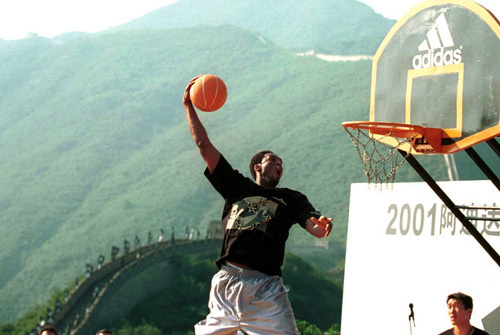
There was that time when he dunked on the Great Wall of China.

The time when he scored 68 points in 15 minutes at a celebrity game.

There is that statue of him in the city of Guangzhou.

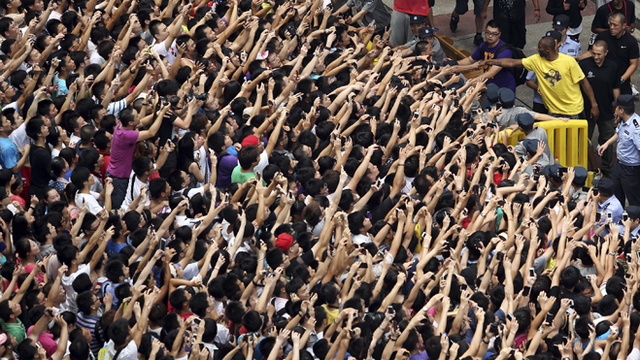
There was the time when he had 15,000 fans waiting for him at a venue at 9 in the morning, in line for his scheduled appearance at 4 in the afternoon.

And the time when the Asia Society celebrated him as a Cultural Ambassador to China and others referred to him as a “one-man State department, reaching directly to the people.” 

For a country that has long thrived on the socialist philosophies of ‘we’ rather than ‘I’, China have a complicated history with personality cults, starting with the Supreme Commander himself. With changing times, a new type of celebrity obsession has hit the Chinese youth, and everyone from Rihanna to Justin Bieber to David Beckham draw colossal numbers of screaming fans with their every move.

Basketball has long been one of the favourite sports, and with the success of Yao Ming, the NBA has become by far the most popular sporting league in China. Yao is considered one of the country’s greatest ambassadors and is a role model for many, but now that he’s settled back in China, his presence isn’t as novel as it once used to be. Amongst current NBA-ers, LeBron James has dominated Chinese social media (renren, sina weibo, tencent weibo, youko, etc.) more than any other Western celebrity over the past year. Tracy McGrady attracted big crowds in every Chinese small town where he CBA team visited last season, and was even welcomed by 2,000 screaming fans when he first landed at the Qingdao airport. Derrick Rose, Kevin Durant, and of course, Jeremy Lin are a big deal here, too.

But nothing matches the strange and wonderful veneration of Kobe. It started in the last 90s, when a young Kobe began to host basketball camps around China. The mainstream popularity of the NBA in the country synchronized with the Shaq-Kobe three-peat, and by the time Yao became an NBA mainstay superstar, Kobe was hitting game-winners on the regular and scoring in the 40s, 50s, 60s, and 80s.

By the time he had won his fifth championship, the legend of Kobe in China was sealed. Mamba was visiting the country nearly every off-season and visiting smaller off-beat towns to get closer to more and more hardcore fans. He was part of the US Olympic Basketball squad that won the 2008 gold medal in Beijing, and in front of the crowd at the same MasterCard center, it was Kobe that memorably stepped up as the brightest star in a team full of superstars to defeat Spain in the Final. On the side, he became involved with charity projects and set up the Kobe Bryant China Fund, which ended up raising millions to help those affected by natural disasters in the country.

Judy Seto, a trusted physical therapist of Bryant, reveals many of the strangest stories about Kobe’s popularity in China, and she adds that, “He’s made an effort to cultivate that relationship [with China] every year. And it’s not just, ‘Let me make this stop at this store.’ It’s, ‘Let me hold this clinic to work with some of the kids and spend some time with them. Let me understand what this city has in terms of culture or the main manufacturing or what’s the main draw.’”

Before the Lakers-Warriors exhibition in Beijing, NBA Commissioner David Stern tried to explain the Kobe phenomenon in China. “Well first of all, he’s playing for the Lakers,” Stern said, “He’s been playing for a very long time, as viewership and interest in our game has grown dramatically. And he has come to this country quite often and understands what it is to cultivate a fan base which totally understands that he has, shall I say, the heart of a champion. His Chinese fans totally expect him, beyond all odds, to make a full recovery from his injury because they have come to have enormous confidence in his ability and his determination. I think that’s because he’s shown the ability and determination at different stages of his career to win, to play at his highest and to elevate his teammates.”

Bryant, however, slightly deflects the answer from himself when speaking on his own popularity. "If you go back to the States, fans have gone through this progression of hero marketing,” he told Mike Bresnahan of LA Times, “They kind of lived through that in the '80s with Michael [Jordan] and Magic [Johnson] and having the fanaticism of fans. With so many [U.S.] media outlets, I think it's evolved to something beyond that, where we're a little bit more desensitized by celebrities. Out here, not so much. It's something that's kind of relatively new.”

In recent years, the two championships for the Miami Heat, coupled with the forgettable years for the Lakers, have boosted LeBron’s popularity amongst the newer, younger NBA fans, many of whom are more active on Chinese social media. China likes winners, and yet, despite the fact that Kobe’s last meaningful playoff game came over three years ago, fans have remained loyal to him. Regardless of the problems of the present – the injury, the age, and the declining roster – the Myth of Kobe is secured. “China likes him because he is always working so hard, and he always wants to win,” describes Sun Yimeng, an editor and writer for SLAM China and one of the most famous Kobe fans in China, “I have seen grown men crying in his presence because he inspires them so much.” She also tells the story of a fan – one of many – who bought a Mercedes-Benz ‘Smart Car’ simply to put his name into a lottery of those (in the thousands) with a chance to meet Kobe. “Luckily for him,” she adds, “He won!”

The love for Kobe reached its peak in the player’s darkest on-court moment. When Kobe went down with the Achilles injury to the Warriors at the end of last season, Weibo – China’s version of Twitter – erupted with good-will messages for Bryant. Kobe, who has over 2.3 million followers on Weibo, posted a photograph of himself preparing for surgery on his account. Within 24 hours, the photo had accumulated 45,000 comments and forwarded over 70,000 times. ‘Pray for Kobe’ and ‘God Bless Kobe’ became amongst the most popular trending topics in the country, and fans didn’t hold back with their emotional outpouring of their favourite Kobe memories, their wishes, and their determination to believe that Bryant would be back to his best again. (Jason Q. Ng compiled a fascinating, long list of Weibo comments for Kobe post his injury).

Outside the borders of Mainland China, down to Hong Kong, eastwards to Taiwan, and then around in other Asian nations who are slowly falling deeper in love with the NBA, the Kobe mania continues. In Taiwan, Kobe is in commercials with the country’s most popular entertainer Jay Chou. In the Philippines, the crowd at the recent Rockets-Pacers exhibition game chanted Kobe’s name at his former Laker teammate Dwight Howard. In India, where basketball is still a minor sport, fans on Facebook ran a petition to try and get Kobe to visit the country.

While Kobe – and LeBron, too – are the dominant NBA personalities amongst most of China and Asia in the present, there is a special place still saved for the man who was once bigger than the sport of basketball itself. In China, legions of followers still swear by the gospel of Michael Jordan, and to many of Asia, interest in the NBA is still stuck in a 90s time-warp. According to the Financial Review, back in 1992 during MJ’s heyday, a survey taken by students in China revealed that Jordan was considered the most influential person of the twentieth century.

Jordan made way for Iverson, Iverson for Yao and McGrady, and then, to the new era of LeBron, with Rose and Durant and others. And then there’s Kobe, who has survived all the post-Jordan eras and maintained his popularity and relevance in world basketball.

“Kobe! Kobe! Kobe!”

The venue now is Shanghai, and it’s the second of two China preseason games on October 18th at the Mercedes-Benz Arena. A loud cheer greets Shanghai’s proudest son – Yao Ming – who waved at the fans in attendance. An even louder cheer was saved for Kobe Bryant, who via Philadelphia to Italy to Los Angeles become a legend to a country of hundreds of millions of basketball fans.

Bryant didn’t play in either game in China. The Lakers lost both games. But it didn’t matter. Fans screamed. Fans cried. He was mobbed everywhere he went. Some got to see him in person. Some saw on him on the jumbotron. Some watched him with pride on the Television, excited that he was back in their country. And others sent him messages online.

The chants never stopped. And the cult of Kobe continued.