July 6, 2013

Spaniard Francisco Garcia is the new coach of India’s Women’s Basketball Team


The Basketball Federation of India (BFI) has announced that experienced Spanish coach Francisco Garcia will be named as the head coach of India’s Senior Women’s Basketball squad. Garcia (41), has 20 years of coaching experience in the past in Spain, Denmark, and Finland, will become the fourth international head coach for the Indian Women and take over from Pete Gaudet.

The Times of India reported that Garcia spent the last season with Spanish Women’s national team players as a private development coach, including stars like Amaya Valdermoro, who has won three WNBA championships.

Via Times of India:

Having started his coaching career way back in 1994 in Asturias, Francisco was involved in various women's professional programs in Spain, Denmark and Finland, where he won a gold and silver medal.
Since returning to Spain in 2005, he has been coaching in various Spanish Federation Youth National Development Camps.

The development has left Indian hoopsters feeling excited. Top star Geethu Anna Jose said, "The BFI has done its part. We had a small chat with Francisco and he seems very interested in Indian basketball… He feels India has very good talent and is really happy to work with us. I'm waiting for the camp."

Garcia will have to be up to his task from the get go: he only has a few months of preparation before India's Women get a chance to play for the Asia's biggest basketball event - the 2013 FIBA Asia Championship for Women - from October 27 - November 3 in Bangkok (Thailand). After finishing sixth in the 2011 Championship, the Indian team finds itself in Level I of the tournament, along with Asian superpowers China, Korea, Japan, Chinese Taipei, and Lebanon.

Pete Gaudet, who was formerly coach at Duke University, left India after 15 months with the team.

July 4, 2013

And the NBA’s 2013 Social Media Champions Are…


Let’s say it bluntly shall we: the Los Angeles Lakers had a horrible 2012-13 season. Their ‘big five’ starting lineup of Steve Nash, Kobe Bryant, Metta World Peace, Pau Gasol, and Dwight Howard never figured out a way to gel together, they fired a bad coach and hired another bad one, they were unforgivably cursed by injuries all year, finished a disappointing eighth in the West, and were swept in four games in the First Round of the playoffs.

And yet, despite the tragic times, the popularity of one of the NBA’s most successful and famous franchises of All Time never wavered. A simple eye-test of the number of Laker jerseys or die-hard Kobe fans or the team’s outreach into popular culture confirms that, but now we also have some real statistical confirmation of their social media influence. While the team itself wasn’t good enough to finish better than eighth in the West, they continued to dominate social media platforms like Facebook and Twitter, and were (once again) the NBA Champions.

A few weeks ago, Unmetric, a company that tells global brands how they stack up against competition on social media, released its second annual NBA Social Media Playoffs Report which details the social media efforts of all 30 NBA teams participating in the 2013 season to observe the impact of social media presence and to compare results from the 2012 season. For the season, Unmetric gave each NBA franchise a score based on a blend of quantitative and qualitative metrics, weighted and averaged by sector to produce a single number ranging from 0 to 100 for each social network – one score for Facebook and one for Twitter. These scores, the Unmetric Scores, were based on metrics such as content strategy, engagement, growth, timing and frequency of tweets and posts on Twitter and Facebook.

The Lakers had the highest score (out of 200) in the NBA of 120. The Miami Heat – 2012-13’s actual NBA champions – finished second in the Unmetric ladder with 110. The Chicago Bulls came in third, followed by the Boston Celtics and the Oklahoma City Thunder.

Here are some more interesting facts about the NBA teams’ Facebook/Twitter activity from the Unmetric report:

- The Lakers have the most Twitter followers in the NBA (3,067,125).

- The Lakers also have the most Facebook fans (16,271,154)

- The Nets were the fastest-growing team on Facebook, and the Raptors on Twitter.

- The Bucks had the most tweets during the course of the season (8,518).

- The Grizzlies had the highest number of admin posts on their official Facebook page (2,113), and also had the fastest average reply time on Facebook.

- The Pistons had the fastest average reply time on Twitter.

- Miami Heat were given the ‘engagement’ crown, as the team most engaged in giving their fans updates on latest schedules, scores, articles, and videos on Facebook. Meanwhile, Miami superstar LeBron James’ old haunt – the Cleveland Cavaliers – finished dead last when it came to engaging with their Facebook fans.

Unmetric did some other interesting research, going beyond just the quantity of content provided by the teams to discover what type of content got fans most involved. The most popular categories for the top 10 teams included content about the players, game schedule, game results, questions to their fans, and score updates.

Lakers have the most Twitter followers in the NBA. The Heat, the Magic (surprising!), Celtics, and Bulls round up the top five. Lakers also have the most Facebook fans, followed by Bulls, Heat, Celtics, and Knicks.

Nice to know that the Lakers are still ‘winning’ something, although another poor season could definitely see the Heat closing the gap on them next year. Miami are NBA champions in the basketball sense of the definition, and the definition that ultimately matters, and their recent success has also made them one the most popular and engaging teams in the league in recent years.

Overall, the NBA is one of the most engaged and active brands when it comes to social media. They rank top amongst all sports brands in Twitter followers and third (behind Manchester United and Barcelona) in Facebook ‘likes’.

All stats and graphic provided via Unmetric – thanks particularly to Vikas Bysani for his help.

July 3, 2013

India U16 Boys to compete in SABA Qualifiers in Dhaka for 3rd U16 FIBA Asia Championship


India's under-16 boys' basketball team is in Dhaka (Bangladesh) to take part in the South Asian Basketball Association (SABA) Qualifiers for the 3rd FIBA Asia U16 Championship for Men. The Qualifiers are being held from July 3-5 and four teams - India, Bangladesh, Nepal, and Maldives - will take part to determine who will be representing South Asia in the U16 FIBA Asia Championship, scheduled to be held in Tehran (Iran) from September 25-October 4, 2013.

The Basketball Federation of India (BFI) has finalized a 12-men roster for this championship who are already in Dhaka along with their coaching staff, led by Head Coach Raghvendra Singh Gour. Several young up-and-coming Indian talents, including the likes of Yogesh Kaneriya and Mahipal Singh, are part of India's team.

Here is India's U16 Boys Basketball roster for the SABA Qualifiers:
  • Mahipal Singh (Rajasthan)
  • Akhilesh Kumar Tudu (Rajasthan)
  • Yogesh Kaneriya (Rajasthan)
  • Prabhnoor Singh (Punjab)
  • Rahul Mehla (Punjab)
  • Jaipal Singh (Punjab)
  • Bitto (Delhi)
  • Sunil (Delhi)
  • Mithun Das (Chhattisgarh)
  • Dhimant Sahi (Tamil Nadu)
  • Erash Hooda
  • Arjun Pandit (Delhi)
  • Coach: Raghavendra Singh Gour
  • Assistant Coach: Tirthesth Guha
  • Physiotherapist: Raj Kumar Dubey
  • FIBA Referee: Atanu Banerjee
Here is the schedule of games at the tournament:
  • July 3: India vs Maldives (6 PM) / Nepal vs Bangladesh (7:30 PM)
  • July 4: Nepal vs India (4 PM) / Bangladesh vs Maldives (5:30 PM)
  • July 5: Nepal vs Maldives (4 PM) / India vs Bangladesh (5:30 PM)
As it usually is in South Asian basketball competitions, India will start as clear favourites to go qualify for the 3rd U16 FIBA Championship for the third consecutive year.

India will have good memories of the U16 FIBA ABC. Two years ago in the previous championship at Nha Trang, a team led by behemoth talent Satnam Singh Bhamara broke out into the scene and gave some of Asia's finest squads a scare. India couldn't improve on their 10th place finish, but showed much-improved performances on court. It was Bhamara's breakout moment, as he ended up as the leading scorer of the championship and was perhaps the best defensive player in the tournament too. There seems to be no such talent on the Indian roster this time around, but hopefully the team can play well together as a unit to surprise Asia's finest once again.

But, first things first. India has to deal with Nepal, Maldives, and Bangladesh. It will be an important tune-up to get the team ready for bigger things ahead.

June 30, 2013

Basketball Traveller - NBA’s Greg Stolt: “Our purpose in China is to have people go out to play and enjoy basketball!”


This feature was first published in the 109th edition (2013 - No. 12) of SLAM China Magazine. Here is my original English version of the story. 

Things change. From running alongside Mike Miller and Udonis Haslem and Florida, to playing in the sunny seaside of Spain. From feasting on sushi in Japan to hanging with the surfers in Australia. The smell of spicy curries in India and the taste of spicy Hot-Pot in Beijing. Basketball has taken Greg Stolt all across the world. And as NBA China’s Associate Vice President of Basketball Operations, Stolt is now bringing that wealth of experience to help develop the future of hoops in China.

Things change. But throughout the changes, through the different languages, cultures, continents and lifestyles, one thing brought them all together: basketball.

A former college star with the NCAA Division 1 side Florida in his college years, Stolt has played professionally across the world. But now, he is concentrating on a different role. The NBA has had a formal presence in China for several years now: they opened their first office in 1992 and the NBA has been on air on CCTV since 1987. The league has 300 million fans in China and NBA’s social media accounts in Sina and Tencent have 53 million followers. Their relationship with the Chinese Basketball Association (CBA) dates back nearly three decades ago. Today, the NBA helps run a state-of-the-art CBA Basketball School in Dongguan which has trained over a 1000 Chinese youth players. Stolt, who is now based in China full-time, has been involved in various different NBA-China activities which includes the school in Dongguan, coaches’ training programmes, and in promoting the NBA’s presence in China with events such as NBA’s preseason ‘China Games’ in the country.

Recently, Stolt – the head of NBA China’s Basketball Operations department – spoke to SLAM discussing his past journeys with basketball, his present involvement with the game in China, and his optimistic outlook about the future of basketball in the Middle Kingdom!

Things change. But the basketball remained the same.

SLAM: How long have you been working in China, and how has your experience been in the country so far?

Stolt: I’ve been here since August 2012. Prior to that, I was working with the NBA in New York for three years, and over those years, I made several visits abroad to places like China and India to work with basketball operations.

China has been fantastic. There have been great opportunities here because basketball is so integral to the culture here. China has good basketball fans and I’ve been able to learn many new things.

SLAM: Talk a little about your role with the NBA in China.

I work with the department of basketball operations with NBA China, and it has a different structure here than in the US. Our product – the NBA – is in the USA. Here, the aim is to support the passionate development of the game. We do that by collaborating with the Chinese Basketball Association (CBA) in various parts of the country.

SLAM: How do you feel that your background as a college star and your experience playing internationally helps to work with younger players now in China?

Stolt: Yes, I have had quite a unique background with basketball. I’ve been quite fortunate because I was surrounded by great coaches all my life. My father was a coach and player and he played with many great players himself. I had a great coach in college. I lived and played in Europe, Australia, Japan, and back in the USA with the D-League. The experience helped me truly broaden my horizons and show me a world that was very different to my upbringing.

When it comes to working with young players here, I’ve discovered that, up to a certain stage, kids learning basketball around the world are pretty much the same. They want to play, and they love the game, whether they are in China, India, or in the USA. That is the common denominator. Playing around the world has indeed given me an idea on how things in other countries work or don’t work. I’ve had experiences that you can’t get from books. It has given me great practical opportunities and prepared me to have more insight into the basketball world.

SLAM: You had quite a memorable career with the Florida Gators. How did that team prove to be such a good fit for your talents?

Stolt: I have to give credits to my coaches, who were both able to help my development. In my freshman year (1995-96), we had Coach Lon Kruger at the helm. After that, we had coach Billy Donovan – who is still the team’s Head Coach now. Coach Donovan let it be known that I could really get better and move on to the next level. With him, I saw new opportunities in a new system. The three years I spent with him (1996-99) were great. He was a phenomenal coach. He taught me about how to carry myself on and off the court, about conditioning, nutrition, and that teaching helped me be prepared with the building blocks to eventually play professionally in Europe.


1999 was my most successful season there, when we reached the Sweet 16 stage in the NCAA tournament – the only time I got to play in the tournament. We got some good players in my sophomore year like Mike Miller and Udonis Haslem, and we developed together to our full potential by the time I was a Senior. It was a nice nucleus of players and good teammates. The Coach stressed on improving our conditioning. A lot of us could play multiple positions and we shot a lot of threes – it made difficult for opponents to keep up with us!

SLAM: After College, you were an international basketball journeyman. In which countries have you played professionally?

Stolt: I played in the Dominican Republic, Spain, Belgium, then back in the USA during the first year of the NBA’s D-League, in the old CBA (Continental Basketball Association) in the States, France, Japan, Australia, and I ended my playing career in Japan. Those who play basketball internationally can play in different countries over a 12-month calendar – for example, I was in Australia during their season and back in Japan the same year. 2003-04 was my last playing season.

I didn’t have a chance to play in China, although I would have loved to do so!

SLAM: So what was your most interesting international basketball experience?

Stolt: They are all very unique, and all were phenomenal. And it is only when you leave a country that you realize how great the experience there was! In France, the level of play is phenomenal – they have the best athletes outside of the NBA. I had some great experiences in Japan, which is a country that I never expected to visit otherwise. They have hardworking players there and an interesting culture. Australia is another unique place to play and to live.

The bottom line is that these experiences are all about the people you meet and work with. And in each place, I met some great people.

SLAM: You have a unique vantage point towards basketball, from the perspective of having played or worked with the NCAA, the NBA, in Europe, in Australia, and in Asia. How do they all differ?

Stolt: For me, there was a little bit of a learning curve required after playing in the NCAA system. In the NCAA, a player is very well taken care of, and there, I didn’t have to worry about little things like where to eat, where to do my laundry, etc. On the professional level, you don’t have the same type of support system. Playing internationally, the general theme was to find one other American in every team, where (like China) usually two foreign players are allowed per team. In most cases, the foreign players stick with each other, but I made it a commitment to get to know my local teammates and coaches too. It helped my understanding of the local culture wherever I was and helped me get the most out of my experience.

The on-court learning curve was different, too. In Europe, for example, teams play a lot of preseason games, so there is a lot of opportunity to learn their style of play together. But in Japan, I had to find my place in the offense on the fly.

Foreign players like me had to do whatever the team asked us to do: in most cases, the focus was on getting statistics and scoring as much as possible. And at the same time, I had to ensure that the team was successful. There is more concern internationally than in the USA for foreign players to find a balance between big stats and winning games.

SLAM: From what you have seen here, how does basketball in China differ from your previous experiences?

Stolt: China is right there with the rest of the world in the level of basketball played and coaching. The CBA as made many great initiatives in recent years. Most importantly, people in China can’t get enough of basketball and are passionate about it! The country has the resources, the interest of the community, which is the total equation to help the game develop further here. In whichever country there is a passion in the people to learn and play more, then basketball will surely become better there.

SLAM: What are the NBA’s future plans in continuing to grow the game here?


Stolt: Our number one goal is to grow and develop the game alongside the CBA. The unique thing about China is that it is the only place in the world where we have a basketball academy – in Dongguan. 130 kids were admitted there this year! Our hope is that the players from the academy can play in the CBA one day or even in the USA.

Growing our relationship with the CBA also helps us to help develop coaches in China. We have an annual CBA Coaches Programme where we work with numerous CBA coaches. In late October or early November, we host 15 CBA coaches in the USA to provide them a look at how basketball coaching and operations works over there. Many of the top CBA coaches like Cui Wan Jun (Xinjiang), Min Lulei (Beijing), Gong Xiaobin (Shandong), and Qu Shaobin (Guangdong) have been part of our Coaches Programme in the past. We are also bringing eight coaches from the USA to China this summer to conduct clinics and camps. We’ve already done such clinics over the years across the country. We are reaching out to college/high school level coaches in our various grassroots programmes.

We will continue to look at opportunities to team up with local basketball stakeholders. Hopefully more exposure to the Chinese people to the NBA can continue to help grow the game here. The NBA’s purpose in China is to have people go out to play and enjoy basketball.

SLAM: Talk about the training Center in Dongguan and how it is benefiting young Chinese players.

Stolt: The CBA Dongguan Basketball School – An NBA Training Center, opened in 2011. It is very much like a full-fledged High-School for kids aged between 8-17. We have academic staff there to handle 130 children in five different grades. We have split them up by their basketball skill level. The whole curriculum has been brought together by Bruce Palmer, who is the technical director at the school. We have also been able to run numerous clinics for national and international teams over there.

It is a special place. Anyone who enters will feel like picking up a basketball and start playing!

The NBA’ basketball operations work to select kids for this training center with camps all across the country. We have camps in eight Chinese cities last year, and pick kids not only on their potential basketball skills, but also on their academic strengths and personality.

SLAM: And finally: what do you foresee for the future of Chinese Basketball?

Stolt: I think that the sky is the limit for basketball in China. China has enthusiasm and interest in playing the game amongst the fans. I think we will surely see more success stories of Chinese players who eventually make it to the NBA and the WNBA. And back here, we will see more Chinese who will become interested in playing basketball. It won’t be long before more young players from China can take help take the game to the next level.


June 29, 2013

Anthony Bennett leads the way in the most unpredictable NBA Draft night


First there were the boos. NBA Commissioner has been hearing them at damn near every pick in damn near every year of his 30-year tenure as the league's head honcho. And once more, for the last time in his eventful era as Commissioner, Stern heard boos over and over again as he called out names of the NBA's newest professionals. By now, the boos are more a mark of affection than hate. They have been the necessary soundtrack to the beginning of every NBA career in the past three decades.

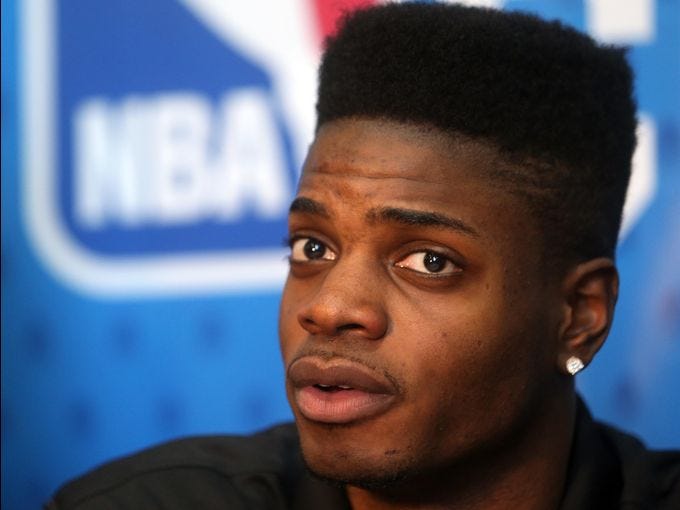
And those three decades of draft nights came to an end for Stern with one of the most surprising drafts ever. With no clear consensus top pick in what many experts were calling a 'weak' draft, there was some sense of mystery surrounding who the Cleveland Cavaliers would choose to call with their first selection. The slight favourite was Nerlens Noel, but he has been injured since February. Some thought it could be Ben McLemore, but many scouts questioned his maturity issues. Alex Len's stock was rising, but he was slightly unproven. Victor Oladipo became everyone's last minute favourite, and some thought he could be the surprise top choice.

Instead, the Cavs made the unpredictable draft even crazier and chose UNLV's undersized power forward Anthony Bennett as the first pick of 2013. Bennett is a solid player across the board, and despite his recent shoulder surgery, a relatively 'safe' pick. Still, it was a surprise pick and it completely jumbled the best-laid plans of the rest of the teams picking on draft night. For the Cavaliers, Bennett is an interesting pick: will they choose to play him at small forward, which is their weak spot in the starting five at this point? Will they choose to play him at power forward instead of Tristan Thomas. Or will they make a move for either one of them? I guess we'll wait and see.

Victor Oladipo went second to the Orlando Magic, a sound pick for a team that needs help in nearly every department, and chose a hard-working player to build their future around. The Wizards plugged in their small forward hole with Otto Porter Jr., a well-rounded jack of all trades at three. Still, no sign of Noel or McLemore, or Len.

And then, with the fourth pick, the Bobcats make the draft even zanier when they decided to pick Indiana's Cody Zeller, a great college player but with doubts to translate his talent into the pros. Bobcats fans heartily booed this decision. In hindsight, this was a typical pick by the greatest player of all time aka the worst team owner of all time, Mr. Michael Jordan. Jordan has long been a fan of great college winners with unfulfilled pro potential.

The Suns picked Alex Len at five, a good pick for another team that needs help pretty much everywhere.

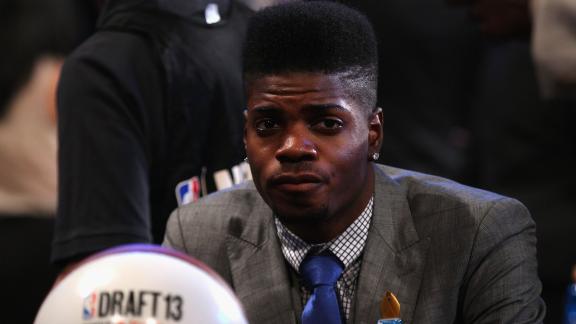
And finally, after wearing a dejected face for most of the earlier half hour, top prospect Nerlens Noel was picked sixth by the Pelicans. Before he could speak of teaming up with Anthony Davis, he was quickly traded to the 76ers. Before he could team up with Jrue Holiday, Holiday was in the trade coming to New Orleans. Another draft night shocker. The Pelicans added Holiday to a core of Anthony Davis and Greivis Vasquez, effectively signalling the end of the unfulfilled Eric Gordon era. Speaking of unfulfilled eras, the 76ers will effectively say goodbye to Andrew Bynum now that Noel is touted to be their franchise center. Later on in the draft, the 76ers picked athletic, tall point guard Michael Carter-Williams with the 11th pick to replace Holiday and go into full rebuilding mode (otherwise known as the Andrew Wiggins Sweepstakes #LosingForWiggins).

With the 7th pick, the Kings went for the best player available and added talented-but-immature Ben McLemore to a core that includes talented-but-immature Tyreke Evans and talented-but-immature DeMarcus Cousins. Fun times in Sacramento.

The Pistons added dead-eye shooter Kentavious Caldwell-Pope with the eighth pick. The Timberwolves picked college player of the year Trey Burke at ninth, but soon, it was revealed that Burke would be traded to Utah for the 14th and 21st picks. These picks translated into Shabazz Muhammad and Gorgui Dieng, respectively. Burke is the perfect fit for the Jazz, who were in desperate need of a decent perimeter player.

And despite the bad news bears, I'm fully in the Shabazz Muhammad camp (#ShabazzBandwagon) and believe that he can be the best player from this class. Shabazz is also the perfect fit in Minnesota, along with Ricky Rubio, Andrei Kirilenko, Kevin Love, and Nikola Pekovic. If this team can stay healthy, we could see them making some noise in the West. Shabazz college year was topsy-turvy to say the least, but I think he'll be suited for the pro game. Years from now, you can come back here and applaud me for my faith when he becomes a multiple-time All Star, or alternatively, laugh at my face when he translates into Micheal Beasley 2.0.

The Trailblazers made a great pick at 10th with CJ McCollum, who is the perfect back-court component to run along with reigning rookie of the year Damian Lillard. At 12th, the Thunder took New Zealand's big man Steven Adams. The Mavericks traded their 13th pick to the Celtics, and Boston chose Kelly Olynyk.

And so and so forth the draft went, featuring more surprises, crazy hair (Lucas Nogueira), cheers (for Masom Plumpee and Tim Hardaway Jr.), and jeers. The draft represented a lot of foreign-born talent, too, including top pick Bennett (Canada), Len (Ukraine), and Adams (New Zealand), and later, the likes of Giannis Antetokounmpo (Greece), Sergey Karasev (Russia), and Dennis Schroeder (Germany) drafted by Bucks, Cavaliers, and Hawks respectively.

The first round of the draft ended with yet another surprise. The first pick that David Stern ever made in 1984 - a young Nigerian then known as 'Akeem' Olajowon - returned to the stage (in the same-style tuxedo!) to surprise Stern and provide a fitting end to his draft era. Adam Silver took over the Second Round, and will be taking over the First Round from next year onwards. 30 years later, Stern will soon step off after a distinguished tenure as the Commish. And he ended his last draft night with excitement, unpredictable moments, and a whole lotta boos!

But the biggest news of the draft night wasn't connected to the 2013 draft at all. To add to the crazy, the Boston Celtics traded Paul Pierce, Kevin Garnett, and Jason Terry to Brooklyn for Gerald Wallace, other players, and many future first round picks. It signaled another major shake-up in the Eastern Conference. And considering how the 2013 draft has panned out, don't be surprised if there are a lot more trades involving the effected teams between now and the start of the new season.

Congrats to the big winner of the night: Anthony Bennett. He couldn't have wished for a more memorable and entertaining night to join the big leagues.

You only have to hold your breath for one more year, as some of the NBA's worst teams join the #LosingForWiggins race and hope to make another Canadian the top pick in 2014.

June 27, 2013

Klay Thompson: The Language of Swish


This feature was first published in the 109th edition (2013 - No. 12) of SLAM China Magazine. Here is my original English version of the story.

Klay Thompson moved his elbow up to a shooting position, making an ‘L’ shape with his hands, and then let his wrists throw the imaginary ball into an imaginary hoop. “Just like that,” he instructed the rows of eager teens seated ahead of him, “Let your hand form this motion. My father taught me: your shooting hand should look like you’re reaching high for the cookie jar.”

There was a brief moment of silence, and then his translator picked up those words and began to convert them in Chinese for the audience. Thompson turned to his side while the translator talked and showed the shooting form again. A perfect ‘L’. And the wrist dropping into the cookie jar.

Thompson couldn’t speak a word of Chinese. And the basketball-loving teenagers at the ‘Klay Thompson Fan Day’ in Beijing struggled with their English. And yet, they didn’t have to wait for the translator to understand. With a simple gesture of the hands and a flick of the wrist, he had gotten his point across.

This is how you shoot a perfect jump-shot. And it sounds like a “swish” in every language.

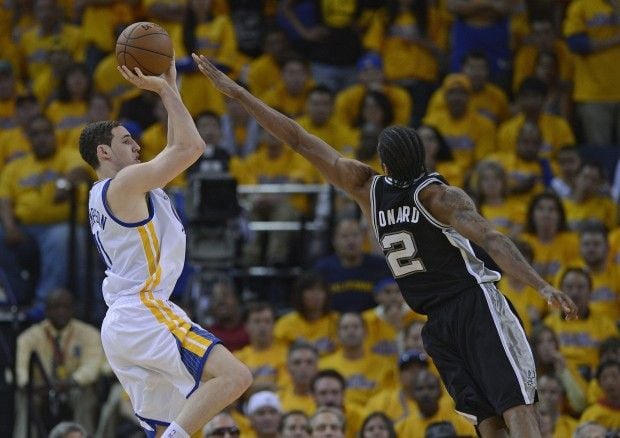
Thompson’s been accustomed to that sound now. The 23-year-old exploded to the scene in his second season in the NBA as one of the most dangerous shooters in the league. After just starting 29 games in his rookie year, Thompson was in Golden State’s starting five for all 82 contests in 2012-13 and averaged 16.6 points per contest. And then, he became part of a magical playoffs run for the Warriors as the lower-seeded team upset the Denver Nuggets and battled the heavily-favoured Spurs to Game 6. It was in this series that one of Golden State’s two wins came courtesy of Thompson’s career-best night, when he scored a career-high 34 points on 8-9 shooting from beyond the three-point arc, and added a career-high 14 rebounds.

About a month and a half after his heroics – and the Warriors’ subsequent playoff loss – Thompson found himself breaking a sweat on the basketball court for the first time since he played the Spurs. The competition and the stage were distinctly different, of course. He was playing a casual one-on-one game with a Chinese media personality in a quiet hall on the East side of Beijing.

But within moments, every court in every city and every opponent in the world morphed into the same thing. Because the sound of the “swish” was still the same.

Understandably, it was Thompson’s potent jump-shot that was the center of attraction at this shooting clinic at Beijing. And Thompson obliged the young learners with tips on how to perfect that jumper, both through the body and the mind.

“Physically, you have to practice hard to improve the shot, and make sure to spend enough hours in the gym,” he instructed, “But you have to have mental confidence too. You have to have ultimate belief in yourself that you are the best shooter, that even if you’ve missed 10 in a row, you will be able to make the next 20.”

Thompson’s range has come into even extra scrutiny because of the changing circumstances around the league and the increasing reliance on three-point shot for success. In the NBA Finals, Danny Green made waves by breaking the record for most threes made in a Finals. The Miami Heat – with Ray Allen, Norris Cole, Mike Miller, Shane Battier, and more – became a dangerous crew from beyond the arc as well. The New York Knicks enjoyed a wealth of success this season because of their three-point accuracy. And how can we forget Thompson’s own teammate Stephen Curry, who is well on his way to becoming one of the greatest three-point shooters of all time. (“He’s the best shooter I’ve ever seen,” Thompson says of Curry.)

“The three-point shot shows the evolution of the game,” Thompson spoke to the assembled kids at the clinic, “It has become huge in the NBA, and we see how great three-point shooters are spacing the floor. “I think three-point shooting has become a real weapon and is the future of the league.”

In that case, Klay Thompson is the future of the league, too.

Thompson visited China in mid June, travelling to Xian, Beijing, and Chengdu, to promote the NBA Global Games 2013. He will be back in Beijing and Shanghai in October, along with Curry and the rest of his Warriors’ teammates, to take part in ‘China Games’, two pre-season NBA games held in China against the world famous Los Angeles Lakers. Even though they are technically just ‘exhibition’ games, Thompson believes that he will be ready to response to the playoff-type atmosphere at these contests.

“Whenever the crowd is like that, you wanna give them a show. Both of our teams are really competitive. It’s fun to play in front of fans who are rowdy and who love the game, and that’s what we’ll see in these two exhibition games in Beijing and Shanghai. I’m really excited for them, and my teammates will be too.”

Looking ahead, Thompson also feels that he and his team will be motivated to come back stronger after their memorable run this season.

“If we don’t go past the second round next season I feel it will be a disappointment,” he said, “We have a bright future. As long as we keep our core together and keep working hard, I think we can win championships in the near future.”

Speaking on his own goals for next season, Thompson added: “I wanna be a better pick and roll player and better at finishing around the rim. And keep working on the defensive end as well – people forget that the game is 50 percent defense. I think I can be an All Defensive player in this league. It’s gonna take a lot of work, but I think that I can get there. I took big strides in that area last summer. I don’t wanna be known for just my shooting. I wanna be known as a good defender, a good passer, and hopefully I can add one new element to my game every year. Hopefully next year I can also be a better play-maker than I was this last year.”

His angst for improvement is understandable. No man wants to be pigeon-holed into one box. Klay Thompson has an arsenal of different, improving talents, and he’s making it clear that he wants to make considerable improvements in all of them.

Shooting is still his calling card though, and it was still the major reason why fans gasp when they see him catch fire and when youngsters listen when he teaches them how to emulate his form. It is that shooting form that breaks barriers of language and culture and gets the point across. From the perfect release to the perfect “swish.”

June 25, 2013

Shots in the Dark: My 2013 NBA Mock Draft


Even with less than three days to go until the 2013 NBA Draft, I remain clueless. 2013 is being called a fairly weak year in the draft, and with no sure-shot answers to the problems plaguing the lottery teams, there is no way to expertly predict the sequence at which young players will accept their team hats on Thursday night. As a matter of fact, I probably feel more confident of predicting next year’s draft class than the one three days from now.

Still, a draft is to be conducted, and so, in my annual tradition, a draft is to be mocked. So, with utter lack of confidence in my predictions, but full faith to defend them the moment they are published, here is my 2013 NBA Mock Draft of the lottery (1-14) picks.

Click here to read full feature.