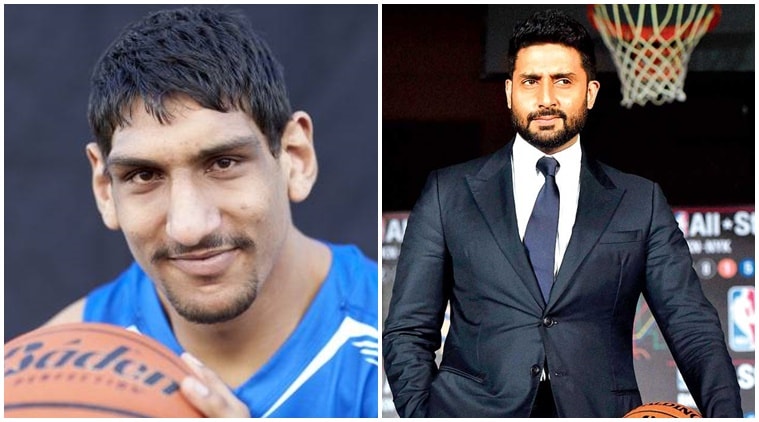
- Abhishek Bachchan is an Indian actor, star of Bollywood hits like Dhoom, Dostana, Bunty Aur Babli, Guru, and Sarkar, and the son of India's most-respected actor ever, Amitabh Bachchan.
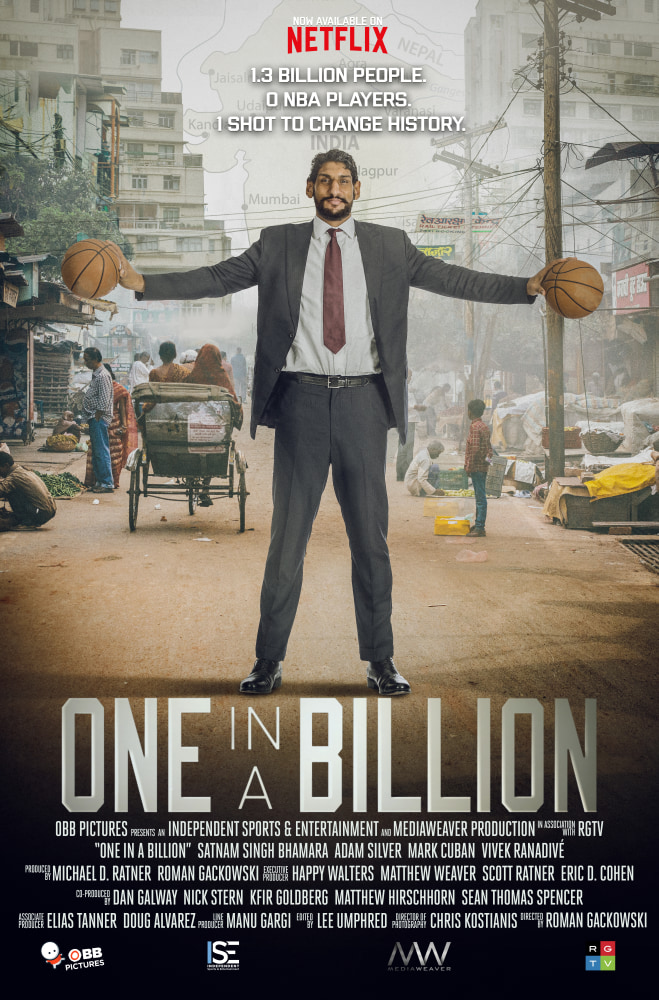
- Satnam Singh was the first Indian basketball player to be drafted into the NBA in 2015 and plays for the D-League team Texas Legends. His extraordinary story from poor Punjabi village of Ballo Ke to the NBA Draft was captured in the recent documentary One in a Billion.
- A few days ago, Satnam Singh said that, if a biopic was made of his life, Indian actors Akshay Kumar and Abhishek Bachchan would be "best suited" for the role.
- Bachchan is 6-foot-2 and 40-year-old. Satnam is 7-foot-1 and 21-years-old. Satnam knows how to play basketball. Bachchan knows how to act.
- Satnam has yet to play an NBA game. Although he is never going to be an NBA star, there is still a possibility that the big guy gets signed on to a fringe role by an NBA team. Satnam's chances of winning an NBA championship would depend highly on a perfect situation of playing for a team that both has the space/requirement for a big guy of his skillset and the talent to beat the top contenders in the league for the title. Think DJ Mbenga from the 2009-2010 back-to-back champion Lakers' squads.
- The Golden State Warriors will sign Satnam as a backup, where he immediately becomes 'The Splash Singh'. Satnam will join a roster that already includes Stephen Curry, Kevin Durant, Klay Thompson, Draymond Green, and Andre Iguodala. He would be the umpteenth big man option behind Green, Zaza Pachulia, JaVale McGee, David West, Anderson Varejao, Kevin Looney, James McAdoo, and Damian Jones.
- In the 2017 NBA Finals - round three between the Cavaliers and the Warriors - Golden State would lose Draymond Green after another accidental kung-fu reflex moment, Zaza to the Georgian parliament, McGee after he Shaqted-a-Fool one too many times, Varejao and David West to old age, and Looney, McAdoo and Damian Jones to foul trouble. In this moment of desperation, they would call upon The Behemoth of Ballo Ke, The Punjabi Premier of the Paint, to save the day in Game 7. In seven invaluable minutes of action, Satnam would set up important screens for open jumpers for Curry, Durant, and Thompson, outrebound Tristan Thompson, deny LeBron easy access to the basket, and pick up six quick fouls to destroy Cleveland's comeback momentum.
- Warriors will win the 2017 NBA Title and Satnam Singh will get his championship ring.
- In 2020, when Abhishek Bachchan is in his mid-40s, he will requires the help of India's finest computer graphic designers to make him a foot taller and 30-years younger. He will play Satnam from age 15-25 in India's greatest sporting biopic film of all time.
- 'King Singh: The Sikh With Da Sickness' will break all the box office records, win Bachchan all the Filmfare Awards, and become India's choice for Oscars' 'Best Foreign Language film', obviously winning that award, too.
- The film's popularity will make basketball one of the most popular sports in India and earn Satnam an honorary place as 'Basketball Ambassador' in the Hall of Fame.
- Satnam will eventually co-star in a travel show alongside Stephen Curry called 'The Curry-wallahs: Basketball and Butter Chicken from Ballo Ke to the Bay Area'.
I talked to Satnam Singh about his inspirational new documentary on Netflix, which chronicles his stranger-than-fiction journey from India to an NBA Draft pick.
World No. 1 is the Ballo Ke village, district Barnala, in the heartland of the India’s north-western state of Punjab. Ballo Ke is not on the map. Its population of eight hundred people—mostly poor, disenfranchised farming families—live among paddy fields, separated from the rest of civilization by hours, which are traveled along a bumpy dirt path. Electricity came here late, and mobile phones rarely connect. Ask for a cup of chai and someone will milk a buffalo in front of you. It’s dusty all the time.
World No. 2 is the Barclays Center in Brooklyn, NY, opened in 2012 as one of the swankiest multi-event facilities on the planet. It cost over a billion US dollars to construct. Its tenants include the Brooklyn Nets, an NBA franchise valued in the billions which plays under the electrical charge of flashing jumbotrons, on-court laser shows, and machine guns spewing T-shirts into the stands. Since 2013, it has hosted the NBA Draft in a room full of some of world’s richest CEOs, VPs, agents, and future basketball superstars.
These worlds are polar opposites of culture, economy, and lifestyle. And yet, through the course of one of the most inspiring stories in all of sports, one young man—Satnam Singh—lived through it all, marrying the dichotomy of the marginalized third-world with the highest stakes of the world’s richest basketball league, and journeying through it all while carrying the improbable hopes of a billion-strong country on his wide shoulders.
The summary, if this was a piece of fiction, sounds too improbable to be true. But truth is often stranger than fiction, and over the last decade, that story actually took place: Satnam, the son of a farmer from Ballo Ke village, used both nature (his size) and nurture (hard work) to make history when the Dallas Mavericks picked him in the 2015 NBA Draft.
Satnam’s entire life is the equivalent of Kevin Garnett screaming “Anything is Possible!” on infinite loop. Now, his journey’s been encapsulated in the feature-length documentary One in a Billion, directed by Roman Gackowski, and released worldwide on Netflix on December 6. OBB Pictures partnered with Media Weaver and RGTV to produce this project. For a year and a half of filming, Gackowski followed Satnam as he visited his tiny farming village in Punjab, India, finished his time at the IMG Basketball Academy, Florida, and got drafted into the NBA on that fateful night in New York City.
The film shows the wild extremes lives that Satnam leads, in his farm in the Ballo Ke, where he is gifted a goat upon his return and walks around paddy fields in basketball kicks, and later, in the IMG Basketball Academy, one of the world’s finest facilities for youth basketball development. We see him take jumpshots on basketball courts in Punjab and meet high-level NBA executives and coaches at draft combines in the US.
Also featured in the film are individuals who have played a role in the life of Satnam or in basketball at large over the years, including NBA India’s former Director of Operations Troy Justice, NBA Commissioner Adam Silver, Dallas Mavericks owner Mark Cuban, IMG Academy Basketball coach Dan Barto, former India national team coach and now-IMG Academy director of basketball Kenny Natt, basketball agent Travis King, Secretary General of Punjab Basketball Association Teja Singh Dhaliwal, Sacramento Kings owner Vivek Ranadive, VP of Kings’ basketball operations Vlade Divac, Satnam’s family, including his father Balbir, and many more. SLAM senior editor Abe Schwadron’s pre-draft interview with Satnam also makes a cameo. (And after closely following Satnam’s journey over the past seven years, I sat down for an interview that’s featured in the documentary, too.)
Satnam Singh is the true star here, though. Through old photographs, stories, footage, and the lead-up to draft day, the documentary paints the picture of a young man who stood up to the responsibility of shouldering a moment in history.
On the day of the film’s worldwide release on Netflix, I spoke to director/producer Roman Gackowski, producer Michael D. Ratner, President/CEO of OBB Pictures, and Satnam Singh himself to learn more about the story behind One in a Billion.
SLAM: What first attracted you to Satnam’s story and this project?
Gackowski: Michael and I had worked together in the past and were looking for a project to collaborate on. Michael wanted a different kind of storyline and this was the one that specially struck a chord. He brought it up to me; we both felt it was a deep human interest story, and it felt even greater once we started pursuing it. As a lifelong sports fan, it blew my mind that a country with the population of India had never produced an NBA player, especially when you look at the way the NBA has evolved over last 25-30 years with their international exposure. There was a curiosity as to why that was. The story was fascinating from the beginning and Satnam was an interesting character.
Ratner: I was working on an ESPN 30 for 30 documentary and I wanted more sports stories that are about character and are inspirational. I was talking to different agents, and Travis King, who had been following Satnam, mentioned him. I was fascinated by this potential underdog story. We knew the stakes were high, and we couldn’t predict the ending—if he would actually get drafted. There are 1.3 billion people in his country and nobody had made it before. The final moment when I wanted to do this was when I spoke to Troy Justice [formerly of NBA India] who knew Satnam personally and told me he was a special young man. Troy was absolutely right! There is a scene in the movie, before the draft, when Satnam says that he has only opened the lock to basketball in India, but the door is still closed. This story is still going on, the end of the story is not written yet.
SLAM: Satnam, how did you first react to the news that there are people interested in a documentary about you? Was it strange having a film crew follow you around as you went through some of the most important moments of your life?
Singh: The documentary crew came with me to India, I remember, and my Dad asked me, ‘Why are they doing this?’ I told my Dad that they wanna focus on where I’m from and let people know who I am. Then I told myself, ‘These people are spending a lot of money for you, if you don’t work hard and you don’t do anything, it won’t be good for you’. So, that’s why I knew I need to work hard. I needed to go open the lock. That became my goal, to not disappoint my family, the investment by IMG, by the film crew. I did everything that they needed. As I say in the film: right now, I’ve only opened the lock. I’m only in the D-League. I need to go further and open the door to the NBA.
SLAM: What were the most challenging aspects of filming this story?
Gackowski: Going to his village, for sure, it was a different environment. Thankfully, the producers had put us up with the right people for this project, so we had the support we needed. The thing that struck me most was to see the differences: Satnam was 14 when he left his home, his family, and went literally halfway around the world. When you see the world he grew up in, to see where he was then, and then to IMG Academy in Florida, it’s another world. That was a story that we tried to tell. There were difficulties working around language, but we had set ourselves up in a position to tell the story. Satnam is a really good, true human being, who was trying to do so much for not just himself but his family and his country. You kinda get invested in a guy like that. When we were going along with him, everybody on the crew felt so close to him and kept on asking about him. We were rooting for him and were so happy how it eventually turned out. I know Satnam felt so much stress and pressure before the draft. All of us felt the same way.
SLAM: Satnam, when you see your whole journey in this film, from your village to NBA, what does it make you think?
Singh: When I watched the movie, I realized how much nicer the court is now back in Punjab! It wasn’t so nice when I started playing basketball there! I came to the USA in 2010. When I came here I said ‘Damn! If only we had the same opportunity in India!’ I was lucky I got a great opportunity and had coaches to help me here. I know my body changed, I learned a new language, changed the way I talked to people. But I don’t like to change my attitude of where I’m from. My background is important to me. You should never forget where you come from. Even if I have a million, billion dollars: money and the new people you meet matter less. The most important thing in my life is to understand where my family is, to understand how much I had when I first came here, and why I came here. I came here to play ball, make a name for myself, make history for India. That’s why I have only one focus.
SLAM: What do you hope that viewers take from One in a Billion?
Ratner: I hope that the viewer walks away feeling optimistic and engaged, and understand that they have watched a story that is still being written. This is a feel-good film. The climactic scene honestly tugged at my heart. When you watch it, you see the math the agents are doing for him to be drafted and you feel the pressure, too. Yes, the movie wouldn’t have been a failure if he hadn’t been drafted, but to be picked, it made it matter so much more. There’s something unbelievable there, the feat of him being drafted, shaking the deputy commissioner’s hand. This was a true Cinderella Story, a risk for this young man who worked hard, flew across the world away from his country, and made history. The commissioner [Adam Silver] said that Satnam could really open the door for NBA in India. Now the goal is for him to be on the NBA court. To play in his first NBA game.
SLAM: What did you learn about Satnam by getting to know him and interviewing the people close to him?
Gackowski: I come away with the understanding that he is an incredibly brave, dedicated, and pure individual. It was a big deal for him to come to the USA because there were people from his village, his family, his coaches, who had a lot of expectations. They didn’t quite understand what the journey would be for him. Satnam was still young when he first went out. There were a lot of expectations but he said to himself, ‘No matter what, I’ll take this on my shoulders. I’ll do this’.
He came to the USA and didn’t know the language. He was trapped and he fought through it. He took the risk. There’s some powerful moments in the films as he spent years learning the language, feeling lost, trapped, while he was working hard to be able to understand be productive on court and in the classroom. There was a scene when a coach talked to him and he understood, and it was a breakthrough moment! You could feel that it someone in his life had just turned the lights on!
He tells you to take a risk, to be brave. He did everything he could possibly could to get to this level. Troy Justice said in the documentary that Satnam is the kind of player who would run through the wall for you, and he literally will. If he hadn’t accomplished this, it wouldn’t have been for a lack of trying. That’s what we see in the film: he’ll do it and do it the right way. And he doesn’t just do it for himself. It’s for everyone involved, for his parents and coaches in India and the USA.
SLAM: Satnam, the movie is over, but your basketball career goes on. You’ve already made history. If there was a sequel to the story, and you could write it, what would you like to see.
Singh: Having them [the documentary crew] around motivated me more, it gave me more help to have a strong mind and work hard. Maybe I’ll have one more documentary again. The same movie or a different kind—about what I can achieve in my next step!
Here's a pitch for a movie: a poor farmer's son from rural India learns basketball and becomes the first of a country of 1.3 billion to be drafted into the NBA.
The summary, if this was a piece of fiction, sounds too improbable to be realistic. But the truth is often stranger than fiction, and over the last decade, that story actually took place: Satnam Singh, the son of a farmer from Ballo Ke village in Punjab, used both nature (his size) and nurture (hard work) to make history when the Dallas Mavericks picked him in the 2015 NBA Draft.
Released worldwide to stream on Netflix on December 6, 2016, "One in a Billion" tells Satnam's comprehensive story so far in great detail. The documentary was produced by OBB Pictures and directed by Roman Gackowski. For a year and a half of filming, Gackowski followed Satnam as he finished his time at the IMG Basketball Academy, got drafted to the NBA, and visited his village in Punjab. He also interviewed several close individuals connected with Satnam's story from this childhood, his education, and his professional career.
If you know Indian basketball, you know the ending of the story already. "One in a Billion" takes us back to the beginning. It brings to screen the surreal story behind Satnam's real life. Some of the strongest moments are when the documentary crew follows him into the hinterlands of Punjab as he visits his family, introduces his friends, and lays on the very farm he grew up in. These scenes are juxtaposed with scenes a few months later at the IMG Academy, one of the finest facility of youth sports development around the world. The documentary introduces viewers to Satnam's family, his coaches, teachers, and his agent. We see him direct the way deep into his Punjabi village. We see agent Travis King's pitch to Satnam, we see him visit draft combines and get suited up for the draft, perform at pre-draft workouts with various teams in the NBA.
One of the most powerful scenes in the film is when Satnam - who has struggled in IMG because of his weak English proficiency - realises that his English has now become good enough to converse freely. "I just wanted to keep talking," he says joyfully. Of course, the moment at the Barclay's Center in New York City when NBA Deputy Commissioner drafts Satnam into the NBA is Satnam and the film's crowning moment.
Also featured in the film are individuals who have played a role in the life of Satnam or in basketball at large over the years, including NBA India's former Director of Operations Troy Justice, NBA Commissioner Adam Silver, Dallas Mavericks owner Mark Cuban, IMG Academy Basketball coach Dan Barto, IMG Academy and former India national team coach Kenny Natt, basketball agent Travis King, Secretary-General of Punjab Basketball Association Teja Singh Dhaliwal, owner of the Sacramento Kings Vivek Ranadive, VP of Kings' basketball operations Vlade Divac, Satnam's family, including his father Balbir, and many more. As I have been tracking Satnam's story closely for several years and offer an international perspective on Indian basketball, I was featured in the documentary as well.
Satnam Singh, however, is the of course the star of the documentary. Through old photographs, stories, footage, and the lead-up to draft day, the documentary paints the picture of a young man who stood up to the responsibility of shouldering a moment in history. Satnam says early in the movie, citing the responsibilities his father told he has for his family and India, that "It's a lot!" The documentary shows a humble young man going out into the big world of NBA basketball where everyone except himself seemed to have a well-carved space. Satnam, instead, created his own space, breaking through the giant wall with his 7-foot frame and coming out on the other side as an ever-smiling, ever-vulnerable, gentle giant.
Go and watch "One in a Billion" now! If you already know the story, it will open your eyes to understand the man in the middle, the details of his struggles, and the joy of his triumph. And if you don't know it yet, well, get ready for an inspirational tale, against all the odds, of an Indian star's success.
K. Govindraj, the president of 'Team Govindraj' faction of the BFI*, met Satnam along with members of NBA India on Monday, October 26, pledged Rs. 50,000 a month to Satnam's family. Satnam Singh hails from a farmer's family from Ballo Ke village in Barnala district of Punjab. The 19-year-old made history earlier this year by becoming the first Indian national to be drafted into the NBA, the world’s most competitive and elite professional basketball league in North America.
*(The BFI divided into two opposing factions with two executive committees and two different presidents earlier this year, Team Govindraj and Team Mahajan. Team Govindraj is currently running domestic and international events and have the backing of FIBA, while Team Mahajan is fighting for the BFI with the intervention of the Indian Olympic Association).
Explaining the reasoning behind this decision, Govindraj said, "By overcoming numerous obstacles, Satnam has immensely contributed in putting Indian basketball on the world map, and continues to bring positive attention to the sport within India. Even though he is still very young, he has already shown himself to be a capable role model for other Indian youth to aspire and realise their full potential."
Satnam has represented India's junior and senior national teams in the past. In this regard, he clarified his earlier comments on his availability to play for the country (he criticized Indian basketball infrastructure to The Times of India and mentioned that he wouldn't play for the national team right now). Satnam informed, and the NBA confirmed, that while his focus is on representing the NBA team who drafted him - the Dallas Mavericks - and its Developmental League affiliate Texas Legends, with enough advance notice he will be privileged to don national colours as long as it doesn’t conflict with his NBA commitments.
Good for Satnam and his family: his achievements totally deserve recognition and support. However, the BFI should consider saving some of those funds to develop grassroots basketball in India so more players can follow in Satnam's footsteps.
For five years, Satnam Singh lived his life between two environmental and cultural extremities of home and school. Home, for Satnam, was the tiny village of Ballo Ke in Punjab’s farming hinterlands, a nondescript Indian village of less than a thousand people, where his family lived and farmed. School was the state-of-the-art facilities of the IMG Basketball Academy in Bradenton, Florida—thousands of miles away, in the United States.
In aesthetic, development, comfort, culture, and language, Ballo Ke and Bradenton couldn’t be further apart. And yet, somehow, India’s biggest basketball hope—a 7-2 giant with the expectations of turning the world’s second-largest population into the sport’s next lucrative market—handled the extremes with surprising aplomb. He was recruited by IMG at 14, whisked away from Punjab to Florida, honed and perfected his game in a completely new environment, and returned home regularly to pay homage to the land that birthed him.
Each trip back from the US, Satnam traveled through India’s capital, stopping by in New Delhi for a short stay before taking a challenging trip back to his village. Despite his rising status among India’s small (and mostly ignored) basketball fraternity, he was mostly anonymous in India off the court. Or, as anonymous as a 7-footer could possibly be in a land where he stands a foot-and-some taller than the average male.
But a couple of weeks ago, in his most recent trip home, everything was different for the now 19-year-old. Satnam was greeted by dozens with banners, marigold garlands, flashing cameras, friendly handshakes, and celebration to rival the scenes of a Punjabi wedding. For the next two weeks, he was welcomed by an entourage of fans and well-wishers everywhere he went. He dominated the sports pages of India’s mainstream newspapers—the same papers which have largely ignored basketball for decades—every day. He filmed news-channel documentaries, made coaching and speaking appearances, and was shadowed closely by cameras even when he prayed. No Indian citizen whose primary profession as to dribble a basketball had ever experienced celebrity like this before.
Satnam had broken a barrier that none of his countrymen—in India’s long basketball history—had ever penetrated. He’d become the first Indian citizen to be drafted into the NBA.
The NBA Draft is the culmination of years of toil and dreams, and the birth of a whole new era, for dozens of young and talented basketball players. For the average basketball fan, though, most players picked outside the lottery or the later stages of the first round are just names to fill out blank spaces. Only a small percentage of those names ever make an NBA appearance, and an even smaller percentage leave enough of a mark to be truly remembered.
As usual, the big names in the top 10, and the “steals” and role players were picked up later in the first round. Hours after the Minnesota Timberwolves made Karl-Anthony Towns the number-one pick of the night, the Dallas Mavericks selected Satnam Singh with the No. 52 pick of the 2015 Draft, sandwiched between Tyler Harvey of the Magic at 51 and Sir’Dominic Pointer to the Cavaliers at 53. After a soft cheer from what was left of the crowd gathered at the Barclays Center in Brooklyn, the 2015 Draft concluded without further notable interruption. In reality, most fans had checked out by the time the first round concluded.
But No. 52 (like the jersey number he donned during Summer League) was more than just a name to fill up a blank space. Just like they had done with Wang Zhi Zhi and China 16 years earlier, the Mavericks made history for a billion-strong population with their second round pick.
Hugs. A draft hat. A handshake with the deputy commissioner. A life transformed.
Despite the pick, few around the league and in the Mavericks camp were truly expecting the big kid to be NBA-ready anytime in the near future. Mavericks owner Mark Cuban made it clear early that Satnam would be heading to the Mavs’ D-League affiliate Texas Legends (now coached by former NBA guard Nick Van Exel) and would be, in NBA terms, a “project.”
“The Summer League was pretty good because I had never before played that level,” Satnam told SLAM over the phone soon after Summer League ended. “It was my first time there, and it was a good experience. I learned about the speed of the game, how much faster it is, and about my own speed and movement in the time I got to play. I think my coaches were happy with my progress, especially since I was coming straight from school to there, without college. IMG Academy is [high] school level and this was much different. This felt more professional, like being at a job.”
Back home, however, even those baby steps were being celebrated as giant leaps.
In early August, Satnam returned to India for the first time after being drafted. His fortnight back in the homeland was jam-packed with events and media appearances. Satnam toured the Golden Temple in Amritsar with his family and former coaches, taking a moment to pray at the Sikh holy shrine. He spent time in his village, briefly turning the quiet little hamlet abuzz with national media interest and attention. He returned to the Guru Nanak Stadium in Ludhiana, the court where he first honed his game as a pre-adolescent. He reconnected with his boyhood idol in Indian basketball (Jagdeep Singh Bains) and paid respect to the family of the late Dr. Subramanian, one of India’s most respected basketball coaches who taught the game to Satnam and dozens of other national team players. Satnam trained young players in Ludhiana, travelled to the state of Rajasthan to interact with students in Jaipur, and received felicitations and accolades everywhere he went.
“People in India can learn from my example if I do better for myself and go further in my career,” Satnam said. “I want to show young players that I got this far by focusing on nothing but the game. I’ve been drafted in the NBA and I want to play in the NBA. I hope that more Indian players can follow me here. But if you want to become like me, follow the hard work I did. Hard work, every day. Even if there is a move you’re good at, keep trying it multiple times. Make it perfect. Keep working on your game. Don’t focus on anyone or anything else.”
Soon before his triumphant return to India, Satnam reflected at how much life had changed for him between the ages of 14 and 19, when he went from being a scholarship student at IMG to India’s first NBA draftee.
“Back then, I had only thought that I will play hard and see where it goes,” he said. “Now, I’m feeling good to have come this far. It’s good, but it’s not great—because I won’t rest until I play my first NBA game. I won’t be happy until my first game. When I see a full stadium of fans, and feel the support of Indian fans, that is when I’ll feel truly happy.”
In 2011, months before his 16th birthday, Satnam already made his senior team debut for India and played bit minutes in the FIBA Asia Championship that year in China. For the next two years, while most of his classmates in school enjoyed family and downtime during the holiday seasons, Satnam returned to India to play for the national team and in domestic championships.
Now, while he tries to chase his NBA dream, Satnam has made it clear that he won’t be donning India’s national basketball team colors anytime soon, specifically at the 2015 FIBA Asia Championship set to tip off back in China the last week of September.
“This year, I will not play for India at the FIBA Asia Championship,” he told SLAM. “When the FIBA tournament happens, I will have to be back here, in the US, for practice and for training camps. Hopefully, I will get a chance to play for India when there is no clash in the schedule between the international tournaments and my engagements in the US. I have no plans to go to play for India until I’m established professionally.”
For now, his focus is completely on using the D-League stage to take the next leap higher, where he hopes to follow in the footsteps of 7-5 Canadian giant Sim Bhullar. Last season, Bhullar slowly gained his footing for the Reno Bighorns of the NBDL to eventually get a call-up by the Sacramento Kings and become the first player of Indian-origin to play an NBA game.
“What I’ve been told by my coaches is simple,” Satnam said. “The better I get, the more opportunities I will get to play. They have said that I could win a 10-day contract by the Mavericks if I play well enough in the D-League, and then 10 more days if I get better and so on and so on. I was informed by the other coaches there about the D-League and my future after the D-League. The better I play there, the higher up I’ll go.
“I can definitely be ready to make the jump the NBA soon,” he added. “I know I can do better, at least improve my game by 50 percent when I’m in the D-League. Many of the players in the D-League are en route to the NBA or have already played there—playing and practicing among them will improve me a lot. This is a big chance for me. I will feel good when I go up against other seven-footers in the D-League.”
However his journey proceeds, Satnam has already achieved the impossible. The boy from a non-descript Punjabi village has come further than the distance between Ballo Ke and Dallas and jumped higher than his own gargantuan height. On Draft night, he may have been a relatively unknown giant in a sharp suit; but once he was drafted, his name rung out across fans in India, and eventually, fans around the world, too.
“My hope is to play basketball for long, and play in the NBA a long time,” he said, “I want to help improve things in India, too. When I’m done with playing basketball, I want to go back to India and find other players and help them, too. I want to go help and teach everyone in India.”
Satnam Singh Bhamara made history by becoming the first Indian player to be drafted into the NBA. That was Step 1. What happens now? On Episode 10 of the Indian basketball podcast Hoopdarshan, hosts Kaushik Lakshman and Karan Madhok catch up with ESPN contributor and accomplished novelist Mark Winegardner, who has closely followed Satnam's journey from Ballo Ke Village to the IMG Academy to the NBA Draft for the past four years. Mark recalls his experiences visiting Satnam in his village in Punjab, helps us predict Satnam's future in the NBA, and we discuss what this achievement means for India and the NBA.
Listen in to also hear about our draft night reactions and Satnam's incredible journey to becoming an NBA draftee. Karan and Kaushik also discuss the rest of the NBA Draft as well as the upcoming SABA Qualifiers for India's national men's team in Bengaluru.
Winegardner is an American journalist and novelist based in Florida. He is a contributing writer for ESPN The Mag, a professor at Florida State University, and the author of books like Crooked River Burning, The Godfather Returns, The Godfather's revenge, etc. He visited India and the village of Ballo Ke to write a 2012 story on Satnam Singh Bhamara's roots and his hopes to become the first India in the NBA for ESPN: NEXT magazine.
Hoopdarshan aims to be the true voice of Indian basketball, and since we're such hopeless fans of the game, it will become the voice of everything basketball related we love, from the NBA to international hoops, too. On every episode of Hoopdarshan, we will be inviting a special guest to interview or chat to about a variety of topics. With expert insight from some of the brightest and most-involved people in the world of Indian basketball, we hope to bring this conversation to a many more interested fans, players, and followers of the game.
What do you get when you mix Satnam Singh Bhamara - the prospect dreaming of becoming India's first NBA player - and Hoopdarshan - the first Indian basketball podcast? Fireworks, of course! The 7-foot-2, 19-year-old giant Bhamara declared for the NBA draft last month and now hopes to become the first Indian player to make it to the league. On Episode 6 of Hoopdarshan, he joins hosts Kaushik Lakshman and Karan Madhok for an engaging discussion on the improvements he's made on the court over the past few years, his incredible journey from being the son of a Punjabi farmer to becoming an NBA prospect, his relationship with basketball in India, and going to his High School prom.
Born in the tiny Ballo Ke village in Punjab, Bhamara was scouted at age 14 (2010) by IMG Reliance and handed a scholarship to play at the IMG Basketball Academy in Florida, USA, where he has been for the past five years. Last month, Bhamara bypassed college to declare for the 2015 NBA Draft, as he hopes to become the first Indian citizen to play in the NBA. Bhamara has represented India at the international level several times over the past few years already and has been playing for the IMG team at the High School level in America. He is currently preparing for the draft with pre-draft workouts and visits to scouts at various interested NBA teams.
Hoopdarshan aims to be the true voice of Indian basketball, and since we're such hopeless fans of the game, it will become the voice of everything basketball related we love, from the NBA to international hoops, too. On every episode of Hoopdarshan, we will be inviting a special guest to interview or chat to about a variety of topics. With expert insight from some of the brightest and most-involved people in the world of Indian basketball, we hope to bring this conversation to a many more interested fans, players, and followers of the game.
These are exciting times if you're a seven-foot-plus Punjabi guy that plays basketball. Earlier this month, the 22-year-old 7-5 Canadian-Punjabi Sim Bhullar became the first player of Indian-descent to play in the NBA when he featured for the Sacramento Kings. Just a few weeks later, India may get their first citizen a step closer to the world's finest basketball league. 19-year-old 7-1 talent Satnam Singh Bhamara - who hails from the Ballo Ke village in Punjab but has perfected his skills at the IMG Academy in Florida, USA - has now declared for the 2015 NBA Draft.
Bhamara, who has represented India at the the Senior and Youth levels multiple times as a teenager already, is one of the finest basketball talents to ever come out of the country. His fascinating story saw him emerge as a farmer's son from the tiny Ballo Ke village in Punjab at age 10 to quickly become one of India's hottest young talents in less than four years. At 14, Bhamara was selected by the IMG on a scholarship programme to learn the game further and play at the IMG Basketball Academy in Bradenton, Florida. He has been there since 2010, only to return to India for holidays or to play in occasional national/international tournaments.
"I've declared for the NBA draft," Bhamara told me via a Skype conversation from Florida earlier this week, "Currently, I'm taking part in pre-draft training with three other prospects at IMG. From the next month, I have to go and do practices and pre-draft workouts with a number of NBA teams that are showing interest in me."
Bhamara said that he has been offered a lot of assistance in the process of learning and game and moving forward with his NBA fans by IMG coaches Dan Barto and Kenny Natt, the latter of whom was India's national team basketball coach from 2011-12 and played Bhamara in several international tournaments.
"My coaches suggested that I should try for the NBA draft," Bhamara said, "I've spent the last year practicing and working out, playing with Coach Natt's IMG team. My coaches have been training me hard. I think I've never practiced this hard in my life. I've felt like I've been training in the army, like the Khalsa Army!"
Bhamara is currently in Florida at IMG Academy, where he played for the post graduate team and averaged 9.2 points, 8.4 rebounds and 2.2 blocks in less than 20 minutes per game for the No. 2 team in the country. He drew recruiting interest from Purdue, Pittsburgh, USC, USF and UMass. In his report, Pete Thamel opined that Bhamara's game is considered to have a bigger upside than his Canadian-Indian predecessor Sim Bhullar. But despite his basketball talents, he couldn't secure a college scholarship in the United States.
"My grades weren't good enough for college," Bhullar told me, "I was asked by many people why I'm bypassing college, but the grades were a challenge. I could barely even speak English when I first came here. [His English is much more proficient now] I'm sure that if I had started earlier, I would've made it to college here."
Despite the academic setback, Bhamara is confident that he will be ready for the elite challenge that the NBA will bring.
"I've improved my speed, running up and down the court, and my shooting and post-play have both improved a bit," he said, "I've learnt how to react to different situations in the court, 24-second situations, 10-second situations, all types of tense situations. My coaches have told me that I'm ready for the NBA. In High School games here, I get guarded by three defenders each time, but in the NBA, I will be single-guarded because my outside shooters will be better. You can't leave them open, and one-one-one, I can work the man who's guarding me and have the power to go past him."
Around this time a year ago, Sim Bhullar - who played two years of NCAA D1 college basketball for New Mexico State - also declared for the NBA draft, before going undrafted, playing in the Summer League for the Kings, and eventually, heading to the NBA's Development League (NBDL). Bhamara is adamant that, if his NBA gamble doesn't work out, he will stay in the USA to continue striving for a shot at the top level of the game.
"If NBA team doesn't work out, I hope to try with the D-League, and then try for the NBA again," he said, "I want to try here in USA: this is where the level of basketball is the highest. I'm familiar with it. If I try to go play basketball in a league in another foreign country, I'll have to learn another language and get suited to another lifestyle, and it may get complicated."
Ultimately, Bhamara hopes to inspire others from India - especially those from far-out parts of the country outside of mainstream reach - to explore their NBA dreams, too.
"I want 10 more players to come out of India after me," he said, "I don't want to be the only one to be there. I want to work it out there and prove myself so that 10 more will come, and 20 more after that. I want to open a road in India for basketball. I'm from a small village, there could be others like me in small villages or towns in India who can dream of playing in the NBA."
I asked him if he had told his parents the news of his NBA declaration yet.
"They will only get the good news when I make it to the NBA!"
Ambitious words from a talent young man - but does he have enough to challenge the best and brightest basketball players in the world? Bhamara is currently not high in the picture of this coming summer's top draft prospects (the respected website DraftExpress.com ranks him at 94th) but he could change all that if he can impress scouts at the pre-draft workouts. Thamel added in his report that Bhamara has managed to stay injury free this past year and has shown improvements in shooting with both hands, being a reliable free throw shooter, and acting as a defensive presence. His weaknesses are his agility and lateral movement, writes Thamel, things that he can focus on as a professional for the next few years.
There will be hundreds of prospects competing for the same dreams that Bhamara strives for, but few - if any - will have a more intriguing story. At 10, he was farming in a tiny Indian village and told me that he didn't know the difference between basketball and volleyball. At 19, he finds himself working out with NBA teams and fighting for a spot in the world's finest basketball league. Regardless of what happens ahead, he has already improved and achieved beyond his wildest dreams. Indian basketball fans will be wishing that he can keep the momentum going so that he can become the first Indian player in the NBA and become a role model for millions others back home. Hopefully, his parents get to hear some good news, soon!