January 19, 2011

Arjun Singh: Point Perfect


As a chubby young child, Arjun Singh got the nickname ‘Golu’, which literally translated, means 'Round One'. As he grew older though, he left the chubbiness and roundness behind him – but it was another round thing that caught his full attention.

The basketball.

From the looks of it, this new ‘Golu’ in Arjun’s life is likely to stick with him forever.

Fulfilling his potential as an explosive youth star, Arjun Singh has become one of the most respected and feared young players in India over the last few years. Still only 20 years of age, Arjun is already becoming a key ingredient of India’s senior national team. He has starred in several national and international tournaments already, and is looking to cement his position as India’s top choice at the point guard position in the future.

Following the footsteps of his older brother, former Indian international Amit Singh, the Varanasi-boy Arjun started playing basketball when he was just 11 years old. “My brother had a serious knee injury that ended his career early,” Arjun said, “I always liked the game and used to watch my brother playing so well and winning – I knew I had to make this game my future, too.”

Arjun began playing the game at the UP College basketball court in Varanasi, where his ascension as a basketball star mirrored another young player that started with him – Vishesh Bhriguvanshi. Arjun and Vishesh started off playing together at the same age, making it through to the UP Sub-Jr. team together, and then moving on to the Youth, Junior, and finally the Senior level. Arjun also followed Vishesh to Indian Railways, where the duo combined to make a devastating backcourt for Railways’ two of the last three years of National Championship victories.

Arjun’s first experience to a national side was when he was called up to play for the Junior FIBA Asian Basketball Championship (ABC) back in 2008. The youngster got his first exposure of playing internationally in Tehran. He followed this with another call-up when the team went to Kuwait for the Stancovic Cup.

Things started to get better for the youngster: Arjun, along with Vishesh, was part of the squad that won gold for India at the 1st Beach Games in Bali (Indonesia) at the 3-on-3 championship.

2010 was an up and down year for Golu: After playing for India in the South Asian Games in Dhaka, he went on to have his best performance to date for India as the Junior ABC in Yemen neared. A good ball-handling PG for his tall height, Arjun and the Indian Junior Team dominated opponents at the Middle Asia Zone Qualifying matches held at Bangalore. His performances gained him steady crowd support too, and when India headed to Yemen for the tournament in September, he announced his arrival at the Asian stage, finishing as India’s leading scorer in a tournament that was otherwise a disappointment for the talented young team.

“The ABC experience was great,” Arjun says, “This was the second time in this tournament for me and many of the other players. I was able to play more confidently this time. Plus our coach was Mr. Ram Kumar, who is also my coach at Indian Railways. With him on our side, I knew that the training for this tournament was going to much better.”

Unfortunately, Arjun faced a setback at this tournament: despite his good performances, he suffered an injury that kept him out of contention for India’s Sr. Team which went on to make the country’s first appearance in an Asian Games basketball tournament since 1982.

Arjun watched from home as India, after winning their grudge match against Afghanistan in their first game, went on to lose their next five matches against Qatar, Chinese Taipei, Iran, Philippines, and Japan. “We lost, but India played very well,” Arjun defended his fellow players, “The team lacked experience, but still played much above their level through stretches in many of the matches.”

Arjun’s injury kept him out of the team for the Super Kung Sheung Cup in Hong Kong too, but he chose the biggest domestic stage – the National Championship – to announce his much-awaited comeback to basketball. In his second year for Indian Railways, for whom he is the starting point guard, Arjun became a fan favourite at the tournament, wowing opponents and supporters alike with his improving abilities. Indian Railways went on to win their third straight National Championship gold, defeating their rivals, Services, in the Final, 74-62.

Arjun was in scorching-hot form in the final, scoring a game-high 27 points. Boasting an exciting line-up of Arjun, Vishesh, Gagan Deep Singh, Prakash Mishra, Yadivinder Singh, and Kiran Pal Singh, blazed through the tournament in style.

But there is one problem that plagues Arjun despite the domestic success: many of the successful Indian players continue to get caught up in an unhealthy cycle of winning big in domestic tournaments, and then, unprepared to handle better talent, India’s national team ends up suffering internationally. “We need more exposure against better international teams before major tournaments,” Arjun said, “The Men’s team had little exposure together between the South Asian Games in January and the Asian Games in December. We can’t improve if we just keep playing against each other at home.”

Still, Arjun remains optimistic about improvement, both for the Indian National team as well for his own game. “It will take time, but I think we are close to figuring things out,” he says, “We need to make a habit of playing and practicing together to become a stronger side. Once we can find the perfect combination of players in the team, we should be able to improve. Of course, all of us have to remain motivated and keep training harder.”

“I want to keep improving my game, too,” Arjun adds, “Right now, I’m a good passer of the ball and can be quick running the floor. But to hang with international opponents, I have a lot more work to do. I have to add more body weight to take on stronger opponents, as well as try and get faster.”

With a sunny future in basketball ahead of him, the boy known as Golu has come a long way at a young age. For now, his focus is on the next challenge ahead of him: the upcoming Savio Cup in Mumbai, where he will once again lead Indian Railways as the team’s premier feeder. Following that will be the Federation Cup and the basketball tournament at the National Games later in February. Railways doesn’t play in the National Games, but Arjun will be there: A highly touted player, he is wanted both by Punjab (where his current job posting is) and Jharkhand (who, as hosts, can call upon any player). His decision could well bolster one lucky side at the tournament.

Though the young star’s ambitions, clearly, lie strongly with the National side. “I want to keep representing my country,” he says, “India’s position is down right now, so I feel that it will be my responsibility in the future to help fulfill the shortcomings we face today.”

January 17, 2011

Indian Men's Basketball: Dream Team


India has sent several different Men's teams to international competitions over the past year. These have included the South Asian Games at Dhaka in January, the Asian Games at Guanzhou in November, and the Super Kung Sheung Cup at Hong Kong in December. Additionally, a talented bunch of Indian youngsters represented the country at the Junior FIBA Asia Championships at Yemen in September. Of course, many fans got a chance to watch their favourite players in action for their states/clubs at the National Championship that was held at New Delhi in December/January.

Now, with all these different squads, which have included several new omissions, players left out due to injury/behaviour reasons, or other changes, it is hard to decide what would be India's strongest Men's side.

Fear not: what I have decided to compile here is my personal favourite pick of Indian players. If I was India's coach/selector, this is the squad of 12 I would pick to represent the country in International competitions. I have tried to pick a good blend of players with different sizes and abilities that I feel will complement each other. Also, this team should be a good blend of youth and experience - seniors to help lead the squad, players in their prime, and youngsters to provide the right kind of energy and hunger.

My Indian Dream Team

Starting Five
PG: TJ Sahi
SG: Vishesh Bhriguvanshi (Captain)
SF: Trideep Rai
PF: Jagdeep Singh
C: Yadivinder Singh
Bench
Hareesh Koroth
Dinesh CV
Dishant Shah
Arjun Singh
Amjyot Singh
Sambaji Kadam
Jai Ram Jat


As you may notice, I've picked players like Sahi and Kadam, who are now in exile from the national system, but I feel who are strong enough to still make a difference at the biggest stage.

Here are some players who I would like to give honourable mention to: S. Robinson, Kiran Pal Singh, Prakash Mishra, Eudrick Pereira, Bobby Singh, Sunil Rathee, Ajay Pratap Singh.

Over to you now: if you could pick your Indian Men's Dream Team, what would it be?

January 16, 2011

Mahindra NBA Challenge continues expansion with the launch of adult league in Mumbai and Delhi


The Mahindra NBA Challenge, the largest, multi-city, community-based basketball league in India, tipped off an adult league in Mumbai and Delhi on Saturday as the programme continues to expand in India during its second season.

In Mumbai, 38 teams of men and women, ages 19 and over, will receive world-class basketball training in a fun environment and have the chance to compete against each other over the course of six weeks at the Indian Gymkhana and the Ghatkopar YMCA. The same programme will be held in New Delhi, where 44 teams have been registered to participate. The Delhi course will be held at the Oxford Secondary School (Vikaspuri).

The league, conducted in partnership with the Basketball Federation of India (BFI), will culminate with a weekend-long celebration of basketball from Feb. 24 to 26 that will engage the community with NBA-style entertainment, musical and dance performances and oncourt basketball contests where fans can win prizes from the NBA and Mahindra.

The weekend will feature an All-Star Game, semi-finals and finals, along with appearances from an NBA Legend and a current WNBA player in Mumbai and Delhi who will be on hand to crown the champions on Feb. 26. The players will interact with fans and join in the weekend-long celebration.

Season two of the programme, which is visiting a record five cities, tipped off in Nov. 2010 with youth division leagues in Mumbai and Delhi. The programme will return to Bangalore and Ludhiana and launch for the first time in Chennai later this year.

To date, participation in Mumbai has increased by 25-percent this season as the program has expanded to four divisions, up from two in season one: sub-junior for ages 12 to 13, youth for ages 14 to16, and junior for ages 16 to 18 and adults 19 and over.

The inaugural Mahindra NBA Challenge, held from April 2010 to September 2010, included leagues in Mumbai, Ludhiana, and Bangalore and attracted thousands of participants, including members of India’s Men’s National Basketball Team. Current and former NBA and WNBA players traveled to India to run clinics for participants of the Mahindra NBA Challenge, including NBA All-Stars Pau Gasol of the Los Angeles Lakers and Dwight Howard of the Orlando Magic, as well as NBA Legend AC Green and WNBA Legend Teresa Edwards.

January 14, 2011

Arjuna Awardee basketball player Anil Kumar Punj passes away at 63


Anil Kumar Punj, Arjuna Awardee, former outstanding International Basketball Player of India died on January 14, 2011 in Delhi. He was 63 years old.

Punj had an illustrious career in the Border Security Force from 1968 to 2004 from where he retired as Commandant. He distinguished himself at the international and national level and was a member of the Indian Basketball Teams which participated in the 1970 Asian Games in Bangkok, and two Asian Basketball Championships - 1971 (Tokyo) and 1973 (Manila). Anil Kumar Punj was a highly talented, brilliant and respected player. He was famed for his sportsmanship and for always gave his best to the team.

Over his career Punj bagged two Gold, four Silver and four Bronze Medals in National Basketball Championships and also 13 Gold Medals and 2 Silver Medals in All India Police Games. He was decorated with the Arjuna Award by the Govt. of India in 1976 and Police Medal for Meritorious Services 1992. He was also decorated with the Maharaja Ranjit Singh Award by the Punjab Govt. in 1986.

The Punjab Basketball Association (PBA), in a special meeting presided over by Basketball Federation of India (BFI) President R.S. Gill, IPS (Retd.), condoled the sudden demise of Punj. In this hour of grief, the PBA has promised to stand the family of the deceased and offer all help wherever and whenever required.

Harish Sharma, the Secretary-General of the BFI offered his condolences to Punj's family and friends. "This is great loss to basketball in India," said Sharma, "Anil Kumar Punj was a legendary basketball player."

Teja Singh Dhaliwal, the Secretary-General of the PBA, said, "It is a sad moment for the basketball society. We have lost a great player and a great friend."

January 12, 2011

FIBA rules leaning the NBA way


Rule changes have been abuzz for a while now for FIBA (Fédération Internationale de Basket-ball), the globe's dominating authority on all that's right and wrong in basketball. With 214 national federations as members, everyone from world champions' USA to India to the Republic of Benin follow FIBA's laws when conducting the game of basketball. Thanks a lot, Dr. James Naismith.

But just because everyone follows FIBA doesn't mean FIBA doesn't follow someone too - the biggest basketball league in the world, the NBA, has its own set of slightly differing basketball rules. The differences may be negligible to the laymen, but to a serious basketball player or any other technical expert of the game, they're massive. FIBA's new set of rules, started officially from October 2010 but implemented to all FIBA Asia events starting Jan 1, 2011, are starting to lean more and more towards the NBA. Whether it is the extended three-point line or the 'no-charge' area, FIBA is starting to get a little more NBA-ised. And since FIBA controls basketball, basketball is going to get a little more NBA-ised. Deal with it.

There will be several FIBA Asia championships in which India will potentially participate in this year, and thus, have to adhere to this new rules, such as the FIBA Asia Championship, the FIBA Asia U19 Championship, and the FIBA Asia U16 Championship (competitions will be held separately for Men and Women).

In his two part article, FIBA Asia's Technical Director Col. Lee Kak Kuan lays describes these changes well for the FIBA Asia website, offering his own opinion mostly from a refereeing standout about how these changes will affect the game. Here is a quick recap of the major rule changes:

The Restricted Area: The trapezoid that is unique to FIBA has been replaced with the Rectangular Restricted Area, similar to NBA marking. Though the shape has changed, the rules and related interpretations remain the same. The overall area has been increased and uniform to allow better maneuver of the players.

Three-point field goal area: The 3-point semi-circle has been extended from the radius of 6.25 meters to 6.75 meters, making three-pointers ever-so-slightly more difficult. Kuan argues that extending this semi-circle will make life difficult for players in the FIBA competitions, who are mostly amateurs, unlike NBA players, who are professionals. It gives them less space to maneuver between the sidelines on the sides, and of course, makes shooting more difficult.

Kuan says: "We failed to consider NBA is mainly played by professionals. Whereas, FIBA has to cater for the various categories of competitions including the amateurs, the junior boys and girls. It would be a handicap to Asians who are generally smaller built compare with their Western counterparts, to master the 3 pointer shots. Physical and mental strength are vital to produce the power required for consistency in distance shooting."

Throw-in Lines

In FIBA, when a team takes a time-out during the last two minutes of the game, the game re-starts with a throw-in from the half-line. Now, just like the NBA, the throw-in line will be a few meters inside the opponents half.

The No-charge Area

If points were give for charges, then the likes of Shane Battier and Glen Davis might be given a little more respect in the NBA! Also like the NBA, FIBA will now have a no-charge semi-circle under the basket - a small area where a charge will not result in an offensive foul.

Again, this is what Kuan has to say about it: "The introduction of the no charge area is deemed to make basketball game less dramatic instead of improving it. The coach may consider that it would be a disadvantage to have the defense at this area and has to plan its strategy on defense outside the area. Also taking into consideration that more casualties would sustain on legal or illegal contacts taking place here."
"This rule may be good for NBA which is exclusively for the Professionals. As FIBA caters for all levels of championships, it is definitely not feasible for the Junior Boys or Girls (Cadets)"


24-seconds

Like the NBA, the 24-second shot-clock, like the game-clock now starts not when the ball is thrown inbounds but when a player first touches the ball. Also like the NBA, if there are less than 14 seconds left on the shot-clock when the defensive team commits a foul, then the offensive team gets 14 seconds to start with. This used to be 13 seconds before.

A few more minor changes are mentioned in Kuan's and the FIBA articles. But the end-result is clear: FIBA is clearly influenced by the NBA, and it seems to be slowly leaning its basketball to favour the NBA's style of play. For some, this may be great news, as the NBA does indeed feature eye-catching and more dramatic basketball. Others might believe that these changes might hurt the games of Non-American players, who aren't accustomed to the new systems.

In any case, there does exist a Bible/Qu'ran/Manusmriti for all those that subscribe to the religion of basketball. That is the booklet of FIBA's Official Basketball Rules.

Now, it's up to you to decide whether or not FIBA/NBA should really be the word of basketball's higher power!

January 11, 2011

NBA Eye from an Indian Guy


If you're an NBA fan in India, I'm excited to announce that your weekly NBA analysis on NBA-India is about to get twice as nice! Starting this week, I will be doing two weekly articles for the NBA-India website. In addition to the feature article I write towards the end of every week, I will now have a Tuesday morning column called 'NBA Eye from an Indian Guy', a recap of all the NBA games broadcasted in India over the past week.

With the new and improved broadcasting deals for NBA in India, I have more and more reason to lose sleep, wake up at unearthly hours of the morning, and rub my eyes through live NBA action. Four, and sometimes five NBA games are now being shown in India every week, and I try to watch most of the action from most of these games. This column should give fans a chance to get a (very short) recap of the weekly matches.

In the first installment of this series, I talk about how it isn't just Kevin Durant that's made OKC Thunder a contender, I take a look at the Bulls' statement in Boston, and yes, much more!

Check out my entire blog archive of my NBA-India articles here.

January 10, 2011

Co-MVPs?


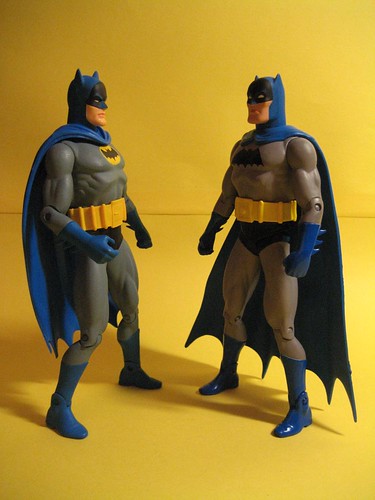
About a month and a half ago, with the much-hyped Miami Heat side struggling to live up to their expectations, I posed a question for the team's top two stars on my NBA-India article: Which one of LeBron and Wade was going to bite the bullet and become the sidekick? After an 8-7 start, I felt Miami needed a clear Jordan and a clear Pippen. Bosh was always going to be the third option - it was really between Batman and Batman to figure out which one of them was going to be Robin.

Oh, how things have changed since! Ever since a November 27th loss to the Mavericks, the Heat have gone on an incredible run, winning 21 of their last 22 games. Their only loss came, again, between this streak to the Mavericks again. Except for that one setback, the Heat have been on fire, not only winning but winning by large, double-digits margins, embarrassing opponents, becoming the greatest road-show in the league, and going as far as cornily naming themselves 'The Heatles'. Their last two wins, on the road to the Bucks and to the Blazers, showed a different side to their toughness, as Heat showed that they can hang tough in close games too, winning both the match-ups in overtime.

So what the hell happened? They say it was a magic post-game talk that took place after that Mavericks loss in November. But on court, there was no change in the roles shared by Wade and LeBron. Aptly nicknamed 'The Super-Twins', both of them continued to play at the highest level, neither budging away from the spotlight and neither hogging it. For the first time, two players with almost identical games, both who are arguably the top two players in the league, began playing equally well at the same time.

Simply said, there was no need for a Robin. Wade and LeBron have done the Batman and Batman act to perfection - both defending hard, both hounding the passing lanes, both creating shots for their teammates, both creating shots for themselves, both attacking the rim, both finding ways to win games for their team.

For the first time, the NBA named co-Eastern Conference Players of the Month from the same team when The Super-Twins led Miami to a 15-1 record in December. During this period, Wade averaged 27.9 ppg, 6.9 rpg, 4.1 apg, and LeBron averaged 25.2 ppg, 7.9 rpg, 6.8 apg. Their season averages at this point are ridiculously awesome, especially considering that both these numbers are players in the same squad: LeBron getting 25.3, 7.0, 7.2, Wade getting 25.0, 6.6, 4.2.

The arranged marriage of this awesome-twosome was always going to be scary for the rest of the league, but no one (except perhaps for Jeff Van Gundy) expected them to be this good this soon.

Which brings me to wonder... What are the chances that, for the first time ever, the NBA will hand out a co-MVP award. In the history of the NBA, no players have ever shared the MVP award. The only time any of the awards have been shared has been the Rookie of the Year award, won both by Grant Hill and Jason Kidd in 1995 and Elton Brand and Steve Francis in 2000.

A week ago, LeBron came out and said that sharing the spotlight in Miami will mean that neither him or Wade can win the MVP award this year, but I think that this message will only increase their chances. Other candidates like Amar'e Stoudemire, Derrick Rose, Dirk Nowitzki, and Dwight Howard are having nice seasons, but the only reason any of them have a chance to be MVP this year is because LeBron James decided to take his talents to South Beach.

Realistically, it is quite unlikely that this award is going to be split 50/50 between the two - the MVP award is voted for by a panel of sportswriters and broadcasters in US and Canada, each of whom chooses their top five MVP options, and for each position, the player receives a certain amount of points. Given the complication of this process, it is improbable that two players will come out with the same score.

But improbably isn't impossible. And if there was ever going to be a chance for two players, from the same team, to win this award, it is going to be now. I guess there is space in the same Gotham City for two Batmen. We will see the true test of their superhero abilities once the playoffs begin.