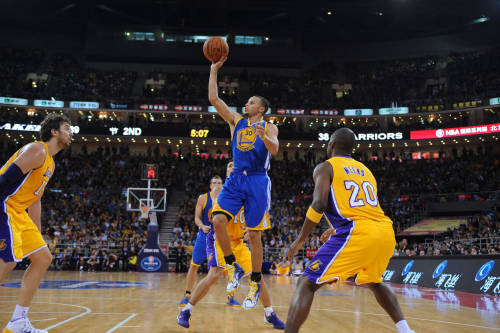
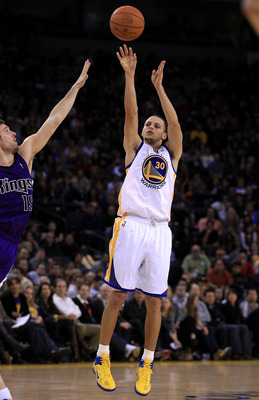
Stephen Curry and the NBA’s three-point explosion is evolving basketball across the globe
This feature was first published in my column for Ekalavyas.com on March 13, 2016. You can find the original article here.

Whenever I play basketball at my favourite court – the ‘Benares Club’ in my hometown Varanasi – my friends feature among them the usual gang of universal pick-up hoops personalities: the slow, lumbering, but effective post-player; the mid-range wizard; the pesky little ball-hawker; the fast-break specialist; the veteran who gives sage advice about passing first and shooting second; the one player only on court to intimidate and collect fouls; the fearless athlete driving into the basket; the indiscriminate chucker.
Now, anyone who has played basketball in India – especially in pick-up games – would’ve noticed how much the game relies on fast-breaks. Too often, one player of the defensive team doesn’t really play defence and instead, waits out on the wings. If a defensive rebound is secured, a teammate pitches the ball forward (Kevin Love / Wes Unseld inspired) to the player who sprints down the length of the court, making a beeline to be positioned right below the opposing basket for an easy layup before the opponents can catch up. This play is risky because it puts extra pressure on defensive possessions, but when it works, the faster/fitter team can pile up points in a hurry.
This ‘technique’ has been used by many in my friends circle, too, but recently, I let my imagination think ahead of itself, and imagine a slightly different, future scenario. In this imaginary scene, there’s a fast-break opportunity, but the player who had sprinted down to the other end of the floor didn’t wait for the ball below the opposing basket. Instead, he took a sharp left turn to the corner of the court to place himself an inch outside the three-point line. Milliseconds later, another teammate on offense turned right to position himself on the other end. The defensive players who made it back in time had to spread in two directions too, leaving the middle wide open. The ball moved around from one corner to a player in the middle to the other corner before it was shot.
Splash!
And just then, we were introduced to another important pick-up personality on the court, a character that hadn’t been valued or trusted too much in our parts in the past because, well, his speciality used to seem too damn unlikely to become a regular weapon in our offense. He was the three-point sniper.
He used to be just the shorter guy who had developed an outside shot as a survival instinct, his way of staying relevant on the court if he didn’t have the size, strength, or athleticism to bang down in the post or the handle to move with the ball and create his own shot. But now, he began to appear everywhere and was emulated by everyone else. The fearless athlete was shooting threes, the mid-range wizard was stepping out, the indiscriminate chucker didn’t need to be told twice, the foul-collector joined into the fun, and even the lumbering post-man got himself some range.
Basketball had changed. Outside had become the new inside. Threes were the new dunks.
And the root cause of this metamorphosis was this little, scrawny guard causing havoc thousands of kilometres away in California.
*
Basketball has a certain set of rules, and to a first-timer, remembering them all can seem tiresome. But the beauty of the game is that most of the rules are quite intuitive, and where basketball truly leaps into greatness is within the gaps between the rules. It is these gaps that bring in the creativity, the style, and the personality to the game. Everyone approaches the game differently, every unstoppable style is countered by a defence to stop it, and that defence evokes a new offensive style, calling the need for a new defence scheme, and so on and so forth. Basketball becomes a chess match, with each manoeuvre further evolving and developing the game.
And it is the NBA – the finest basketball league in the world – that is the forefront of the game’s evolution and its changing styles. Since it is the gold standard of basketball that young players aspire for, aesthetics and tactics adopted by the best players and teams in the NBA eventually trickle down to young players in NCAA Division 1, High School, and grassroots basketball around the world. Soon, it is not just the players, but many coaches and trainers who begin to adopt those tactics in their teaching of the game.
Basketball is a team game, but NBA history has been defined by game-changing individuals who have crashed the party with their own unique style of dominance and nudged a shift in the game’s philosophy over the years. Last month, the 99% Invisible podcast went into great detail in explaining how the game shifted from the biggest men to the smallest ever since its inception. When basketball was grounded in the NBA’s earliest years, players like George Mikan used their size and passing ability to become the best and stand tall over their competitors. Soon, the likes of Bill Russell and Wilt Chamberlain added a breath-taking athletic ability to that size, Kareem Abdul-Jabbar dominated college ball with his size so much that they had to ban dunking for a decade, and big men like Shaquille O’Neal became unstoppable all the way into the 90s because no one could match their combination of size, strength, and skill. Of course, mirroring the NBA, ‘taller’ was considered ‘better’ in basketball in the rest of the world, too. The ball went in to the big men first, who would scope out the defensive schemes and decide the best mode of offense for himself or his teammates.
But slowly, the perimeter player began to take over. It started in earnest with Magic and Bird, and then, the era of the swingman launched the NBA into a new direction with Michael Jordan, Kobe Bryant, and into the 2000s, LeBron James. Instead of playing inside-out, many of these teams centred around talented swingman used these perimeter stars to have the ball in their hands a lot and creating plays for themselves and for others. These players were faster than the big men and had a better ability to create their own shot and beat opponents off the dribble. Since they were smaller, more fans around the world related to these players, and the Jordanesque “Hero Ball” was born.
Which brings us to current day. The three-point shot was introduced in the ABA and later in the NBA in the 70s, and its ascent over the next few decades was slow and steady. But in the last few years, the numbers have skyrocketed. From 2.77 threes per attempted per game in 1980, NBA teams are now attempting nearly 24 threes a game. At the top of this revolution are players like Damian Lillard, James Harden, Klay Thompson, and Paul George.
And the three-point King – in every sense of the word – Stephen Curry.
*

Curry – the reigning MVP who is in line to become the MVP again – is having a season that is shattering NBA history. Apart from leading the league in scoring (30.7 ppg) and an All Time best Player Efficiency Rating (32.99), Curry has made more threes already in a season than anyone in history with over a month left in the season, (he’s number 2 and number 3 on that list), made 300 threes in a season, has broken the streak of most games with at least one three made, and is making over 5.1 threes per game, by far the best rate in NBA history. In a league that has featured Larry Bird, Reggie Miller, Ray Allen, and more, Curry is already the greatest shooter of All Time – and he’s still only 27!
More than the numbers however, are the emotions that Curry has evoked in the basketball world. He has made the three-pointer the sexiest thing in the game. Curry’s range continues to get farther and farther away from the basket. He is making 25 to 30 footers with ease, and that game-winning shot over the Thunder a few weeks ago – his casual confidence to even try that shot and then make it – disoriented the world’s understanding of how even to play defence against someone that skilled. Just like Wilt Chamberlain, Michael Jordan, and Shaquille O’Neal in the past, he has become an offensive problem that will need a creative, evolved defensive solution.
Curry is also the most popular player in the NBA: his jersey sells more than any other and he would’ve been the leading All Star vote-getter had it not been Kobe Bryant’s last season. Many players have been compared to Michael Jordan over the last 15 years, but Curry’s level of night-to-night dominance and the circus that follows his greatness makes him in many ways the closest one (for a short term). The Warriors, gunning for Jordan’s Bulls record of 72 wins in a season, have become the league’s most fascinating traveling bandwagon. Decades from now, we’ll see young players in remote parts of Earth wearing ‘Warriors # 30’ jerseys the way we see ‘Bulls # 23’ today.
Curry isn’t the only one, but he has been the front-runner of the three-point revolution, and the NBA’s smartest analytic minds will tell you that if a good shooter takes (and makes) a high percentage of their threes, it is far more effective than the same shooter making a higher percentage of their twos (and particularly, the less effective long-twos). Even the maths is now telling us that if you can shoot above a certain percentage from behind the arc, then shoot away.
Of course, no revolution comes without its complaints. A few months ago, Curry’s former coach Mark Jackson mentioned that, despite his talents, Curry was ‘hurting the game’. “What I mean by that is that I go into these high school gyms, I watch these kids, and the first thing they do is they run to the 3-point line,” Jackson said, “You are not Steph Curry. Work on the other aspects of the game.”
Curry’s (and others’) penchant for the three-point line seems to have put the mid-range game on life-support, and even many of today’s talented bigger players (DeMarcus Cousins, Anthony Davis, Karl Towns) are moving further and further away from the basket on offense. No wonder Brian Shaw – former Laker player and Nuggets coach – in India last week complained that the Warriors’ success was only due to a lack of good Bigs in today’s game.
Some NBA circles are even considering tweaking with the three-point line and moving it back to make the shot tougher and bring back attention to mastering the inside game.
*
Mark Jackson is right in some ways, and wrong in many others. Sure, none of us are Steph Curry, but then again, none of us have been Magic Johnson, Michael Jordan, Shaquille O’Neal, Kevin Garnett, Allen Iverson, or LeBron James either. Those athletic, talent, or size limitations haven’t stopped young players from around the world emulating their favourite stars. Big guys want to flex and bang inside like Shaq, bring some finesse to the game like Garnett, or copy Kareem Abdul-Jabbar’s sky-hook. Wingmen want to dominate from the perimeter through scoring like Jordan or Kobe or by running the floor as All-Round players like Magic or LeBron. The smallest guys on the court relied on their speed like Iverson or Isiah Thomas. These models of excellence seem practically unachievable, but if we’re not going to try and be like the best, why even try?
And now, there’s Steph Curry, who is the Abdul-Jabbar of perimeter players, making a three-pointer look as easy as the big man’s traditional sky-hook. Because of Curry’s size – or lack thereof – he has further democratised basketball, making excellence look like a tangible, achievable goal, even for those without otherworldly genetic blessings.
But, hey, Mark Jackson is right: None of us are actually Steph Curry, who is a once-in-a-generational talent. He is blessed with speed, genius, and puts in more hard-work into perfecting his art than most beings on Earth. He is transforming the game as we speak, in real time, hitting his sixth and seventh three while we’re still tweeting about his third and fourth.
Curry’s exploits are changing the approach to the three-point-line, and thus, the entire approach to attacking and defending in the game of basketball. There will soon come a time among the younger generation of ballers where a three-point shot becomes a bigger weapon even in the arsenal of pick-up games than the humble two-pointer.
*
Out on our court in Varanasi, my imagination is suddenly crashed by reality. Sure, the players on offense are spreading wide instead of running into the basket, but their efforts are coming up short. None of us have close to the speed, release, accuracy, form, and perfection to our shot that Curry has.
Instead of expecting a splash, there is a whole lot more dry clangs off the rim.
The ball is rebounded by the defensive side, who throw it forward for a quick, fast-break possession, too. But this team stays within their limits, and goes for the easiest, most reliable scoring opportunity: a bee-line to the basket and an easy lay-up. Maths always wins, and until we can shoot threes with the accuracy of the NBA’s new greats, the easiest shot in the game is still the best shot in the game!